


Short-Form Video Checklist for High Retention
Short-Form Video Checklist for High Retention
A 3-phase checklist — before filming during recording and after editing — that removes the avoidable mistakes killing your watch-through rate.
Published:

Read Time:

3 min

Written by:
Fawwaz
Trend Research and Copywriter
EVERY FRAME HELPS OR HURTS
Retention is rarely lost in a single moment, but erodes through dozens of small creative decisions.
EVERY FRAME HELPS OR HURTS
Retention is rarely lost in a single moment, but erodes through dozens of small creative decisions.
EVERY FRAME HELPS OR HURTS
Retention is rarely lost in a single moment, but erodes through dozens of small creative decisions.
Most short-form videos underperform not because the idea was bad, but because something avoidable broke the execution.
This checklist is organized around the three phases where most failures happen: before you record, while you're recording, and after you edit. Work through it in order.
Before You Record: Strategy and Setup
The decisions made before the camera turns on determine more of a video's performance than anything that happens during or after filming.
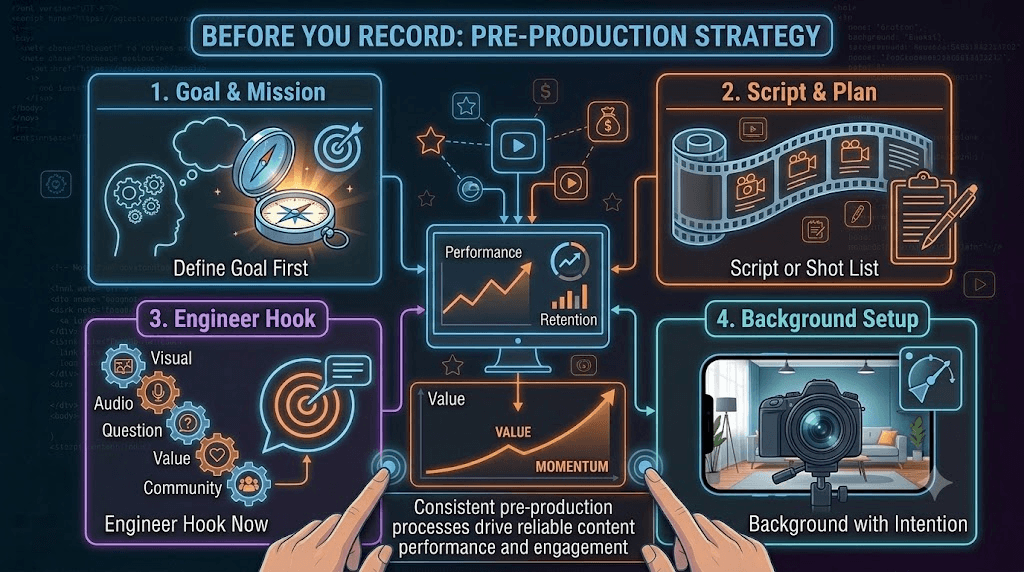
Define the goal before you write anything. A video meant to entertain and a video meant to educate require structurally different approaches. Trying to do both without a clear primary objective usually results in neither being done well. Pick one.
Write a script or shot list for every video, without exception. Improvised content occasionally works, but it works because of experience built from scripted practice, not instead of it. Even a rough shot list creates intentionality that shows in the final output.
Engineer the hook before anything else. The first two to three seconds should be the most deliberately constructed part of the video. Ask: what specific thing will make someone who is already mid-scroll stop? A strong visual, a provocative question, or a relatable call-out — each of these is a different mechanic, and each requires a different opening setup.
Choose your background with intention. A visually interesting or contextually relevant background adds production value without costing anything. A cluttered, distracting, or generic background pulls attention away from the content. Blank walls read as low effort.
During Recording: Technical Fundamentals
These are the items that, if missed, create problems that editing cannot fix.
Film in vertical format (9:16) every time. Horizontal footage converted to vertical loses significant frame information and signals to the algorithm that the content wasn't native to the platform.
Check your framing before the first take. Key elements — your face, the product, whatever the video is about — should be centered and not cut off at the edges. Framing issues that look minor on a phone screen look obviously wrong when the video is played in a feed.
Light from the front, not from behind. Backlighting turns the subject into a silhouette. Natural light facing you, a ring light, or any direct light source positioned in front of the camera is sufficient.
Check that your camera lens is clean. It takes five seconds and it matters more than most creators realize.
Confirm resolution and frame rate settings before recording. 4K at 30fps or 1080p at 60fps are both workable; what creates problems is inconsistency between settings across a session, or settings that don't match the platform's native specs.
Charge your device and clear storage space before long shooting sessions. Interruptions mid-session are harder to edit around than most people account for.
After Editing: Self-Review Before Publishing
The goal of this phase is to evaluate the video as a viewer who has never seen it, rather than as the person who made it.
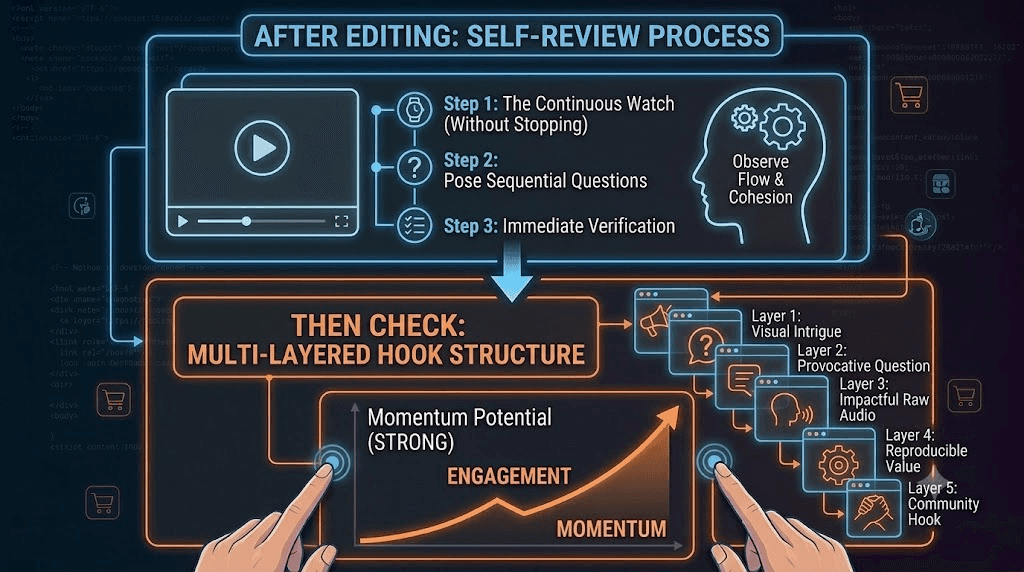
Watch it through once without stopping and ask these questions in sequence:
Is the first two seconds visually interesting or at minimum clearly framed? Does the hook land fast enough that a cold viewer would keep watching? Is the information or entertainment value clear within the first ten seconds? Is there a conflict or tension — a "but therefore" problem-solution structure — that gives the viewer a reason to stay until the end? Does it end with something the viewer can do, feel, or think differently about?
Then check the multi-layered hook structure:
A video with strong retention typically operates on more than one channel simultaneously. Does it have a visual hook (something striking or unexpected to look at)? A sound hook (audio that's either trending, satisfying, or tonally interesting)? A text hook (an overlay that adds context, tension, or curiosity for sound-off viewers)?
Not every video needs all three, but awareness of which channels you're using tells you where the retention gap might be if the video underperforms.
The Underlying Principle
Virality isn't a property of good ideas. It's a property of ideas that were executed correctly at every stage of production and distributed under the right conditions. The checklist doesn't guarantee performance, but it systematically removes the avoidable failures that make the gap between a good idea and a video people actually watch.
Run it every time. The friction of checking diminishes quickly. The cost of not checking compounds over every video you publish.

Want a structured review of how your current content setup stacks up against what's actually driving performance on TikTok and Meta in 2026?
Most short-form videos underperform not because the idea was bad, but because something avoidable broke the execution.
This checklist is organized around the three phases where most failures happen: before you record, while you're recording, and after you edit. Work through it in order.
Before You Record: Strategy and Setup
The decisions made before the camera turns on determine more of a video's performance than anything that happens during or after filming.
Define the goal before you write anything. A video meant to entertain and a video meant to educate require structurally different approaches. Trying to do both without a clear primary objective usually results in neither being done well. Pick one.
Write a script or shot list for every video, without exception. Improvised content occasionally works, but it works because of experience built from scripted practice, not instead of it. Even a rough shot list creates intentionality that shows in the final output.
Engineer the hook before anything else. The first two to three seconds should be the most deliberately constructed part of the video. Ask: what specific thing will make someone who is already mid-scroll stop? A strong visual, a provocative question, or a relatable call-out — each of these is a different mechanic, and each requires a different opening setup.
Choose your background with intention. A visually interesting or contextually relevant background adds production value without costing anything. A cluttered, distracting, or generic background pulls attention away from the content. Blank walls read as low effort.
During Recording: Technical Fundamentals
These are the items that, if missed, create problems that editing cannot fix.
Film in vertical format (9:16) every time. Horizontal footage converted to vertical loses significant frame information and signals to the algorithm that the content wasn't native to the platform.
Check your framing before the first take. Key elements — your face, the product, whatever the video is about — should be centered and not cut off at the edges. Framing issues that look minor on a phone screen look obviously wrong when the video is played in a feed.
Light from the front, not from behind. Backlighting turns the subject into a silhouette. Natural light facing you, a ring light, or any direct light source positioned in front of the camera is sufficient.
Check that your camera lens is clean. It takes five seconds and it matters more than most creators realize.
Confirm resolution and frame rate settings before recording. 4K at 30fps or 1080p at 60fps are both workable; what creates problems is inconsistency between settings across a session, or settings that don't match the platform's native specs.
Charge your device and clear storage space before long shooting sessions. Interruptions mid-session are harder to edit around than most people account for.
After Editing: Self-Review Before Publishing
The goal of this phase is to evaluate the video as a viewer who has never seen it, rather than as the person who made it.
Watch it through once without stopping and ask these questions in sequence:
Is the first two seconds visually interesting or at minimum clearly framed? Does the hook land fast enough that a cold viewer would keep watching? Is the information or entertainment value clear within the first ten seconds? Is there a conflict or tension — a "but therefore" problem-solution structure — that gives the viewer a reason to stay until the end? Does it end with something the viewer can do, feel, or think differently about?
Then check the multi-layered hook structure:
A video with strong retention typically operates on more than one channel simultaneously. Does it have a visual hook (something striking or unexpected to look at)? A sound hook (audio that's either trending, satisfying, or tonally interesting)? A text hook (an overlay that adds context, tension, or curiosity for sound-off viewers)?
Not every video needs all three, but awareness of which channels you're using tells you where the retention gap might be if the video underperforms.
The Underlying Principle
Virality isn't a property of good ideas. It's a property of ideas that were executed correctly at every stage of production and distributed under the right conditions. The checklist doesn't guarantee performance, but it systematically removes the avoidable failures that make the gap between a good idea and a video people actually watch.
Run it every time. The friction of checking diminishes quickly. The cost of not checking compounds over every video you publish.
Want a structured review of how your current content setup stacks up against what's actually driving performance on TikTok and Meta in 2026?
Related Reading


Need help scaling?
Book a strategy call with our expert team to audit your current UGC setup.
Related Reading
How Apple Turns a Product Launch Into a Yearly UGC Event That Runs Itself
How Apple's September launch cycle turns anticipation, information scarcity, creators, and product novelty into a recurring UGC engine.
4 min
|
How Apple Turns a Product Launch Into a Yearly UGC Event That Runs Itself
How Apple's September launch cycle turns anticipation, information scarcity, creators, and product novelty into a recurring UGC engine.
4 min
|

The Sydney Sweeney Novig Playbook: Why the Most Talked-About Ad of NFL Week 1 Was Also the Smartest
How Sydney Sweeney and Novig built a smarter celebrity partnership through equity, creative control, brand fit, and strategic timing.
4 min
|
The Sydney Sweeney Novig Playbook: Why the Most Talked-About Ad of NFL Week 1 Was Also the Smartest
How Sydney Sweeney and Novig built a smarter celebrity partnership through equity, creative control, brand fit, and strategic timing.
4 min
|
Why “September” by Earth, Wind & Fire Is the Most Viral Song on TikTok Every Year
Discover why Earth, Wind & Fire’s September goes viral on TikTok each year, and how brands can plan for predictable seasonal virality.
4 min
|
Why “September” by Earth, Wind & Fire Is the Most Viral Song on TikTok Every Year
Discover why Earth, Wind & Fire’s September goes viral on TikTok each year, and how brands can plan for predictable seasonal virality.
4 min
|