



How to Build a UGC Portfolio That Gets You Hired
How to Build a UGC Portfolio That Gets You Hired
What brands actually look for in a UGC creator portfolio — and the 5 steps to build one that consistently converts.
Published:

Read Time:

3 min

Written by:
Fawwaz
Trend Research and Copywriter
ATTENTION IS THE FIRST AUDITION
If a brand loses interest in the first few seconds, the quality of your work no longer matters.
ATTENTION IS THE FIRST AUDITION
If a brand loses interest in the first few seconds, the quality of your work no longer matters.
ATTENTION IS THE FIRST AUDITION
If a brand loses interest in the first few seconds, the quality of your work no longer matters.
The portfolio isn't a showcase of your best work, but a conversion page.
This guide covers exactly what to include, how to structure it, and what most creators get wrong.
What Brands Are Actually Looking for in a UGC Portfolio
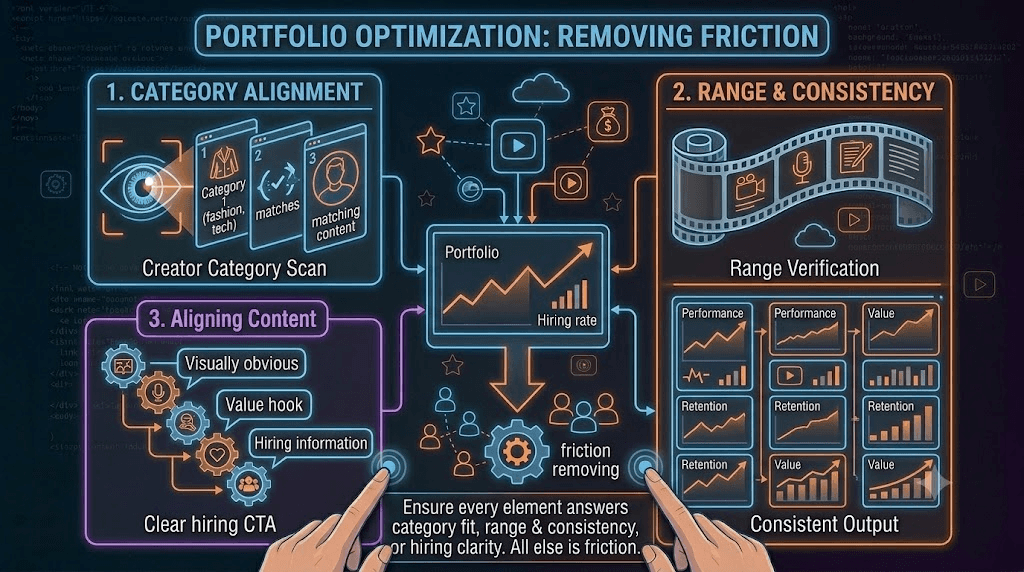
Before building anything, it helps to understand what a brand's content manager is scanning for when they open your deck or portfolio site. They're not asking "is this creator talented?" They're asking three faster questions: Can this creator produce content for my category? Can I see range and consistency? Is it obvious how to hire them?
Every element of your portfolio should answer one of those three questions. Anything that doesn't answer one of them is friction.
Step 1: Lead with a Clear Niche, Not a General Reel
The most common mistake in UGC portfolios is opening with a general highlight reel that spans multiple categories, such as beauty, food, fitness, tech, lifestyle. The instinct makes sense: you want to show range. But a range without a defined niche reads as uncommitted, and brands looking for a creator in a specific category will move on quickly if they can't immediately identify whether you work in their space.
Lead with your primary niche. If you work across two or three categories, organize your work by niche rather than presenting it as an undifferentiated montage. The goal is for a brand to see your first three videos and immediately think "this creator works in my space."
Step 2: Show at Least Six Videos That Demonstrate Different Skills
Six videos is the practical minimum for demonstrating range within a niche. Each video should show a different skill or format rather than six variations of the same style. A strong six-video set might include a talking-head testimonial, an action-open lifestyle piece, a product demo with text overlays, a before-and-after, a voiceover-only piece, and a trending-format adaptation.
The point is not quantity, but the evidence that you can execute more than one approach. Brands test multiple creative formats simultaneously, and a creator who can only deliver one style limits how useful they are across a campaign.
Step 3: Include the Practical Details Brands Need to Book You
Every portfolio review that doesn't result in an outreach is partially a friction problem. If a brand likes your work but can't easily figure out your niche, location, rate structure, or how to contact you, they move on rather than hunting for that information.
Your portfolio should include, in a place that's easy to find without scrolling:
Your primary niche and any secondary categories you work in
Your city and country (relevant for brands with geo-specific campaigns)
Contact information: email at minimum, WhatsApp if you work internationally
Links to all active social profiles
An embedded or linked booking calendar if you accept strategy calls
Your age demographic — whether you're Gen Z or millennial matters for casting decisions
Key stats and a callout of your highest-performing content
Step 4: Keep the Design Intentionally Simple
Portfolio design is not where you express creativity. It's where you remove obstacles between the viewer and your work. Two to three primary colors, one font family, and a layout that puts videos front and center is more effective than a heavily designed deck that takes five seconds to load and ten seconds to understand.
The benchmark is straightforward: if someone can open your portfolio, immediately find your niche, watch two videos, and find your contact information within 30 seconds, the design is working. If any of those steps require hunting, the design is working against you.
Step 5: Test It Before You Send It
Before submitting your portfolio to any brand or agency, show it to someone who doesn't know your work, maybe to a friend, a family member, anyone unfamiliar with what you do. Watch where their eyes go first. Watch what they click on. Watch where they stop and ask questions.
The places where they hesitate or get confused are exactly the places where a brand's content manager will close the tab. Fix those before you send.
The three questions worth asking yourself before every submission:
Is it immediately obvious what niche I serve?
Is it unambiguously clear how to hire me?
If the answer to any of those is "kind of" rather than "yes," the portfolio isn't ready.

Ready to work with brands that are brief to a high standard and push your creative range?
The portfolio isn't a showcase of your best work, but a conversion page.
This guide covers exactly what to include, how to structure it, and what most creators get wrong.
What Brands Are Actually Looking for in a UGC Portfolio
Before building anything, it helps to understand what a brand's content manager is scanning for when they open your deck or portfolio site. They're not asking "is this creator talented?" They're asking three faster questions: Can this creator produce content for my category? Can I see range and consistency? Is it obvious how to hire them?
Every element of your portfolio should answer one of those three questions. Anything that doesn't answer one of them is friction.
Step 1: Lead with a Clear Niche, Not a General Reel
The most common mistake in UGC portfolios is opening with a general highlight reel that spans multiple categories, such as beauty, food, fitness, tech, lifestyle. The instinct makes sense: you want to show range. But a range without a defined niche reads as uncommitted, and brands looking for a creator in a specific category will move on quickly if they can't immediately identify whether you work in their space.
Lead with your primary niche. If you work across two or three categories, organize your work by niche rather than presenting it as an undifferentiated montage. The goal is for a brand to see your first three videos and immediately think "this creator works in my space."
Step 2: Show at Least Six Videos That Demonstrate Different Skills
Six videos is the practical minimum for demonstrating range within a niche. Each video should show a different skill or format rather than six variations of the same style. A strong six-video set might include a talking-head testimonial, an action-open lifestyle piece, a product demo with text overlays, a before-and-after, a voiceover-only piece, and a trending-format adaptation.
The point is not quantity, but the evidence that you can execute more than one approach. Brands test multiple creative formats simultaneously, and a creator who can only deliver one style limits how useful they are across a campaign.
Step 3: Include the Practical Details Brands Need to Book You
Every portfolio review that doesn't result in an outreach is partially a friction problem. If a brand likes your work but can't easily figure out your niche, location, rate structure, or how to contact you, they move on rather than hunting for that information.
Your portfolio should include, in a place that's easy to find without scrolling:
Your primary niche and any secondary categories you work in
Your city and country (relevant for brands with geo-specific campaigns)
Contact information: email at minimum, WhatsApp if you work internationally
Links to all active social profiles
An embedded or linked booking calendar if you accept strategy calls
Your age demographic — whether you're Gen Z or millennial matters for casting decisions
Key stats and a callout of your highest-performing content
Step 4: Keep the Design Intentionally Simple
Portfolio design is not where you express creativity. It's where you remove obstacles between the viewer and your work. Two to three primary colors, one font family, and a layout that puts videos front and center is more effective than a heavily designed deck that takes five seconds to load and ten seconds to understand.
The benchmark is straightforward: if someone can open your portfolio, immediately find your niche, watch two videos, and find your contact information within 30 seconds, the design is working. If any of those steps require hunting, the design is working against you.
Step 5: Test It Before You Send It
Before submitting your portfolio to any brand or agency, show it to someone who doesn't know your work, maybe to a friend, a family member, anyone unfamiliar with what you do. Watch where their eyes go first. Watch what they click on. Watch where they stop and ask questions.
The places where they hesitate or get confused are exactly the places where a brand's content manager will close the tab. Fix those before you send.
The three questions worth asking yourself before every submission:
Is it immediately obvious what niche I serve?
Is it unambiguously clear how to hire me?
If the answer to any of those is "kind of" rather than "yes," the portfolio isn't ready.
Ready to work with brands that are brief to a high standard and push your creative range?
Related Reading


Need help scaling?
Book a strategy call with our expert team to audit your current UGC setup.
Related Reading

What Is a UGC Hook? And How Is It Different From a Regular Hook?
Learn what a UGC hook is, why it's different from regular content hooks, and discover six proven hook types with examples for higher-performing UGC.
6 min
|
What Is a UGC Hook? And How Is It Different From a Regular Hook?
Learn what a UGC hook is, why it's different from regular content hooks, and discover six proven hook types with examples for higher-performing UGC.
6 min
|

What The Odyssey and Spider-Man: Brand New Day Have in Common (Besides Tom Holland and Zendaya)
Learn how The Odyssey and Spider-Man: Brand New Day used opposite marketing strategies to generate massive organic UGC and audience engagement.
4 min
|
What The Odyssey and Spider-Man: Brand New Day Have in Common (Besides Tom Holland and Zendaya)
Learn how The Odyssey and Spider-Man: Brand New Day used opposite marketing strategies to generate massive organic UGC and audience engagement.
4 min
|

The Odyssey's Marketing Playbook: What Brands Can Learn From a $264M Opening
Learn how The Odyssey used scarcity, exclusive IMAX experiences, and FOMO to drive a $264M opening and millions of dollars in earned media.
4 min
|
The Odyssey's Marketing Playbook: What Brands Can Learn From a $264M Opening
Learn how The Odyssey used scarcity, exclusive IMAX experiences, and FOMO to drive a $264M opening and millions of dollars in earned media.
4 min
|