The UGC Secret: Nobody Cares with Your Product’s Features. Speak Your Customer's Pain!
Most UGC fails because it talks about products instead of customer pain. Here's the research process behind high-converting UGC content.
Published:

Read Time:

4 min

Written by:
Fawwaz
Trend Research and Copywriter
ACTUALLY IT IS NOT ABOUT YOUR CREATIVITY
Many UGC campaigns fail not because the content is poorly made, but because the research behind it is weak.
ACTUALLY IT IS NOT ABOUT YOUR CREATIVITY
Many UGC campaigns fail not because the content is poorly made, but because the research behind it is weak.
ACTUALLY IT IS NOT ABOUT YOUR CREATIVITY
Many UGC campaigns fail not because the content is poorly made, but because the research behind it is weak.
The highest-performing UGC speaks the customer's language. Instead of creating stories from scratch, great creators tap into the frustrations and desires their audience already feels. That's what makes people stop scrolling.
Why Customer Language Matters More Than Product Features
Most brands know their products inside and out. They understand every feature, specification, benefit, and competitive advantage.
The challenge is that customers do not really care about it. Most of the customers focus on the frustrations they face, the obstacles holding them back, and the emotions they experience while trying to solve a problem.
A project management app might describe itself as:
"An integrated workflow management platform."
A customer might describe the exact same problem as:
"I have too many things to keep track of."
One description comes from the company, while the other comes from the customer's real experience.
In most cases, the language customers use is far more likely to grab attention because it feels familiar and authentic. Research consistently shows that effective messaging starts with understanding how people describe their own problems.
A Simple Example
Check the comparison picture below, about a supplement brand that wants to promote a sleep product.
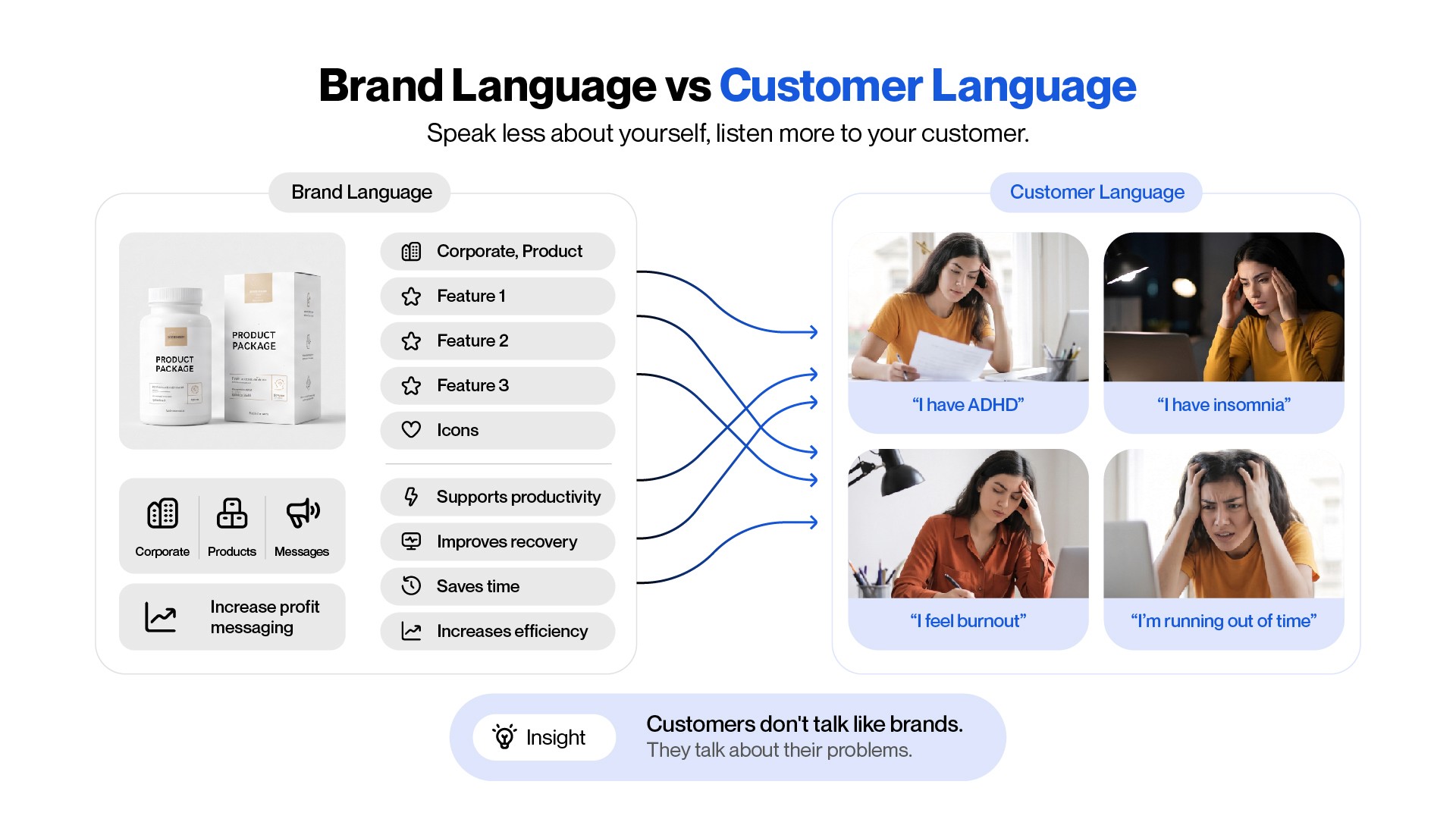
Both statements in the picture describe the same problem, but they feel very different.
One sounds like a marketing language, while the other sounds like a real experience. The second is more likely to resonate because it reflects the way customers actually think and talk about their problems.
The Research Stack: Where To Find Customer Language
The next question is where these insights come from.
Fortunately, customers leave clues everywhere through reviews, comments, discussions, and conversations. The goal is not to focus on a single comment, but to identify recurring patterns that reveal how people consistently think, feel, and talk about their problems.
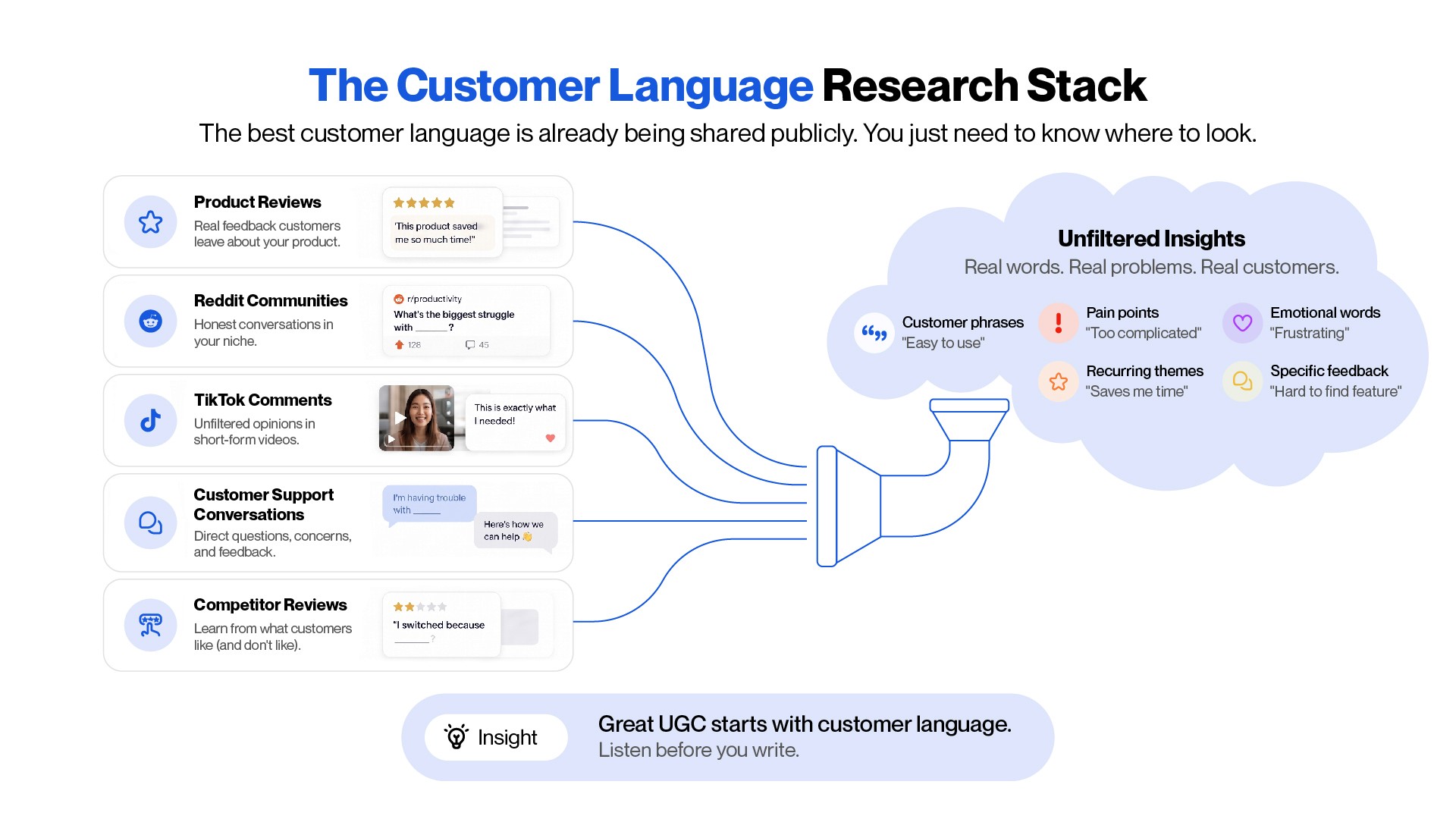
1. Product Reviews
Product reviews are one of the easiest places to start because customers naturally talk about their frustrations, expectations, outcomes, and objections.
Pay close attention to recurring phrases. When multiple customers describe the same problem using similar language, it often reveals the exact words and emotions that resonate with your audience.
For example, a brand might describe a benefit as "improved confidence." But customers may say something much more specific, like "I finally felt comfortable wearing shorts again." That phrase carries a stronger emotional connection because it reflects a real experience rather than a generic marketing claim.
2. Reddit Communities
Reddit is one of the most valuable sources of customer research because people tend to speak openly about their experiences. They describe problems in detail, share frustrations, ask questions, and discuss the challenges they face while trying to find a solution.
When reviewing these conversations, the goal is not to find content ideas. It is to identify recurring patterns in the language people use, because those patterns often reveal the thoughts and emotions that drive attention and buying decisions.
3. TikTok Comments
Many creators focus on the content itself, but the comment section is often where the most valuable insights are found. Comments reveal audience reactions, objections, desires, and personal experiences. In many cases, the next great hook is already waiting in the conversations happening below the video.
4. Customer Support Conversations
Support tickets are often one of the best sources of customer research because they capture real problems in the customer's own words.
People explain what confused them, what frustrated them, and what they expected to happen. These conversations often contain specific language and recurring themes that can later be turned into compelling hooks and messaging.
5. Competitor Reviews
Your competitors can also be a valuable source of customer research. By reading both positive and negative reviews, you can uncover the language customers use to describe their experiences.
Positive reviews often reveal the outcomes people want, while negative reviews highlight the frustrations they are trying to avoid. Together, they provide valuable insight into how your audience thinks and talks about the problem.
How To Identify The Trigger Phrase
After collecting customer language, the next step is identifying trigger phrases.
These are the phrases that immediately capture the attention of the right audience, not because they are clever, but because they feel familiar. When people hear them, they recognize their own experiences and think, "That's exactly how I feel."
That moment of recognition is often what earns attention in the first place.
What Trigger Phrases Usually Look Like
Good trigger phrases are usually specific, emotional, conversational, and rooted in real experiences.
For example, marketers might describe a problem as an "unhealthy relationship," while customers talk about "toxic relationships" and "red flags." A productivity expert might discuss attention issues, but customers often describe the same struggle as "feeling like I have ADHD."
The language changes, but the underlying problem is the same. The brands that win are the ones that speak in the customer's language, not their own.
They are often difficult to invent from scratch, but surprisingly easy to discover when you listen closely to your customers.
Turning Research Into A UGC Script
This is where many creators get stuck.
They uncover a valuable insight or customer pain point, but struggle to turn it into compelling content. The challenge is not finding the insight. It is knowing how to structure it into a message that captures attention and drives engagement.
A useful framework is:
Trigger Phrase | Start with the customer's exact frustration. Example: "I felt like I was constantly behind." |
Story | Expand the experience.
|
Product Introduction | Introduce the product naturally as part of the story. |
Demonstration | Show how the solution works. |
Outcome | Show the emotional transformation.
|
Example Framework
Hook | "I was constantly missing deadlines." |
Story | The creator explains how disorganized work created stress. |
Product | A productivity app enters the story. |
Demonstration | The creator shows the app organizing tasks. |
Outcome | Deadlines become manageable and stress decreases. |
The framework itself is simple, but the research behind it is what makes it effective.
Why This Method Consistently Produces Better UGC
Many creators start by thinking about the product and what they want to say about it.
High-performing creators often take a different approach. They start by thinking about the customer and the problems that person is already trying to solve.
That small shift can change the entire creative process. Instead of asking, "What should I say about this product?" they ask, "What problem is my audience already thinking about?" The second question usually leads to stronger content because people care about their problems before they care about your solution.
A Simple Customer L¡¡¡anguage Checklist
Before writing your next UGC script, ask:
✓ Have I researched real customer conversations? |
✓ Am I using language customers actually use? |
✓ Does my hook reflect genuine frustration? |
✓ Can someone immediately recognize themselves in the story? |
✓ Does the product solve the problem introduced in the hook? |
If the answer is yes, you're already ahead of most campaigns.
The Language That Makes People Stop Scrolling
Many marketers spend a lot of time searching for better hooks, formats, and editing techniques.
While those elements matter, they often come after the most important step: understanding the customer. The strongest UGC usually starts with a problem, frustration, or desire that the audience already recognizes.
Once creators learn how to uncover customer language and build content around it, the creative process becomes much easier because the audience already feels understood. This is why Masterhooks places so much emphasis on studying customer conversations, creator trends, and audience behavior. In many successful UGC campaigns, the content that performs best is often the content that sounds most like the customer's own thoughts.
Understand your customers better with Masterhooks

Understand your customers better with Masterhooks
The highest-performing UGC speaks the customer's language. Instead of creating stories from scratch, great creators tap into the frustrations and desires their audience already feels. That's what makes people stop scrolling.
Why Customer Language Matters More Than Product Features
Most brands know their products inside and out. They understand every feature, specification, benefit, and competitive advantage.
The challenge is that customers do not really care about it. Most of the customers focus on the frustrations they face, the obstacles holding them back, and the emotions they experience while trying to solve a problem.
A project management app might describe itself as:
"An integrated workflow management platform."
A customer might describe the exact same problem as:
"I have too many things to keep track of."
One description comes from the company, while the other comes from the customer's real experience.
In most cases, the language customers use is far more likely to grab attention because it feels familiar and authentic. Research consistently shows that effective messaging starts with understanding how people describe their own problems.
A Simple Example
Check the comparison picture below, about a supplement brand that wants to promote a sleep product.
Both statements in the picture describe the same problem, but they feel very different.
One sounds like a marketing language, while the other sounds like a real experience. The second is more likely to resonate because it reflects the way customers actually think and talk about their problems.
The Research Stack: Where To Find Customer Language
The next question is where these insights come from.
Fortunately, customers leave clues everywhere through reviews, comments, discussions, and conversations. The goal is not to focus on a single comment, but to identify recurring patterns that reveal how people consistently think, feel, and talk about their problems.
1. Product Reviews
Product reviews are one of the easiest places to start because customers naturally talk about their frustrations, expectations, outcomes, and objections.
Pay close attention to recurring phrases. When multiple customers describe the same problem using similar language, it often reveals the exact words and emotions that resonate with your audience.
For example, a brand might describe a benefit as "improved confidence." But customers may say something much more specific, like "I finally felt comfortable wearing shorts again." That phrase carries a stronger emotional connection because it reflects a real experience rather than a generic marketing claim.
2. Reddit Communities
Reddit is one of the most valuable sources of customer research because people tend to speak openly about their experiences. They describe problems in detail, share frustrations, ask questions, and discuss the challenges they face while trying to find a solution.
When reviewing these conversations, the goal is not to find content ideas. It is to identify recurring patterns in the language people use, because those patterns often reveal the thoughts and emotions that drive attention and buying decisions.
3. TikTok Comments
Many creators focus on the content itself, but the comment section is often where the most valuable insights are found. Comments reveal audience reactions, objections, desires, and personal experiences. In many cases, the next great hook is already waiting in the conversations happening below the video.
4. Customer Support Conversations
Support tickets are often one of the best sources of customer research because they capture real problems in the customer's own words.
People explain what confused them, what frustrated them, and what they expected to happen. These conversations often contain specific language and recurring themes that can later be turned into compelling hooks and messaging.
5. Competitor Reviews
Your competitors can also be a valuable source of customer research. By reading both positive and negative reviews, you can uncover the language customers use to describe their experiences.
Positive reviews often reveal the outcomes people want, while negative reviews highlight the frustrations they are trying to avoid. Together, they provide valuable insight into how your audience thinks and talks about the problem.
How To Identify The Trigger Phrase
After collecting customer language, the next step is identifying trigger phrases.
These are the phrases that immediately capture the attention of the right audience, not because they are clever, but because they feel familiar. When people hear them, they recognize their own experiences and think, "That's exactly how I feel."
That moment of recognition is often what earns attention in the first place.
What Trigger Phrases Usually Look Like
Good trigger phrases are usually specific, emotional, conversational, and rooted in real experiences.
For example, marketers might describe a problem as an "unhealthy relationship," while customers talk about "toxic relationships" and "red flags." A productivity expert might discuss attention issues, but customers often describe the same struggle as "feeling like I have ADHD."
The language changes, but the underlying problem is the same. The brands that win are the ones that speak in the customer's language, not their own.
They are often difficult to invent from scratch, but surprisingly easy to discover when you listen closely to your customers.
Turning Research Into A UGC Script
This is where many creators get stuck.
They uncover a valuable insight or customer pain point, but struggle to turn it into compelling content. The challenge is not finding the insight. It is knowing how to structure it into a message that captures attention and drives engagement.
A useful framework is:
Trigger Phrase | Start with the customer's exact frustration. Example: "I felt like I was constantly behind." |
Story | Expand the experience.
|
Product Introduction | Introduce the product naturally as part of the story. |
Demonstration | Show how the solution works. |
Outcome | Show the emotional transformation.
|
Example Framework
Hook | "I was constantly missing deadlines." |
Story | The creator explains how disorganized work created stress. |
Product | A productivity app enters the story. |
Demonstration | The creator shows the app organizing tasks. |
Outcome | Deadlines become manageable and stress decreases. |
The framework itself is simple, but the research behind it is what makes it effective.
Why This Method Consistently Produces Better UGC
Many creators start by thinking about the product and what they want to say about it.
High-performing creators often take a different approach. They start by thinking about the customer and the problems that person is already trying to solve.
That small shift can change the entire creative process. Instead of asking, "What should I say about this product?" they ask, "What problem is my audience already thinking about?" The second question usually leads to stronger content because people care about their problems before they care about your solution.
A Simple Customer L¡¡¡anguage Checklist
Before writing your next UGC script, ask:
✓ Have I researched real customer conversations? |
✓ Am I using language customers actually use? |
✓ Does my hook reflect genuine frustration? |
✓ Can someone immediately recognize themselves in the story? |
✓ Does the product solve the problem introduced in the hook? |
If the answer is yes, you're already ahead of most campaigns.
The Language That Makes People Stop Scrolling
Many marketers spend a lot of time searching for better hooks, formats, and editing techniques.
While those elements matter, they often come after the most important step: understanding the customer. The strongest UGC usually starts with a problem, frustration, or desire that the audience already recognizes.
Once creators learn how to uncover customer language and build content around it, the creative process becomes much easier because the audience already feels understood. This is why Masterhooks places so much emphasis on studying customer conversations, creator trends, and audience behavior. In many successful UGC campaigns, the content that performs best is often the content that sounds most like the customer's own thoughts.
Understand your customers better with Masterhooks
Related Reading
Related Reading

UGC and Influencer Marketing Pricing Guide for Brands in 2026
4 min
|
UGC and Influencer Marketing Pricing Guide for Brands in 2026
Compare UGC rates, influencer fees, usage rights, and agency costs, with published pricing references and an example creator campaign budget for 2026.
4 min
|

How to Find the Right Influencer Marketing Agency for Your Brand (Without Wasting Budget)
6 min
|
How to Find the Right Influencer Marketing Agency for Your Brand (Without Wasting Budget)
Learn how to choose an influencer marketing agency using a practical scorecard, performance criteria, red flags, and pre-contract checks.
6 min
|

AI Video Ad Agencies: A Buyer's Guide for DTC Brands (2026)
4 min
|
AI Video Ad Agencies: A Buyer's Guide for DTC Brands (2026)
Compare AI video ad agency types, pricing, performance metrics, ownership rights, and seven questions DTC brands should ask before hiring.
4 min
|


Need help scaling?
Book a strategy call with our expert team to audit your current UGC setup.