


The Secret Behind UGC Ads That Consistently Convert
The Secret Behind UGC Ads That Consistently Convert
After analyzing winning UGC ads, one pattern appears repeatedly: emotional hooks followed by product demonstrations. Here's why it works.
Published:

Read Time:

5 min

Written by:
Fawwaz
Trend Research and Copywriter
VIRAL CONTENT LOOKS DIFFERENT. THE FORMULA DOESN'T.
We found out that across 150+ UGC videos, the products and creators changed, but the winning structure stayed the same.
VIRAL CONTENT LOOKS DIFFERENT. THE FORMULA DOESN'T.
We found out that across 150+ UGC videos, the products and creators changed, but the winning structure stayed the same.
VIRAL CONTENT LOOKS DIFFERENT. THE FORMULA DOESN'T.
We found out that across 150+ UGC videos, the products and creators changed, but the winning structure stayed the same.
After studying dozens of high-performing UGC ads across DTC brands, AI apps, supplements, software products, and creator-led campaigns, one pattern appears again and again:
Emotional Establishment → Product Demonstration
Most creators focus on the product, but the best focus on the emotion first, and that difference often determines whether someone keeps watching or scrolls away.
The Pattern Hidden Inside Most Winning UGC
Let's start by watching these videos:
Some UGC ads promote skincare products, supplements, AI apps, financial services, or even fitness apps.
On the surface, they look completely different because they target different audiences and solve different problems. But many of the highest-performing examples follow the same structure.
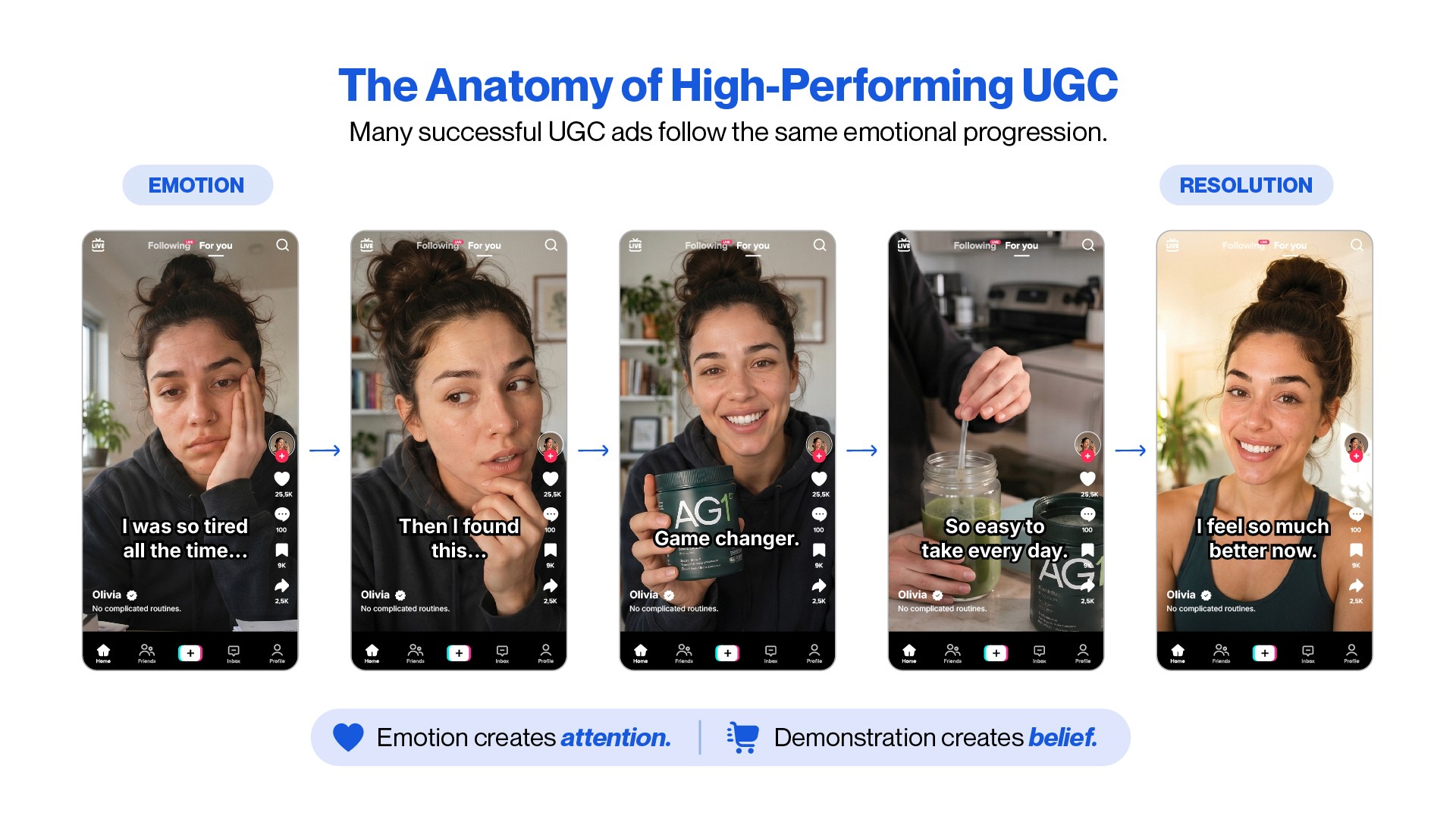
They begin by introducing an emotion, problem, or desire the audience already recognizes, then use a product demonstration to provide proof. This simple sequence is one of the reasons UGC feels more natural, relatable, and persuasive.
Part One: Emotional Establishment
This is the part many marketers overlook. Most viewers do not care about the product when they first see the content. They care about whether it feels relevant to their life and experiences.
That is why strong UGC rarely begins with features or benefits. Instead, it starts with an emotion, problem, or desire that the audience immediately recognizes.
Common examples include:
|
|
|
|
|
|
|
|
The goal is to create emotional alignment between the creator and the viewer.

Psychologists refer to this process as emotional contagion. Research suggests that emotions can spread between people through observation and communication. When viewers see someone expressing a feeling they recognize, they often experience a version of that feeling themselves.
That emotional connection creates attention, that drives watch time, and builds distribution.
Common Emotional Hook Categories
Pain"I was wasting three hours every day." | Frustration"I tried everything and nothing worked." |
Aspiration"I wanted to become more productive." | Curiosity"This completely changed how I work." |
Relief"I wish I found this sooner." |
These emotional openings appear across thousands of successful UGC ads because they create immediate relevance.
Part Two: Product Demonstration as The Answer
Once the audience connects with the problem, they naturally start looking for a solution.
Product demonstrations work because they show how the product can help solve the frustration or challenge introduced earlier in the video. Instead of just describing what the product does, they make the solution feel real and achievable.
The viewer is asking:
"What product is this? Can this actually solve the problem?"
The demonstration answers that question.
What Good Product Demonstrations Actually Do
The strongest demonstrations show transformation by connecting directly to the emotion introduced earlier.
For example:
Emotional Hook | Product Demonstration |
|---|---|
"I spent hours editing videos." | Show the software reducing editing time. |
"I struggled with breakouts." | Show skincare application and results. |
"I never knew what to post." | Show the tool generating content ideas. |
The emotional section creates desire while the demonstration creates credibility. Together they create persuasion.
The Three Most Common Demonstration Styles
1. Before-And-After
One of the oldest and most effective structures.
The audience immediately understands the transformation.
2. Screen Recording
Especially effective for apps, AI tools, and SaaS products.
Viewers can see the product working in real time.
3. Real-Life Usage
The creator uses the product naturally inside their routine.
This format often feels the most authentic because it resembles genuine user behavior.
1. Before-And-After
One of the oldest and most effective structures.
The audience immediately understands the transformation.
2. Screen Recording
Especially effective for apps, AI tools, and SaaS products.
Viewers can see the product working in real time.
3. Real-Life Usage
The creator uses the product naturally inside their routine.
This format often feels the most authentic because it resembles genuine user behavior.
According to UGC ad studies, product demonstrations consistently outperform feature explanations because viewers can visually verify the benefit themselves.
Why This Formula Keeps Winning
The Emotional Establishment → Product Demonstration sequence works because it follows how people naturally make decisions.¡¡¡

People rarely buy products because of features alone. They first want to feel understood, then they want proof that the solution works. The emotional hook creates that connection, while the product demonstration builds belief. Together, they make action more likely.
This is why the framework appears across so many industries, including DTC brands, AI/SaaS apps, and other consumer products.
Follow the Pattern and Win
Most successful UGC ads look different on the surface, with different creators, industries, editing styles, and products. However, many follow the same underlying structure: they start by creating an emotional reaction and then support that emotion with proof.
The emotional hook creates relevance. The product demonstration creates belief. Together, they form a repeatable framework that continues to appear across some of the strongest UGC campaigns online today.
This is one of the reasons Masterhooks frequently analyzes creator content, UGC trends, and high-performing advertisements. The goal isn't to copy individual videos. It's to identify the psychological patterns beneath them and understand why audiences continue responding to the same frameworks across different industries and platforms.
Master the Formula for Your Brand with Masterhooks!

Master the Formula for Your Brand with Masterhooks!
After studying dozens of high-performing UGC ads across DTC brands, AI apps, supplements, software products, and creator-led campaigns, one pattern appears again and again:
Emotional Establishment → Product Demonstration
Most creators focus on the product, but the best focus on the emotion first, and that difference often determines whether someone keeps watching or scrolls away.
The Pattern Hidden Inside Most Winning UGC
Let's start by watching these videos:
Some UGC ads promote skincare products, supplements, AI apps, financial services, or even fitness apps.
On the surface, they look completely different because they target different audiences and solve different problems. But many of the highest-performing examples follow the same structure.
They begin by introducing an emotion, problem, or desire the audience already recognizes, then use a product demonstration to provide proof. This simple sequence is one of the reasons UGC feels more natural, relatable, and persuasive.
Part One: Emotional Establishment
This is the part many marketers overlook. Most viewers do not care about the product when they first see the content. They care about whether it feels relevant to their life and experiences.
That is why strong UGC rarely begins with features or benefits. Instead, it starts with an emotion, problem, or desire that the audience immediately recognizes.
Common examples include:
|
|
|
|
|
|
|
|
The goal is to create emotional alignment between the creator and the viewer.
Psychologists refer to this process as emotional contagion. Research suggests that emotions can spread between people through observation and communication. When viewers see someone expressing a feeling they recognize, they often experience a version of that feeling themselves.
That emotional connection creates attention, that drives watch time, and builds distribution.
Common Emotional Hook Categories
Pain"I was wasting three hours every day." | Frustration"I tried everything and nothing worked." |
Aspiration"I wanted to become more productive." | Curiosity"This completely changed how I work." |
Relief"I wish I found this sooner." |
These emotional openings appear across thousands of successful UGC ads because they create immediate relevance.
Part Two: Product Demonstration as The Answer
Once the audience connects with the problem, they naturally start looking for a solution.
Product demonstrations work because they show how the product can help solve the frustration or challenge introduced earlier in the video. Instead of just describing what the product does, they make the solution feel real and achievable.
The viewer is asking:
"What product is this? Can this actually solve the problem?"
The demonstration answers that question.
What Good Product Demonstrations Actually Do
The strongest demonstrations show transformation by connecting directly to the emotion introduced earlier.
For example:
Emotional Hook | Product Demonstration |
|---|---|
"I spent hours editing videos." | Show the software reducing editing time. |
"I struggled with breakouts." | Show skincare application and results. |
"I never knew what to post." | Show the tool generating content ideas. |
The emotional section creates desire while the demonstration creates credibility. Together they create persuasion.
The Three Most Common Demonstration Styles
1. Before-And-After
One of the oldest and most effective structures.
The audience immediately understands the transformation.
2. Screen Recording
Especially effective for apps, AI tools, and SaaS products.
Viewers can see the product working in real time.
3. Real-Life Usage
The creator uses the product naturally inside their routine.
This format often feels the most authentic because it resembles genuine user behavior.
According to UGC ad studies, product demonstrations consistently outperform feature explanations because viewers can visually verify the benefit themselves.
Why This Formula Keeps Winning
The Emotional Establishment → Product Demonstration sequence works because it follows how people naturally make decisions.¡¡¡
People rarely buy products because of features alone. They first want to feel understood, then they want proof that the solution works. The emotional hook creates that connection, while the product demonstration builds belief. Together, they make action more likely.
This is why the framework appears across so many industries, including DTC brands, AI/SaaS apps, and other consumer products.
Follow the Pattern and Win
Most successful UGC ads look different on the surface, with different creators, industries, editing styles, and products. However, many follow the same underlying structure: they start by creating an emotional reaction and then support that emotion with proof.
The emotional hook creates relevance. The product demonstration creates belief. Together, they form a repeatable framework that continues to appear across some of the strongest UGC campaigns online today.
This is one of the reasons Masterhooks frequently analyzes creator content, UGC trends, and high-performing advertisements. The goal isn't to copy individual videos. It's to identify the psychological patterns beneath them and understand why audiences continue responding to the same frameworks across different industries and platforms.
Master the Formula for Your Brand with Masterhooks!
Related Reading
Related Reading

How to Find the Right Influencer Marketing Agency for Your Brand (Without Wasting Budget)
6 min
|
How to Find the Right Influencer Marketing Agency for Your Brand (Without Wasting Budget)
Learn how to choose an influencer marketing agency using a practical scorecard, performance criteria, red flags, and pre-contract checks.
6 min
|

AI Video Ad Agencies: A Buyer's Guide for DTC Brands (2026)
4 min
|
AI Video Ad Agencies: A Buyer's Guide for DTC Brands (2026)
Compare AI video ad agency types, pricing, performance metrics, ownership rights, and seven questions DTC brands should ask before hiring.
4 min
|

How Taylor Swift Engineered a UGC Wave With 13 Seconds of Video and One Awards Show
4 min
|
How Taylor Swift Engineered a UGC Wave With 13 Seconds of Video and One Awards Show
How Taylor Swift turned a 13-second teaser, Easter eggs, and a live VMA premiere into a UGC engine brands can adapt for organic distribution.
4 min
|


Need help scaling?
Book a strategy call with our expert team to audit your current UGC setup.

