
How to Find the Right Influencer Marketing Agency for Your Brand (Without Wasting Budget)
How to Find the Right Influencer Marketing Agency for Your Brand (Without Wasting Budget)
Learn how to choose an influencer marketing agency using a practical scorecard, performance criteria, red flags, and pre-contract checks.
Published:

Read Time:

6 min

Written by:
Fawwaz
Trend Research and Copywriter
THEY CAN HELP YOUR BRAND GROW, BUT CHOOSING THE WRONG ONE IS A WASTE
Choosing an influencer marketing agency is becoming increasingly difficult as the number of service providers continues to grow. From approximately 1,120 agencies and platforms in 2019, the number is projected to reach around 6,939 by 2025. While this abundance of choices gives brands more options, it also increases the risk of selecting the wrong partner.
THEY CAN HELP YOUR BRAND GROW, BUT CHOOSING THE WRONG ONE IS A WASTE
Choosing an influencer marketing agency is becoming increasingly difficult as the number of service providers continues to grow. From approximately 1,120 agencies and platforms in 2019, the number is projected to reach around 6,939 by 2025. While this abundance of choices gives brands more options, it also increases the risk of selecting the wrong partner.
THEY CAN HELP YOUR BRAND GROW, BUT CHOOSING THE WRONG ONE IS A WASTE
Choosing an influencer marketing agency is becoming increasingly difficult as the number of service providers continues to grow. From approximately 1,120 agencies and platforms in 2019, the number is projected to reach around 6,939 by 2025. While this abundance of choices gives brands more options, it also increases the risk of selecting the wrong partner.
Overview
Influencer marketing agencies and platforms grew from roughly 1,120 in 2019 to a projected 6,939 by 2025, so choosing a brand influencer marketing agency now takes more than comparing pitch decks and client logos.
The best influencer management agencies win on proof, not presentation: ask what happened after the content went live, not how many creators they can access.
Score any agency across five weighted criteria that add up to 100 points: strategic depth (25), paid media integration (20), attribution and measurement (20), creator procurement quality (20), and reporting and account management (15).
Six red flags signal a weak agency: leading with network size, case studies that only cite impressions, vague answers on attribution, no paid media capability, a proposal that's just a creator list, and testimonials with no relevant industry context.
Before signing, verify the agency with five concrete steps: request three relevant case studies, ask for a sample report, map how attribution actually works, start with a paid pilot, and meet the person who will run the account day to day.
Knowing how to choose a marketing agency for influencer campaigns means treating the decision differently from picking a single creator: you're evaluating a strategy, measurement, and creator-management system, not just a personality fit.
Therefore, when evaluating a brand influencer marketing agency, look beyond just the number of creators, client logos, or an attractive pitch deck. What’s more important is the agency’s ability to deliver measurable business impact, manage creators, integrate paid media, and explain attribution. This article will discuss a practical framework for evaluating influencer marketing agencies as business partners, not merely as intermediaries connecting brands with creators.
Why the Agency Selection Problem Has Changed
Influencer marketing has grown into a major marketing channel. The global market was estimated at $32.55 billion in 2025, while research cited by Uplodio found that 39.6% of brands use agencies for influencer campaigns.
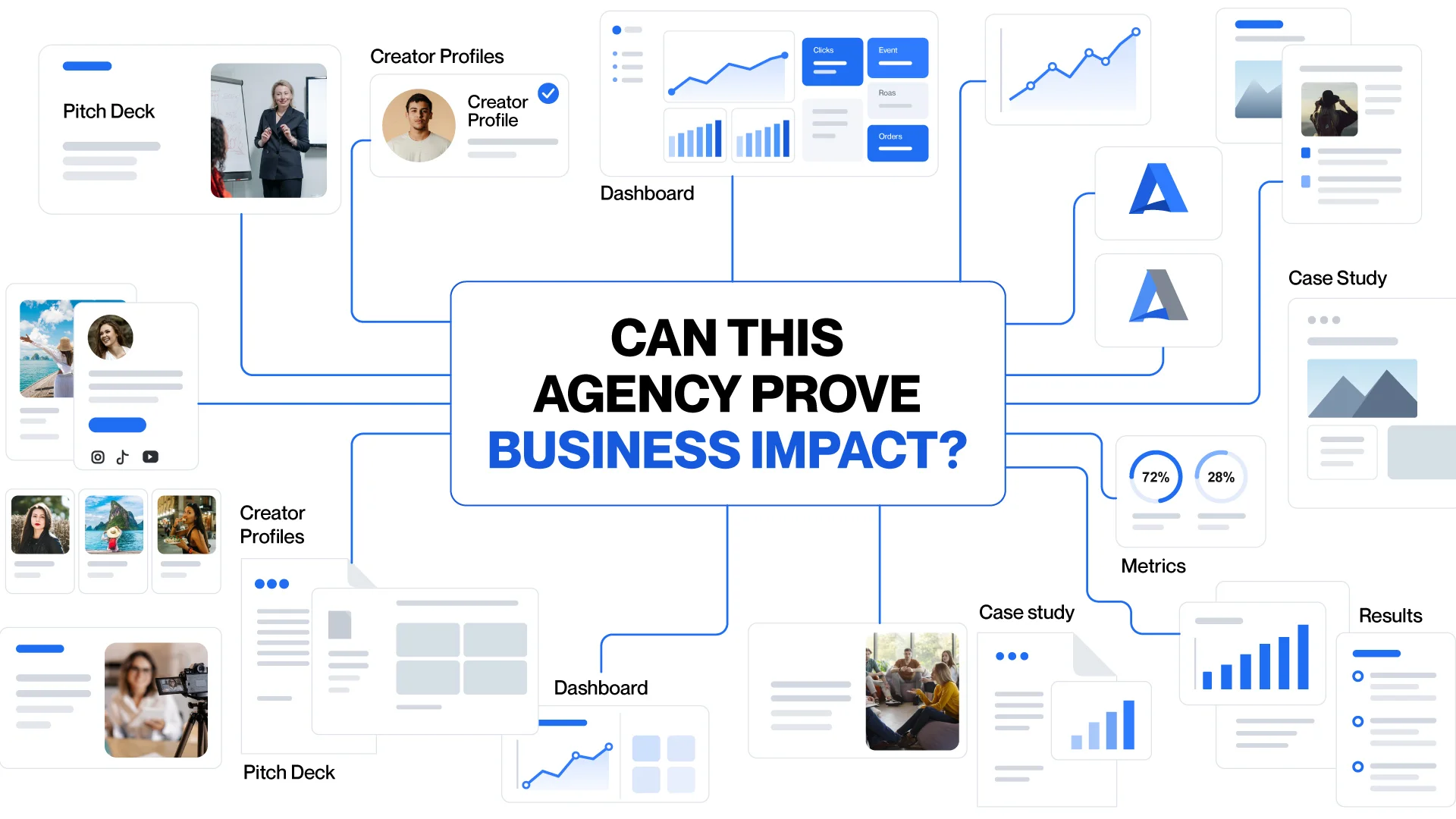
As the market has grown, the agency's role has changed. Creator discovery is easier with technology that can find creators, analyze audiences, check engagement, automate outreach, and manage campaigns.
That makes “we have access to thousands of creators” a weaker selling point. The more important questions are whether the agency can find the right creators, build the strategy, turn creator content into paid media, and connect campaign activity to conversions and revenue.
What Most Brands Get Wrong When Choosing an Agency
They buy the presentationMost agency pitches are designed to look impressive, with polished campaign examples, major client logos, creator screenshots, audience data, and large network numbers. But the more useful evidence comes from what happened after the content went live. Ask about the campaign spend, CPA, conversions, strongest-performing creators, and what changed after the first reporting cycle. A credible agency should be able to clearly connect creator selection, content, distribution, and business results. |
They confuse network size with capabilityA network of 100,000 creators may sound more valuable than one with 5,000, but size matters less if only a small number are relevant to your audience. Creator quality, audience fit, category expertise, and past performance are often more useful when evaluating an agency. Instead of asking “How many creators can you access?”, ask “How does your agency decide which creators deserve my budget?” That question reveals how the agency actually selects creators for your campaign. |
The Five Criteria That Actually Matter
A useful evaluation should score agencies across capabilities that directly affect campaign performance, using the following 100-point framework during an RFP or agency shortlist.
Criterion | Weight | What to Evaluate |
|---|---|---|
Strategic depth | 25 | Audience research, campaign architecture, creator strategy, briefing |
Paid media integration | 20 | Spark Ads, Meta Partnership Ads, paid amplification |
Attribution & measurement | 20 | CPA, ROAS, revenue, conversion tracking |
Creator procurement quality | 20 | Vetting, vertical fit, audience quality, selection logic |
Reporting & account management | 15 | Reporting quality, team structure, communication |
The weights can vary by campaign. Awareness campaigns may prioritize strategy and creative, while DTC campaigns focused on acquisition may place more weight on paid media and attribution. The goal is to define your criteria before the sales pitch influences the decision.
1. Strategic Depth: Are They Building a Program or Booking Creators?
A strong influencer marketing agency should explain its strategy before presenting a creator shortlist. Ask how it moves from business objective → audience insight → creator criteria → creative strategy → campaign structure → distribution → measurement → optimization.
A weak process jumps straight from the brief to a list of creators. That can suggest the agency is acting more like a creator matchmaking service than a strategic marketing partner.
What to ask
How do you translate our business objective into a creator strategy?
What determines whether a creator makes the shortlist?
How do you brief creators without making the content feel scripted?
How do you decide what to test?
What happens after the first campaign report?
The more clearly an agency can explain those decisions, the easier it is to understand what you are actually paying for.
2. Paid Media Integration: What Happens After the Creator Posts?
This is one of the most important questions to ask in 2026. Creator content does not have to stop at organic reach. TikTok's Spark Ads and Meta's Partnership Ads allow brands to turn eligible creator content into paid media, creating a bridge between influencer marketing and paid social.
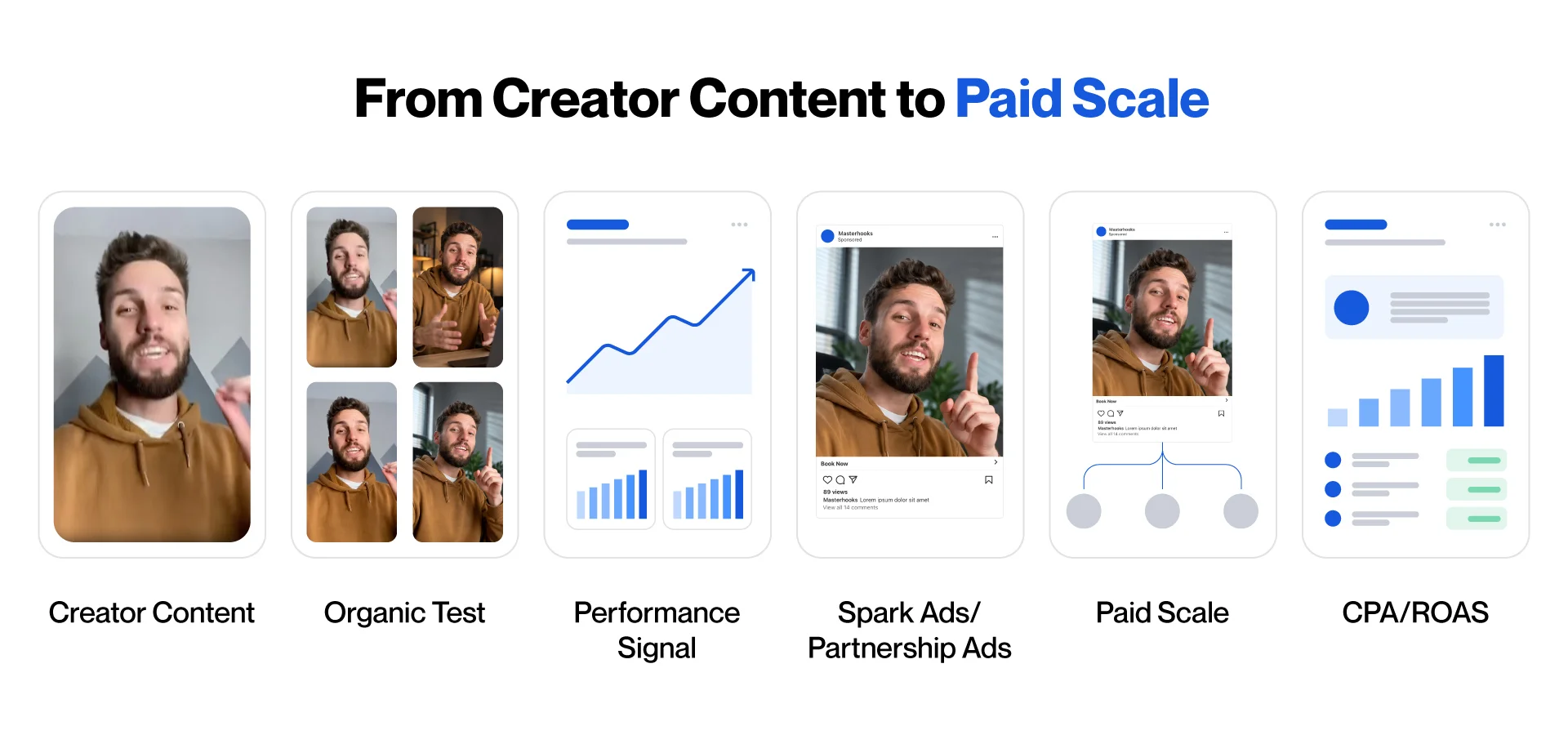
Ask the agency: “Can you take our best-performing creator content and turn it into paid media?” Then ask how. A capable agency should explain its process for usage rights, platform setup, media buying, creative testing, and performance reporting. If a creator's content already performs well organically, paid amplification can help that content reach a much larger audience.
3. Attribution: Can They Connect Creators to Revenue?
This is where many influencer reports become difficult to evaluate. Impressions, reach, and engagement are useful, but they do not automatically show whether a campaign generated profitable growth.
A strong influencer marketing agency should be able to explain how creator activity connects to website visits, leads, purchases, and revenue, using tools such as UTM links, promo codes, affiliate tracking, platform conversion data, and landing-page analytics. Just as importantly, it should clarify what can be measured directly, what relies on attribution assumptions, and where measurement becomes less certain.
More advanced campaigns may also use revenue attribution, incrementality testing, or customer-level analysis. The exact model will depend on the campaign, but the agency should be able to explain how results will be measured before the campaign begins.
Ask for the attribution mapGive the agency a hypothetical customer journey: Creator sees brief → publishes → consumer watches → clicks → visits website → purchases. Then ask, “Which parts of this journey can you measure?” |
4. Creator Procurement Quality: How Do They Choose?
A large creator network becomes valuable when the agency can explain how it filters and evaluates creators. Ask the agency to clearly outline the criteria it uses to decide which creators are the right fit for each campaign. You want to hear about factors such as:
|
|
Follower count should be just one factor among many. A creator with 80,000 followers who consistently reaches your target audience can be more valuable than someone with 800,000 followers who has little connection to your category. Industry experience also matters because a creator's ability to turn attention into action can vary greatly across beauty, fitness, SaaS, finance, and other categories.
5. Reporting and Account Management: Who Actually Does the Work?
The person giving the pitch may not be the person running your campaign. Before signing, ask to meet the team handling the account and find out who owns strategy, manages creators, handles reporting, manages paid media, and makes optimization decisions. This is also where the best influencer management agencies separate themselves from ones that just book creators and disappear
It is also worth asking how many other accounts they manage. A strong pitch followed by junior-only execution can create a very different experience from what was presented during the sales process.
Ask for a sample monthly report as well. A good report should make it easy to understand what happened, why it happened, and what the agency recommends doing next.
The Red Flags That Should Make You Pause
Red Flag 1: The pitch starts and ends with network sizeIf most of the presentation focuses on how many creators the agency can access, ask what happens after discovery. Access is useful, but the ability to select the right creators is what turns that access into a campaign. |
Red Flag 2: Every case study leads with impressionsA case study showing “50 million impressions” means little without context. Ask about the campaign’s traffic, conversions, revenue, CPA, or relevant awareness metrics such as brand lift or search lift. Reach is useful, but it should not be presented as proof of business performance when the campaign had commercial goals. |
Red Flag 3: They cannot explain attributionIf the agency gives a vague answer to “How do you measure revenue from creator content?”, keep digging. Measurement should be built into the campaign strategy from the start, not added as an afterthought in the final report. |
Red Flag 4: Paid media is someone else's problemIf the agency produces creator content but has limited paid media capabilities, ask how its best-performing assets will be scaled. It does not need to manage your entire paid budget, but it should understand how creator content can move from organic performance into paid media. |
Red Flag 5: The proposal is mostly creator namesA creator list is not a strategy. Ask why each creator was selected, what role they play, what creative angle they will test, and what happens if the content underperforms. These questions turn a talent list into a clear campaign plan. |
Red Flag 6: Testimonials could belong to any industryGeneric testimonials are easy to collect, but relevant case studies are more useful. A SaaS company may care about product education, longer consideration cycles, and measurable acquisition, while a beauty brand may focus more on content volume, product demonstrations, and paid creative performance. Industry relevance gives a case study more meaning. |
How to Verify an Agency Before Signing
You can try to use these five steps before committing to a large retainer:
1. Request three relevant case studies
Ask for three campaigns that resemble your business model. Request for these details:
|
|
These variables will give you enough information that you need to understand whether the agency measures the same outcomes your business cares about.
2. Request a sample report
Ask for a redacted campaign report from a previous client to see how the agency thinks. Look at what it prioritizes, how it explains creator-level performance, connects content to paid results, and turns findings into recommendations. A report can reveal more about an agency's approach than a pitch deck.
3. Ask how attribution works
Do not accept “we track everything,” instead use the attribution map from earlier and ask the agency to walk through it live. This can reveal more about the agency's approach than a dozen portfolio slides.
4. Start with a paid pilot
A small paid pilot can reduce the risk of a larger commitment. Give the agency a clear budget and objective, then evaluate its strategy, creator selection, communication, content quality, execution, reporting, and optimization. The pilot also shows how well the agency works with your team and how quickly it learns from campaign results.
5. Meet the person who will actually manage the account
Ask “Who will be my day-to-day contact?” and meet them before signing. Ask how they would respond if the first batch underperformed and how they would decide whether to change the creator, hook, brief, offer, or media strategy. You will learn more from this conversation than from another portfolio slide.
The 100-Point Influencer Agency Scorecard
Once you have interviewed several influencer marketing agencies, score them using the same framework.
Category | Weight | Score 1-5 | Weighted Score |
|---|---|---|---|
Strategic depth | 25% | ||
Paid media integration | 20% | ||
Attribution & measurement | 20% | ||
Creator procurement quality | 20% | ||
Reporting & account management | 15% | ||
Total | 100% | /100 |
Use a simple five-point scale for each category:
1 = Little evidence 2 = Basic capability 3 = Competent | 4 = Strong evidence 5 = Extensive evidence |
The score is not meant to identify an objectively best agency. It gives your team a consistent way to compare agencies based on your campaign's specific needs. An agency suited to enterprise awareness campaigns may score differently from one focused on creator content and paid social, so the right partner depends on the problem you need the agency to solve.
The Difference Between a Creator and an Agency DecisionChoosing a creator and choosing an agency require different evaluation processes. A creator should be judged on audience, content style, credibility, and creative fit, while an agency should be evaluated on its ability to build strategy, manage creators, run campaigns, measure results, and improve performance. You are not just hiring a creator. You are hiring the operating system behind your influencer program. |
Build the Partnership Around Evidence
Knowing how to choose a marketing agency for influencer campaigns comes down to evidence over polish. The growth of influencer marketing agencies gives brands more options, but it also makes it easier to be impressed by surface-level signals. A large network, famous clients, or polished presentation does not prove an agency can deliver the results your business needs. Before signing, ask for relevant case studies, sample reports, an attribution model, the paid media workflow, the actual account team, and ideally a small pilot.
For brands comparing individual creators, the process is different, and the Masterhooks guide on How to Find the Right Influencer for Your Brand covers that decision in more detail. Masterhooks takes a broader approach by connecting strategy, content development, creator relationships, and performance, giving brands a partner that can bring these pieces together rather than simply provide a creator list.
Not sure whether your current influencer program can actually prove its impact?
Not sure whether your current influencer program can actually prove its impact?
Therefore, when evaluating a brand influencer marketing agency, look beyond just the number of creators, client logos, or an attractive pitch deck. What’s more important is the agency’s ability to deliver measurable business impact, manage creators, integrate paid media, and explain attribution. This article will discuss a practical framework for evaluating influencer marketing agencies as business partners, not merely as intermediaries connecting brands with creators.
Why the Agency Selection Problem Has Changed
Influencer marketing has grown into a major marketing channel. The global market was estimated at $32.55 billion in 2025, while research cited by Uplodio found that 39.6% of brands use agencies for influencer campaigns.
As the market has grown, the agency's role has changed. Creator discovery is easier with technology that can find creators, analyze audiences, check engagement, automate outreach, and manage campaigns.
That makes “we have access to thousands of creators” a weaker selling point. The more important questions are whether the agency can find the right creators, build the strategy, turn creator content into paid media, and connect campaign activity to conversions and revenue.
What Most Brands Get Wrong When Choosing an Agency
They buy the presentationMost agency pitches are designed to look impressive, with polished campaign examples, major client logos, creator screenshots, audience data, and large network numbers. But the more useful evidence comes from what happened after the content went live. Ask about the campaign spend, CPA, conversions, strongest-performing creators, and what changed after the first reporting cycle. A credible agency should be able to clearly connect creator selection, content, distribution, and business results. |
They confuse network size with capabilityA network of 100,000 creators may sound more valuable than one with 5,000, but size matters less if only a small number are relevant to your audience. Creator quality, audience fit, category expertise, and past performance are often more useful when evaluating an agency. Instead of asking “How many creators can you access?”, ask “How does your agency decide which creators deserve my budget?” That question reveals how the agency actually selects creators for your campaign. |
The Five Criteria That Actually Matter
A useful evaluation should score agencies across capabilities that directly affect campaign performance, using the following 100-point framework during an RFP or agency shortlist.
Criterion | Weight | What to Evaluate |
|---|---|---|
Strategic depth | 25 | Audience research, campaign architecture, creator strategy, briefing |
Paid media integration | 20 | Spark Ads, Meta Partnership Ads, paid amplification |
Attribution & measurement | 20 | CPA, ROAS, revenue, conversion tracking |
Creator procurement quality | 20 | Vetting, vertical fit, audience quality, selection logic |
Reporting & account management | 15 | Reporting quality, team structure, communication |
The weights can vary by campaign. Awareness campaigns may prioritize strategy and creative, while DTC campaigns focused on acquisition may place more weight on paid media and attribution. The goal is to define your criteria before the sales pitch influences the decision.
1. Strategic Depth: Are They Building a Program or Booking Creators?
A strong influencer marketing agency should explain its strategy before presenting a creator shortlist. Ask how it moves from business objective → audience insight → creator criteria → creative strategy → campaign structure → distribution → measurement → optimization.
A weak process jumps straight from the brief to a list of creators. That can suggest the agency is acting more like a creator matchmaking service than a strategic marketing partner.
What to ask
How do you translate our business objective into a creator strategy?
What determines whether a creator makes the shortlist?
How do you brief creators without making the content feel scripted?
How do you decide what to test?
What happens after the first campaign report?
The more clearly an agency can explain those decisions, the easier it is to understand what you are actually paying for.
2. Paid Media Integration: What Happens After the Creator Posts?
This is one of the most important questions to ask in 2026. Creator content does not have to stop at organic reach. TikTok's Spark Ads and Meta's Partnership Ads allow brands to turn eligible creator content into paid media, creating a bridge between influencer marketing and paid social.
Ask the agency: “Can you take our best-performing creator content and turn it into paid media?” Then ask how. A capable agency should explain its process for usage rights, platform setup, media buying, creative testing, and performance reporting. If a creator's content already performs well organically, paid amplification can help that content reach a much larger audience.
3. Attribution: Can They Connect Creators to Revenue?
This is where many influencer reports become difficult to evaluate. Impressions, reach, and engagement are useful, but they do not automatically show whether a campaign generated profitable growth.
A strong influencer marketing agency should be able to explain how creator activity connects to website visits, leads, purchases, and revenue, using tools such as UTM links, promo codes, affiliate tracking, platform conversion data, and landing-page analytics. Just as importantly, it should clarify what can be measured directly, what relies on attribution assumptions, and where measurement becomes less certain.
More advanced campaigns may also use revenue attribution, incrementality testing, or customer-level analysis. The exact model will depend on the campaign, but the agency should be able to explain how results will be measured before the campaign begins.
Ask for the attribution mapGive the agency a hypothetical customer journey: Creator sees brief → publishes → consumer watches → clicks → visits website → purchases. Then ask, “Which parts of this journey can you measure?” |
4. Creator Procurement Quality: How Do They Choose?
A large creator network becomes valuable when the agency can explain how it filters and evaluates creators. Ask the agency to clearly outline the criteria it uses to decide which creators are the right fit for each campaign. You want to hear about factors such as:
|
|
Follower count should be just one factor among many. A creator with 80,000 followers who consistently reaches your target audience can be more valuable than someone with 800,000 followers who has little connection to your category. Industry experience also matters because a creator's ability to turn attention into action can vary greatly across beauty, fitness, SaaS, finance, and other categories.
5. Reporting and Account Management: Who Actually Does the Work?
The person giving the pitch may not be the person running your campaign. Before signing, ask to meet the team handling the account and find out who owns strategy, manages creators, handles reporting, manages paid media, and makes optimization decisions. This is also where the best influencer management agencies separate themselves from ones that just book creators and disappear
It is also worth asking how many other accounts they manage. A strong pitch followed by junior-only execution can create a very different experience from what was presented during the sales process.
Ask for a sample monthly report as well. A good report should make it easy to understand what happened, why it happened, and what the agency recommends doing next.
The Red Flags That Should Make You Pause
Red Flag 1: The pitch starts and ends with network sizeIf most of the presentation focuses on how many creators the agency can access, ask what happens after discovery. Access is useful, but the ability to select the right creators is what turns that access into a campaign. |
Red Flag 2: Every case study leads with impressionsA case study showing “50 million impressions” means little without context. Ask about the campaign’s traffic, conversions, revenue, CPA, or relevant awareness metrics such as brand lift or search lift. Reach is useful, but it should not be presented as proof of business performance when the campaign had commercial goals. |
Red Flag 3: They cannot explain attributionIf the agency gives a vague answer to “How do you measure revenue from creator content?”, keep digging. Measurement should be built into the campaign strategy from the start, not added as an afterthought in the final report. |
Red Flag 4: Paid media is someone else's problemIf the agency produces creator content but has limited paid media capabilities, ask how its best-performing assets will be scaled. It does not need to manage your entire paid budget, but it should understand how creator content can move from organic performance into paid media. |
Red Flag 5: The proposal is mostly creator namesA creator list is not a strategy. Ask why each creator was selected, what role they play, what creative angle they will test, and what happens if the content underperforms. These questions turn a talent list into a clear campaign plan. |
Red Flag 6: Testimonials could belong to any industryGeneric testimonials are easy to collect, but relevant case studies are more useful. A SaaS company may care about product education, longer consideration cycles, and measurable acquisition, while a beauty brand may focus more on content volume, product demonstrations, and paid creative performance. Industry relevance gives a case study more meaning. |
How to Verify an Agency Before Signing
You can try to use these five steps before committing to a large retainer:
1. Request three relevant case studies
Ask for three campaigns that resemble your business model. Request for these details:
|
|
These variables will give you enough information that you need to understand whether the agency measures the same outcomes your business cares about.
2. Request a sample report
Ask for a redacted campaign report from a previous client to see how the agency thinks. Look at what it prioritizes, how it explains creator-level performance, connects content to paid results, and turns findings into recommendations. A report can reveal more about an agency's approach than a pitch deck.
3. Ask how attribution works
Do not accept “we track everything,” instead use the attribution map from earlier and ask the agency to walk through it live. This can reveal more about the agency's approach than a dozen portfolio slides.
4. Start with a paid pilot
A small paid pilot can reduce the risk of a larger commitment. Give the agency a clear budget and objective, then evaluate its strategy, creator selection, communication, content quality, execution, reporting, and optimization. The pilot also shows how well the agency works with your team and how quickly it learns from campaign results.
5. Meet the person who will actually manage the account
Ask “Who will be my day-to-day contact?” and meet them before signing. Ask how they would respond if the first batch underperformed and how they would decide whether to change the creator, hook, brief, offer, or media strategy. You will learn more from this conversation than from another portfolio slide.
The 100-Point Influencer Agency Scorecard
Once you have interviewed several influencer marketing agencies, score them using the same framework.
Category | Weight | Score 1-5 | Weighted Score |
|---|---|---|---|
Strategic depth | 25% | ||
Paid media integration | 20% | ||
Attribution & measurement | 20% | ||
Creator procurement quality | 20% | ||
Reporting & account management | 15% | ||
Total | 100% | /100 |
Use a simple five-point scale for each category:
1 = Little evidence 2 = Basic capability 3 = Competent | 4 = Strong evidence 5 = Extensive evidence |
The score is not meant to identify an objectively best agency. It gives your team a consistent way to compare agencies based on your campaign's specific needs. An agency suited to enterprise awareness campaigns may score differently from one focused on creator content and paid social, so the right partner depends on the problem you need the agency to solve.
The Difference Between a Creator and an Agency DecisionChoosing a creator and choosing an agency require different evaluation processes. A creator should be judged on audience, content style, credibility, and creative fit, while an agency should be evaluated on its ability to build strategy, manage creators, run campaigns, measure results, and improve performance. You are not just hiring a creator. You are hiring the operating system behind your influencer program. |
Build the Partnership Around Evidence
Knowing how to choose a marketing agency for influencer campaigns comes down to evidence over polish. The growth of influencer marketing agencies gives brands more options, but it also makes it easier to be impressed by surface-level signals. A large network, famous clients, or polished presentation does not prove an agency can deliver the results your business needs. Before signing, ask for relevant case studies, sample reports, an attribution model, the paid media workflow, the actual account team, and ideally a small pilot.
For brands comparing individual creators, the process is different, and the Masterhooks guide on How to Find the Right Influencer for Your Brand covers that decision in more detail. Masterhooks takes a broader approach by connecting strategy, content development, creator relationships, and performance, giving brands a partner that can bring these pieces together rather than simply provide a creator list.
Not sure whether your current influencer program can actually prove its impact?
Related Reading
Related Reading

AI Video Ad Agencies: A Buyer's Guide for DTC Brands (2026)
4 min
|
AI Video Ad Agencies: A Buyer's Guide for DTC Brands (2026)
Compare AI video ad agency types, pricing, performance metrics, ownership rights, and seven questions DTC brands should ask before hiring.
4 min
|

How Taylor Swift Engineered a UGC Wave With 13 Seconds of Video and One Awards Show
4 min
|
How Taylor Swift Engineered a UGC Wave With 13 Seconds of Video and One Awards Show
How Taylor Swift turned a 13-second teaser, Easter eggs, and a live VMA premiere into a UGC engine brands can adapt for organic distribution.
4 min
|
How Blumhouse Built a $740M Horror Franchise by Spending Less Than Any Competitor
4 min
|
How Blumhouse Built a $740M Horror Franchise by Spending Less Than Any Competitor
How Blumhouse turned low-budget horror into a repeatable franchise model using controlled costs, social amplification, and audience-driven content.
4 min
|


Need help scaling?
Book a strategy call with our expert team to audit your current UGC setup.