



How to Find & Choose the Right Influencer for Your Brand (Without Getting Burned)
How to Find & Choose the Right Influencer for Your Brand (Without Getting Burned)
Learn how to find influencers for your brand using audience fit, engagement quality, growth patterns, content quality, and campaign history.
Published:

Read Time:

5 min

Written by:
Fawwaz
Trend Research and Copywriter
MORE FOLLOWERS DON’T ALWAYS MEAN MORE IMPACT.
Influencer marketing works best when the right creator reaches the right audience, not just the largest one. The right influencer is rarely the one with the most followers, because there are many other factors that determine whether a particular influencer is the right choice to help a brand succeed in its campaign.
MORE FOLLOWERS DON’T ALWAYS MEAN MORE IMPACT.
Influencer marketing works best when the right creator reaches the right audience, not just the largest one. The right influencer is rarely the one with the most followers, because there are many other factors that determine whether a particular influencer is the right choice to help a brand succeed in its campaign.
MORE FOLLOWERS DON’T ALWAYS MEAN MORE IMPACT.
Influencer marketing works best when the right creator reaches the right audience, not just the largest one. The right influencer is rarely the one with the most followers, because there are many other factors that determine whether a particular influencer is the right choice to help a brand succeed in its campaign.
Quick Summary
Finding the right influencer isn't about choosing the creator with the biggest following. It's about finding someone whose audience, content, and performance fit your brand.
Start with audience fit, not follower count. Relevance and engagement can matter more than reach alone.
Look beyond the media kit by checking recent content, engagement quality, audience data, and performance patterns.
Watch for red flags like suspicious growth, weak engagement, inconsistent performance, and too many sponsored posts.
The strongest partnerships come from creators with relevant audiences, consistent content, and a proven track record.
Start With the Audience, Not the Creator
A creator can look perfect on paper and still be a poor choice for an influencer campaign. For example, a skincare brand might choose between a fashion and lifestyle creator with 180,000 followers and a skincare creator with 24,000 followers. The first has a bigger audience, but the second may have a more valuable one.
A creator with 20K highly relevant followers can be more valuable than a creator with 2M followers who have little interest in the product. This shift becomes particularly important in 2026, when follower count is no longer a reliable indicator of reach, while topic relevance and content style are becoming more important to audiences. That's why finding influencers for brand campaigns should start with audience analysis. The creator's interests matter, but the audience's interests matter more.
Sprout Social's 2026 research found that only 17% of consumers check follower count before engaging with a creator, while subject relevance and content style play a bigger role. To identify the right influencer, brands need to assess the realistic level of engagement a creator can generate for the brand.
The first filter
Yes, you can still start by filtering based on the number of followers, but do that when you still have a large number of options. Let’s say you have 1,000 influencer options; you can filter them by the number of followers so that you’re left with the 100 influencers with the most followers.
Once you’re down to those 100, you can then filter again based on their respective audiences to decide which ones are the best fit. You can see the process illustrated in the following image:
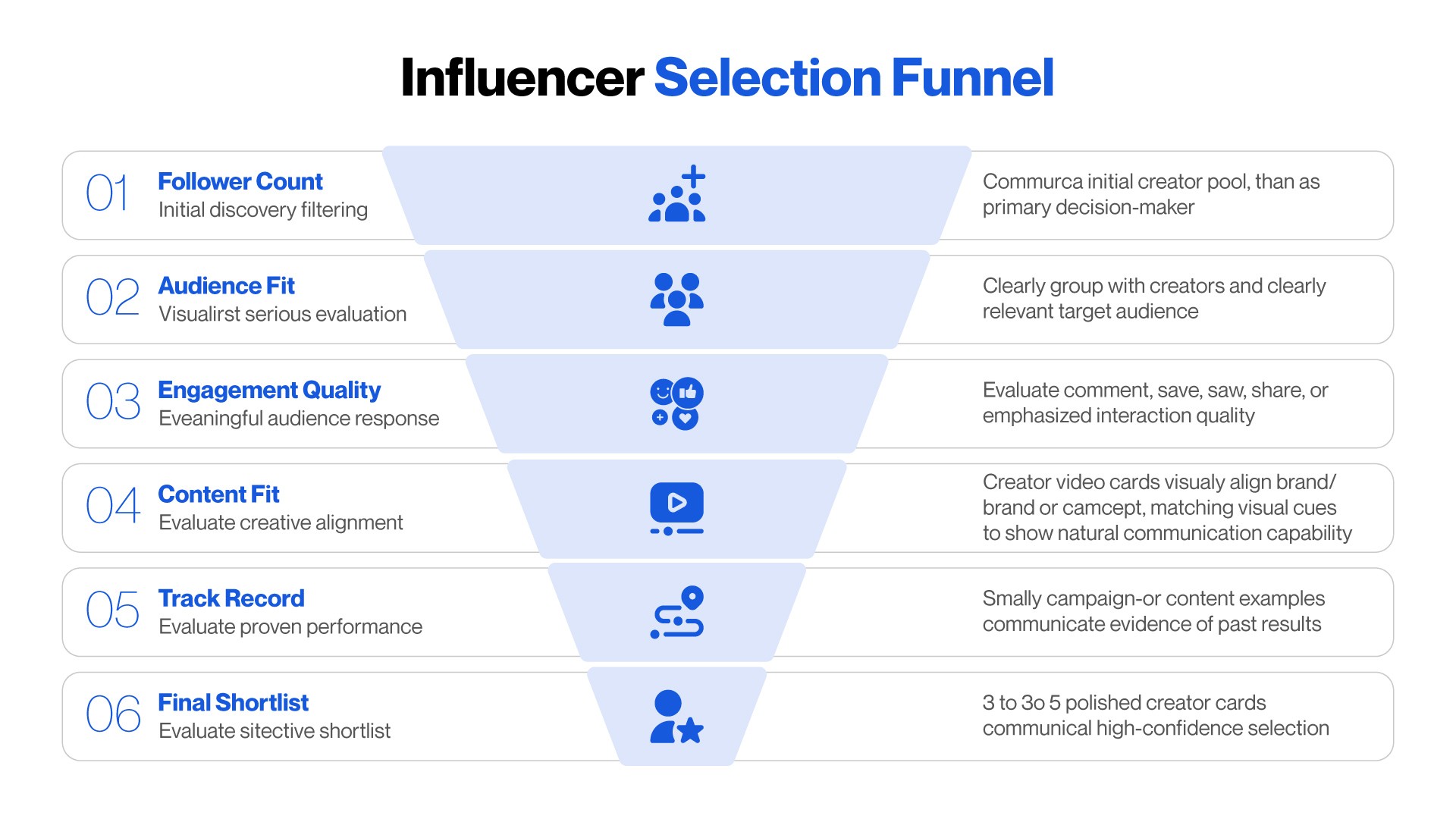
After successfully narrowing down the 100 influencers to a few whose audiences align with your campaign and brand, you can continue filtering to assess the quality of their engagement, and so on.
Engagement Rate Is Your First Performance Check
In brand influencer marketing, follower count shows how large a creator's audience is, but engagement shows whether people are actually paying attention.
A simple engagement rate can be calculated by dividing average engagements per post by follower count and multiplying by 100. For example, 1,650 average engagements on 25,000 followers gives a 6.6% engagement rate.
Use this as a screening tool, not a strict pass-or-fail rule. Engagement rates vary by platform, category, audience size, and content format, so the most useful approach is to look at the creator's engagement pattern across recent posts.
Engagement quality matters more than the percentageA 7% engagement rate may look impressive, but if most of the comments are generic phrases, repeated emojis, or unrelated conversations, the headline number becomes less meaningful. Instead of only asking how high the engagement rate is, brands should ask: Who is actually engaging with this creator? |
Audit the Last 20 to 30 Posts
Never choose a creator based on their media kit alone. Review their last 20–30 posts to understand their normal performance, including views, likes, comment quality, content consistency, sponsored-post frequency, and how often posts outperform the rest.
The goal is to see the creator's typical performance rather than their single best post. This matters because individual posts can reach people far beyond the creator's follower base through recommendation feeds.
ExampleTwo creators can both have 100,000 followers but very different performances. One might consistently get around 40K–60K views per video, while another might get anywhere from a few thousand to over a million. The second creator can still be valuable, but you should understand why their results vary so much before spending your budget. |
Five Red Flags That Should Slow You Down
If the creator shows you one of these red flags, you have to be careful and reconsider your decision in working with them. Those red flags are:
1. A suspicious follower-growth curveA sudden spike on the creator's follower growth curve can be legitimate if it comes from a viral post, collaboration, or media appearance, but repeated unexplained jumps can be a red flag for fake followers or artificial growth. |
2. Huge audience, tiny engagementA creator with 200,000 followers but only a few hundred interactions per post deserves a closer look because a large gap between follower count and actual engagement can be a warning sign. |
3. Comments that make no senseRead the comments to see if the creator's audience matches the campaign. If an account targeting the United States has mostly generic comments in unrelated languages, it may be worth investigating further. Geography alone doesn't prove fraud, so focus on whether the audience makes sense for your campaign. |
4. Wildly inconsistent performanceSome variation in engagement is normal, but extreme swings can be a red flag. If one post gets 5,000 likes, the next gets 200, and another gets 80,000, look into what caused the difference and whether the creator can explain it. |
5. The feed is almost entirely sponsoredLook at how often the creator posts sponsored content. If most posts are ads, their credibility may be weaker, and your campaign may struggle to stand out if they already promote many similar brands. |
Three Things to Look for in the Right Influencer
Now that you understand red flags, here are three green flags that can increase your campaign’s chances of success
1. Audience-brand alignmentAudience fit is the most important filter since a creator may love your product, but their audience may not care about it. Always ask whether the people watching the creator are the right audience for your product, because audience fit matters more than creator fit. | 2. Content consistencyLook at the creator's last 30 days of content. Check whether they post consistently, maintain quality, and have a clear style that could naturally include your product. The best creator is often the one whose existing content already matches what your brand wants to create. |
3. Track recordAsk what happened in the creator's previous campaigns. Look for reach, views, engagement, clicks, conversion data, screenshots, and examples of sponsored content. A creator doesn't need a huge portfolio to be valuable, but if they have worked with several brands and cannot show meaningful results, that should affect your confidence. Focus on metrics that match your campaign goals, like reach, traffic, engagement, conversions, and brand mentions can all matter, depending on what you want the campaign to achieve. | |
The Audience Data You Should Request
Once a creator passes the initial screening, ask for audience demographics directly. At minimum, request:
Age | Does the creator reach the intended customer age group? |
Gender | Is the audience composition relevant to the product? |
Location | Does the creator reach the markets where the brand actually sells? |
Audience interests | Do their followers show meaningful interest in the relevant category? |
Average views | What does their content normally generate? |
Recent campaign results | What happened when another brand paid for a similar activation? |
Don’t rely entirely on screenshots, instead verify the creator’s data as much as possible through a third-party platform or the platform’s native analytics. This will help you ensure that the data provided to you is accurate.
The Tools Worth Using Before You Sign
You may need tools to help you conduct influencer analysis, but that doesn’t mean you need every tool and platform out there. Just use a few that fit your needs; here are some you can try:
How Does a Brand Choose an Influencer?
The goal is to make how to use influencers for marketing less dependent on instinct. A simple workflow can look like this:
Step 1 | Shortlist creators based on audience relevance. |
Step 2 | Remove anyone with the wrong audience, geography, or category. |
Step 3 | Review their last 20 to 30 posts and calculate typical engagement. |
Step 4 | Check comment quality, follower growth, and previous sponsored content. |
Step 5 | Request audience demographics and past campaign results. |
Step 6 | Score each creator and move the strongest candidates into negotiation. |
Step 7 | Define campaign KPIs and expectations before signing. |
This process helps avoid choosing the wrong creator and trying to fix the campaign later. If the audience isn't interested in the product, better briefs or paid promotion can only do so much. Keep a database of strong creators with key details like audience, platform, content style, rates, and past results so your team can quickly find the right creators for future campaigns.
From Influencer Selection to Better Content
The influencer market is moving toward a model where audience size is only one part of a creator's value. Understanding how influencer marketing works can help brands make better decisions about which creators to work with. Sprout Social's 2026 research highlights this shift, showing that recommendation feeds can separate distribution from follower count, while consumers increasingly care about relevance and content style.
For brands, the goal is no longer to find the biggest creator, but the right one: someone with the audience you want, content you can use, and performance you can measure. Masterhooks supports this approach by treating creator content as a strategic marketing asset, with a focus on UGC, creator formats, and content performance.
Not sure if the creators you're considering are actually the right fit for your brand?
Not sure if the creators you're considering are actually the right fit for your brand?
Quick Summary
Finding the right influencer isn't about choosing the creator with the biggest following. It's about finding someone whose audience, content, and performance fit your brand.
Start with audience fit, not follower count. Relevance and engagement can matter more than reach alone.
Look beyond the media kit by checking recent content, engagement quality, audience data, and performance patterns.
Watch for red flags like suspicious growth, weak engagement, inconsistent performance, and too many sponsored posts.
The strongest partnerships come from creators with relevant audiences, consistent content, and a proven track record.
Start With the Audience, Not the Creator
A creator can look perfect on paper and still be a poor choice for an influencer campaign. For example, a skincare brand might choose between a fashion and lifestyle creator with 180,000 followers and a skincare creator with 24,000 followers. The first has a bigger audience, but the second may have a more valuable one.
A creator with 20K highly relevant followers can be more valuable than a creator with 2M followers who have little interest in the product. This shift becomes particularly important in 2026, when follower count is no longer a reliable indicator of reach, while topic relevance and content style are becoming more important to audiences. That's why finding influencers for brand campaigns should start with audience analysis. The creator's interests matter, but the audience's interests matter more.
Sprout Social's 2026 research found that only 17% of consumers check follower count before engaging with a creator, while subject relevance and content style play a bigger role. To identify the right influencer, brands need to assess the realistic level of engagement a creator can generate for the brand.
The first filter
Yes, you can still start by filtering based on the number of followers, but do that when you still have a large number of options. Let’s say you have 1,000 influencer options; you can filter them by the number of followers so that you’re left with the 100 influencers with the most followers.
Once you’re down to those 100, you can then filter again based on their respective audiences to decide which ones are the best fit. You can see the process illustrated in the following image:
After successfully narrowing down the 100 influencers to a few whose audiences align with your campaign and brand, you can continue filtering to assess the quality of their engagement, and so on.
Engagement Rate Is Your First Performance Check
In brand influencer marketing, follower count shows how large a creator's audience is, but engagement shows whether people are actually paying attention.
A simple engagement rate can be calculated by dividing average engagements per post by follower count and multiplying by 100. For example, 1,650 average engagements on 25,000 followers gives a 6.6% engagement rate.
Use this as a screening tool, not a strict pass-or-fail rule. Engagement rates vary by platform, category, audience size, and content format, so the most useful approach is to look at the creator's engagement pattern across recent posts.
Engagement quality matters more than the percentageA 7% engagement rate may look impressive, but if most of the comments are generic phrases, repeated emojis, or unrelated conversations, the headline number becomes less meaningful. Instead of only asking how high the engagement rate is, brands should ask: Who is actually engaging with this creator? |
Audit the Last 20 to 30 Posts
Never choose a creator based on their media kit alone. Review their last 20–30 posts to understand their normal performance, including views, likes, comment quality, content consistency, sponsored-post frequency, and how often posts outperform the rest.
The goal is to see the creator's typical performance rather than their single best post. This matters because individual posts can reach people far beyond the creator's follower base through recommendation feeds.
ExampleTwo creators can both have 100,000 followers but very different performances. One might consistently get around 40K–60K views per video, while another might get anywhere from a few thousand to over a million. The second creator can still be valuable, but you should understand why their results vary so much before spending your budget. |
Five Red Flags That Should Slow You Down
If the creator shows you one of these red flags, you have to be careful and reconsider your decision in working with them. Those red flags are:
1. A suspicious follower-growth curveA sudden spike on the creator's follower growth curve can be legitimate if it comes from a viral post, collaboration, or media appearance, but repeated unexplained jumps can be a red flag for fake followers or artificial growth. |
2. Huge audience, tiny engagementA creator with 200,000 followers but only a few hundred interactions per post deserves a closer look because a large gap between follower count and actual engagement can be a warning sign. |
3. Comments that make no senseRead the comments to see if the creator's audience matches the campaign. If an account targeting the United States has mostly generic comments in unrelated languages, it may be worth investigating further. Geography alone doesn't prove fraud, so focus on whether the audience makes sense for your campaign. |
4. Wildly inconsistent performanceSome variation in engagement is normal, but extreme swings can be a red flag. If one post gets 5,000 likes, the next gets 200, and another gets 80,000, look into what caused the difference and whether the creator can explain it. |
5. The feed is almost entirely sponsoredLook at how often the creator posts sponsored content. If most posts are ads, their credibility may be weaker, and your campaign may struggle to stand out if they already promote many similar brands. |
Three Things to Look for in the Right Influencer
Now that you understand red flags, here are three green flags that can increase your campaign’s chances of success
1. Audience-brand alignmentAudience fit is the most important filter since a creator may love your product, but their audience may not care about it. Always ask whether the people watching the creator are the right audience for your product, because audience fit matters more than creator fit. | 2. Content consistencyLook at the creator's last 30 days of content. Check whether they post consistently, maintain quality, and have a clear style that could naturally include your product. The best creator is often the one whose existing content already matches what your brand wants to create. |
3. Track recordAsk what happened in the creator's previous campaigns. Look for reach, views, engagement, clicks, conversion data, screenshots, and examples of sponsored content. A creator doesn't need a huge portfolio to be valuable, but if they have worked with several brands and cannot show meaningful results, that should affect your confidence. Focus on metrics that match your campaign goals, like reach, traffic, engagement, conversions, and brand mentions can all matter, depending on what you want the campaign to achieve. | |
The Audience Data You Should Request
Once a creator passes the initial screening, ask for audience demographics directly. At minimum, request:
Age | Does the creator reach the intended customer age group? |
Gender | Is the audience composition relevant to the product? |
Location | Does the creator reach the markets where the brand actually sells? |
Audience interests | Do their followers show meaningful interest in the relevant category? |
Average views | What does their content normally generate? |
Recent campaign results | What happened when another brand paid for a similar activation? |
Don’t rely entirely on screenshots, instead verify the creator’s data as much as possible through a third-party platform or the platform’s native analytics. This will help you ensure that the data provided to you is accurate.
The Tools Worth Using Before You Sign
You may need tools to help you conduct influencer analysis, but that doesn’t mean you need every tool and platform out there. Just use a few that fit your needs; here are some you can try:
How Does a Brand Choose an Influencer?
The goal is to make how to use influencers for marketing less dependent on instinct. A simple workflow can look like this:
Step 1 | Shortlist creators based on audience relevance. |
Step 2 | Remove anyone with the wrong audience, geography, or category. |
Step 3 | Review their last 20 to 30 posts and calculate typical engagement. |
Step 4 | Check comment quality, follower growth, and previous sponsored content. |
Step 5 | Request audience demographics and past campaign results. |
Step 6 | Score each creator and move the strongest candidates into negotiation. |
Step 7 | Define campaign KPIs and expectations before signing. |
This process helps avoid choosing the wrong creator and trying to fix the campaign later. If the audience isn't interested in the product, better briefs or paid promotion can only do so much. Keep a database of strong creators with key details like audience, platform, content style, rates, and past results so your team can quickly find the right creators for future campaigns.
From Influencer Selection to Better Content
The influencer market is moving toward a model where audience size is only one part of a creator's value. Understanding how influencer marketing works can help brands make better decisions about which creators to work with. Sprout Social's 2026 research highlights this shift, showing that recommendation feeds can separate distribution from follower count, while consumers increasingly care about relevance and content style.
For brands, the goal is no longer to find the biggest creator, but the right one: someone with the audience you want, content you can use, and performance you can measure. Masterhooks supports this approach by treating creator content as a strategic marketing asset, with a focus on UGC, creator formats, and content performance.
Not sure if the creators you're considering are actually the right fit for your brand?
Related Reading

How Blumhouse Built a $740M Horror Franchise by Spending Less Than Any Competitor
4 min
|

What Is Influencer Marketing? A No-Fluff Guide for Brands Ready to Actually Use It
5 min
|

How “End of August” Became TikTok’s Song of the Summer, and What It Teaches Us About Viral Audio
3 min
|



Need help scaling?
Book a strategy call with our expert team to audit your current UGC setup.
Related Reading
How Blumhouse Built a $740M Horror Franchise by Spending Less Than Any Competitor
How Blumhouse turned low-budget horror into a repeatable franchise model using controlled costs, social amplification, and audience-driven content.
4 min
|
How Blumhouse Built a $740M Horror Franchise by Spending Less Than Any Competitor
How Blumhouse turned low-budget horror into a repeatable franchise model using controlled costs, social amplification, and audience-driven content.
4 min
|
What Is Influencer Marketing? A No-Fluff Guide for Brands Ready to Actually Use It
Ready to use influencer marketing for your brands? Learn influencer types, campaign models, costs, ROI, measurement, and how to choose the right creators.
5 min
|
What Is Influencer Marketing? A No-Fluff Guide for Brands Ready to Actually Use It
Ready to use influencer marketing for your brands? Learn influencer types, campaign models, costs, ROI, measurement, and how to choose the right creators.
5 min
|
How “End of August” Became TikTok’s Song of the Summer, and What It Teaches Us About Viral Audio
Learn why Noah Kahan’s End of August became a TikTok hit and what its timing, emotion, and cultural identity teach brands about viral audio.
3 min
|
How “End of August” Became TikTok’s Song of the Summer, and What It Teaches Us About Viral Audio
Learn why Noah Kahan’s End of August became a TikTok hit and what its timing, emotion, and cultural identity teach brands about viral audio.
3 min
|