



Creator Economy
How Blumhouse Built a $740M Horror Franchise by Spending Less Than Any Competitor
How Blumhouse Built a $740M Horror Franchise by Spending Less Than Any Competitor
How Blumhouse turned low-budget horror into a repeatable franchise model using controlled costs, social amplification, and audience-driven content.
Published:

Read Time:

4 min

Written by:
Fawwaz
Trend Research and Copywriter
SPENDING LESS, GETTING MORE!!
Blumhouse’s strength lies in its ability to keep production costs low while creating films that generate significant buzz. Insidious: Out of the Further demonstrates that this model remains effective in 2026.
SPENDING LESS, GETTING MORE!!
Blumhouse’s strength lies in its ability to keep production costs low while creating films that generate significant buzz. Insidious: Out of the Further demonstrates that this model remains effective in 2026.
SPENDING LESS, GETTING MORE!!
Blumhouse’s strength lies in its ability to keep production costs low while creating films that generate significant buzz. Insidious: Out of the Further demonstrates that this model remains effective in 2026.
The film made $25.3 million in its opening weekend on an estimated $18 million budget, while reaching 282.2 million people on social media before release. The Insidious franchise had already earned over $740 million worldwide, giving each new film an existing audience, recognizable brand, and years of fan conversations to build on. This allows new releases to generate fresh buzz without starting their marketing from scratch.
The Blumhouse Model Starts With the Budget
Blumhouse's low-budget strategy gives filmmakers more freedom to experiment.
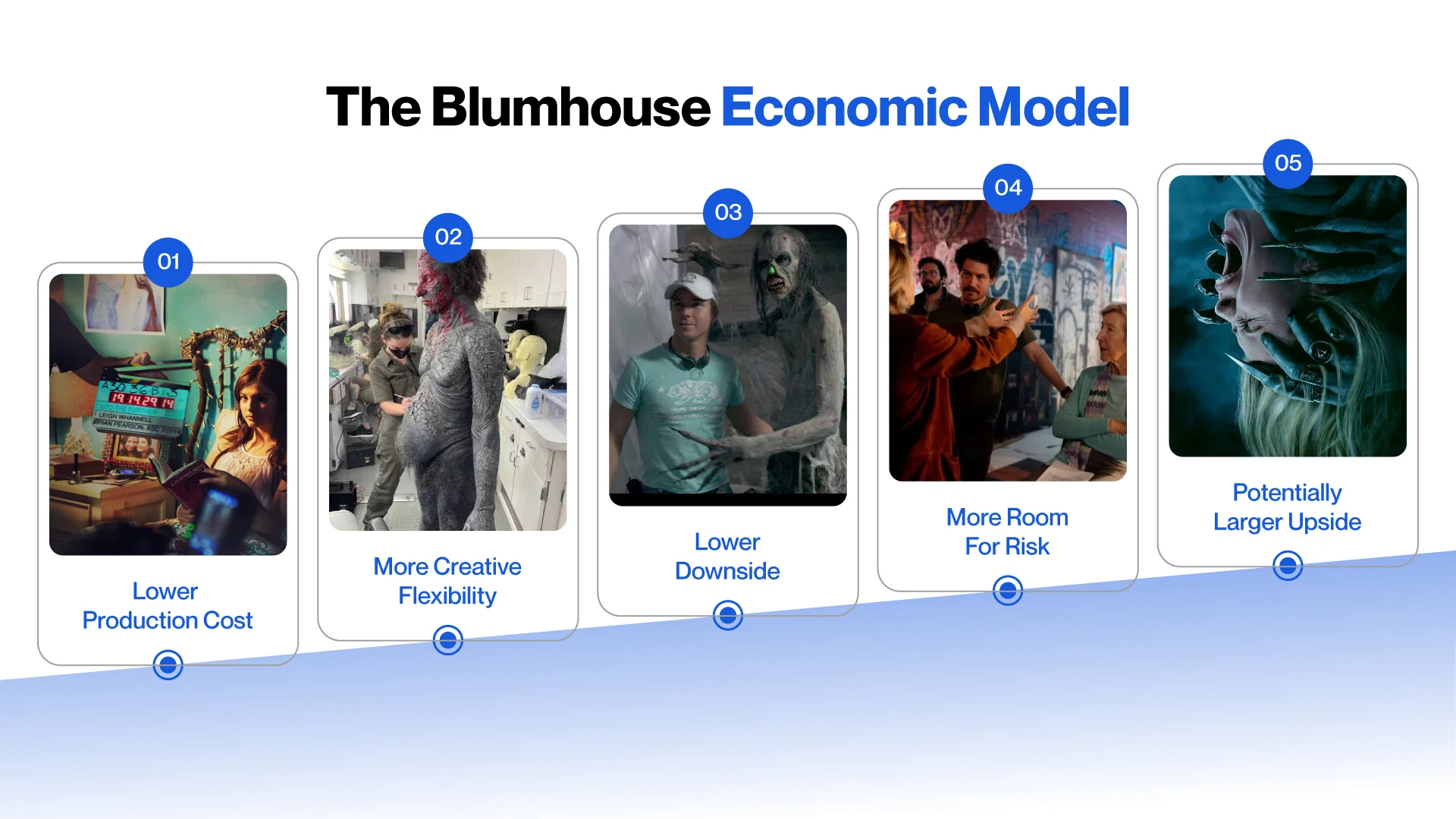
Jason Blum has explained that smaller budgets help the studio keep creative control and try unusual ideas without putting too much money at risk. After Paranormal Activity, Blumhouse made Insidious for less than $1 million instead of immediately increasing its budget.
This is the core of the Blumhouse business model: an approach that runs opposite to big-budget Hollywood films. A $100 million movie needs massive returns to justify its cost, while a smaller horror film can take more creative risks, reach a niche audience, and still generate strong returns.
Constraint Becomes A Creative AdvantageLow production costs force filmmakers to focus on what matters most: creating a reaction. Without expensive sets, locations, or visual effects, the value of a strong sound, reveal, character, or memorable moment becomes even greater. This is the foundation of low-budget, high-return film marketing: making a film where the production costs match its ability to capture and spread audience attention. |
Why Horror Is Especially Compatible With This Model
Horror has a natural advantage on social media because people don't just watch scary movies, they also record and share their reactions. A scary scene can lead to reaction videos, memes, theories, challenges, and scene recreations, giving audiences many ways to participate.
Tap to play
Tap to play
Tap to play
This creates a strong connection between horror and user-generated content. Instead of creating every piece of promotional content themselves, studios can give audiences something worth reacting to and let them spread it through their own content. This makes Blumhouse horror UGC especially interesting as a marketing strategy.
Insidious Has Something Most New Films Do Not
Unlike a new horror film that has to build awareness from scratch, Insidious: Out of the Further entered the market with years of built-in attention.
As the sixth theatrical film in the franchise, it benefited from a series that had already earned more than $740 million worldwide, giving the latest release an established audience and years of accumulated awareness. That includes:
Existing fans | Search demand | Recognizable characters | Previous trailers and clips |
Fan theories | Reaction videos | Previous installments | Familiar franchise imagery |
Reviews | Memes | Social accounts available to revisit | |
Every new film has another opportunity to reactivate that ecosystem, and this is the real franchise advantage.
The Social Universe Is Getting Bigger
Insidious: Out of the Further had a 282.2 million social-media universe across TikTok, Facebook, Instagram, X, and YouTube before its North American opening, compared with more than 182 million for Insidious: The Red Door in 2023.
That is an increase of roughly 100 million in the measured social universe, which does not actually represent 100 million individual fans or prove that UGC alone caused the growth. Still, the growth shows what a working horror franchise social media strategy looks like: each film compounds attention instead of starting over. They show that the franchise entered its sixth film with a much larger social footprint, giving the new release a stronger base of existing attention.
The economics make that footprint even more valuable where Out of the Further reportedly cost $18 million to produce and opened to approximately $25.3 million domestically and $60.3 million worldwide in its opening frame. The opening weekend alone exceeded the reported production budget, although profitability also depends on marketing, distribution, theater splits, financing, and other costs.
The Franchise Is the Asset
This is where the Insidious franchise marketing strategy becomes more interesting than the economics of one movie. Each film adds to a growing library of audience attention. The first builds awareness, the next gives people a reason to return, and each new installment brings in more viewers.
By the sixth film, the franchise has years of content to reactivate. A new trailer can bring attention back to older films, a new character can revive interest in the franchise, and a new scare can inspire reaction content. Each release adds more stories, characters, and moments that the marketing team can use again, making the content ecosystem stronger with every cycle. The model can be reduced to a simple marketing flywheel:
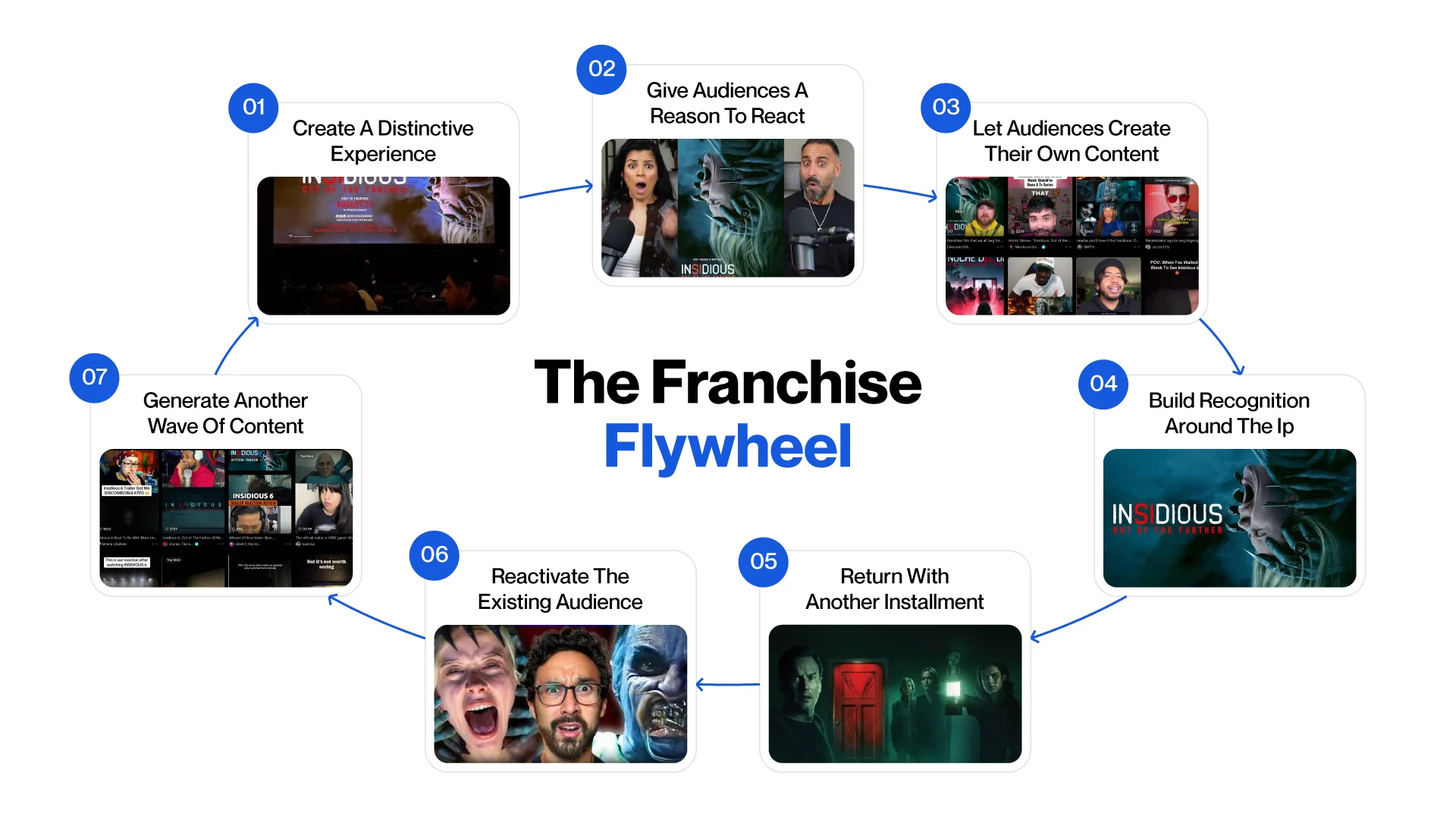
The important part is the final step so the next campaign does not begin from zero.
What Brands Should Measure
If brands apply this framework outside entertainment, they need to look beyond immediate campaign results. Useful measurements include:
Audience growth | Did the campaign increase the brand's addressable audience? |
|---|---|
UGC volume | How much content did people create without being directly paid to produce it? |
Search growth | Did people start looking for the brand, product, or campaign? |
Content reuse | Can creator and audience content become paid media or owned content? |
Repeat participation | Do people come back for the next activation? |
Franchise recognition | Are people beginning to recognize recurring characters, formats, or campaign concepts? |
These metrics show whether a campaign created value beyond its initial reach, so you can measure what the campaign leaves behind. Instead of asking only how much attention one campaign generated, brands should ask how much useful audience and content infrastructure it built for the future.
Three Lessons Brands Can Take From Blumhouse
Blumhouse's model offers three useful lessons for marketers:
Put The Budget Where It Can Create More Value.
A bigger production budget can improve quality, but it does not guarantee better distribution. Brands can instead invest in stronger ideas, creators, distribution, and amplification that help content travel beyond the initial media budget.
Design For Reactions.
Don't wait for UGC to appear after launch. Ask during the creative process: What would make someone want to record themselves experiencing this? Horror naturally creates reactions, but every category has its own version, from product transformations to taste tests, demonstrations, predictions, and debates.
Build An Ecosystem Instead Of Chasing One Viral Hit.
A single post may disappear, while recurring launches, formats, creators, characters, or community rituals can keep bringing audiences back. Blumhouse combines controlled production costs, an established franchise, and a genre that naturally creates reactions. For brands, the goal is similar: spend carefully on production, invest in attention, and build assets that become more valuable each time the audience comes back.
But what happens after someone experiences your product, and what would make them want to share it?
Build the Next Layer
Masterhooks' broader work on creator content and UGC follows the same strategic question from a marketing perspective: what makes an idea easy for audiences and creators to pick up, reinterpret, and distribute?
Its analysis of horror marketing, creator formats, and audience-driven content gives brands a useful framework for moving from one-off campaigns toward content systems that can keep generating attention after the original media spend is gone.
Want to find a marketing model that gets more from every dollar you spend on content?

Want to find a marketing model that gets more from every dollar you spend on content?
The film made $25.3 million in its opening weekend on an estimated $18 million budget, while reaching 282.2 million people on social media before release. The Insidious franchise had already earned over $740 million worldwide, giving each new film an existing audience, recognizable brand, and years of fan conversations to build on. This allows new releases to generate fresh buzz without starting their marketing from scratch.
The Blumhouse Model Starts With the Budget
Blumhouse's low-budget strategy gives filmmakers more freedom to experiment.
Jason Blum has explained that smaller budgets help the studio keep creative control and try unusual ideas without putting too much money at risk. After Paranormal Activity, Blumhouse made Insidious for less than $1 million instead of immediately increasing its budget.
This is the core of the Blumhouse business model: an approach that runs opposite to big-budget Hollywood films. A $100 million movie needs massive returns to justify its cost, while a smaller horror film can take more creative risks, reach a niche audience, and still generate strong returns.
Constraint Becomes A Creative AdvantageLow production costs force filmmakers to focus on what matters most: creating a reaction. Without expensive sets, locations, or visual effects, the value of a strong sound, reveal, character, or memorable moment becomes even greater. This is the foundation of low-budget, high-return film marketing: making a film where the production costs match its ability to capture and spread audience attention. |
Why Horror Is Especially Compatible With This Model
Horror has a natural advantage on social media because people don't just watch scary movies, they also record and share their reactions. A scary scene can lead to reaction videos, memes, theories, challenges, and scene recreations, giving audiences many ways to participate.
Tap to play
Tap to play
Tap to play
This creates a strong connection between horror and user-generated content. Instead of creating every piece of promotional content themselves, studios can give audiences something worth reacting to and let them spread it through their own content. This makes Blumhouse horror UGC especially interesting as a marketing strategy.
Insidious Has Something Most New Films Do Not
Unlike a new horror film that has to build awareness from scratch, Insidious: Out of the Further entered the market with years of built-in attention.
As the sixth theatrical film in the franchise, it benefited from a series that had already earned more than $740 million worldwide, giving the latest release an established audience and years of accumulated awareness. That includes:
Existing fans | Search demand | Recognizable characters | Previous trailers and clips |
Fan theories | Reaction videos | Previous installments | Familiar franchise imagery |
Reviews | Memes | Social accounts available to revisit | |
Every new film has another opportunity to reactivate that ecosystem, and this is the real franchise advantage.
The Social Universe Is Getting Bigger
Insidious: Out of the Further had a 282.2 million social-media universe across TikTok, Facebook, Instagram, X, and YouTube before its North American opening, compared with more than 182 million for Insidious: The Red Door in 2023.
That is an increase of roughly 100 million in the measured social universe, which does not actually represent 100 million individual fans or prove that UGC alone caused the growth. Still, the growth shows what a working horror franchise social media strategy looks like: each film compounds attention instead of starting over. They show that the franchise entered its sixth film with a much larger social footprint, giving the new release a stronger base of existing attention.
The economics make that footprint even more valuable where Out of the Further reportedly cost $18 million to produce and opened to approximately $25.3 million domestically and $60.3 million worldwide in its opening frame. The opening weekend alone exceeded the reported production budget, although profitability also depends on marketing, distribution, theater splits, financing, and other costs.
The Franchise Is the Asset
This is where the Insidious franchise marketing strategy becomes more interesting than the economics of one movie. Each film adds to a growing library of audience attention. The first builds awareness, the next gives people a reason to return, and each new installment brings in more viewers.
By the sixth film, the franchise has years of content to reactivate. A new trailer can bring attention back to older films, a new character can revive interest in the franchise, and a new scare can inspire reaction content. Each release adds more stories, characters, and moments that the marketing team can use again, making the content ecosystem stronger with every cycle. The model can be reduced to a simple marketing flywheel:
The important part is the final step so the next campaign does not begin from zero.
What Brands Should Measure
If brands apply this framework outside entertainment, they need to look beyond immediate campaign results. Useful measurements include:
Audience growth | Did the campaign increase the brand's addressable audience? |
|---|---|
UGC volume | How much content did people create without being directly paid to produce it? |
Search growth | Did people start looking for the brand, product, or campaign? |
Content reuse | Can creator and audience content become paid media or owned content? |
Repeat participation | Do people come back for the next activation? |
Franchise recognition | Are people beginning to recognize recurring characters, formats, or campaign concepts? |
These metrics show whether a campaign created value beyond its initial reach, so you can measure what the campaign leaves behind. Instead of asking only how much attention one campaign generated, brands should ask how much useful audience and content infrastructure it built for the future.
Three Lessons Brands Can Take From Blumhouse
Blumhouse's model offers three useful lessons for marketers:
Put The Budget Where It Can Create More Value.
A bigger production budget can improve quality, but it does not guarantee better distribution. Brands can instead invest in stronger ideas, creators, distribution, and amplification that help content travel beyond the initial media budget.
Design For Reactions.
Don't wait for UGC to appear after launch. Ask during the creative process: What would make someone want to record themselves experiencing this? Horror naturally creates reactions, but every category has its own version, from product transformations to taste tests, demonstrations, predictions, and debates.
Build An Ecosystem Instead Of Chasing One Viral Hit.
A single post may disappear, while recurring launches, formats, creators, characters, or community rituals can keep bringing audiences back. Blumhouse combines controlled production costs, an established franchise, and a genre that naturally creates reactions. For brands, the goal is similar: spend carefully on production, invest in attention, and build assets that become more valuable each time the audience comes back.
But what happens after someone experiences your product, and what would make them want to share it?
Build the Next Layer
Masterhooks' broader work on creator content and UGC follows the same strategic question from a marketing perspective: what makes an idea easy for audiences and creators to pick up, reinterpret, and distribute?
Its analysis of horror marketing, creator formats, and audience-driven content gives brands a useful framework for moving from one-off campaigns toward content systems that can keep generating attention after the original media spend is gone.
Want to find a marketing model that gets more from every dollar you spend on content?
Related Reading

How to Find & Choose the Right Influencer for Your Brand (Without Getting Burned)
5 min
|
Creator Economy

What Is Influencer Marketing? A No-Fluff Guide for Brands Ready to Actually Use It
5 min
|
Creator Economy

How “End of August” Became TikTok’s Song of the Summer, and What It Teaches Us About Viral Audio
3 min
|
Creator Economy


Need help scaling?
Book a strategy call with our expert team to audit your current UGC setup.
Related Reading
How to Find & Choose the Right Influencer for Your Brand (Without Getting Burned)
Learn how to find influencers for your brand using audience fit, engagement quality, growth patterns, content quality, and campaign history.
5 min
|
Creator Economy
How to Find & Choose the Right Influencer for Your Brand (Without Getting Burned)
Learn how to find influencers for your brand using audience fit, engagement quality, growth patterns, content quality, and campaign history.
5 min
|
Creator Economy
What Is Influencer Marketing? A No-Fluff Guide for Brands Ready to Actually Use It
Ready to use influencer marketing for your brands? Learn influencer types, campaign models, costs, ROI, measurement, and how to choose the right creators.
5 min
|
Creator Economy
What Is Influencer Marketing? A No-Fluff Guide for Brands Ready to Actually Use It
Ready to use influencer marketing for your brands? Learn influencer types, campaign models, costs, ROI, measurement, and how to choose the right creators.
5 min
|
Creator Economy
How “End of August” Became TikTok’s Song of the Summer, and What It Teaches Us About Viral Audio
Learn why Noah Kahan’s End of August became a TikTok hit and what its timing, emotion, and cultural identity teach brands about viral audio.
3 min
|
Creator Economy
How “End of August” Became TikTok’s Song of the Summer, and What It Teaches Us About Viral Audio
Learn why Noah Kahan’s End of August became a TikTok hit and what its timing, emotion, and cultural identity teach brands about viral audio.
3 min
|
Creator Economy