


The Authenticity Gap is Widening: Why the Value of Human Content is Skyrocketing
The Authenticity Gap is Widening: Why the Value of Human Content is Skyrocketing
AI content is flooding every feed — and audiences can tell. Here's why human-made UGC is now a premium differentiator and how smart brands are using both.
Published:

Read Time:

5 min

Written by:
Fawwaz
Trend Research and Copywriter
MORE CONTENT ISN'T THE ANSWER
Production has become easier than ever, but creating content that genuinely resonates has become increasingly difficult.
MORE CONTENT ISN'T THE ANSWER
Production has become easier than ever, but creating content that genuinely resonates has become increasingly difficult.
MORE CONTENT ISN'T THE ANSWER
Production has become easier than ever, but creating content that genuinely resonates has become increasingly difficult.
The reason is straightforward: when everyone uses the same generative tools, the output converges. And audiences have developed a fast, reliable sense for content that was assembled rather than experienced.
What the "Sea of Sameness" Actually Looks Like
AI content tools are trained on historical data. They identify patterns, replicate structures, and produce output that is statistically likely to resemble what has performed well before. That's useful for speed and volume. It's a problem for differentiation.
When a sector's brands all use the same tools with similar inputs, the result is content that occupies the same aesthetic and structural territory. The copy sounds the same. The visual grammar repeats. The emotional beats arrive in predictable order.
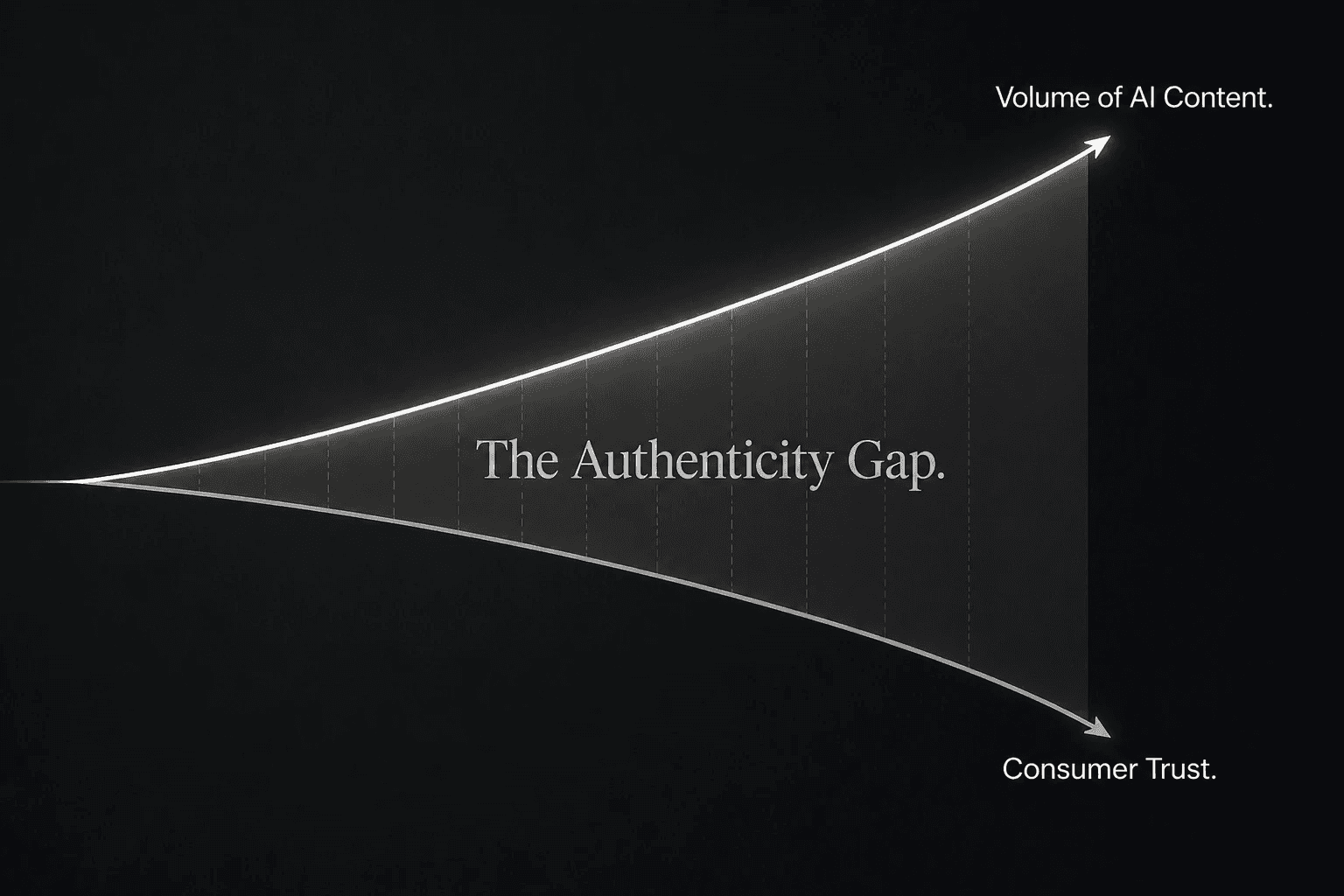
Audiences experience this as noise. Not because any individual piece is bad, but because the aggregate feels undifferentiated. Research into what observers have called the "Authenticity Paradox" in modern advertising consistently finds that consumers can distinguish AI-generated content from human-created content, even when they can't articulate exactly how, and that this recognition correlates with lower trust and lower engagement.
The phenomenon has a parallel in UX design: the uncanny valley. Content that looks almost human but isn't quite triggers a subtle unease rather than connection. The closer AI content gets to human output without fully arriving there, the more conspicuous the gap becomes.
Why Human-Created Content Is Now a Differentiator
The economic logic here follows the same pattern as any market where mass production has commoditized the standard option.
When manufactured goods became cheap and abundant during the industrial era, handcrafted goods didn't become irrelevant. They became premium. The scarcity shifted. What was once ordinary became distinctive, and distinctive commanded a price.
The same shift is happening in digital content. When AI-generated output is the default, human-created content carries a signal that automated content can't replicate: evidence of lived experience.
A human creator adjusting their tone in real time based on something they genuinely care about, showing frustration with a problem they've actually encountered, or expressing relief when a solution works, produces micro-expressions, vocal inflections, and behavioral cues that AI cannot yet synthesize convincingly. Audiences register these cues at a level that doesn't require conscious analysis.
This matters most in the context of UGC, because the foundational mechanism of UGC is peer validation. The viewer's internal logic is: this person is like me, and this worked for them. That logic only functions when the viewer actually believes the person is real and the experience is genuine. Replace the real person with an avatar and the mechanism breaks, regardless of how convincing the avatar appears on a technical level.
Industry data consistently supports this: consumer trust in human-created product reviews sits measurably higher than trust in AI-generated equivalents. The gap may narrow as the technology improves, but the underlying preference for human judgment in purchasing decisions is structural, not incidental.
How the Best Brands Are Using AI Without Losing the Human Signal
The winning approach is not AI versus humans, but using each where they add the most value.
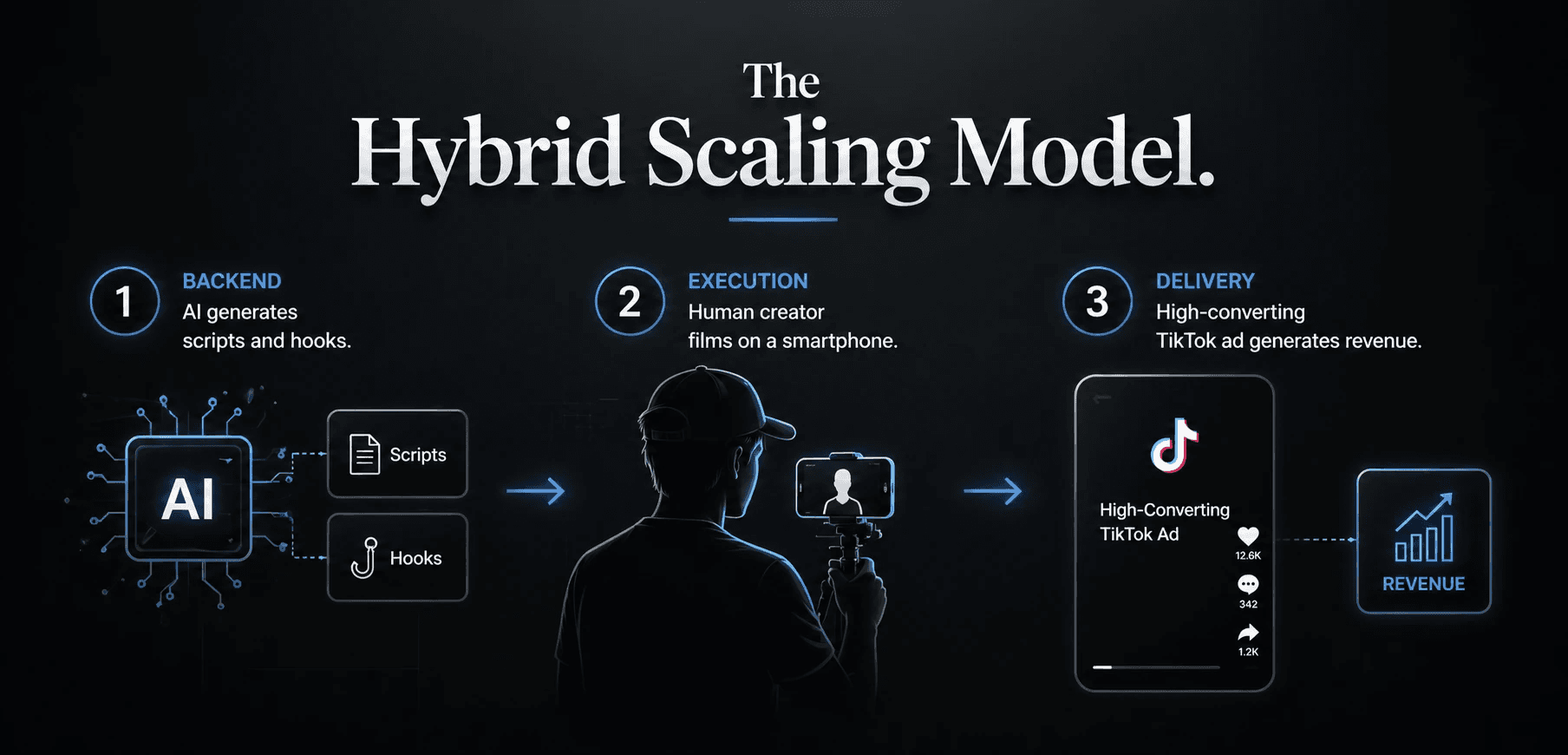
AI is genuinely useful for the analytical and structural work that happens before a camera is ever pointed at a creator: processing performance data across large volumes of content to identify which hook categories are converting, generating script variations for human review, researching competitor creative, and handling post-production tasks like captioning and audio syncing.
What AI doesn't replace is the customer-facing moment: the creator on camera, speaking from something that resembles real experience, in an environment that reads as organic to the platform. That's the piece that carries the trust signal, and it's the piece that audiences are most sensitive to detecting when it's absent.
The practical implication is a division of labor. AI handles backend research and efficiency. Human creators handle the front-facing delivery. Neither is optional if the goal is content that performs at scale without sacrificing the authenticity that makes UGC work in the first place.
What This Means for Brand Content Strategy in 2026
Brands that replace human creators with AI across the board may save money in the short term, but risk losing audience trust over time.

The more durable position is treating human creator output as the asset it is — something worth investing in, briefing well, and deploying strategically — while using AI to make the surrounding process faster and more informed.
For the UGC channel specifically, where the authenticity of the recommendation is what drives conversion, this isn't a philosophical position. It's a performance consideration.
Want to know if your creative is building trust?

Want to know if your creative is building trust?
The reason is straightforward: when everyone uses the same generative tools, the output converges. And audiences have developed a fast, reliable sense for content that was assembled rather than experienced.
What the "Sea of Sameness" Actually Looks Like
AI content tools are trained on historical data. They identify patterns, replicate structures, and produce output that is statistically likely to resemble what has performed well before. That's useful for speed and volume. It's a problem for differentiation.
When a sector's brands all use the same tools with similar inputs, the result is content that occupies the same aesthetic and structural territory. The copy sounds the same. The visual grammar repeats. The emotional beats arrive in predictable order.
Audiences experience this as noise. Not because any individual piece is bad, but because the aggregate feels undifferentiated. Research into what observers have called the "Authenticity Paradox" in modern advertising consistently finds that consumers can distinguish AI-generated content from human-created content, even when they can't articulate exactly how, and that this recognition correlates with lower trust and lower engagement.
The phenomenon has a parallel in UX design: the uncanny valley. Content that looks almost human but isn't quite triggers a subtle unease rather than connection. The closer AI content gets to human output without fully arriving there, the more conspicuous the gap becomes.
Why Human-Created Content Is Now a Differentiator
The economic logic here follows the same pattern as any market where mass production has commoditized the standard option.
When manufactured goods became cheap and abundant during the industrial era, handcrafted goods didn't become irrelevant. They became premium. The scarcity shifted. What was once ordinary became distinctive, and distinctive commanded a price.
The same shift is happening in digital content. When AI-generated output is the default, human-created content carries a signal that automated content can't replicate: evidence of lived experience.
A human creator adjusting their tone in real time based on something they genuinely care about, showing frustration with a problem they've actually encountered, or expressing relief when a solution works, produces micro-expressions, vocal inflections, and behavioral cues that AI cannot yet synthesize convincingly. Audiences register these cues at a level that doesn't require conscious analysis.
This matters most in the context of UGC, because the foundational mechanism of UGC is peer validation. The viewer's internal logic is: this person is like me, and this worked for them. That logic only functions when the viewer actually believes the person is real and the experience is genuine. Replace the real person with an avatar and the mechanism breaks, regardless of how convincing the avatar appears on a technical level.
Industry data consistently supports this: consumer trust in human-created product reviews sits measurably higher than trust in AI-generated equivalents. The gap may narrow as the technology improves, but the underlying preference for human judgment in purchasing decisions is structural, not incidental.
How the Best Brands Are Using AI Without Losing the Human Signal
The winning approach is not AI versus humans, but using each where they add the most value.
AI is genuinely useful for the analytical and structural work that happens before a camera is ever pointed at a creator: processing performance data across large volumes of content to identify which hook categories are converting, generating script variations for human review, researching competitor creative, and handling post-production tasks like captioning and audio syncing.
What AI doesn't replace is the customer-facing moment: the creator on camera, speaking from something that resembles real experience, in an environment that reads as organic to the platform. That's the piece that carries the trust signal, and it's the piece that audiences are most sensitive to detecting when it's absent.
The practical implication is a division of labor. AI handles backend research and efficiency. Human creators handle the front-facing delivery. Neither is optional if the goal is content that performs at scale without sacrificing the authenticity that makes UGC work in the first place.
What This Means for Brand Content Strategy in 2026
Brands that replace human creators with AI across the board may save money in the short term, but risk losing audience trust over time.
The more durable position is treating human creator output as the asset it is — something worth investing in, briefing well, and deploying strategically — while using AI to make the surrounding process faster and more informed.
For the UGC channel specifically, where the authenticity of the recommendation is what drives conversion, this isn't a philosophical position. It's a performance consideration.
Want to know if your creative is building trust?
Related Reading



Need help scaling?
Book a strategy call with our expert team to audit your current UGC setup.
Related Reading

How Apple Turns a Product Launch Into a Yearly UGC Event That Runs Itself
How Apple's September launch cycle turns anticipation, information scarcity, creators, and product novelty into a recurring UGC engine.
4 min
|
How Apple Turns a Product Launch Into a Yearly UGC Event That Runs Itself
How Apple's September launch cycle turns anticipation, information scarcity, creators, and product novelty into a recurring UGC engine.
4 min
|

The Sydney Sweeney Novig Playbook: Why the Most Talked-About Ad of NFL Week 1 Was Also the Smartest
How Sydney Sweeney and Novig built a smarter celebrity partnership through equity, creative control, brand fit, and strategic timing.
4 min
|
The Sydney Sweeney Novig Playbook: Why the Most Talked-About Ad of NFL Week 1 Was Also the Smartest
How Sydney Sweeney and Novig built a smarter celebrity partnership through equity, creative control, brand fit, and strategic timing.
4 min
|
Why “September” by Earth, Wind & Fire Is the Most Viral Song on TikTok Every Year
Discover why Earth, Wind & Fire’s September goes viral on TikTok each year, and how brands can plan for predictable seasonal virality.
4 min
|
Why “September” by Earth, Wind & Fire Is the Most Viral Song on TikTok Every Year
Discover why Earth, Wind & Fire’s September goes viral on TikTok each year, and how brands can plan for predictable seasonal virality.
4 min
|