The True Cost of Video Ads in 2026: UGC vs. In-House Production
5 min
read

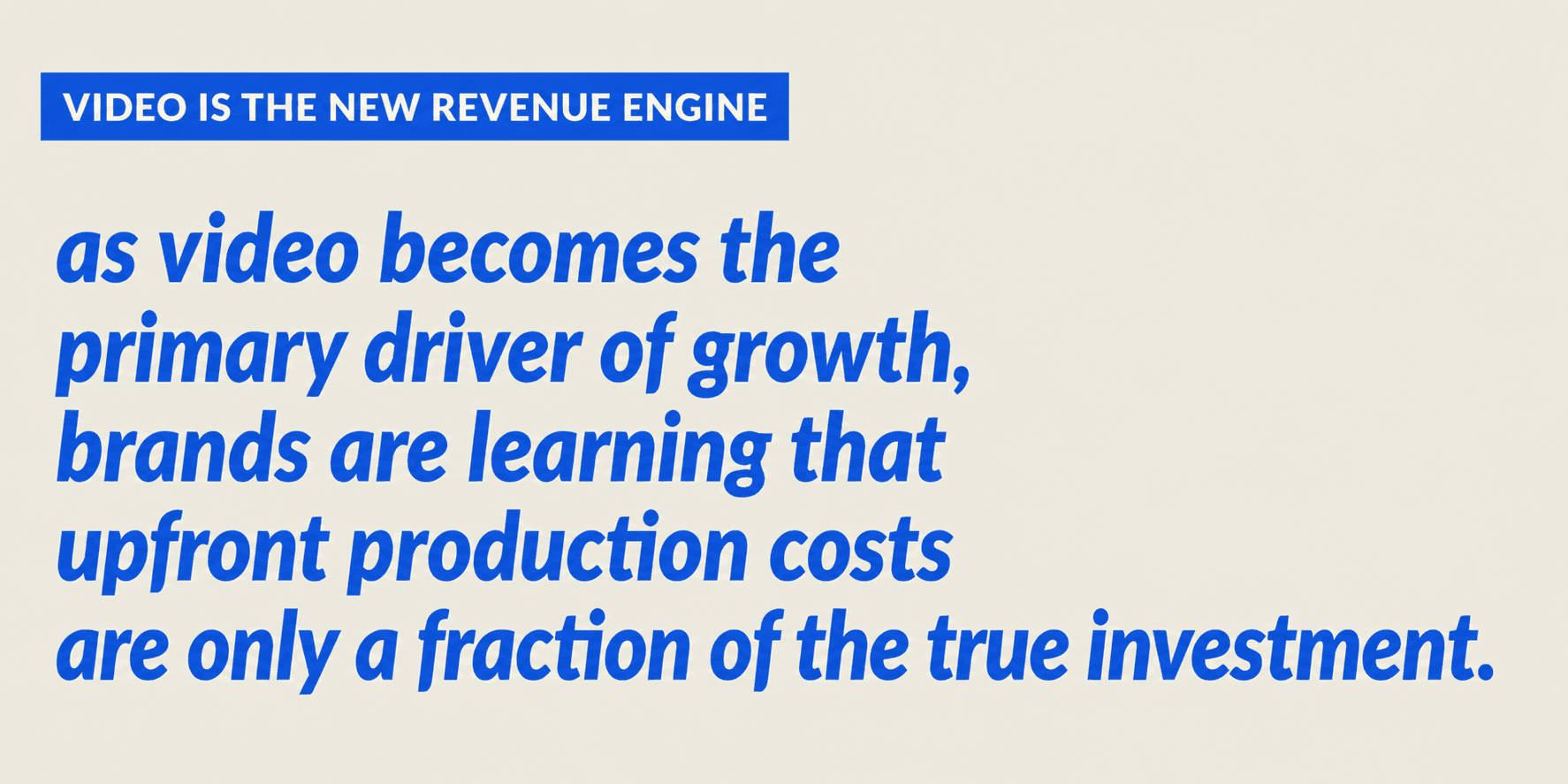
As the demand for video content skyrockets, growth teams are constantly faced with a massive financial dilemma: Should you invest in high-end, in-house video production, or should you scale using User-Generated Content (UGC)?
Here is a deep dive into the economics of UGC versus in-house production, and which model actually delivers a lower Customer Acquisition Cost (CAC) at scale.
The True Cost of In-House Production
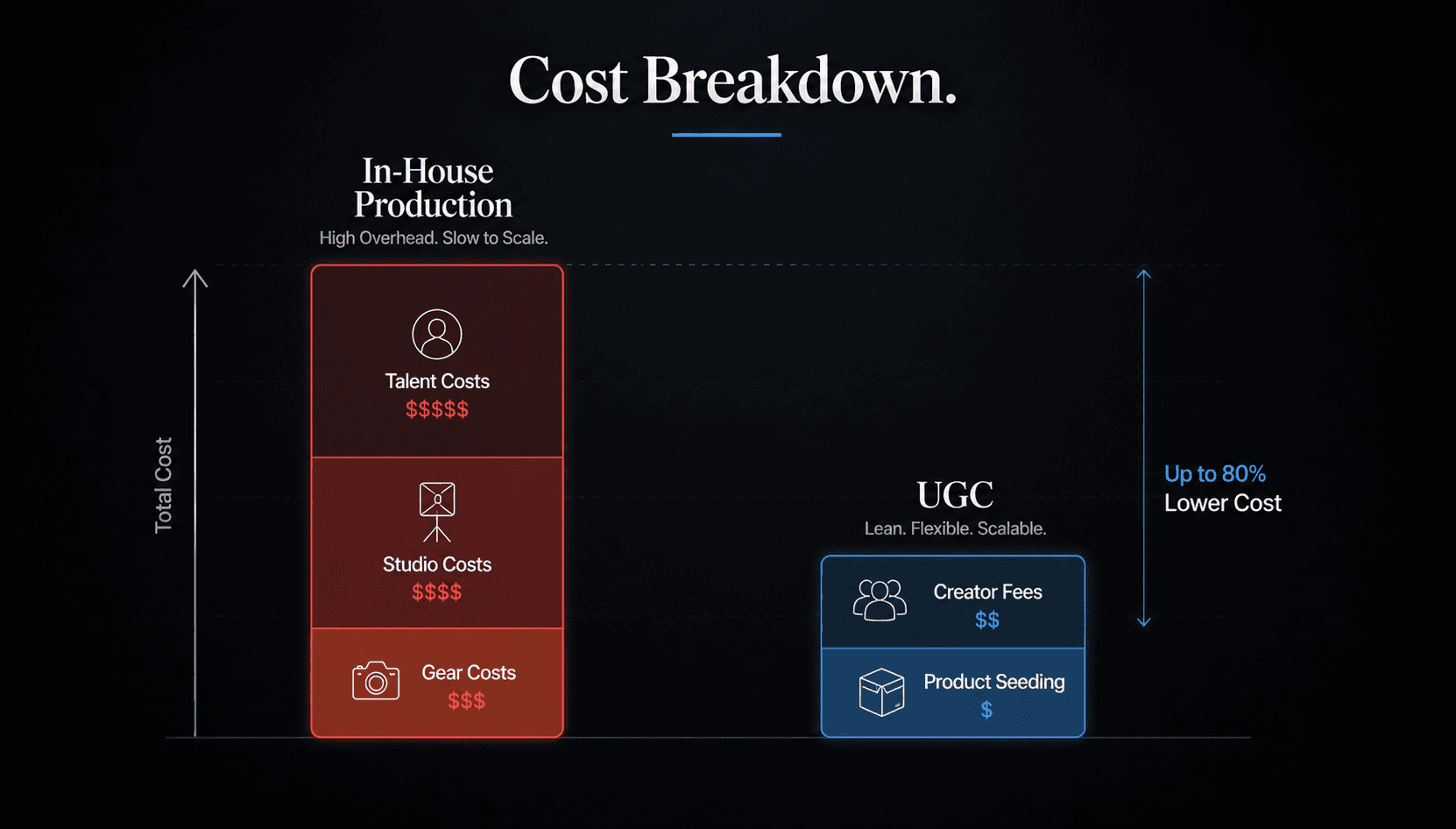
Building an internal production studio or hiring a traditional creative agency to shoot high-end commercials is a model built on quality control and brand safety. You get cinema-grade lighting, professional actors, and pixel-perfect color grading.
However, the fixed and variable costs are staggering.
Equipment and Overhead
Professional cameras, lighting grids, audio equipment, and studio space easily run into the tens of thousands of dollars. Even if you rent, studio day rates average $1,000 to $3,000.
Talent and Crew
Hiring professional actors, a director of photography, and a dedicated video editor significantly inflates the budget.
The Production Timeline
Planning a shoot, executing it, and going through multiple rounds of post-production revisions typically takes 3 to 6 weeks.
Equipment and Overhead
Professional cameras, lighting grids, audio equipment, and studio space easily run into the tens of thousands of dollars. Even if you rent, studio day rates average $1,000 to $3,000.
Talent and Crew
Hiring professional actors, a director of photography, and a dedicated video editor significantly inflates the budget.
The Production Timeline
Planning a shoot, executing it, and going through multiple rounds of post-production revisions typically takes 3 to 6 weeks.
The Bottom Line: A single, polished, 30-second in-house commercial can cost anywhere from $2,000 to $10,000+.
The Economics of User-Generated Content (UGC)
UGC flips the traditional production model upside down. Instead of paying for a studio and a crew, brands pay individual creators to script, shoot, and edit videos natively on their smartphones.
Zero Equipment Overhead The creator provides the camera (their phone), the location (their home), and the talent (themselves). |
Agile Production Because the content is meant to look raw and native to social media, turnaround times are radically compressed. A batch of UGC videos can be delivered in 5 to 7 days. |
Flat-Rate Pricing Most UGC creators charge a flat fee per video, generally ranging from $150 to $500, depending on their experience and the complexity of the hook. |
The Hidden Variable: Ad Fatigue and ROI
If you only need one video to live on your website's homepage for the next three years, an in-house studio production is a worthy investment. But if your goal is to run paid ads on Meta or TikTok, the math changes entirely due to ad fatigue.
On modern social platforms, even the greatest video ad in the world will burn out as the audience gets tired of seeing it.
Studio Ad - Low ROAS
UGC Ad - Massive ROAS
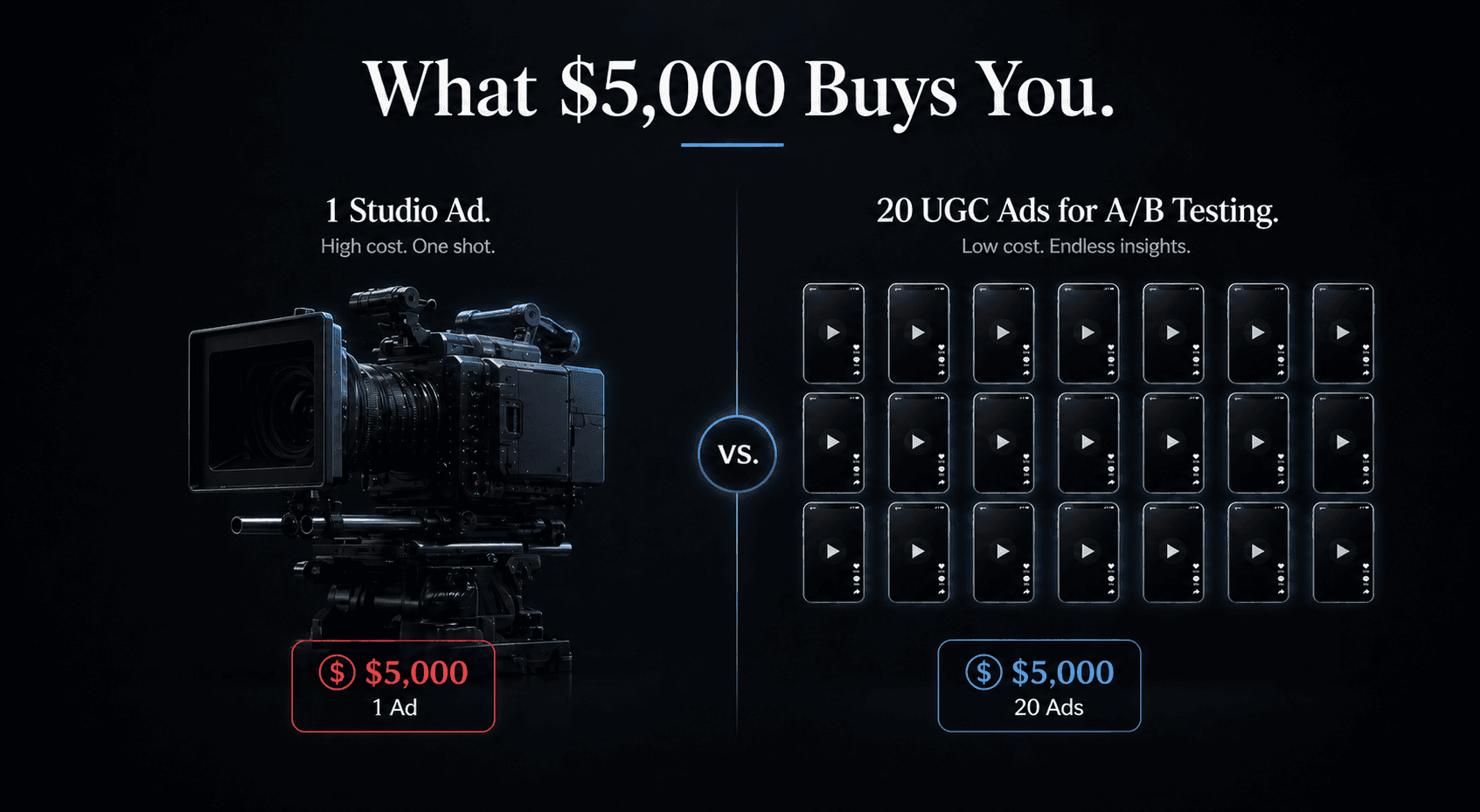
If a brand spends $5,000 on a studio commercial and it burns out in two weeks, they have to spend another $5,000 to replace it. Conversely, for that same $5,000, a brand could source 15 to 20 unique UGC videos.
This allows the media buying team to constantly test new psychological hooks, iterate on winning angles, and refresh the ad account endlessly without blowing the budget.
As digital marketing experts frequently note, production value no longer correlates with conversion rates.
According to internal platform insights from TikTok, ads that feature native creators and raw, lo-fi aesthetics consistently achieve higher watch times and lower Cost Per Click (CPC) than polished brand videos.
Consumers swipe past commercials; they stop for authentic stories.
Which is Cheaper?
When factoring in the sheer volume of content required to sustain a modern paid social strategy, UGC is exponentially cheaper and significantly more profitable.
It mitigates the risk of a "flop" by allowing brands to test dozens of cheap variations rather than betting their entire quarterly budget on a single, expensive studio shoot.
Scaling Efficiently with Masterhooks
Transitioning from in-house production to a high-volume UGC strategy saves money, but managing dozens of individual creators can quickly become a logistical nightmare for internal marketing teams.
This is exactly where Masterhooks steps in as a growth partner.

Rather than forcing brands to waste hours sourcing talent and negotiating rates, Masterhooks operates as a turnkey, high-performance creative engine. They provide direct access to a vetted network of premium creators and handle the entire process.
For brands looking to lower their production costs while simultaneously increasing their ad conversions, Masterhooks delivers the strategic volume necessary to scale profitably.
Ready to improve your marketing efficiency?

Ready to improve your marketing efficiency?
As the demand for video content skyrockets, growth teams are constantly faced with a massive financial dilemma: Should you invest in high-end, in-house video production, or should you scale using User-Generated Content (UGC)?
Here is a deep dive into the economics of UGC versus in-house production, and which model actually delivers a lower Customer Acquisition Cost (CAC) at scale.
The True Cost of In-House Production
Building an internal production studio or hiring a traditional creative agency to shoot high-end commercials is a model built on quality control and brand safety. You get cinema-grade lighting, professional actors, and pixel-perfect color grading.
However, the fixed and variable costs are staggering.
Equipment and Overhead
Professional cameras, lighting grids, audio equipment, and studio space easily run into the tens of thousands of dollars. Even if you rent, studio day rates average $1,000 to $3,000.
Talent and Crew
Hiring professional actors, a director of photography, and a dedicated video editor significantly inflates the budget.
The Production Timeline
Planning a shoot, executing it, and going through multiple rounds of post-production revisions typically takes 3 to 6 weeks.
The Bottom Line: A single, polished, 30-second in-house commercial can cost anywhere from $2,000 to $10,000+.
The Economics of User-Generated Content (UGC)
UGC flips the traditional production model upside down. Instead of paying for a studio and a crew, brands pay individual creators to script, shoot, and edit videos natively on their smartphones.
Zero Equipment Overhead The creator provides the camera (their phone), the location (their home), and the talent (themselves). |
Agile Production Because the content is meant to look raw and native to social media, turnaround times are radically compressed. A batch of UGC videos can be delivered in 5 to 7 days. |
Flat-Rate Pricing Most UGC creators charge a flat fee per video, generally ranging from $150 to $500, depending on their experience and the complexity of the hook. |
The Hidden Variable: Ad Fatigue and ROI
If you only need one video to live on your website's homepage for the next three years, an in-house studio production is a worthy investment. But if your goal is to run paid ads on Meta or TikTok, the math changes entirely due to ad fatigue.
On modern social platforms, even the greatest video ad in the world will burn out as the audience gets tired of seeing it.
Studio Ad - Low ROAS
UGC Ad - Massive ROAS
If a brand spends $5,000 on a studio commercial and it burns out in two weeks, they have to spend another $5,000 to replace it. Conversely, for that same $5,000, a brand could source 15 to 20 unique UGC videos.
This allows the media buying team to constantly test new psychological hooks, iterate on winning angles, and refresh the ad account endlessly without blowing the budget.
As digital marketing experts frequently note, production value no longer correlates with conversion rates.
According to internal platform insights from TikTok, ads that feature native creators and raw, lo-fi aesthetics consistently achieve higher watch times and lower Cost Per Click (CPC) than polished brand videos.
Consumers swipe past commercials; they stop for authentic stories.
Which is Cheaper?
When factoring in the sheer volume of content required to sustain a modern paid social strategy, UGC is exponentially cheaper and significantly more profitable.
It mitigates the risk of a "flop" by allowing brands to test dozens of cheap variations rather than betting their entire quarterly budget on a single, expensive studio shoot.
Scaling Efficiently with Masterhooks
Transitioning from in-house production to a high-volume UGC strategy saves money, but managing dozens of individual creators can quickly become a logistical nightmare for internal marketing teams.
This is exactly where Masterhooks steps in as a growth partner.
Rather than forcing brands to waste hours sourcing talent and negotiating rates, Masterhooks operates as a turnkey, high-performance creative engine. They provide direct access to a vetted network of premium creators and handle the entire process.
For brands looking to lower their production costs while simultaneously increasing their ad conversions, Masterhooks delivers the strategic volume necessary to scale profitably.
Ready to improve your marketing efficiency?
Need help scaling?
Book a strategy call with our expert team to audit your current UGC setup.