


UGC vs Influencer Marketing: What is the actual difference?
UGC vs Influencer Marketing: What is the actual difference?
UGC buys a creative asset. Influencer marketing rents an audience. Here's the honest breakdown of cost, funnel stage, and when to use each one.
Published:

Read Time:

5 min

Written by:
Fawwaz
Trend Research and Copywriter
THE WRONG TOOL CREATES THE WRONG OUTCOME
Marketing performance suffers when brands confuse audience building with conversion generation.
THE WRONG TOOL CREATES THE WRONG OUTCOME
Marketing performance suffers when brands confuse audience building with conversion generation.
THE WRONG TOOL CREATES THE WRONG OUTCOME
Marketing performance suffers when brands confuse audience building with conversion generation.
They're related but distinct, and the distinction matters for how you allocate budget, what you measure, and which one you should be running right now.
The Core Difference: What You're Actually Buying
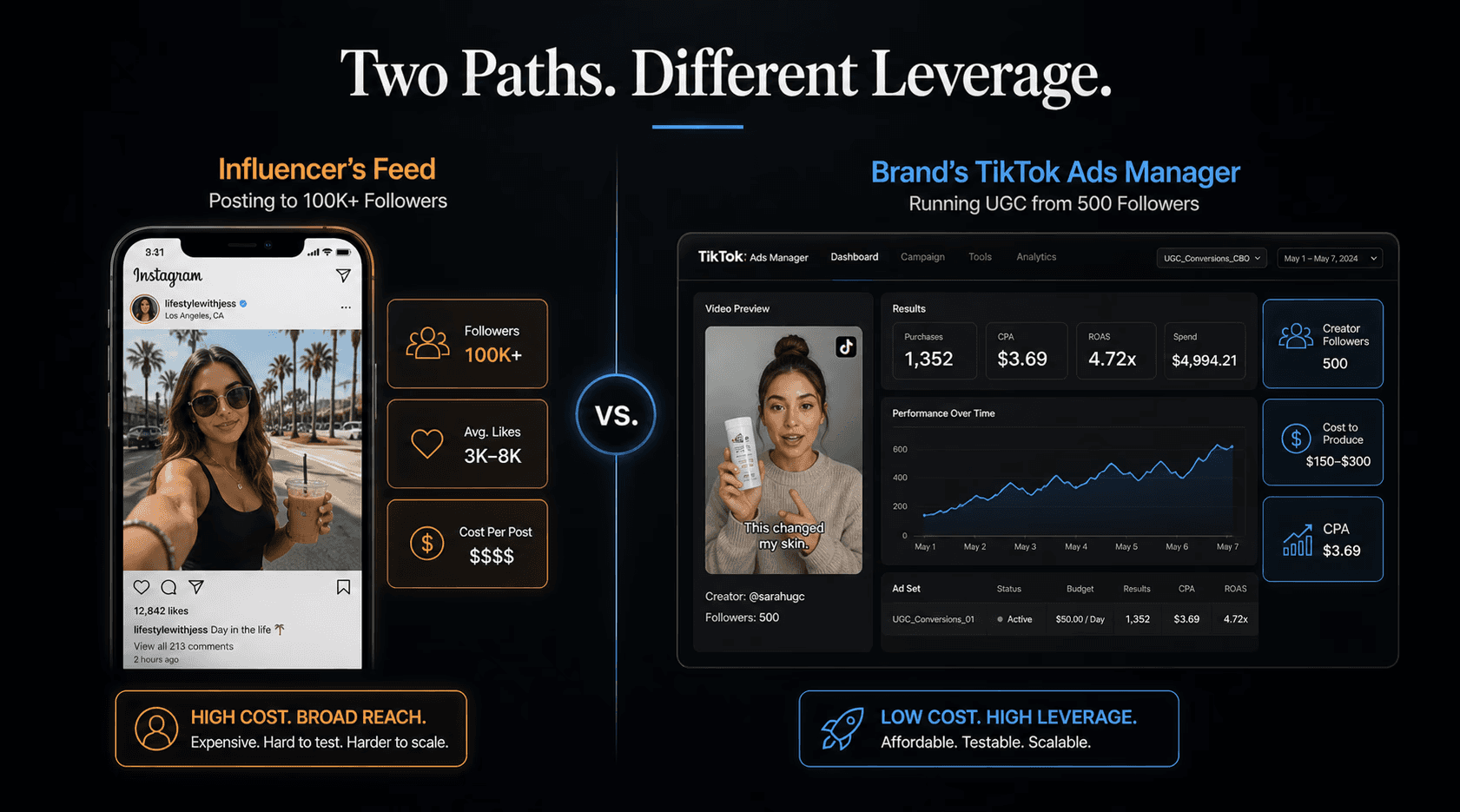
When a brand runs an influencer marketing campaign, it's paying to access someone else's audience. The influencer has built a relationship with their followers over time, and that relationship carries trust. The brand borrows that trust for a post or a series of posts. What the brand gets is reach and social proof, delivered through a channel the brand doesn't own or control.
When a brand commissions UGC, it's paying for a creative asset. The brand gets a video file, fully licensed, that it can run in its own ad account as many times as it wants, across as many channels as it chooses. The creator's audience is irrelevant. What matters is whether the video works as an ad.
This is the fundamental difference: influencer marketing rents an audience. UGC buys a production asset.
Where Each One Belongs in the Funnel
The confusion between the two is partly because they both involve creators and video content. But they serve different stages of the customer journey.
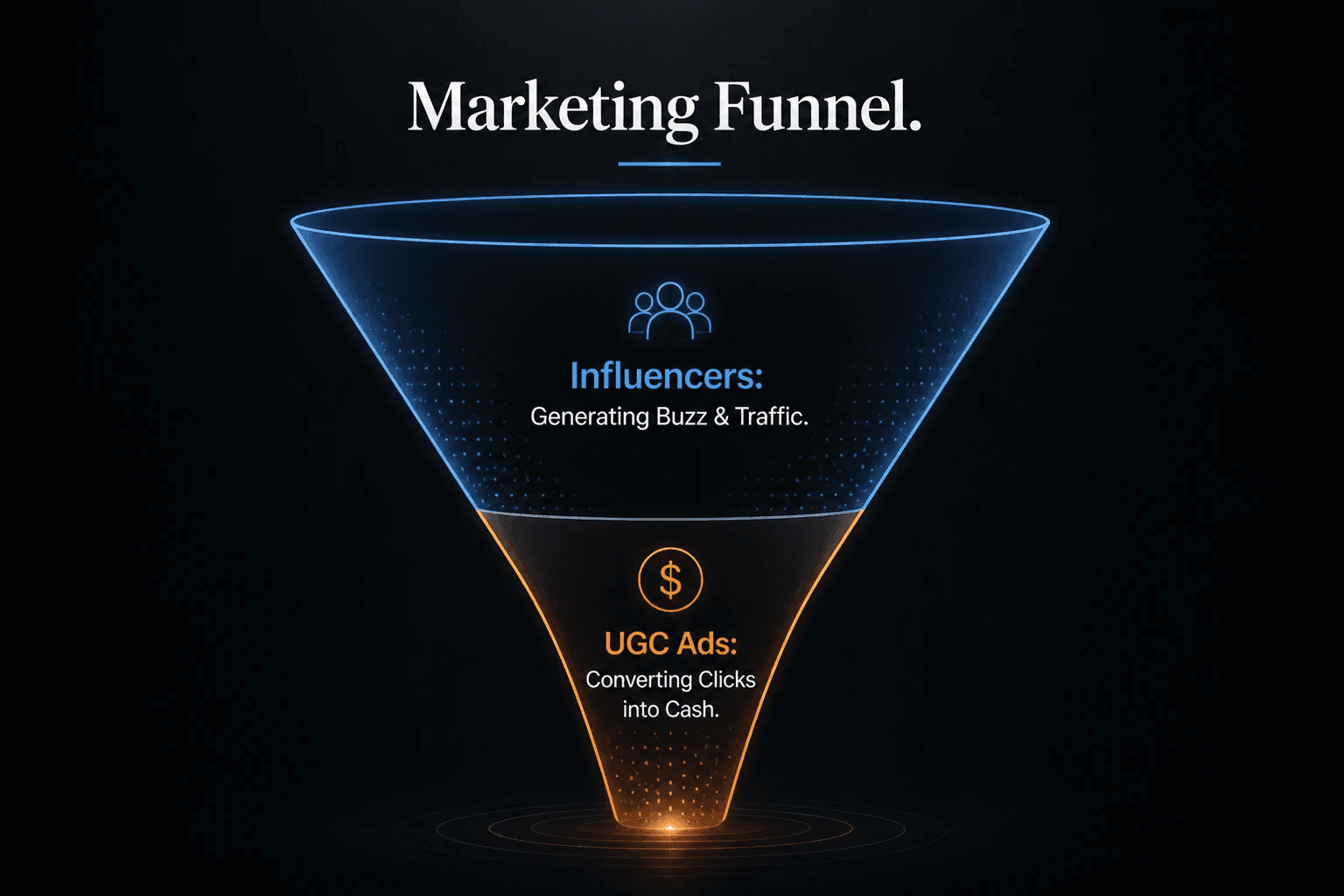
Influencer marketing operates at the top of the funnel. Its job is discovery — putting the brand in front of people who don't know it exists yet, through a voice they already trust. The metric that matters is reach, impression quality, and brand sentiment. Direct attribution to sales is difficult because the mechanism is awareness, not conversion.
UGC for paid social operates at the bottom of the funnel. Its job is conversion — taking someone who has a defined problem and moving them toward a specific action. The metric that matters is cost per acquisition (CPA), click-through rate, and return on ad spend (ROAS). Attribution is direct because the asset lives in an ad account with trackable performance.
Running UGC-style content at cold audiences before any awareness exists tends to underperform because there's no trust infrastructure. Running influencer campaigns at warm audiences who are ready to convert is an expensive way to drive action you could have driven more cheaply through paid UGC.
A Side-by-Side Comparison
Feature | Influencer Marketing | UGC for Paid Social |
|---|---|---|
Primary goal | Brand awareness, community discovery | Direct conversions, CPA reduction |
Where it lives | The creator's feed and audience | The brand's ad accounts |
Pricing model | Based on audience size | Flat rate per video deliverable |
Production speed | Slow — contracts and negotiations | Fast — 5 to 7 days per batch |
Funnel stage | Top of funnel (discovery) | Bottom of funnel (action) |
Ownership | Brand borrows the audience | Brand owns the asset |
When to Use Influencer Marketing
Influencer marketing makes sense when the primary objective is reaching an audience that doesn't know you exist yet, and when the product needs a trusted voice to establish initial credibility. It's also the right choice when trying to break into a very specific niche where a particular creator has built a highly engaged, relevant community.
The tradeoff is cost and attribution. A creator with 200,000 engaged followers in the right niche can charge $2,000 to $5,000 per post, and connecting that spend to downstream revenue requires modeling rather than direct measurement.
When to Commission UGC
UGC for paid social makes sense when the brand has an existing audience or is already running paid ads, and the bottleneck is creative quality or creative volume. If ads are burning out quickly, if CPC is higher than it should be, or if the internal team can't produce enough creative variation to test effectively, UGC solves those problems directly.
The cost structure is dramatically different. Most UGC creators charge $150 to $500 per video. For the cost of one mid-tier influencer post, a brand can have 10 to 20 tested ad variations running simultaneously.
The Model That Works Best at Scale
The brands generating the most efficient growth from content aren't choosing between influencer marketing and UGC. They're sequencing them.
The pattern that works: use influencer marketing to seed awareness and generate authentic organic content in a new market or audience segment. Use that organic momentum to identify which messages and formats resonate. Then commission UGC built around those proven angles and run it as paid media to convert the audience that influencer content has primed.
Each tool does what it's built for. Neither replaces the other.
Trying to figure out which approach fits where your brand is right now?

Trying to figure out which approach fits where your brand is right now?
They're related but distinct, and the distinction matters for how you allocate budget, what you measure, and which one you should be running right now.
The Core Difference: What You're Actually Buying
When a brand runs an influencer marketing campaign, it's paying to access someone else's audience. The influencer has built a relationship with their followers over time, and that relationship carries trust. The brand borrows that trust for a post or a series of posts. What the brand gets is reach and social proof, delivered through a channel the brand doesn't own or control.
When a brand commissions UGC, it's paying for a creative asset. The brand gets a video file, fully licensed, that it can run in its own ad account as many times as it wants, across as many channels as it chooses. The creator's audience is irrelevant. What matters is whether the video works as an ad.
This is the fundamental difference: influencer marketing rents an audience. UGC buys a production asset.
Where Each One Belongs in the Funnel
The confusion between the two is partly because they both involve creators and video content. But they serve different stages of the customer journey.
Influencer marketing operates at the top of the funnel. Its job is discovery — putting the brand in front of people who don't know it exists yet, through a voice they already trust. The metric that matters is reach, impression quality, and brand sentiment. Direct attribution to sales is difficult because the mechanism is awareness, not conversion.
UGC for paid social operates at the bottom of the funnel. Its job is conversion — taking someone who has a defined problem and moving them toward a specific action. The metric that matters is cost per acquisition (CPA), click-through rate, and return on ad spend (ROAS). Attribution is direct because the asset lives in an ad account with trackable performance.
Running UGC-style content at cold audiences before any awareness exists tends to underperform because there's no trust infrastructure. Running influencer campaigns at warm audiences who are ready to convert is an expensive way to drive action you could have driven more cheaply through paid UGC.
A Side-by-Side Comparison
Feature | Influencer Marketing | UGC for Paid Social |
|---|---|---|
Primary goal | Brand awareness, community discovery | Direct conversions, CPA reduction |
Where it lives | The creator's feed and audience | The brand's ad accounts |
Pricing model | Based on audience size | Flat rate per video deliverable |
Production speed | Slow — contracts and negotiations | Fast — 5 to 7 days per batch |
Funnel stage | Top of funnel (discovery) | Bottom of funnel (action) |
Ownership | Brand borrows the audience | Brand owns the asset |
When to Use Influencer Marketing
Influencer marketing makes sense when the primary objective is reaching an audience that doesn't know you exist yet, and when the product needs a trusted voice to establish initial credibility. It's also the right choice when trying to break into a very specific niche where a particular creator has built a highly engaged, relevant community.
The tradeoff is cost and attribution. A creator with 200,000 engaged followers in the right niche can charge $2,000 to $5,000 per post, and connecting that spend to downstream revenue requires modeling rather than direct measurement.
When to Commission UGC
UGC for paid social makes sense when the brand has an existing audience or is already running paid ads, and the bottleneck is creative quality or creative volume. If ads are burning out quickly, if CPC is higher than it should be, or if the internal team can't produce enough creative variation to test effectively, UGC solves those problems directly.
The cost structure is dramatically different. Most UGC creators charge $150 to $500 per video. For the cost of one mid-tier influencer post, a brand can have 10 to 20 tested ad variations running simultaneously.
The Model That Works Best at Scale
The brands generating the most efficient growth from content aren't choosing between influencer marketing and UGC. They're sequencing them.
The pattern that works: use influencer marketing to seed awareness and generate authentic organic content in a new market or audience segment. Use that organic momentum to identify which messages and formats resonate. Then commission UGC built around those proven angles and run it as paid media to convert the audience that influencer content has primed.
Each tool does what it's built for. Neither replaces the other.
Trying to figure out which approach fits where your brand is right now?
Related Reading


Need help scaling?
Book a strategy call with our expert team to audit your current UGC setup.
Related Reading
How Apple Turns a Product Launch Into a Yearly UGC Event That Runs Itself
How Apple's September launch cycle turns anticipation, information scarcity, creators, and product novelty into a recurring UGC engine.
4 min
|
How Apple Turns a Product Launch Into a Yearly UGC Event That Runs Itself
How Apple's September launch cycle turns anticipation, information scarcity, creators, and product novelty into a recurring UGC engine.
4 min
|

The Sydney Sweeney Novig Playbook: Why the Most Talked-About Ad of NFL Week 1 Was Also the Smartest
How Sydney Sweeney and Novig built a smarter celebrity partnership through equity, creative control, brand fit, and strategic timing.
4 min
|
The Sydney Sweeney Novig Playbook: Why the Most Talked-About Ad of NFL Week 1 Was Also the Smartest
How Sydney Sweeney and Novig built a smarter celebrity partnership through equity, creative control, brand fit, and strategic timing.
4 min
|
Why “September” by Earth, Wind & Fire Is the Most Viral Song on TikTok Every Year
Discover why Earth, Wind & Fire’s September goes viral on TikTok each year, and how brands can plan for predictable seasonal virality.
4 min
|
Why “September” by Earth, Wind & Fire Is the Most Viral Song on TikTok Every Year
Discover why Earth, Wind & Fire’s September goes viral on TikTok each year, and how brands can plan for predictable seasonal virality.
4 min
|