
The 3 Marketing Laws Behind Every Viral UGC Post
The 3 Marketing Laws Behind Every Viral UGC Post
The Purple Cow, Social Currency, Dunbar's Number: 3 psychology-backed laws that explain why some UGC spreads and most doesn't. Here's how to engineer all three.
Published:

Read Time:

5 min

Written by:
Fawwaz
Trend Research and Copywriter
VIRALITY LOOKS RANDOM UNTIL YOU STUDY IT CLOSELY.
The posts that consistently break through are the ones that, knowingly or not, align with how human psychology actually processes social content.
VIRALITY LOOKS RANDOM UNTIL YOU STUDY IT CLOSELY.
The posts that consistently break through are the ones that, knowingly or not, align with how human psychology actually processes social content.
VIRALITY LOOKS RANDOM UNTIL YOU STUDY IT CLOSELY.
The posts that consistently break through are the ones that, knowingly or not, align with how human psychology actually processes social content.
Three marketing frameworks explain most of what makes UGC spread. Understanding them doesn't guarantee a viral post, but it does give you a set of principles to engineer against rather than hoping to stumble onto the right combination.
Law 1: The Purple Cow — Being Remarkable Is the Only Strategy That Scales
Seth Godin's Purple Cow concept makes a straightforward observation: in a field full of brown cows, you stop paying attention because they're all the same. One purple cow and you pull over.
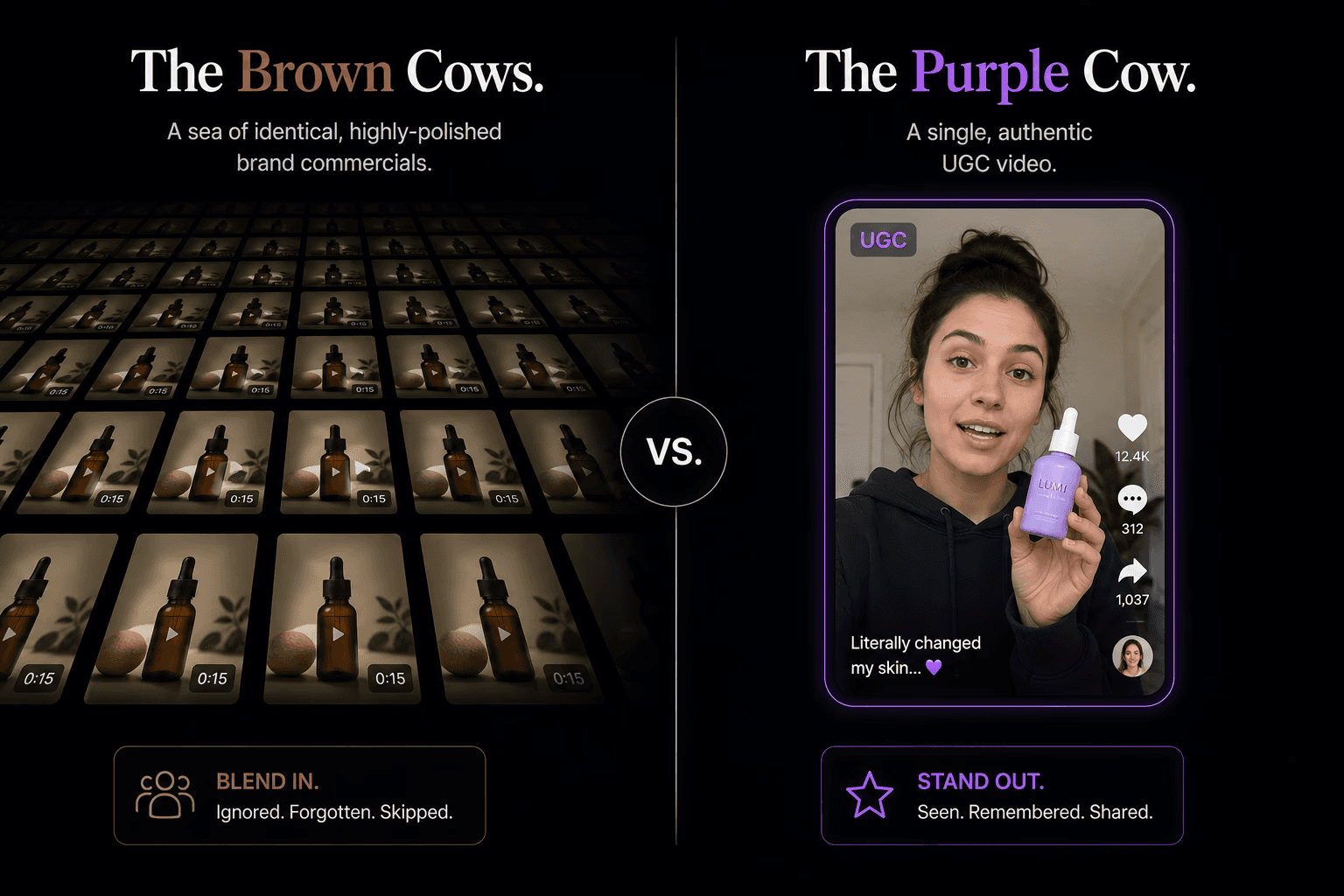
On a TikTok or Instagram feed, the equivalent of brown cows is polished, beautifully produced brand content. It all looks the same because it was all made by the same production logic: clean lighting, professional voiceover, careful brand messaging. The irony is that production quality, when it's applied uniformly across an industry, becomes the thing that makes content invisible.
The Purple Cow in a social feed is often the opposite of what brand managers are trained to create: a slightly shaky shot from a phone camera, a creator sitting in their car with one light source, a direct-to-camera delivery that feels like a conversation rather than a presentation. This format is a pattern interrupt not because it's low quality — it's because it breaks the visual expectation that the brain has developed for "brand content," and that break forces attention.
The practical principle: the production standard for organic-feeling UGC should be calibrated to blend into the feed, not to stand out from it through polish. What makes it stand out is the idea, the hook, and the delivery — not the lighting.
Law 2: Social Currency — People Share Things That Make Them Look Good
Jonah Berger's research on what makes things spread, documented in his book Contagious, identifies social currency as one of the most reliable drivers of sharing behavior. People share things that reflect well on them — content that makes them appear knowledgeable, perceptive, or ahead of the curve to the people in their network.

The practical application for UGC is a shift in framing: instead of writing content that makes the product look impressive, write content that makes the viewer look impressive for knowing about it. The creator who says "I asked a dermatologist what they actually use on their own skin, and they told me about this" is giving the viewer something they can share with their network as a piece of insider knowledge. The viewer isn't sharing an ad — they're sharing a discovery that positions them as someone with access to expert information.
This is why educational hooks, counter-intuitive facts, and "insider information" framings consistently generate higher share rates than straightforward product recommendations. The viewer's motivation to share is driven by what the content says about them, not what it says about the product.
Law 3: Dunbar's Number — Intimacy Scales, Broadcasts Don't
British anthropologist Robin Dunbar's research suggests that humans are cognitively built to maintain meaningful relationships with roughly 150 people. Beyond that, the brain can't sustain the kind of genuine connection that produces trust and loyalty.
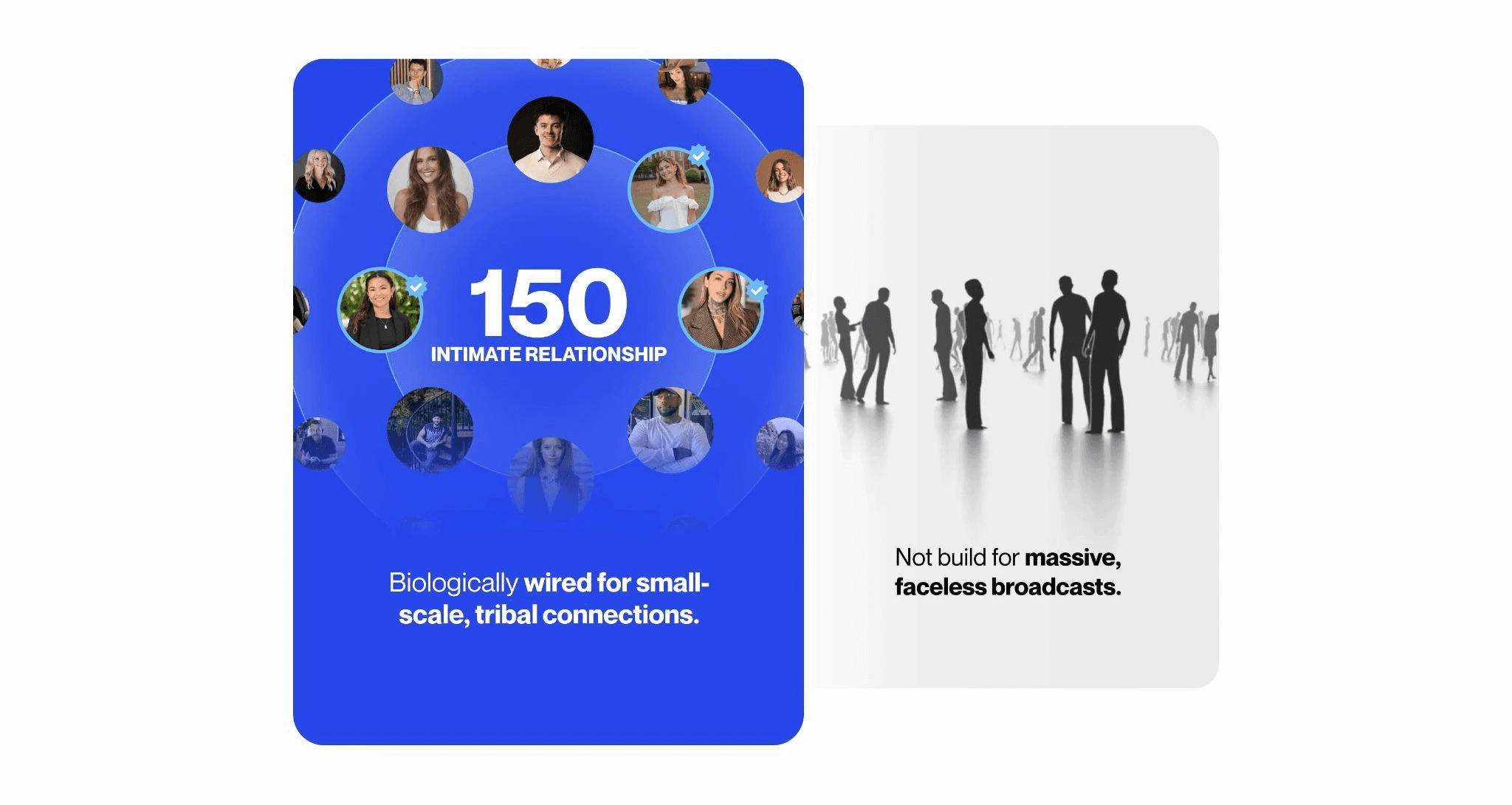
The implication for brand content is significant: content that feels like a broadcast to a million people fails to trigger the trust response that content designed for a small audience reliably produces. The brain recognizes the difference between someone speaking to a crowd and someone speaking to you, and it responds accordingly.
UGC scales intimacy in a way that traditional advertising never could. A creator holding a phone in selfie mode, looking directly at the camera, and addressing a specific niche pain point — "if you're a freelance designer who loses three hours a week to admin tasks" — mimics the cognitive experience of being spoken to directly. The viewer's brain processes it as peer-to-peer communication rather than brand messaging, which is why the trust and engagement responses are fundamentally different.
The practical principle is specificity of audience address. The more specifically a piece of UGC speaks to a defined audience segment, the more intimacy it creates with that segment — even though the actual distribution may be massive.
How the Three Laws Work Together
Each law addresses a different stage of the viewer's attention and trust journey. Here is the summary:
Marketing Law | Definition | Best Used For |
The Purple Cow | Being remarkable and different in a sea of boring, identical content. | Breaking ad-blindness and generating immediate pattern interrupts. |
Social Currency | Providing an "insider" value that makes the viewer look smart for sharing it. | Driving massive organic shares, saves, and word-of-mouth vitality. |
Dunbar's Number | Humans crave intimate, small-circle connections over massive broadcasts. | Building deep consumer trust and increasing average view duration. |
A piece of UGC that applies all three is visually unexpected, delivers information the viewer can use to look knowledgeable, and speaks with enough specificity that the viewer feels directly addressed.
That combination is reproducible. It requires understanding the audience well enough to identify what pattern to interrupt, what knowledge gap to fill, and what specific pain point to name. Then engineering those elements into the brief before the creator ever picks up a camera.
Engineer Your UGC Strategy with Masterhooks

Understanding these marketing laws is one thing, turning them into high-converting videos at scale is another.
These psychological triggers naturally thrive in high-quality UGC. Great UGC stands out like a Purple Cow, builds Social Currency through authentic recommendations, and feels personal enough to align with Dunbar’s Number.
As a performance-first creative lab, Masterhooks combines proven marketing psychology with a vetted network of UGC creators to deliver ad-ready content designed to stop the scroll, fight creative fatigue, and scale revenue profitably.
Want to see how these principles apply to your brand?

Want to see how these principles apply to your brand?
Three marketing frameworks explain most of what makes UGC spread. Understanding them doesn't guarantee a viral post, but it does give you a set of principles to engineer against rather than hoping to stumble onto the right combination.
Law 1: The Purple Cow — Being Remarkable Is the Only Strategy That Scales
Seth Godin's Purple Cow concept makes a straightforward observation: in a field full of brown cows, you stop paying attention because they're all the same. One purple cow and you pull over.
On a TikTok or Instagram feed, the equivalent of brown cows is polished, beautifully produced brand content. It all looks the same because it was all made by the same production logic: clean lighting, professional voiceover, careful brand messaging. The irony is that production quality, when it's applied uniformly across an industry, becomes the thing that makes content invisible.
The Purple Cow in a social feed is often the opposite of what brand managers are trained to create: a slightly shaky shot from a phone camera, a creator sitting in their car with one light source, a direct-to-camera delivery that feels like a conversation rather than a presentation. This format is a pattern interrupt not because it's low quality — it's because it breaks the visual expectation that the brain has developed for "brand content," and that break forces attention.
The practical principle: the production standard for organic-feeling UGC should be calibrated to blend into the feed, not to stand out from it through polish. What makes it stand out is the idea, the hook, and the delivery — not the lighting.
Law 2: Social Currency — People Share Things That Make Them Look Good
Jonah Berger's research on what makes things spread, documented in his book Contagious, identifies social currency as one of the most reliable drivers of sharing behavior. People share things that reflect well on them — content that makes them appear knowledgeable, perceptive, or ahead of the curve to the people in their network.
The practical application for UGC is a shift in framing: instead of writing content that makes the product look impressive, write content that makes the viewer look impressive for knowing about it. The creator who says "I asked a dermatologist what they actually use on their own skin, and they told me about this" is giving the viewer something they can share with their network as a piece of insider knowledge. The viewer isn't sharing an ad — they're sharing a discovery that positions them as someone with access to expert information.
This is why educational hooks, counter-intuitive facts, and "insider information" framings consistently generate higher share rates than straightforward product recommendations. The viewer's motivation to share is driven by what the content says about them, not what it says about the product.
Law 3: Dunbar's Number — Intimacy Scales, Broadcasts Don't
British anthropologist Robin Dunbar's research suggests that humans are cognitively built to maintain meaningful relationships with roughly 150 people. Beyond that, the brain can't sustain the kind of genuine connection that produces trust and loyalty.
The implication for brand content is significant: content that feels like a broadcast to a million people fails to trigger the trust response that content designed for a small audience reliably produces. The brain recognizes the difference between someone speaking to a crowd and someone speaking to you, and it responds accordingly.
UGC scales intimacy in a way that traditional advertising never could. A creator holding a phone in selfie mode, looking directly at the camera, and addressing a specific niche pain point — "if you're a freelance designer who loses three hours a week to admin tasks" — mimics the cognitive experience of being spoken to directly. The viewer's brain processes it as peer-to-peer communication rather than brand messaging, which is why the trust and engagement responses are fundamentally different.
The practical principle is specificity of audience address. The more specifically a piece of UGC speaks to a defined audience segment, the more intimacy it creates with that segment — even though the actual distribution may be massive.
How the Three Laws Work Together
Each law addresses a different stage of the viewer's attention and trust journey. Here is the summary:
Marketing Law | Definition | Best Used For |
The Purple Cow | Being remarkable and different in a sea of boring, identical content. | Breaking ad-blindness and generating immediate pattern interrupts. |
Social Currency | Providing an "insider" value that makes the viewer look smart for sharing it. | Driving massive organic shares, saves, and word-of-mouth vitality. |
Dunbar's Number | Humans crave intimate, small-circle connections over massive broadcasts. | Building deep consumer trust and increasing average view duration. |
A piece of UGC that applies all three is visually unexpected, delivers information the viewer can use to look knowledgeable, and speaks with enough specificity that the viewer feels directly addressed.
That combination is reproducible. It requires understanding the audience well enough to identify what pattern to interrupt, what knowledge gap to fill, and what specific pain point to name. Then engineering those elements into the brief before the creator ever picks up a camera.
Engineer Your UGC Strategy with Masterhooks
Understanding these marketing laws is one thing, turning them into high-converting videos at scale is another.
These psychological triggers naturally thrive in high-quality UGC. Great UGC stands out like a Purple Cow, builds Social Currency through authentic recommendations, and feels personal enough to align with Dunbar’s Number.
As a performance-first creative lab, Masterhooks combines proven marketing psychology with a vetted network of UGC creators to deliver ad-ready content designed to stop the scroll, fight creative fatigue, and scale revenue profitably.
Want to see how these principles apply to your brand?
Related Reading
Related Reading

Why Pretty Little Liars and The Love Hypothesis Are Going Viral in the Same Week
5 min
|
Why Pretty Little Liars and The Love Hypothesis Are Going Viral in the Same Week
Learn how Pretty Little Liars and The Love Hypothesis turn fans into engines for fan-generated content, and what brands can learn about community-led growth.
5 min
|

What Is a Content Pillar? (And How to Build One That Actually Works for UGC)
4 min
|
What Is a Content Pillar? (And How to Build One That Actually Works for UGC)
Learn what a content pillar is, why it matters for UGC, and how to build a practical content pillar strategy with creator briefs and real examples.
4 min
|

First Day of Fall, First Day of Content: The UGC Formats That Win in October
4 min
|
First Day of Fall, First Day of Content: The UGC Formats That Win in October
Discover five October UGC formats brands can use this fall, from seasonal transitions and cozy routines to Halloween teasers and reset content.
4 min
|



Need help scaling?
Book a strategy call with our expert team to audit your current UGC setup.