Educational UGC: How WeMoms Hit 90 Million Views Without Running a Single Ad
Educational UGC: How WeMoms Hit 90 Million Views Without Running a Single Ad
WeMoms hit 90M views by teaching instead of pitching. Here's the 3-part educational UGC playbook any brand can use to generate saves, shares, and installs.
Published:

Read Time:

3 min

Written by:
Fawwaz
Trend Research and Copywriter
THE BIGGEST GROWTH OFTEN LOOKS UNCONVENTIONAL
When competitors follow identical tactics, the brands willing to break the pattern gain the advantage.
THE BIGGEST GROWTH OFTEN LOOKS UNCONVENTIONAL
When competitors follow identical tactics, the brands willing to break the pattern gain the advantage.
THE BIGGEST GROWTH OFTEN LOOKS UNCONVENTIONAL
When competitors follow identical tactics, the brands willing to break the pattern gain the advantage.
Content that leads with information the audience genuinely needs, and lets the product enter as the natural solution to a problem that's already been clearly established.
Why Educational Content Performs Differently Than Promotional Content
The mechanism behind educational UGC's performance isn't complicated, but it's consistently underestimated.
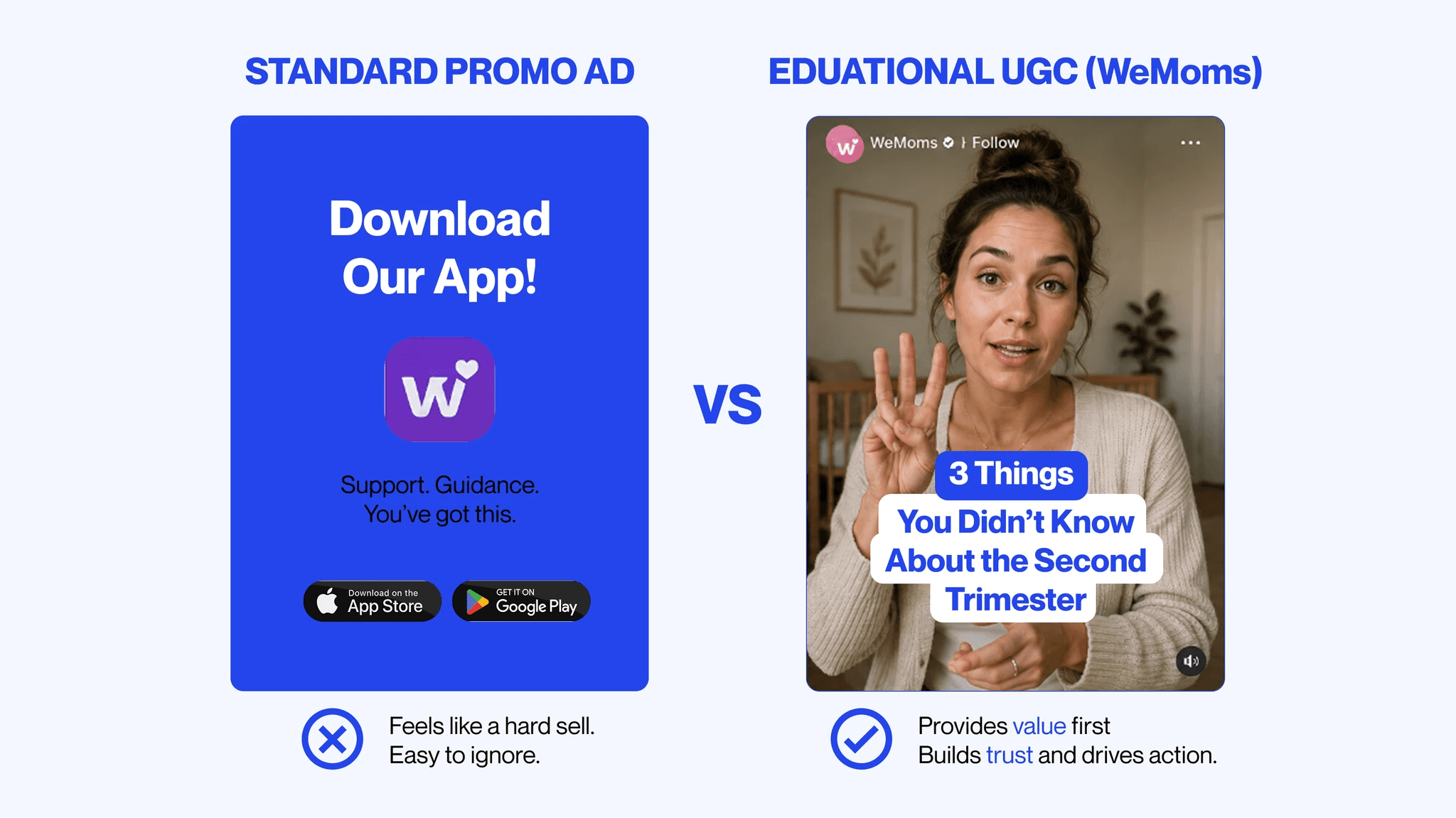
When viewers watch a video that begins with the line “Download our app to track your pregnancy,” they’ll immediately recognize it as an ad and view it with skepticism, low engagement, and a finger ready to hit the skip button.
This is different from a video that begins with “Here are three things no one ever tells you about your baby’s development in week 14.” Viewers perceive this video as a source of information, so they refrain from skipping it and watch it all the way through.
This happens because viewers see themselves as learning from the content, rather than being persuaded to become consumers. By the time the product is introduced, the content creator has already established credibility, and the audience has received value.
This structural difference explains the consistent performance gap between educational and promotional content in terms of saves and shares. People tend to save content they want to revisit, and share content that makes them look knowledgeable or helpful to their network. Educational content reliably triggers both behaviors in ways that promotional content rarely does.
The Three-Part Playbook WeMoms Used
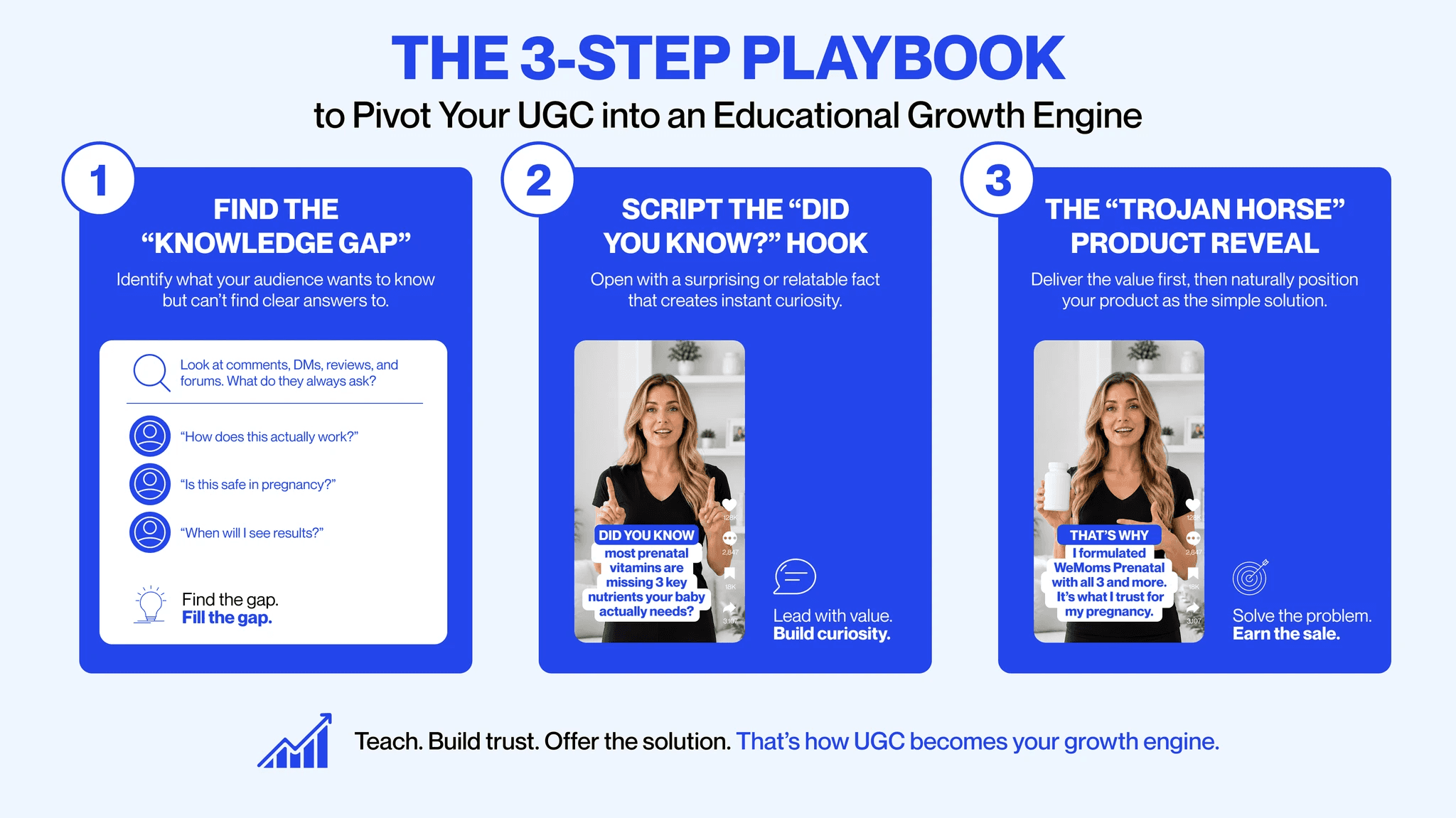
Step 1: Find the knowledge gap your audience doesn't know exists.
The most powerful educational hooks are built around information the target audience doesn't have but would actively want. This requires understanding the audience well enough to identify what they're uncertain, worried, or confused about.
For WeMoms, this knowledge gap takes the form of developmental information that expectant mothers cannot easily find elsewhere in an easy-to-understand format. The content goes beyond general pregnancy advice, offering weekly updates presented in a way that feels like receiving advice from a knowledgeable friend.
The question every brand should ask is: What doesn’t my target audience know about their own issues? Not what they know about my product. What makes them hesitate or feel anxious—and what can my product help address?
Step 2: Lead with the lesson, not the brand.
The hook for educational UGC should never mention the product. It should be a standalone piece of useful information that would be worth watching even if the product never appeared. The "Did you know your bank is legally allowed to charge you X for Y? Here's the loophole" hook works for a finance app because it's genuinely useful knowledge — not because it's a clever way to introduce an app.
This is counterintuitive for brands accustomed to leading with their value proposition. The educational approach requires trusting that leading with value, rather than features, is a more reliable path to both attention and eventual conversion.
Step 3: Introduce the product as the tool, not the subject.
The first two-thirds of the video should consist of purely educational content focused on conveying information, building credibility, and gaining the audience’s trust. The product is introduced in the final third as the easiest way to apply or expand upon what the audience has just learned. Thus, the product is not the core of the video, but rather a practical tool for anyone who finds the lesson useful.
This structure is what WeMoms' creators consistently executed across their best-performing content. The lesson is the "why." The product is the "how."
Why This Strategy Works Across Categories
This approach works anywhere there's a gap between what the audience knows today and what they want to achieve. Educational UGC can work in almost any category as long as it closes a genuine knowledge gap and gives the audience information they actually find useful.
A skincare brand can lead with the chemistry of barrier damage before introducing a repair serum. A finance app can explain fee structures before introducing an alternative. A productivity tool can explain why standard time-blocking fails for ADHD brains before showing a better approach.
The challenge is finding the right balance. Too much promotion feels like an ad, while too much education can lose attention. That's why successful educational UGC relies on strong psychological scripting that keeps content engaging, trustworthy, and conversion-focused.
At Masterhooks, we help brands strike that balance by combining value-first strategies with authentic creators to produce content that builds trust and drives results.
Want to know if your content is built for saves and shares?

Content that leads with information the audience genuinely needs, and lets the product enter as the natural solution to a problem that's already been clearly established.
Why Educational Content Performs Differently Than Promotional Content
The mechanism behind educational UGC's performance isn't complicated, but it's consistently underestimated.
When viewers watch a video that begins with the line “Download our app to track your pregnancy,” they’ll immediately recognize it as an ad and view it with skepticism, low engagement, and a finger ready to hit the skip button.
This is different from a video that begins with “Here are three things no one ever tells you about your baby’s development in week 14.” Viewers perceive this video as a source of information, so they refrain from skipping it and watch it all the way through.
This happens because viewers see themselves as learning from the content, rather than being persuaded to become consumers. By the time the product is introduced, the content creator has already established credibility, and the audience has received value.
This structural difference explains the consistent performance gap between educational and promotional content in terms of saves and shares. People tend to save content they want to revisit, and share content that makes them look knowledgeable or helpful to their network. Educational content reliably triggers both behaviors in ways that promotional content rarely does.
The Three-Part Playbook WeMoms Used
Step 1: Find the knowledge gap your audience doesn't know exists.
The most powerful educational hooks are built around information the target audience doesn't have but would actively want. This requires understanding the audience well enough to identify what they're uncertain, worried, or confused about.
For WeMoms, this knowledge gap takes the form of developmental information that expectant mothers cannot easily find elsewhere in an easy-to-understand format. The content goes beyond general pregnancy advice, offering weekly updates presented in a way that feels like receiving advice from a knowledgeable friend.
The question every brand should ask is: What doesn’t my target audience know about their own issues? Not what they know about my product. What makes them hesitate or feel anxious—and what can my product help address?
Step 2: Lead with the lesson, not the brand.
The hook for educational UGC should never mention the product. It should be a standalone piece of useful information that would be worth watching even if the product never appeared. The "Did you know your bank is legally allowed to charge you X for Y? Here's the loophole" hook works for a finance app because it's genuinely useful knowledge — not because it's a clever way to introduce an app.
This is counterintuitive for brands accustomed to leading with their value proposition. The educational approach requires trusting that leading with value, rather than features, is a more reliable path to both attention and eventual conversion.
Step 3: Introduce the product as the tool, not the subject.
The first two-thirds of the video should consist of purely educational content focused on conveying information, building credibility, and gaining the audience’s trust. The product is introduced in the final third as the easiest way to apply or expand upon what the audience has just learned. Thus, the product is not the core of the video, but rather a practical tool for anyone who finds the lesson useful.
This structure is what WeMoms' creators consistently executed across their best-performing content. The lesson is the "why." The product is the "how."
Why This Strategy Works Across Categories
This approach works anywhere there's a gap between what the audience knows today and what they want to achieve. Educational UGC can work in almost any category as long as it closes a genuine knowledge gap and gives the audience information they actually find useful.
A skincare brand can lead with the chemistry of barrier damage before introducing a repair serum. A finance app can explain fee structures before introducing an alternative. A productivity tool can explain why standard time-blocking fails for ADHD brains before showing a better approach.
The challenge is finding the right balance. Too much promotion feels like an ad, while too much education can lose attention. That's why successful educational UGC relies on strong psychological scripting that keeps content engaging, trustworthy, and conversion-focused.
At Masterhooks, we help brands strike that balance by combining value-first strategies with authentic creators to produce content that builds trust and drives results.
Want to know if your content is built for saves and shares?
Related Reading
Related Reading

Why Pretty Little Liars and The Love Hypothesis Are Going Viral in the Same Week
5 min
|
Why Pretty Little Liars and The Love Hypothesis Are Going Viral in the Same Week
Learn how Pretty Little Liars and The Love Hypothesis turn fans into engines for fan-generated content, and what brands can learn about community-led growth.
5 min
|

What Is a Content Pillar? (And How to Build One That Actually Works for UGC)
4 min
|
What Is a Content Pillar? (And How to Build One That Actually Works for UGC)
Learn what a content pillar is, why it matters for UGC, and how to build a practical content pillar strategy with creator briefs and real examples.
4 min
|

First Day of Fall, First Day of Content: The UGC Formats That Win in October
4 min
|
First Day of Fall, First Day of Content: The UGC Formats That Win in October
Discover five October UGC formats brands can use this fall, from seasonal transitions and cozy routines to Halloween teasers and reset content.
4 min
|


Need help scaling?
Book a strategy call with our expert team to audit your current UGC setup.