Why Brands That Think Like Media Companies Generate More UGC
Why Brands That Think Like Media Companies Generate More UGC
Brands generating the most UGC aren't asking for it — they're building a cultural identity worth joining. Here's how the media company model makes that happen.
Published:

Read Time:

3 min

Written by:
Fawwaz
Trend Research and Copywriter
MEDIA COMPANIES ATTRACT. PRODUCT COMPANIES ASK.
The strongest brands earn participation by creating ongoing value between product launches.
MEDIA COMPANIES ATTRACT. PRODUCT COMPANIES ASK.
The strongest brands earn participation by creating ongoing value between product launches.
MEDIA COMPANIES ATTRACT. PRODUCT COMPANIES ASK.
The strongest brands earn participation by creating ongoing value between product launches.
Most brands treat content as a promotional tool. The difference comes down to whether you're thinking like a product company or a media company.
Why the "Only Post When Selling" Model Is Failing
A brand that only speaks when it has something to sell trains its audience to tune out. There's no reason to pay attention between launches, and by the time the next product announcement arrives, the audience has already mentally categorized the account as promotional noise.
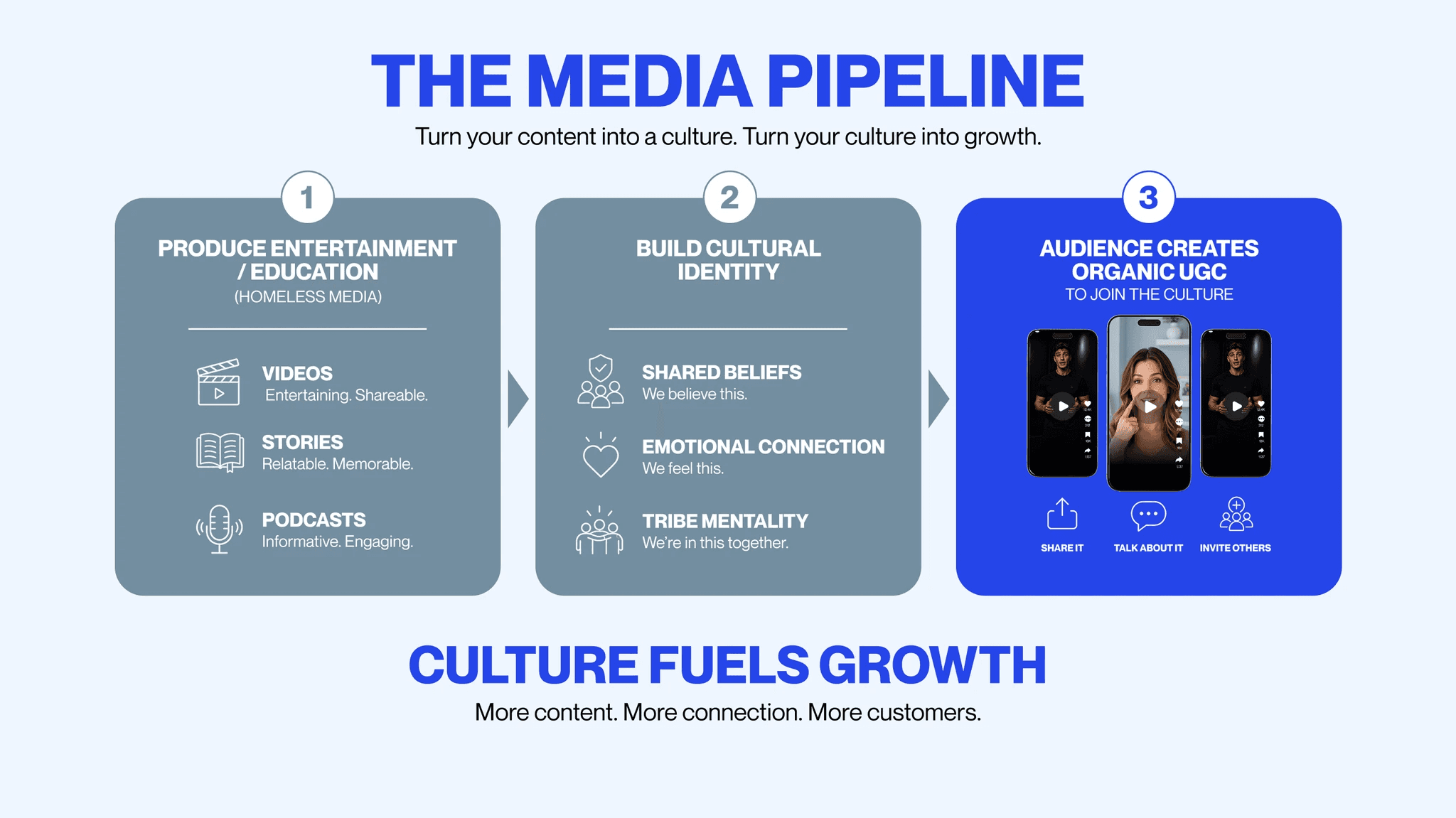
The media company model inverts this. Instead of interrupting people with promotional content, the brand creates content that audiences actively watch, share, and return to because it delivers something worth their time.
The shift isn't about producing more content. It's about producing content with a different objective. A media company's primary goal is attention and trust. Revenue follows from the audience it builds, not the other way around.
This is increasingly relevant for brands trying to generate organic UGC. Audiences don't create content about brands they merely tolerate. They create content about brands whose identity, values, or aesthetic they want to associate with. That association only develops when a brand has built something worth associating with, which is exactly what a media company approach creates.
The Three Shifts That Turn a Brand Into a Media Company
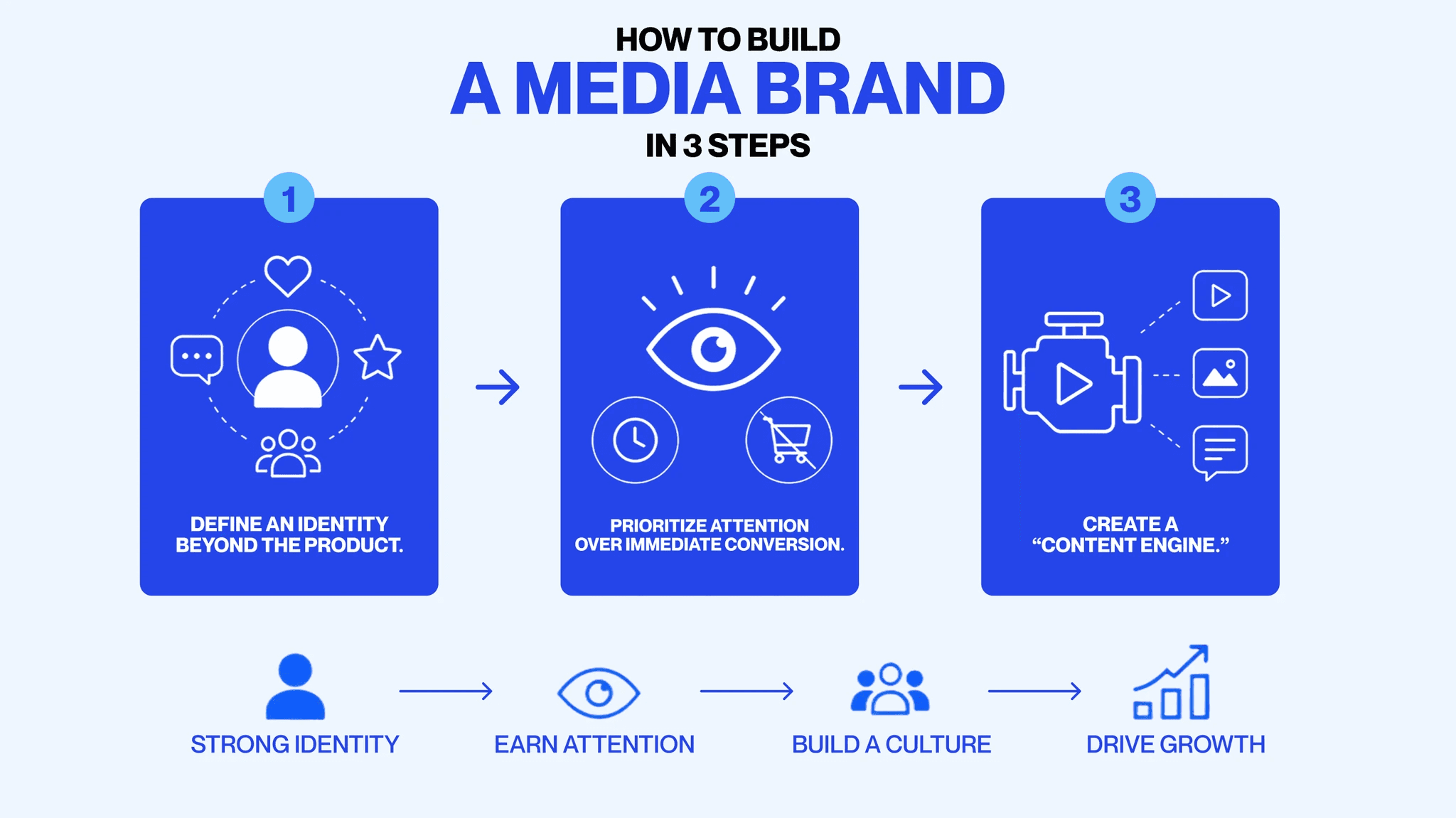
Define an identity that exists outside the product.
The most useful question to ask is: what subculture does this brand belong to? An outdoor gear brand that only talks about jackets is a product company. An outdoor gear brand that publishes long-form content about alpinism, wilderness conservation, and the culture of people who spend their lives outside is a media company. The jacket is still there, but it exists inside a world that people want to inhabit.
This identity clarity is what creates the conditions for organic UGC. When a brand's cultural identity is specific enough, audiences who share that identity will create content that expresses it because they know that doing so expresses something about themselves.
Prioritize attention over immediate conversion.
A media company's content gives away value before asking for anything in return. The goal of most content is to earn and hold attention, build an audience, and develop the trust that eventually makes conversion effortless.
This is a longer game than most brands are comfortable playing. But the compounding effect is significant: an audience built on genuine interest is dramatically more likely to engage, share, and create content than an audience acquired through transactional promotion.
Build a content engine, not a content calendar.
A content calendar is a schedule. A content engine is a system that produces consistently across formats, platforms, and time. The difference is infrastructure: whether the brand has built the production capacity to maintain volume and quality simultaneously, or whether content output depends on individual heroics each week.
Volume matters because consistency is what trains algorithms and audiences alike. A brand that posts high-quality content twice a week will always outperform one that posts excellent content irregularly.
What This Looks Like in Practice: Two Brands That Built It
Red Bull is the most cited example for a reason. They built Red Bull Media House as a standalone content operation producing F1 coverage, extreme sports documentaries, and music content. Energy drinks, which the company considers a secondary product, have actually created an adrenaline-fueled culture that millions of consumers want to be a part of. The organic UGC this generates, people filming their own extreme sports moments with Red Bull branding visible, is marketing that no ad budget could replicate directly.
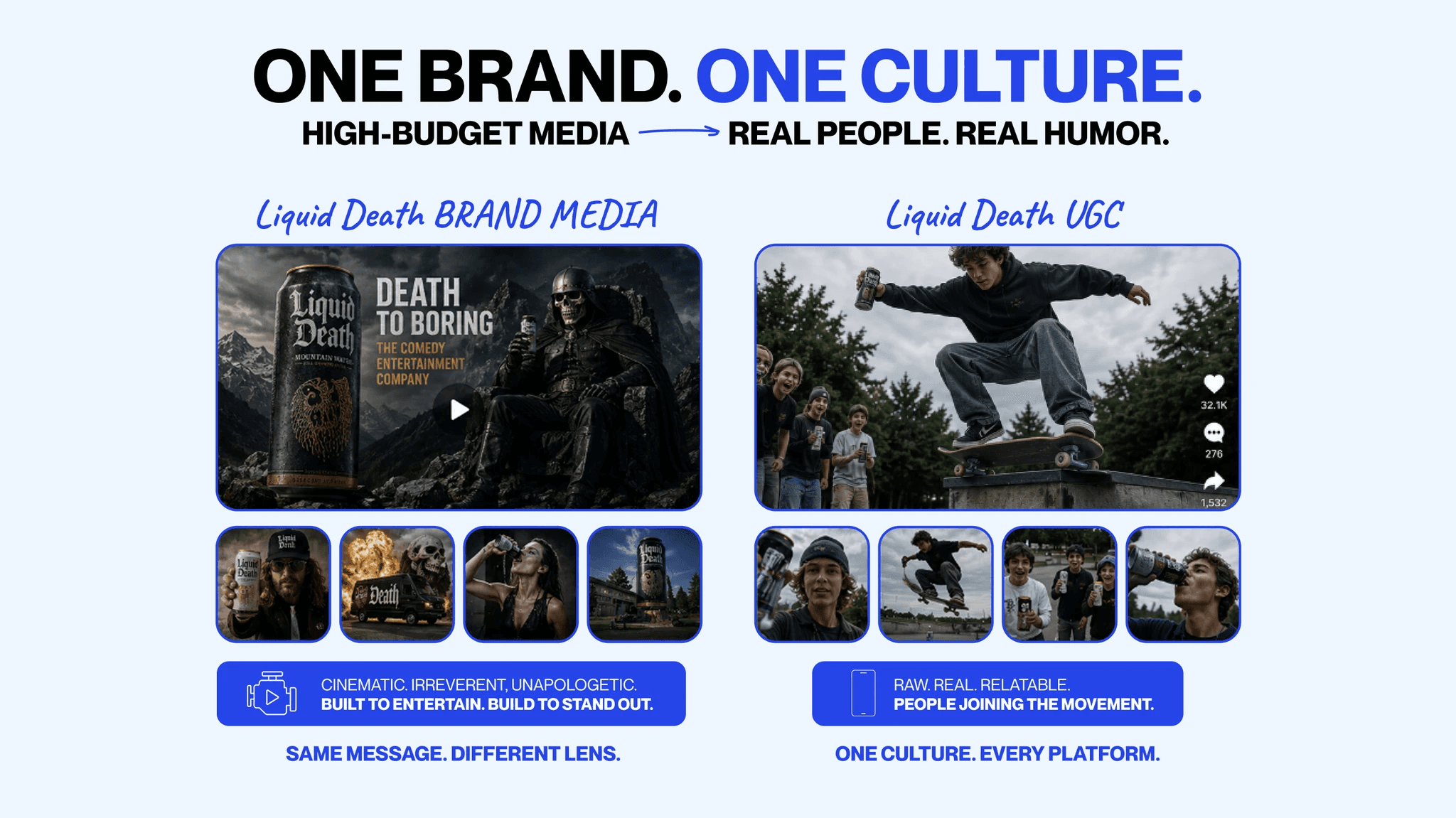
Liquid Death built a comedy entertainment brand around canned water. Their content is internet-native absurdist humor: heavy metal albums made from hate comments, horror parody videos, deliberately outrageous stunts. The product is a commodity. The media identity is not. The resulting organic UGC on TikTok is a direct product of the cultural permission the brand created.
In both cases, the UGC didn't happen because the brand ran a hashtag campaign. It happened because the brand built an identity specific enough that audiences wanted to be associated with it.
The Connection Between Media Identity and UGC Quality
Brands that think like product companies often create transactional UGC, such as unboxings, reviews, and discount-driven content. Brands that think like media companies create content people want to participate in because it reflects an identity, interest, or community.
That difference has a direct impact on UGC performance.
The stronger the brand identity, the more likely people are to create, share, and engage with content organically. At Masterhooks, we help brands turn that engagement into scalable growth by combining strong creative strategy with a vetted network of creators.
Want to see how your content strategy stacks up against what actually drives results?

Want to see how your content strategy stacks up against what actually drives results?
Most brands treat content as a promotional tool. The difference comes down to whether you're thinking like a product company or a media company.
Why the "Only Post When Selling" Model Is Failing
A brand that only speaks when it has something to sell trains its audience to tune out. There's no reason to pay attention between launches, and by the time the next product announcement arrives, the audience has already mentally categorized the account as promotional noise.
The media company model inverts this. Instead of interrupting people with promotional content, the brand creates content that audiences actively watch, share, and return to because it delivers something worth their time.
The shift isn't about producing more content. It's about producing content with a different objective. A media company's primary goal is attention and trust. Revenue follows from the audience it builds, not the other way around.
This is increasingly relevant for brands trying to generate organic UGC. Audiences don't create content about brands they merely tolerate. They create content about brands whose identity, values, or aesthetic they want to associate with. That association only develops when a brand has built something worth associating with, which is exactly what a media company approach creates.
The Three Shifts That Turn a Brand Into a Media Company
Define an identity that exists outside the product.
The most useful question to ask is: what subculture does this brand belong to? An outdoor gear brand that only talks about jackets is a product company. An outdoor gear brand that publishes long-form content about alpinism, wilderness conservation, and the culture of people who spend their lives outside is a media company. The jacket is still there, but it exists inside a world that people want to inhabit.
This identity clarity is what creates the conditions for organic UGC. When a brand's cultural identity is specific enough, audiences who share that identity will create content that expresses it because they know that doing so expresses something about themselves.
Prioritize attention over immediate conversion.
A media company's content gives away value before asking for anything in return. The goal of most content is to earn and hold attention, build an audience, and develop the trust that eventually makes conversion effortless.
This is a longer game than most brands are comfortable playing. But the compounding effect is significant: an audience built on genuine interest is dramatically more likely to engage, share, and create content than an audience acquired through transactional promotion.
Build a content engine, not a content calendar.
A content calendar is a schedule. A content engine is a system that produces consistently across formats, platforms, and time. The difference is infrastructure: whether the brand has built the production capacity to maintain volume and quality simultaneously, or whether content output depends on individual heroics each week.
Volume matters because consistency is what trains algorithms and audiences alike. A brand that posts high-quality content twice a week will always outperform one that posts excellent content irregularly.
What This Looks Like in Practice: Two Brands That Built It
Red Bull is the most cited example for a reason. They built Red Bull Media House as a standalone content operation producing F1 coverage, extreme sports documentaries, and music content. Energy drinks, which the company considers a secondary product, have actually created an adrenaline-fueled culture that millions of consumers want to be a part of. The organic UGC this generates, people filming their own extreme sports moments with Red Bull branding visible, is marketing that no ad budget could replicate directly.
Liquid Death built a comedy entertainment brand around canned water. Their content is internet-native absurdist humor: heavy metal albums made from hate comments, horror parody videos, deliberately outrageous stunts. The product is a commodity. The media identity is not. The resulting organic UGC on TikTok is a direct product of the cultural permission the brand created.
In both cases, the UGC didn't happen because the brand ran a hashtag campaign. It happened because the brand built an identity specific enough that audiences wanted to be associated with it.
The Connection Between Media Identity and UGC Quality
Brands that think like product companies often create transactional UGC, such as unboxings, reviews, and discount-driven content. Brands that think like media companies create content people want to participate in because it reflects an identity, interest, or community.
That difference has a direct impact on UGC performance.
The stronger the brand identity, the more likely people are to create, share, and engage with content organically. At Masterhooks, we help brands turn that engagement into scalable growth by combining strong creative strategy with a vetted network of creators.
Want to see how your content strategy stacks up against what actually drives results?
Related Reading
Related Reading

How to Find the Right Influencer Marketing Agency for Your Brand (Without Wasting Budget)
6 min
|
How to Find the Right Influencer Marketing Agency for Your Brand (Without Wasting Budget)
Learn how to choose an influencer marketing agency using a practical scorecard, performance criteria, red flags, and pre-contract checks.
6 min
|

AI Video Ad Agencies: A Buyer's Guide for DTC Brands (2026)
4 min
|
AI Video Ad Agencies: A Buyer's Guide for DTC Brands (2026)
Compare AI video ad agency types, pricing, performance metrics, ownership rights, and seven questions DTC brands should ask before hiring.
4 min
|

How Taylor Swift Engineered a UGC Wave With 13 Seconds of Video and One Awards Show
4 min
|
How Taylor Swift Engineered a UGC Wave With 13 Seconds of Video and One Awards Show
How Taylor Swift turned a 13-second teaser, Easter eggs, and a live VMA premiere into a UGC engine brands can adapt for organic distribution.
4 min
|


Need help scaling?
Book a strategy call with our expert team to audit your current UGC setup.