Connection, Conversation, Conversion: The Three-Stage Framework Behind UGC That Actually Works
Connection, Conversation, Conversion: The Three-Stage Framework Behind UGC That Actually Works
Most UGC fails at stage one: connection. Here's the 3-stage framework that explains why some brands compound and others plateau — and how to build all three.
Published:

Read Time:

4 min

Written by:
Fawwaz
Trend Research and Copywriter
MOST UGC FAILS AT THE FIRST STAGE.
Not because the product is wrong, not because the creator is weak, and not because the budget is too small — but because the content tries to convert an audience that hasn't been connected with yet.
MOST UGC FAILS AT THE FIRST STAGE.
Not because the product is wrong, not because the creator is weak, and not because the budget is too small — but because the content tries to convert an audience that hasn't been connected with yet.
MOST UGC FAILS AT THE FIRST STAGE.
Not because the product is wrong, not because the creator is weak, and not because the budget is too small — but because the content tries to convert an audience that hasn't been connected with yet.
The brands that consistently generate high-performing organic and paid UGC understand that different content serves different purposes at different stages of a viewer's relationship with a brand.
Building that pipeline intentionally, rather than asking every piece of content to do everything at once, is what separates campaigns that compound from ones that plateau.
Stage 1: Connection — Building the Trust That Makes Everything Else Work
A viewer who doesn't know your brand yet needs one thing before any purchase consideration is possible: a reason to care.
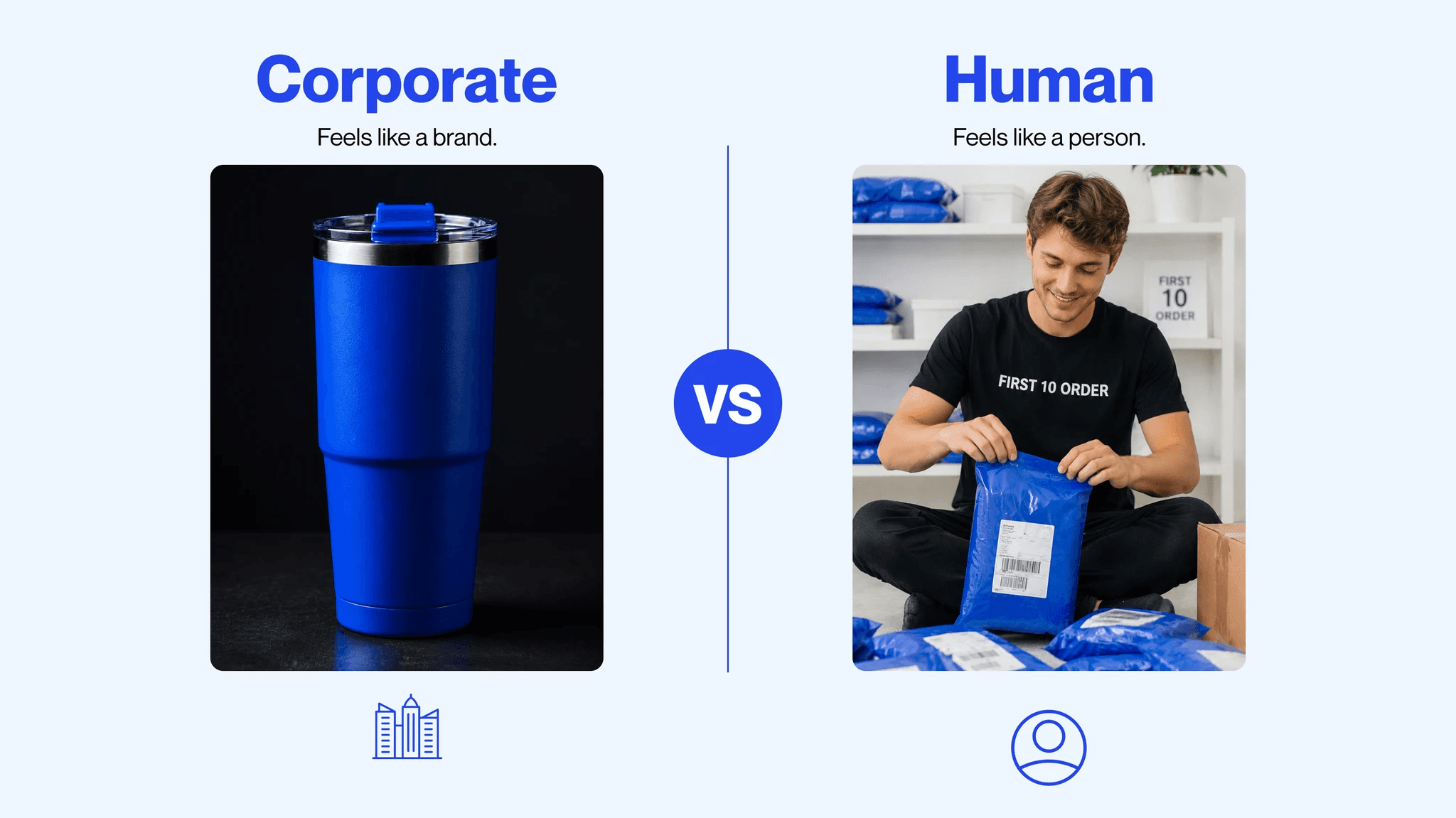
Connection isn't built through product specifications or testimonials from people they don't know. It's built through the feeling that this brand understands something true about my experience.
The Founder Story approach works because it replaces the faceless brand voice with a human one. A lo-fi video of a founder explaining the specific frustration that motivated them to build the product does something that polished advertising can't: it makes the viewer feel like they're meeting someone rather than being marketed to. The failed prototypes, the late nights, the specific moment of realization — these details create the impression of authenticity that no production budget can manufacture.
The reason this converts trust more efficiently than any other format is rooted in how humans evaluate credibility. Vulnerability signals that there's nothing being hidden. A brand willing to show its struggle before its success signals confidence in the product itself.
The Micro-Creator alignment approach works for similar reasons but through social proof rather than founder story. A creator with 15,000 highly engaged followers in a specific niche carries more credibility with that audience than a creator with 2 million generalist followers, because their recommendation comes with existing trust. When a creator who specifically covers ADHD productivity tools recommends an app, their audience's primary response is "this is relevant to me" rather than "this is an ad."
Stage 2: Conversation — Creating Content That the Algorithm Amplifies
Reach on TikTok and Instagram is not distributed based on who paid for it. It's distributed based on who generated the engagement.
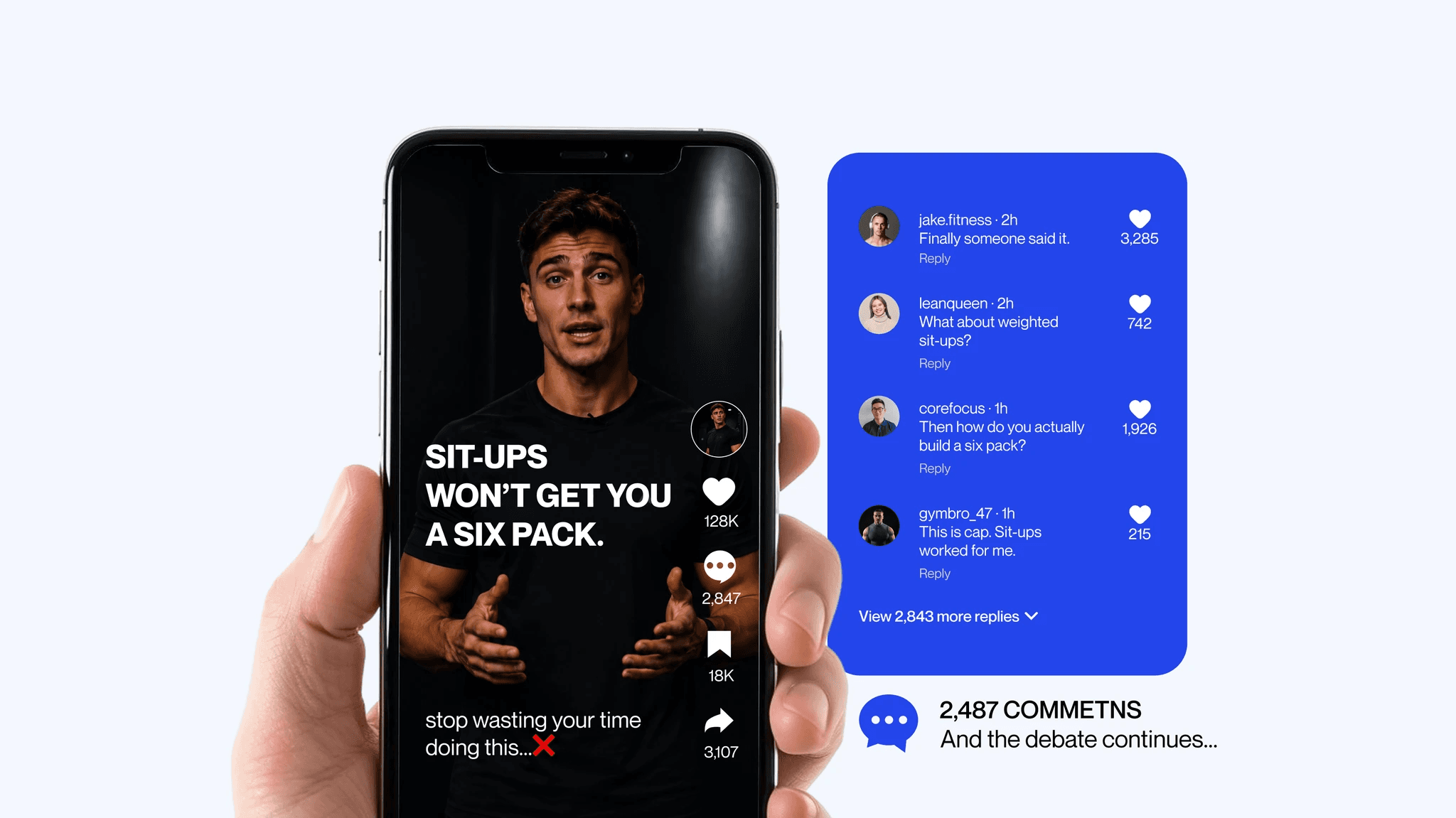
Comments, shares, and saves are the signals that tell the algorithm a piece of content is worth pushing to new audiences. This means that content strategy and distribution strategy are the same thing, which one generates conversation earns its own distribution.
The Contrarian Hook is the most reliable conversation-generating format because it creates a stakes-based incentive to engage. Starting with a statement that challenges a widely held belief gives viewers two options: agree and share to signal they're "in the know," or disagree and comment to defend their position. Both responses drive the engagement metrics that expand reach.
The contrarian hook works best when the challenge is specific and genuinely debatable — not provocative for its own sake, but rooted in a perspective that has real merit and that the brand's product can back up with evidence.
The Build in Public approach generates conversation through a different mechanism: ownership. When a brand lets its audience vote on product decisions, those audience members have a stake in the outcome. They're more likely to share the final result because they feel like they contributed to it. This psychological investment is one of the more durable forms of brand loyalty, because it's based on participation rather than transaction.
Stage 3: Conversion — Removing the Friction Between Interest and Action
By the time a viewer reaches the conversion stage, the heavy lifting has already been done. They know the brand, they've engaged with its content, and they have some level of trust.
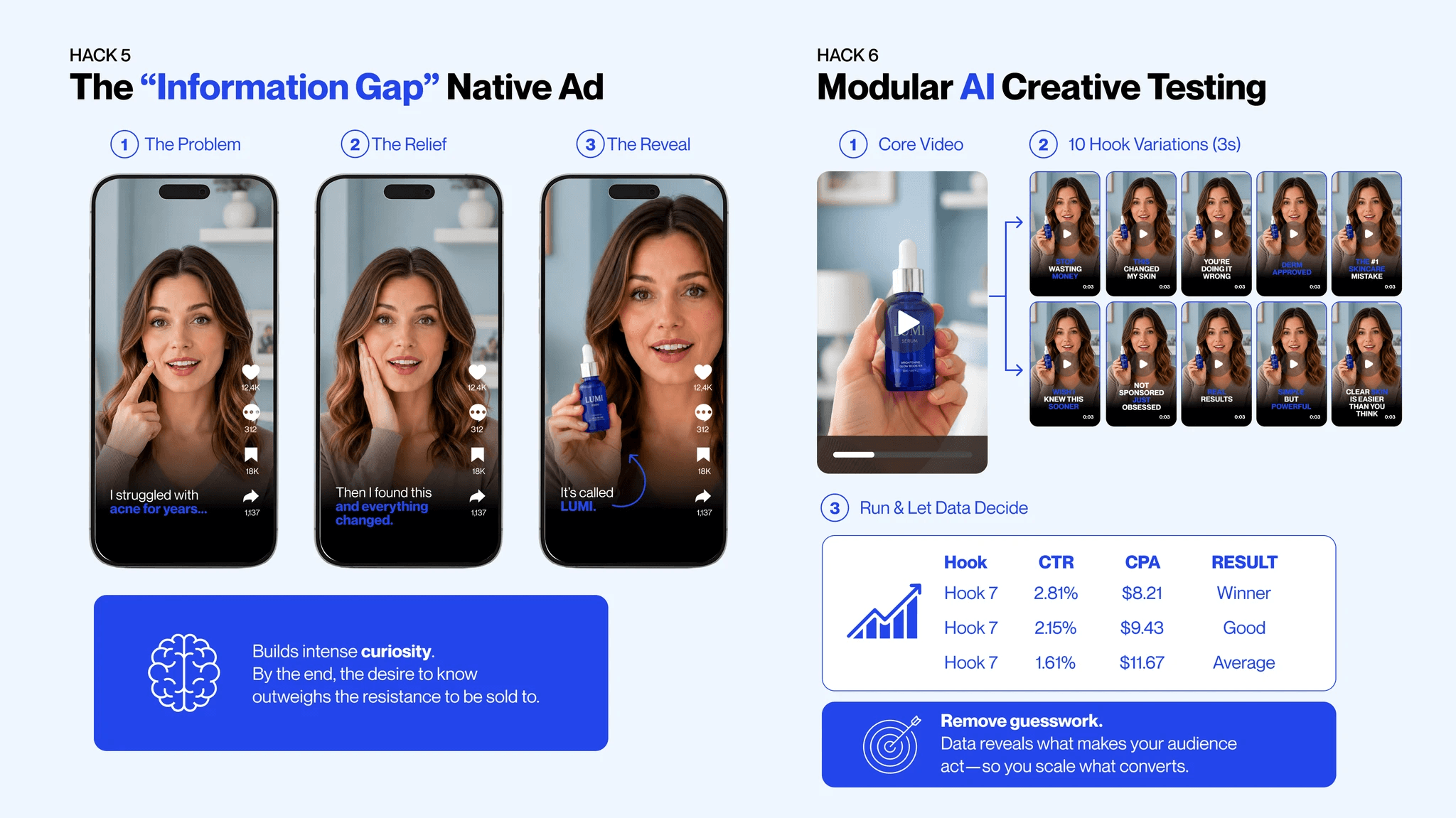
The job at this stage is not to persuade — it's to make acting as easy as possible, and to do it in a way that doesn't break the organic feel of the content that built the relationship.
The Curiosity Loop format builds a natural bridge between engagement and action. Rather than ending a video with a direct sales pitch, the creator ends with something unresolved — a question, a partial reveal, or an invitation to take a small step to find out more. This maintains the viewer's sense that they're discovering something rather than being sold something, which significantly reduces the psychological resistance that typical CTA language triggers.
Modular creative testing matters at the conversion stage because small changes in how an action is framed can produce large differences in conversion rate. Testing different CTA styles — urgency-based, curiosity-based, community-based — against the same core content reveals which emotional trigger most reliably moves the specific audience toward action. The brands that consistently improve their conversion rates are the ones that treat the CTA as a variable to optimize, not a standard line to include.
Build Your C-C-C Pipeline with Masterhooks
The most common failure mode is optimizing for conversion while neglecting connection and conversation. Brands run conversion-focused creative at cold audiences who haven't been warmed up through connection content, and wonder why the conversion rates are low.
The pipeline works when all three stages are running simultaneously and continuously. Understanding the Connection → Conversation → Conversion framework is one thing, but executing it consistently at scale is another. Crafting authentic stories, contrarian hooks, and effective A/B tests can quickly overwhelm in-house teams.
Masterhooks helps brands build this pipeline at scale. By combining data-backed psychological scripting with a vetted network of UGC creators, Masterhooks produces ad-ready content designed to spark engagement, drive conversations, and convert profitably.
Want to know if your content covers all three stages?
Want to know if your content covers all three stages?
The brands that consistently generate high-performing organic and paid UGC understand that different content serves different purposes at different stages of a viewer's relationship with a brand.
Building that pipeline intentionally, rather than asking every piece of content to do everything at once, is what separates campaigns that compound from ones that plateau.
Stage 1: Connection — Building the Trust That Makes Everything Else Work
A viewer who doesn't know your brand yet needs one thing before any purchase consideration is possible: a reason to care.
Connection isn't built through product specifications or testimonials from people they don't know. It's built through the feeling that this brand understands something true about my experience.
The Founder Story approach works because it replaces the faceless brand voice with a human one. A lo-fi video of a founder explaining the specific frustration that motivated them to build the product does something that polished advertising can't: it makes the viewer feel like they're meeting someone rather than being marketed to. The failed prototypes, the late nights, the specific moment of realization — these details create the impression of authenticity that no production budget can manufacture.
The reason this converts trust more efficiently than any other format is rooted in how humans evaluate credibility. Vulnerability signals that there's nothing being hidden. A brand willing to show its struggle before its success signals confidence in the product itself.
The Micro-Creator alignment approach works for similar reasons but through social proof rather than founder story. A creator with 15,000 highly engaged followers in a specific niche carries more credibility with that audience than a creator with 2 million generalist followers, because their recommendation comes with existing trust. When a creator who specifically covers ADHD productivity tools recommends an app, their audience's primary response is "this is relevant to me" rather than "this is an ad."
Stage 2: Conversation — Creating Content That the Algorithm Amplifies
Reach on TikTok and Instagram is not distributed based on who paid for it. It's distributed based on who generated the engagement.
Comments, shares, and saves are the signals that tell the algorithm a piece of content is worth pushing to new audiences. This means that content strategy and distribution strategy are the same thing, which one generates conversation earns its own distribution.
The Contrarian Hook is the most reliable conversation-generating format because it creates a stakes-based incentive to engage. Starting with a statement that challenges a widely held belief gives viewers two options: agree and share to signal they're "in the know," or disagree and comment to defend their position. Both responses drive the engagement metrics that expand reach.
The contrarian hook works best when the challenge is specific and genuinely debatable — not provocative for its own sake, but rooted in a perspective that has real merit and that the brand's product can back up with evidence.
The Build in Public approach generates conversation through a different mechanism: ownership. When a brand lets its audience vote on product decisions, those audience members have a stake in the outcome. They're more likely to share the final result because they feel like they contributed to it. This psychological investment is one of the more durable forms of brand loyalty, because it's based on participation rather than transaction.
Stage 3: Conversion — Removing the Friction Between Interest and Action
By the time a viewer reaches the conversion stage, the heavy lifting has already been done. They know the brand, they've engaged with its content, and they have some level of trust.
The job at this stage is not to persuade — it's to make acting as easy as possible, and to do it in a way that doesn't break the organic feel of the content that built the relationship.
The Curiosity Loop format builds a natural bridge between engagement and action. Rather than ending a video with a direct sales pitch, the creator ends with something unresolved — a question, a partial reveal, or an invitation to take a small step to find out more. This maintains the viewer's sense that they're discovering something rather than being sold something, which significantly reduces the psychological resistance that typical CTA language triggers.
Modular creative testing matters at the conversion stage because small changes in how an action is framed can produce large differences in conversion rate. Testing different CTA styles — urgency-based, curiosity-based, community-based — against the same core content reveals which emotional trigger most reliably moves the specific audience toward action. The brands that consistently improve their conversion rates are the ones that treat the CTA as a variable to optimize, not a standard line to include.
Build Your C-C-C Pipeline with Masterhooks
The most common failure mode is optimizing for conversion while neglecting connection and conversation. Brands run conversion-focused creative at cold audiences who haven't been warmed up through connection content, and wonder why the conversion rates are low.
The pipeline works when all three stages are running simultaneously and continuously. Understanding the Connection → Conversation → Conversion framework is one thing, but executing it consistently at scale is another. Crafting authentic stories, contrarian hooks, and effective A/B tests can quickly overwhelm in-house teams.
Masterhooks helps brands build this pipeline at scale. By combining data-backed psychological scripting with a vetted network of UGC creators, Masterhooks produces ad-ready content designed to spark engagement, drive conversations, and convert profitably.
Want to know if your content covers all three stages?
Related Reading
Related Reading

Why Pretty Little Liars and The Love Hypothesis Are Going Viral in the Same Week
5 min
|
Why Pretty Little Liars and The Love Hypothesis Are Going Viral in the Same Week
Learn how Pretty Little Liars and The Love Hypothesis turn fans into engines for fan-generated content, and what brands can learn about community-led growth.
5 min
|

What Is a Content Pillar? (And How to Build One That Actually Works for UGC)
4 min
|
What Is a Content Pillar? (And How to Build One That Actually Works for UGC)
Learn what a content pillar is, why it matters for UGC, and how to build a practical content pillar strategy with creator briefs and real examples.
4 min
|

First Day of Fall, First Day of Content: The UGC Formats That Win in October
4 min
|
First Day of Fall, First Day of Content: The UGC Formats That Win in October
Discover five October UGC formats brands can use this fall, from seasonal transitions and cozy routines to Halloween teasers and reset content.
4 min
|


Need help scaling?
Book a strategy call with our expert team to audit your current UGC setup.