


The Outcome + Twist Framework: How to Find Your Viral UGC Format
The Outcome + Twist Framework: How to Find Your Viral UGC Format
Most UGC fails because it leads with features, not outcomes. The Outcome + Twist framework shows how to build hooks that resonate — for any product category.
Published:

Read Time:

3 min

Written by:
Fawwaz
Trend Research and Copywriter
PRODUCT FIRST. VIEWER LAST. THAT'S THE PROBLEM.
Many brands struggle because they build content around what they sell instead of what people care about.
PRODUCT FIRST. VIEWER LAST. THAT'S THE PROBLEM.
Many brands struggle because they build content around what they sell instead of what people care about.
PRODUCT FIRST. VIEWER LAST. THAT'S THE PROBLEM.
Many brands struggle because they build content around what they sell instead of what people care about.
The brands generating the most views start with the viewer and work backward to the product. The Outcome + Twist framework is the structure that makes that process repeatable.
Why Feature-First Briefs Almost Always Fail
A feature is what a product does. An outcome is what the user's life looks like after they've used it. These are different things, and confusing them is the most common reason UGC underperforms.
A note-taking app that leads with "AI-powered transcription" is describing a feature. A note-taking app that leads with "passed my interview without memorizing a single note" is describing an outcome. The viewer only cares about the second one, because the second one describes something they want.
The logical gap between a feature and an outcome is where most hooks die. If a viewer needs to make four mental connections to understand how your fitness app will make them healthier, the hook has failed before the product is even named. The outcome has to be direct, specific, and emotionally resonant within the first two seconds.
Step 1: Find the True Outcome Your Product Delivers
The exercise here is straightforward but requires honesty. Ask: what is the actual change in someone's life after they've been using this product for 30 days?
Not the feature. Not the value proposition. The real-world change.
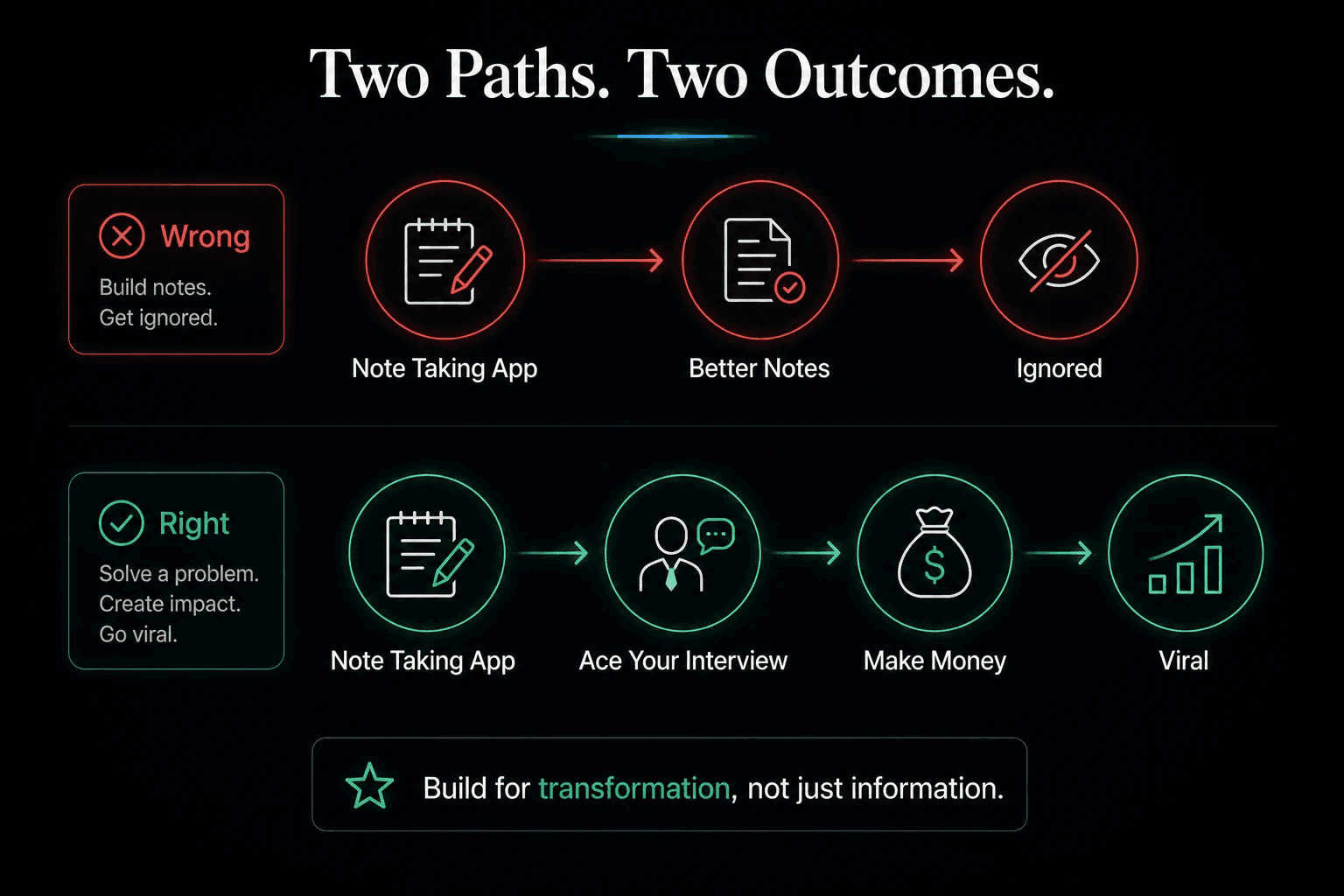
For a productivity app, "better organization" is not an outcome. It's an intermediate step. The outcomes further down that chain are things like finishing work earlier, getting a promotion, or eliminating the Sunday anxiety that comes from knowing Monday is going to be overwhelming. Those are the things people actually want.
The more specific and emotionally concrete the outcome, the stronger the hook. "Made an extra $400 this month using notes I already had" is a specific, emotionally resonant outcome. "Improved my workflow" is not.
A useful test: would a viewer who has never heard of your product feel something when they hear the outcome? If the honest answer is probably not, the outcome isn't there yet.
Step 2: Add the Twist That Earns the Click
An outcome-led hook is good. An outcome-led hook wrapped in a culturally charged frame is what generates shares and drives viral spread.
The Twist is the emotional or cultural context that surrounds the outcome. It's the reason this particular outcome, at this particular moment, feels urgent, surprising, or worth paying attention to. Without a Twist, even a strong outcome can feel generic. With the right Twist, the same outcome becomes something people send to their friends.
There are a few reliable Twist categories that map to what consistently resonates on TikTok and Instagram Reels:
The Speed Twist reframes a familiar outcome around an unexpected timeframe. "Made money in 48 hours" hits differently than "made money." The brevity creates urgency and implies the barrier to entry is lower than the viewer assumed.
The Counter-Narrative Twist positions the outcome against a widely held belief. "I stopped using every productivity app and started doing this instead" works because it challenges the assumption that more tools equal better results, then introduces a specific alternative.
The Specificity Twist narrows the outcome to a precise audience segment, making the hook feel like it was made for exactly one type of person. "For anyone in their first year of freelancing who keeps saying yes to bad clients" is a Twist. It's narrow enough to feel personal, which is exactly what earns a stop on a fast-moving feed.
The Stakes Twist raises the emotional cost of not acting. A financial app hook that leads with "the fee your bank has been charging you every month without telling you" works because it activates loss aversion before the product is ever mentioned.
How the Framework Looks in Practice
A note-taking app using this framework would not start by talking about features. It would start with a familiar frustration, like struggling to listen, learn, and take notes at the same time. The product then becomes the unexpected solution, transforming a common pain point into a compelling story.
This "Outcome + Twist" structure is one of the reasons the framework works across so many categories. At Masterhooks, we use these proven psychological frameworks alongside platform-native creative strategies to help brands produce UGC that captures attention, builds engagement, and scales profitably.
Want to know if your briefs focus on outcomes or features?

Want to know if your briefs focus on outcomes or features?
The brands generating the most views start with the viewer and work backward to the product. The Outcome + Twist framework is the structure that makes that process repeatable.
Why Feature-First Briefs Almost Always Fail
A feature is what a product does. An outcome is what the user's life looks like after they've used it. These are different things, and confusing them is the most common reason UGC underperforms.
A note-taking app that leads with "AI-powered transcription" is describing a feature. A note-taking app that leads with "passed my interview without memorizing a single note" is describing an outcome. The viewer only cares about the second one, because the second one describes something they want.
The logical gap between a feature and an outcome is where most hooks die. If a viewer needs to make four mental connections to understand how your fitness app will make them healthier, the hook has failed before the product is even named. The outcome has to be direct, specific, and emotionally resonant within the first two seconds.
Step 1: Find the True Outcome Your Product Delivers
The exercise here is straightforward but requires honesty. Ask: what is the actual change in someone's life after they've been using this product for 30 days?
Not the feature. Not the value proposition. The real-world change.
For a productivity app, "better organization" is not an outcome. It's an intermediate step. The outcomes further down that chain are things like finishing work earlier, getting a promotion, or eliminating the Sunday anxiety that comes from knowing Monday is going to be overwhelming. Those are the things people actually want.
The more specific and emotionally concrete the outcome, the stronger the hook. "Made an extra $400 this month using notes I already had" is a specific, emotionally resonant outcome. "Improved my workflow" is not.
A useful test: would a viewer who has never heard of your product feel something when they hear the outcome? If the honest answer is probably not, the outcome isn't there yet.
Step 2: Add the Twist That Earns the Click
An outcome-led hook is good. An outcome-led hook wrapped in a culturally charged frame is what generates shares and drives viral spread.
The Twist is the emotional or cultural context that surrounds the outcome. It's the reason this particular outcome, at this particular moment, feels urgent, surprising, or worth paying attention to. Without a Twist, even a strong outcome can feel generic. With the right Twist, the same outcome becomes something people send to their friends.
There are a few reliable Twist categories that map to what consistently resonates on TikTok and Instagram Reels:
The Speed Twist reframes a familiar outcome around an unexpected timeframe. "Made money in 48 hours" hits differently than "made money." The brevity creates urgency and implies the barrier to entry is lower than the viewer assumed.
The Counter-Narrative Twist positions the outcome against a widely held belief. "I stopped using every productivity app and started doing this instead" works because it challenges the assumption that more tools equal better results, then introduces a specific alternative.
The Specificity Twist narrows the outcome to a precise audience segment, making the hook feel like it was made for exactly one type of person. "For anyone in their first year of freelancing who keeps saying yes to bad clients" is a Twist. It's narrow enough to feel personal, which is exactly what earns a stop on a fast-moving feed.
The Stakes Twist raises the emotional cost of not acting. A financial app hook that leads with "the fee your bank has been charging you every month without telling you" works because it activates loss aversion before the product is ever mentioned.
How the Framework Looks in Practice
A note-taking app using this framework would not start by talking about features. It would start with a familiar frustration, like struggling to listen, learn, and take notes at the same time. The product then becomes the unexpected solution, transforming a common pain point into a compelling story.
This "Outcome + Twist" structure is one of the reasons the framework works across so many categories. At Masterhooks, we use these proven psychological frameworks alongside platform-native creative strategies to help brands produce UGC that captures attention, builds engagement, and scales profitably.
Want to know if your briefs focus on outcomes or features?
Related Reading


Need help scaling?
Book a strategy call with our expert team to audit your current UGC setup.
Related Reading
How Apple Turns a Product Launch Into a Yearly UGC Event That Runs Itself
How Apple's September launch cycle turns anticipation, information scarcity, creators, and product novelty into a recurring UGC engine.
4 min
|
How Apple Turns a Product Launch Into a Yearly UGC Event That Runs Itself
How Apple's September launch cycle turns anticipation, information scarcity, creators, and product novelty into a recurring UGC engine.
4 min
|
The Sydney Sweeney Novig Playbook: Why the Most Talked-About Ad of NFL Week 1 Was Also the Smartest
How Sydney Sweeney and Novig built a smarter celebrity partnership through equity, creative control, brand fit, and strategic timing.
4 min
|
The Sydney Sweeney Novig Playbook: Why the Most Talked-About Ad of NFL Week 1 Was Also the Smartest
How Sydney Sweeney and Novig built a smarter celebrity partnership through equity, creative control, brand fit, and strategic timing.
4 min
|
Why “September” by Earth, Wind & Fire Is the Most Viral Song on TikTok Every Year
Discover why Earth, Wind & Fire’s September goes viral on TikTok each year, and how brands can plan for predictable seasonal virality.
4 min
|
Why “September” by Earth, Wind & Fire Is the Most Viral Song on TikTok Every Year
Discover why Earth, Wind & Fire’s September goes viral on TikTok each year, and how brands can plan for predictable seasonal virality.
4 min
|