The True Cost of Video Ads in 2026: UGC vs. In-House Production
A single studio shoot costs $2K to $10K and burns out in weeks. Here's the full cost breakdown between UGC and in-house production for paid social in 2026.
Published:

Read Time:

5 min

Written by:
Fawwaz
Trend Research and Copywriter
ASK THE TRUE QUESTIONS
It is not "how much does a video cost to make?", but "how much does it cost to keep a paid social account performing for a full quarter?"
ASK THE TRUE QUESTIONS
It is not "how much does a video cost to make?", but "how much does it cost to keep a paid social account performing for a full quarter?"
ASK THE TRUE QUESTIONS
It is not "how much does a video cost to make?", but "how much does it cost to keep a paid social account performing for a full quarter?"
When you frame it that way, the math between in-house production and UGC looks completely different.
What In-House Production Actually Costs
The appeal of in-house production is control. The brand owns the process, controls the aesthetic, and can ensure every frame reflects the approved brand guidelines. For content that lives on a homepage or serves as a brand film at an investor presentation, that control is worth the cost.
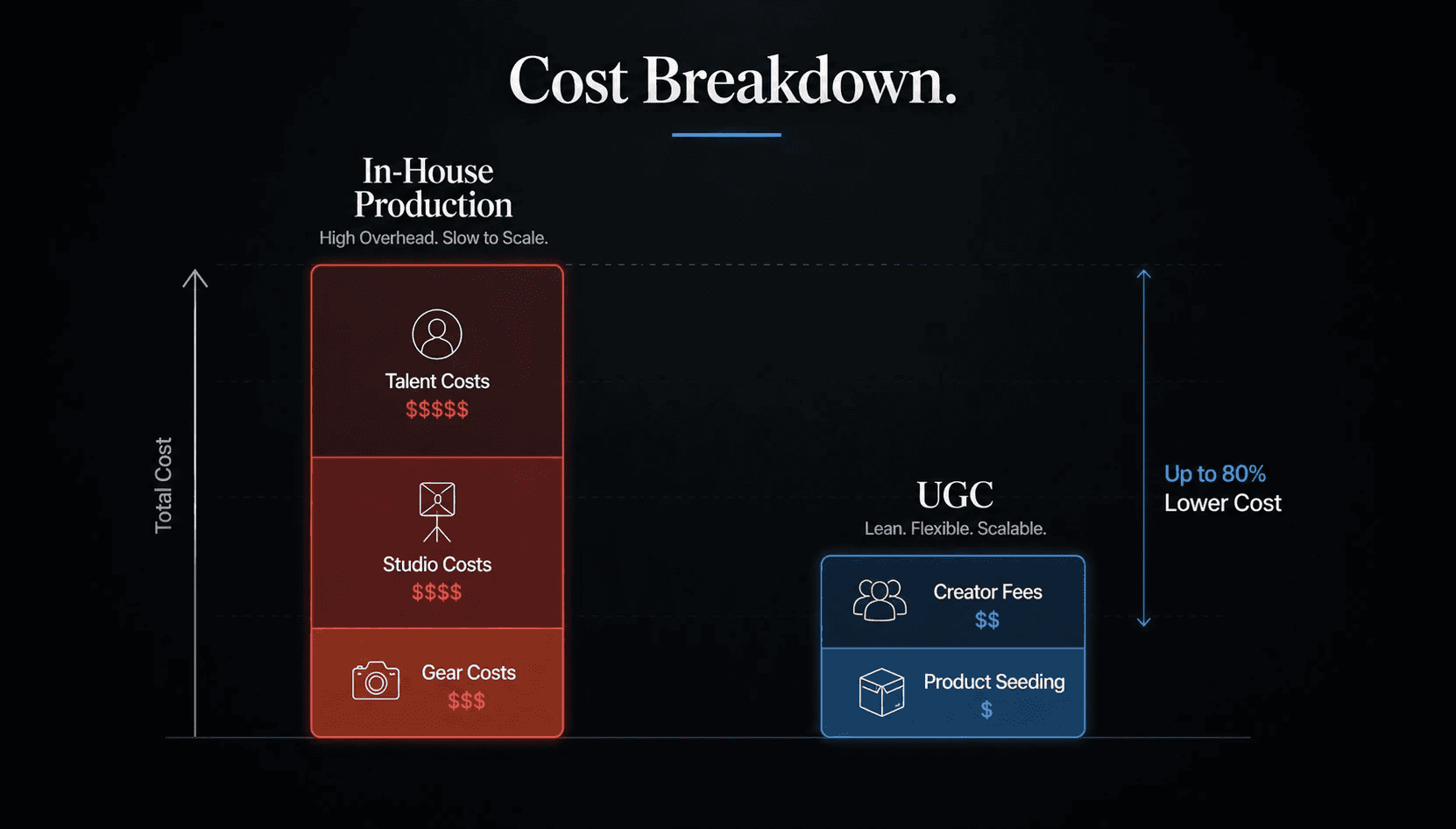
The cost is substantial. Studio day rates for professional equipment and space run $1,000 to $3,000. A director of photography adds $500 to $1,500 per day. Actors and on-camera talent, depending on experience and usage rights, add another $500 to $2,000 per shoot. Post-production — editing, color grading, sound design — typically runs $500 to $3,000 depending on complexity.
A single polished 30-second commercial, before any media spend, costs $2,000 to $10,000 to produce. The production timeline from brief to final delivery runs three to six weeks.
For a brand running one or two campaigns per year with long production windows, this model can be justified. For a brand running paid social at any meaningful scale, it breaks almost immediately.
Why the Math Changes Completely on Paid Social
Paid social has a mechanic that makes high-production video economics unsustainable: ad fatigue. On Meta and TikTok, even a genuinely effective ad loses performance as the audience becomes familiar with it. The creative that drove strong results in week one often shows significant performance decay by week two or three.
That decay is not a bug in the algorithm. It's a signal that the audience has already processed the content and doesn't need to engage with it again. The platform interprets repeated exposure with declining engagement as a sign to reduce distribution.
This means that sustaining paid social performance requires a continuous supply of fresh creative. A brand that can only produce one or two polished videos per quarter is not building a content engine — it's producing expensive assets that will burn out before they've returned the production cost.
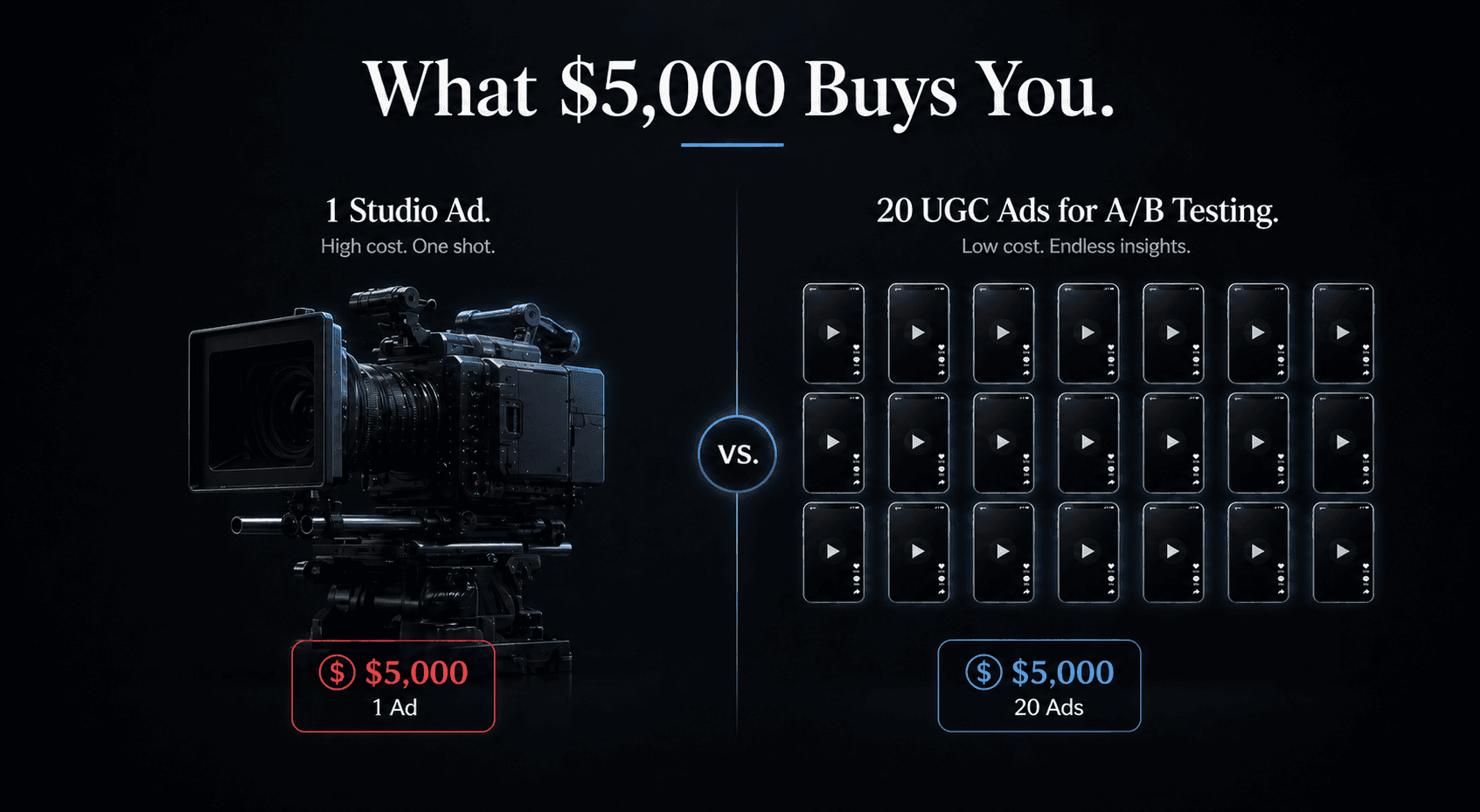
For that same $5,000 that a single studio shoot costs, a brand could commission 15 to 20 UGC videos. That's 15 to 20 different hooks, angles, and formats running simultaneously in an ad account, generating real performance data on what actually resonates with the audience.
What UGC Actually Costs
UGC production inverts the cost structure entirely. The creator provides the camera (their phone), the location (their space), and the on-camera talent (themselves). The brand pays a flat fee per video deliverable.
Studio Ad
Low ROAS
UGC Ad
Massive ROAS
Depending on creator experience, niche, and the complexity of the brief, UGC videos typically cost $150 to $500 each. Turnaround is five to seven days from brief to delivery. There are no overhead costs, no studio day rates, no equipment rentals, and no post-production invoices.
The asset is fully licensed for paid use across TikTok Ads, Meta, and YouTube Shorts from delivery. The brand owns it and can run it indefinitely without additional fees.
The Performance Question: Does Production Quality Matter?
This is the most important thing to understand about the UGC cost model: high production value actively works against performance on social feeds.
The cognitive mechanism is straightforward. Years of social media have trained viewers to recognize the visual signatures of brand advertising — clean lighting, professional color grading, seamless editing, on-screen text in brand fonts. When those signals appear, the viewer's ad-recognition filter fires automatically, and the mental skip response follows.
Content that looks native to the platform doesn't trigger that filter. A slightly shaky shot from a phone, natural lighting, and a creator speaking conversationally in selfie mode reads as organic content, not as an ad. The viewer processes it differently, engages more deeply, and is more likely to click.
TikTok's own platform data consistently shows that ads featuring native creators and lo-fi production aesthetics outperform polished brand videos on watch time and cost per click. Production quality and conversion rate are not correlated on social feeds. They are often inversely correlated.
The True Cost Comparison
Factor | In-House Production | UGC |
Cost per video | $2,000 to $10,000 | $150 to $500 |
Turnaround time | 3 to 6 weeks | 5 to 7 days |
Videos for $5,000 budget | 1 to 2 | 15 to 20 |
Ad fatigue mitigation | Low — limited variation | High — constant fresh creative |
Performance on paid social | Lower (triggers ad recognition) | Higher (native-feeling content) |
Usage rights | Negotiated separately | Included in flat rate |
Which Model Fits Your Situation
In-house or agency production makes sense for brand films, homepage videos, and long-form content where production quality signals brand credibility to a considered buyer. These are contexts where the viewer is already interested and the video's job is to reinforce trust, not create attention.
UGC makes sense for any brand running paid social at scale on Meta or TikTok, where the content's job is to stop a cold audience mid-scroll and move them toward a specific action. The volume flexibility and cost structure of UGC are specifically designed for the demands of a paid social operation.
Most brands eventually need both. The question is which one the current growth objective actually requires.

Is your production model built for paid social scale?
Is your production model built for paid social scale?
When you frame it that way, the math between in-house production and UGC looks completely different.
What In-House Production Actually Costs
The appeal of in-house production is control. The brand owns the process, controls the aesthetic, and can ensure every frame reflects the approved brand guidelines. For content that lives on a homepage or serves as a brand film at an investor presentation, that control is worth the cost.
The cost is substantial. Studio day rates for professional equipment and space run $1,000 to $3,000. A director of photography adds $500 to $1,500 per day. Actors and on-camera talent, depending on experience and usage rights, add another $500 to $2,000 per shoot. Post-production — editing, color grading, sound design — typically runs $500 to $3,000 depending on complexity.
A single polished 30-second commercial, before any media spend, costs $2,000 to $10,000 to produce. The production timeline from brief to final delivery runs three to six weeks.
For a brand running one or two campaigns per year with long production windows, this model can be justified. For a brand running paid social at any meaningful scale, it breaks almost immediately.
Why the Math Changes Completely on Paid Social
Paid social has a mechanic that makes high-production video economics unsustainable: ad fatigue. On Meta and TikTok, even a genuinely effective ad loses performance as the audience becomes familiar with it. The creative that drove strong results in week one often shows significant performance decay by week two or three.
That decay is not a bug in the algorithm. It's a signal that the audience has already processed the content and doesn't need to engage with it again. The platform interprets repeated exposure with declining engagement as a sign to reduce distribution.
This means that sustaining paid social performance requires a continuous supply of fresh creative. A brand that can only produce one or two polished videos per quarter is not building a content engine — it's producing expensive assets that will burn out before they've returned the production cost.
For that same $5,000 that a single studio shoot costs, a brand could commission 15 to 20 UGC videos. That's 15 to 20 different hooks, angles, and formats running simultaneously in an ad account, generating real performance data on what actually resonates with the audience.
What UGC Actually Costs
UGC production inverts the cost structure entirely. The creator provides the camera (their phone), the location (their space), and the on-camera talent (themselves). The brand pays a flat fee per video deliverable.
Studio Ad
Low ROAS
UGC Ad
Massive ROAS
Depending on creator experience, niche, and the complexity of the brief, UGC videos typically cost $150 to $500 each. Turnaround is five to seven days from brief to delivery. There are no overhead costs, no studio day rates, no equipment rentals, and no post-production invoices.
The asset is fully licensed for paid use across TikTok Ads, Meta, and YouTube Shorts from delivery. The brand owns it and can run it indefinitely without additional fees.
The Performance Question: Does Production Quality Matter?
This is the most important thing to understand about the UGC cost model: high production value actively works against performance on social feeds.
The cognitive mechanism is straightforward. Years of social media have trained viewers to recognize the visual signatures of brand advertising — clean lighting, professional color grading, seamless editing, on-screen text in brand fonts. When those signals appear, the viewer's ad-recognition filter fires automatically, and the mental skip response follows.
Content that looks native to the platform doesn't trigger that filter. A slightly shaky shot from a phone, natural lighting, and a creator speaking conversationally in selfie mode reads as organic content, not as an ad. The viewer processes it differently, engages more deeply, and is more likely to click.
TikTok's own platform data consistently shows that ads featuring native creators and lo-fi production aesthetics outperform polished brand videos on watch time and cost per click. Production quality and conversion rate are not correlated on social feeds. They are often inversely correlated.
The True Cost Comparison
Factor | In-House Production | UGC |
Cost per video | $2,000 to $10,000 | $150 to $500 |
Turnaround time | 3 to 6 weeks | 5 to 7 days |
Videos for $5,000 budget | 1 to 2 | 15 to 20 |
Ad fatigue mitigation | Low — limited variation | High — constant fresh creative |
Performance on paid social | Lower (triggers ad recognition) | Higher (native-feeling content) |
Usage rights | Negotiated separately | Included in flat rate |
Which Model Fits Your Situation
In-house or agency production makes sense for brand films, homepage videos, and long-form content where production quality signals brand credibility to a considered buyer. These are contexts where the viewer is already interested and the video's job is to reinforce trust, not create attention.
UGC makes sense for any brand running paid social at scale on Meta or TikTok, where the content's job is to stop a cold audience mid-scroll and move them toward a specific action. The volume flexibility and cost structure of UGC are specifically designed for the demands of a paid social operation.
Most brands eventually need both. The question is which one the current growth objective actually requires.
Is your production model built for paid social scale?
Related Reading
Related Reading
What ComplexCon Reveals About Turning Product Drops Into Event UGC
4 min
|
What ComplexCon Reveals About Turning Product Drops Into Event UGC
Explore how ComplexCon product launch create opportunities for event UGC, with practical lessons for product drops, smaller pop-ups, and measurement.
4 min
|
How to Turn Product Photos Into AI Video Ads That Are Ready to Run
4 min
|
How to Turn Product Photos Into AI Video Ads That Are Ready to Run
Learn how to turn product photos into AI video ads using a practical workflow for storyboarding, generation, editing, quality control, and delivery.
4 min
|

What Fourth Wing Reveals About BookTok and Community Marketing
4 min
|
What Fourth Wing Reveals About BookTok and Community Marketing
See how Fourth Wing fans turn one book into reactions, theories, recommendations, and rituals, and what brands can learn from community-led marketing.
4 min
|


Need help scaling?
Book a strategy call with our expert team to audit your current UGC setup.