



The Messi Effect: What 751 Million Impressions From 10 Posts Teaches Us About
The Messi Effect: What 751 Million Impressions From 10 Posts Teaches Us About
Lionel Messi generated 751 million impressions from just 10 World Cup posts. Here's what brands can learn about timing, influence, and reach.
Published:

Read Time:

3 min

Written by:
Fawwaz
Trend Research and Copywriter
MORE CONTENT DOESN'T CREATE MORE IMPACT
Brands often chase volume, but the biggest marketing wins frequently come from a small number of highly effective pieces of content.
MORE CONTENT DOESN'T CREATE MORE IMPACT
Brands often chase volume, but the biggest marketing wins frequently come from a small number of highly effective pieces of content.
MORE CONTENT DOESN'T CREATE MORE IMPACT
Brands often chase volume, but the biggest marketing wins frequently come from a small number of highly effective pieces of content.
According to CreatorIQ's World Cup influencer marketing analysis, Lionel Messi was able to generate 751 million views with just ten posts. Meanwhile, many creators publish dozens of pieces of content just to reach a fraction of that reach.
What Messi demonstrates isn’t that brands should stop producing content, but that effective distribution isn’t determined solely by high volume. This article will explore how, sometimes, the right person at the right time can create extraordinary results for your brand.
The Data Behind Messi's Performance
The FIFA World Cup is one of the most high-profile events in the global sports world.
To capitalize on this momentum, brands naturally turn to soccer players and content creators to join the buzz surrounding the FIFA World Cup. Among the many soccer players and creators serving as a bridge for brands to participate, Messi stands out far above the rest.
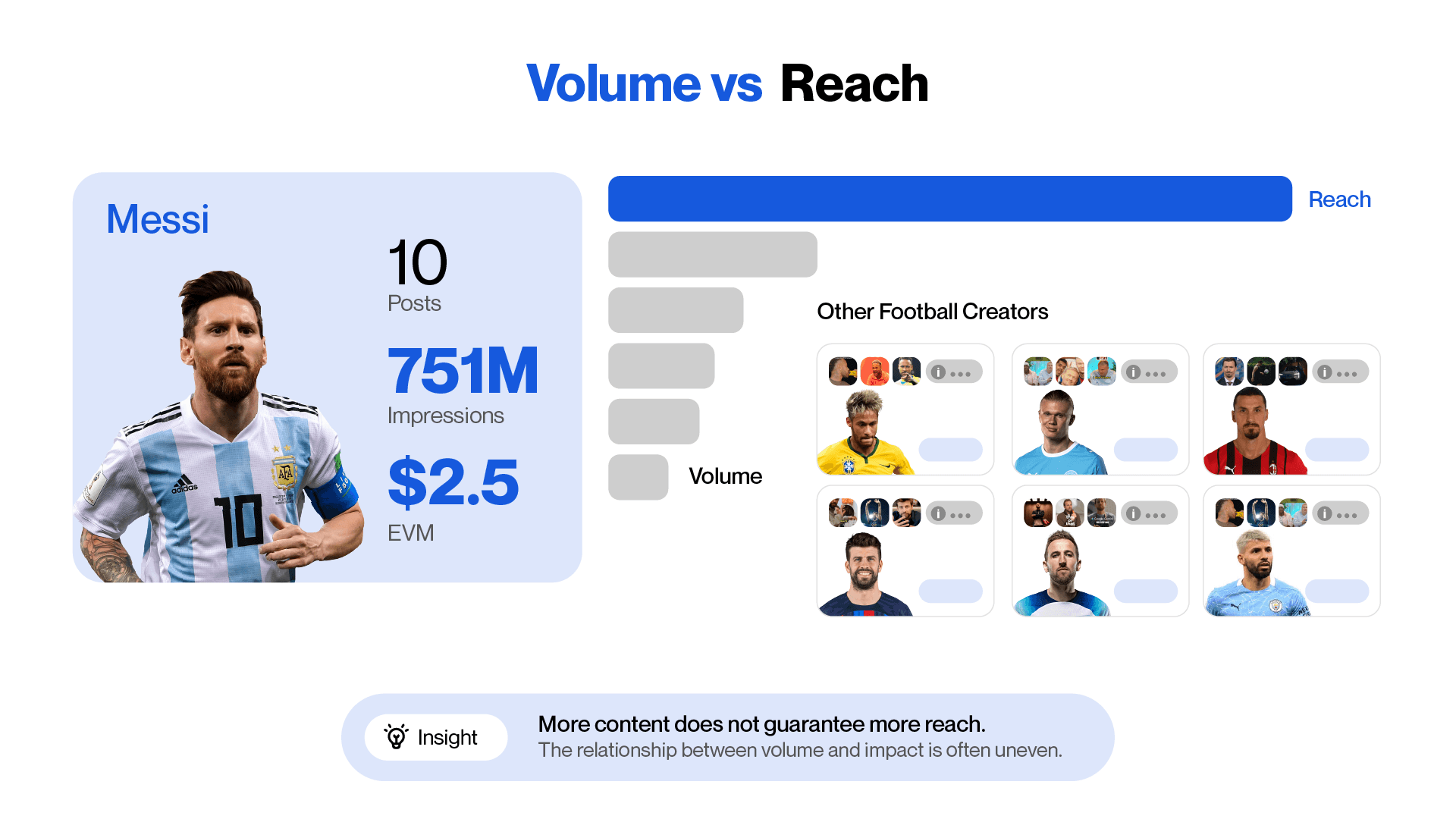
With just 10 sponsored posts, Messi generated 751 million impressions, which translated to approximately $2.5 million in EMV (Earned Media Value). This highlights a massive gap between Messi and many other players, as some athletes post far more content yet none can generate the same level of attention.
Messi’s success in capturing the public’s attention is significant because it challenges common assumptions in marketing. Reach is not distributed evenly; sometimes, a single post from one person can outperform an entire content calendar.
Why Volume Is Not The Whole Story
At this point, marketers are prone to misinterpreting this lesson by immediately concluding that volume isn’t important after looking at the numbers.
That conclusion is incorrect because volume remains crucial in marketing, as many successful brands have grown through consistent content production. The challenge here is to recognize that volume works differently from influence. While volume serves to increase opportunities, influence actually reinforces those opportunities. A creator who publishes 50 posts creates more opportunities to reach an audience. However, a major influencer like Messi can generate massive attention from a single moment because the audience is already invested in his presence.
The relationship between these two concepts is about understanding when one becomes more important than the other. For some brands, volume can build a strong foundation, while strategic moments can accelerate that growth.
What Makes One Post Work So Hard?
To examine the reasons behind the success of Messi’s post, the more appropriate question to ask isn’t how many impressions it received, but why was it so successful? And to answer that question, here are the factors that influenced it:
Factor #1: Source Credibility
Messi is the central figure in one of the world’s greatest sports narratives, not just a soccer player participating in the FIFA World Cup. The public has long paid close attention to Messi, and when someone’s credibility reaches that level, content distribution becomes easier. This is because the audience doesn’t need to be convinced all over again since they’ve already watched him play and know who Lionel Messi is.
Factor #2: The Right Moment
Momentum is something that marketers must recognize and capitalize on. A post published during a typical week has to compete with a lot of distractions, but a post published during a key World Cup moment can tap into an existing conversation.
This is exactly what happened with the Messi content, where the surge in impressions was a direct benefit of the World Cup’s momentum, which is one of the most attention-grabbing events ever. During the World Cup, the audience isn’t just waiting for content; they’re already emotionally invested. Therefore, posting something relevant to this momentum is the right move for a brand that wants to keep growing.
Factor #3: Authentic Context
One reason influencer campaigns struggle is that audiences can immediately spot forced partnerships. In fact, the most effective influencer content campaigns should feel connected to real-life moments. As a major figure in the world of soccer, Messi doesn’t need to create a connection between himself and the ongoing World Cup, which is being followed by so many people. It is this authenticity that boosts public engagement with the content Messi posts.
What This Means For Brands
Most brands cannot afford to sign Lionel Messi because of their limited budgets. Most brands also don’t have access to the kind of attention generated by the World Cup, so you might think that these two reasons make the lesson above irrelevant.
In fact, this case offers a very valuable lesson because the key point isn’t about celebrities, but about leverage. Brands with limited budgets often assume they must compete solely on volume by producing and publishing more content. While that sometimes works, there’s another option that could be a more cost-effective alternative for your marketing budget.
That alternative is to identify a trend where public attention has already been captured, and find a creator who already has credibility among the audience relevant to that trend. Then, create content that feels connected to the existing conversation surrounding that trend. This approach is an excellent alternative because a small creator speaking to the right audience at the right time can outperform a much larger campaign launched at the wrong time.
The Real Competition Isn't Volume
One of the most common pitfalls in modern marketing is assuming that every problem can be solved with more content. While this can certainly help, content only creates value when people care about its source, timing, and the story it tells.
FIFA World Cup data clearly illustrates this point: Messi wasn’t successful simply because he posted more than anyone else. He succeeded because his influence, credibility, timing, and audience engagement all aligned at the same time. This is a difficult combination to achieve, but understanding it can help brands make better decisions about where to invest their resources.
Building Reach Through Better Leverage
The Messi example highlights an important reality about modern marketing: attention is rarely distributed evenly. Some creators, moments, and stories carry significantly more weight than others.
For brands with limited resources, this should be encouraging. Success doesn't always require matching larger competitors in production volume. Sometimes the smarter approach is identifying the right creator, the right audience, and the right moment.
This is one reason Masterhooks frequently studies creator ecosystems, audience psychology, and distribution patterns rather than focusing exclusively on content output. The goal is not simply producing more content. The goal is understanding which pieces of content have the greatest potential to travel through an audience and create disproportionate results.
Want to know how to choose the right creator and capitalize the momentum?

Want to know how to choose the right creator and capitalize the momentum?
According to CreatorIQ's World Cup influencer marketing analysis, Lionel Messi was able to generate 751 million views with just ten posts. Meanwhile, many creators publish dozens of pieces of content just to reach a fraction of that reach.
What Messi demonstrates isn’t that brands should stop producing content, but that effective distribution isn’t determined solely by high volume. This article will explore how, sometimes, the right person at the right time can create extraordinary results for your brand.
The Data Behind Messi's Performance
The FIFA World Cup is one of the most high-profile events in the global sports world.
To capitalize on this momentum, brands naturally turn to soccer players and content creators to join the buzz surrounding the FIFA World Cup. Among the many soccer players and creators serving as a bridge for brands to participate, Messi stands out far above the rest.
With just 10 sponsored posts, Messi generated 751 million impressions, which translated to approximately $2.5 million in EMV (Earned Media Value). This highlights a massive gap between Messi and many other players, as some athletes post far more content yet none can generate the same level of attention.
Messi’s success in capturing the public’s attention is significant because it challenges common assumptions in marketing. Reach is not distributed evenly; sometimes, a single post from one person can outperform an entire content calendar.
Why Volume Is Not The Whole Story
At this point, marketers are prone to misinterpreting this lesson by immediately concluding that volume isn’t important after looking at the numbers.
That conclusion is incorrect because volume remains crucial in marketing, as many successful brands have grown through consistent content production. The challenge here is to recognize that volume works differently from influence. While volume serves to increase opportunities, influence actually reinforces those opportunities. A creator who publishes 50 posts creates more opportunities to reach an audience. However, a major influencer like Messi can generate massive attention from a single moment because the audience is already invested in his presence.
The relationship between these two concepts is about understanding when one becomes more important than the other. For some brands, volume can build a strong foundation, while strategic moments can accelerate that growth.
What Makes One Post Work So Hard?
To examine the reasons behind the success of Messi’s post, the more appropriate question to ask isn’t how many impressions it received, but why was it so successful? And to answer that question, here are the factors that influenced it:
Factor #1: Source Credibility
Messi is the central figure in one of the world’s greatest sports narratives, not just a soccer player participating in the FIFA World Cup. The public has long paid close attention to Messi, and when someone’s credibility reaches that level, content distribution becomes easier. This is because the audience doesn’t need to be convinced all over again since they’ve already watched him play and know who Lionel Messi is.
Factor #2: The Right Moment
Momentum is something that marketers must recognize and capitalize on. A post published during a typical week has to compete with a lot of distractions, but a post published during a key World Cup moment can tap into an existing conversation.
This is exactly what happened with the Messi content, where the surge in impressions was a direct benefit of the World Cup’s momentum, which is one of the most attention-grabbing events ever. During the World Cup, the audience isn’t just waiting for content; they’re already emotionally invested. Therefore, posting something relevant to this momentum is the right move for a brand that wants to keep growing.
Factor #3: Authentic Context
One reason influencer campaigns struggle is that audiences can immediately spot forced partnerships. In fact, the most effective influencer content campaigns should feel connected to real-life moments. As a major figure in the world of soccer, Messi doesn’t need to create a connection between himself and the ongoing World Cup, which is being followed by so many people. It is this authenticity that boosts public engagement with the content Messi posts.
What This Means For Brands
Most brands cannot afford to sign Lionel Messi because of their limited budgets. Most brands also don’t have access to the kind of attention generated by the World Cup, so you might think that these two reasons make the lesson above irrelevant.
In fact, this case offers a very valuable lesson because the key point isn’t about celebrities, but about leverage. Brands with limited budgets often assume they must compete solely on volume by producing and publishing more content. While that sometimes works, there’s another option that could be a more cost-effective alternative for your marketing budget.
That alternative is to identify a trend where public attention has already been captured, and find a creator who already has credibility among the audience relevant to that trend. Then, create content that feels connected to the existing conversation surrounding that trend. This approach is an excellent alternative because a small creator speaking to the right audience at the right time can outperform a much larger campaign launched at the wrong time.
The Real Competition Isn't Volume
One of the most common pitfalls in modern marketing is assuming that every problem can be solved with more content. While this can certainly help, content only creates value when people care about its source, timing, and the story it tells.
FIFA World Cup data clearly illustrates this point: Messi wasn’t successful simply because he posted more than anyone else. He succeeded because his influence, credibility, timing, and audience engagement all aligned at the same time. This is a difficult combination to achieve, but understanding it can help brands make better decisions about where to invest their resources.
Building Reach Through Better Leverage
The Messi example highlights an important reality about modern marketing: attention is rarely distributed evenly. Some creators, moments, and stories carry significantly more weight than others.
For brands with limited resources, this should be encouraging. Success doesn't always require matching larger competitors in production volume. Sometimes the smarter approach is identifying the right creator, the right audience, and the right moment.
This is one reason Masterhooks frequently studies creator ecosystems, audience psychology, and distribution patterns rather than focusing exclusively on content output. The goal is not simply producing more content. The goal is understanding which pieces of content have the greatest potential to travel through an audience and create disproportionate results.
Want to know how to choose the right creator and capitalize the momentum?
Related Reading
Related Reading

How to Find the Right Influencer Marketing Agency for Your Brand (Without Wasting Budget)
6 min
|
How to Find the Right Influencer Marketing Agency for Your Brand (Without Wasting Budget)
Learn how to choose an influencer marketing agency using a practical scorecard, performance criteria, red flags, and pre-contract checks.
6 min
|

AI Video Ad Agencies: A Buyer's Guide for DTC Brands (2026)
4 min
|
AI Video Ad Agencies: A Buyer's Guide for DTC Brands (2026)
Compare AI video ad agency types, pricing, performance metrics, ownership rights, and seven questions DTC brands should ask before hiring.
4 min
|

How Taylor Swift Engineered a UGC Wave With 13 Seconds of Video and One Awards Show
4 min
|
How Taylor Swift Engineered a UGC Wave With 13 Seconds of Video and One Awards Show
How Taylor Swift turned a 13-second teaser, Easter eggs, and a live VMA premiere into a UGC engine brands can adapt for organic distribution.
4 min
|


Need help scaling?
Book a strategy call with our expert team to audit your current UGC setup.

