




Creator Economy
How “End of August” Became TikTok’s Song of the Summer, and What It Teaches Us About Viral Audio
How “End of August” Became TikTok’s Song of the Summer, and What It Teaches Us About Viral Audio
Learn why Noah Kahan’s End of August became a TikTok hit and what its timing, emotion, and cultural identity teach brands about viral audio.
Published:

Read Time:

3 min

Written by:
Fawwaz
Trend Research and Copywriter
A SONG THAT BECAME A CULTURAL PHENOMENON ON TIKTOK
Noah Kahan’s song “End of August” became a cultural phenomenon on TikTok due to the convergence of three elements at just the right moment: an established emotional identity, a very specific sense of place, and the universal feeling of summer coming to an end.
A SONG THAT BECAME A CULTURAL PHENOMENON ON TIKTOK
Noah Kahan’s song “End of August” became a cultural phenomenon on TikTok due to the convergence of three elements at just the right moment: an established emotional identity, a very specific sense of place, and the universal feeling of summer coming to an end.
A SONG THAT BECAME A CULTURAL PHENOMENON ON TIKTOK
Noah Kahan’s song “End of August” became a cultural phenomenon on TikTok due to the convergence of three elements at just the right moment: an established emotional identity, a very specific sense of place, and the universal feeling of summer coming to an end.
“End of August” was released in April 2026, but it didn’t find its broadest social context until several months later, when creators began using it as background music for vacation moments, friendships, sunsets, love stories, and memories of a summer that was slipping away. This time lag is an interesting phenomenon that demonstrates that the virality of an audio track often depends not on its release date, but on the discovery of a moment when the audience already has a reason to feel a certain way.
The Viral Audio Timeline Was Longer Than You Think
One of the easiest mistakes in studying TikTok trends is assuming that a song has to explode immediately after release. But “End of August” tells a different story.
This song is the opening track on Kahan’s fourth album, The Great Divide, which was released on April 24, 2026, but its cultural relevance became much stronger as August approached.
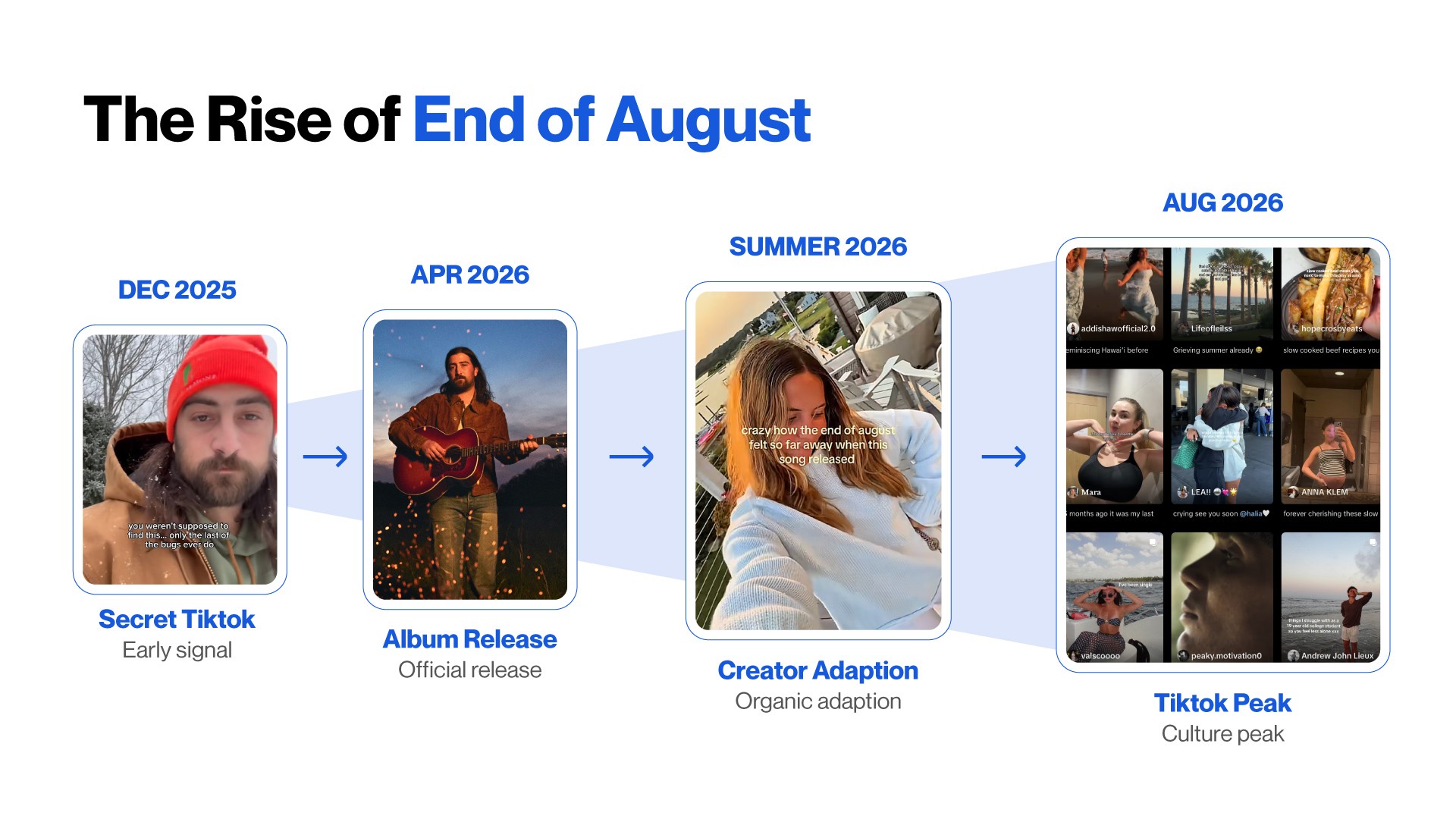
SocialBee’s summary of August TikTok trends shows creators using this song to accompany content centered on vacation memories, sunsets, time with friends, summer romance, photo dumps, and small moments from previous months. This creates an effective diffusion pattern for the song:
Release → discovery → contextual fit → adoption by creators → cultural symbol
The first stage occurred in April, while the fourth and fifth stages took place several months later. This is significant because creators aren’t simply discovering a new song, but something that suddenly provides a way to describe something they’ve actually already experienced.
The “8,600 Videos” Moment
By mid-August, TikTok reports on this trend noted that the audio had been used in more than 8,600 videos, illustrating just how rapidly its use had increased. These exact figures will continue to change as more content uses this song, but a more important lesson to understand lies in the pattern of its growth.
Tap to play
Tap to play
Tap to play
A song released several months earlier suddenly became much more relevant because the timing aligned perfectly with the song. This mechanism is very different from simply promoting a song aggressively until people take notice.
The Secret TikTok Account Created the First Layer of Meaning
Before Noah Kahan's 'End of August' became a widely recognized track on TikTok, he had already built a whole world around it.
Tap to play
In December 2025, a mysterious account, @thelastofthebugs, appeared with a short video featuring Noah Kahan and a snippet of an unreleased song. The account was later revealed to be part of the launch of The Great Divide. Instead of providing a full explanation, Kahan offered clues that encouraged fans to explore the account, formulate theories, and connect it to his previous work, such as Stick Season.
This strategy ensured that the audience didn’t simply receive an announcement but actively helped uncover the story. For creators and brands, this demonstrates how context can enhance the value of an audio asset. A sound that carries a story, identity, or cultural reference can bring inherent meaning when used on TikTok.
Why “End of August” Worked So Well
There are three reasons the song became unusually easy for creators to use.
1. The emotional identity was already there
Noah Kahan enters this moment with an already strong emotional identity. The success of Stick Season has established associations with nostalgia, small-town life, the changing of the seasons, home, and the process of growing up, which are themes that are largely carried forward in his new album.
Therefore, “End of August” doesn’t need to build its emotional identity from scratch. When the audio is used on TikTok, the audience already has an idea of the feelings it aims to convey. Like a visual filter, familiar audio can immediately set the emotional tone for a video even before the audience reads the caption.
2. The song is specific enough to feel real
Kahan expressed his desire for this song to evoke the atmosphere of late summer in Vermont or a small town, when everything feels quieter than usual. This specific imagery actually makes “End of August” easy for listeners to relate to, as it leaves room for personal interpretation.
This is also why so many people search for the meaning behind Noah Kahan's 'End of August'. Rather than telling one literal story, the song describes the feeling of a season quietly ending, which is why listeners looking up what 'End of August' by Noah Kahan is about tend to find their own memories in it instead of a single fixed narrative.
Someone in Vermont might associate it with their hometown, while a listener in California might recall the atmosphere of the beach. A recent graduate might connect it to the end of their college years, while someone just back from vacation might associate it with a return to routine. The backgrounds may differ, but the feelings it evokes remain familiar, and that’s one of the keys to audio that goes viral on TikTok.
The Calendar Did Part of the Marketing
The most important lesson from this trend lies in how this song captures an emotional state that becomes increasingly relevant as August progresses. This means the song’s theme and the listeners’ real-life experiences begin to converge. As August draws to a close, people are already starting to think about:
Summer ending
Going back to school
Leaving vacation
Saying goodbye to friends
Changing routines
Looking back at photos
The first signs of fall
How quickly the year has passed
The song provides a musical backdrop for those feelings, and that’s why the four-month gap between its release and the moment it went viral is so significant.
The song became more relevant because listeners’ experiences finally aligned with the song’s lyrics. This is a crucial distinction for anyone studying audio trends on TikTok. Because sometimes the best audio opportunities aren’t the newest ones on the platform, but rather those that suddenly feel perfectly in tune with what many people are currently experiencing.
How Creators Turned One Song Into Thousands of Stories
The strongest evidence of the flexibility of “End of August” is seen in the variety of content that uses it as a backdrop.
SocialBee’s August trend report highlights content ranging from vacation memories, sunsets, time with friends, summer romance, photo dumps, to everyday moments. This diversity arises because the audio provides an emotional framework, while the creator’s visuals tell a personal story and the captions offer a more specific interpretation. One creator might showcase their last day at the beach, another might capture moments with friends before parting ways to go to college, while yet another might share photos of summer romance or their final nights at home. The same audio connects them all, but the personal visuals ensure that each post still feels unique. This is what makes a song a “song of the season” not just a trending audio clip on TikTok.
What Brands Can Learn From “End of August”
The most important lesson isn’t simply “finding the next Noah Kahan song,” because that approach is too narrow. A better question is: what emotional context is emerging around a piece of audio, and can a brand contribute in a way that aligns with that context? Brands often only take notice of a piece of audio after it goes viral, by which point millions of people may have already associated it with a specific format or context. In reality, the most valuable opportunities arise earlier when creators are still shaping the meaning behind that sound.
For example, a travel brand could use “End of August” to tell the story of one last trip before returning to routine; a food brand could highlight summer dishes that people will miss; or a fashion brand could showcase outfits that define the season. With this approach, products don’t just ride the wave of popular audio, but become part of the emotional narrative the audience has already built. The content then has a reason to exist beyond simply following a trend.
Turning Trends Into Better UGC Decisions
For brands, the advantage comes from recognizing these moments early and understanding what makes them worth turning into content. That means spotting culturally relevant formats, identifying what audiences are responding to, and matching the right creators and concepts to the right distribution environment.
This is the kind of pattern Masterhooks studies when developing UGC strategies. Brands looking to understand where their current content strategy is strong and where opportunities are being missed can start by assessing their creative approach with the Masterhooks Brand Audit.
Want to spot these audio moments before they peak and turn them into UGC?

Want to spot these audio moments before they peak and turn them into UGC?
“End of August” was released in April 2026, but it didn’t find its broadest social context until several months later, when creators began using it as background music for vacation moments, friendships, sunsets, love stories, and memories of a summer that was slipping away. This time lag is an interesting phenomenon that demonstrates that the virality of an audio track often depends not on its release date, but on the discovery of a moment when the audience already has a reason to feel a certain way.
The Viral Audio Timeline Was Longer Than You Think
One of the easiest mistakes in studying TikTok trends is assuming that a song has to explode immediately after release. But “End of August” tells a different story.
This song is the opening track on Kahan’s fourth album, The Great Divide, which was released on April 24, 2026, but its cultural relevance became much stronger as August approached.
SocialBee’s summary of August TikTok trends shows creators using this song to accompany content centered on vacation memories, sunsets, time with friends, summer romance, photo dumps, and small moments from previous months. This creates an effective diffusion pattern for the song:
Release → discovery → contextual fit → adoption by creators → cultural symbol
The first stage occurred in April, while the fourth and fifth stages took place several months later. This is significant because creators aren’t simply discovering a new song, but something that suddenly provides a way to describe something they’ve actually already experienced.
The “8,600 Videos” Moment
By mid-August, TikTok reports on this trend noted that the audio had been used in more than 8,600 videos, illustrating just how rapidly its use had increased. These exact figures will continue to change as more content uses this song, but a more important lesson to understand lies in the pattern of its growth.
Tap to play
Tap to play
Tap to play
A song released several months earlier suddenly became much more relevant because the timing aligned perfectly with the song. This mechanism is very different from simply promoting a song aggressively until people take notice.
The Secret TikTok Account Created the First Layer of Meaning
Before Noah Kahan's 'End of August' became a widely recognized track on TikTok, he had already built a whole world around it.
Tap to play
In December 2025, a mysterious account, @thelastofthebugs, appeared with a short video featuring Noah Kahan and a snippet of an unreleased song. The account was later revealed to be part of the launch of The Great Divide. Instead of providing a full explanation, Kahan offered clues that encouraged fans to explore the account, formulate theories, and connect it to his previous work, such as Stick Season.
This strategy ensured that the audience didn’t simply receive an announcement but actively helped uncover the story. For creators and brands, this demonstrates how context can enhance the value of an audio asset. A sound that carries a story, identity, or cultural reference can bring inherent meaning when used on TikTok.
Why “End of August” Worked So Well
There are three reasons the song became unusually easy for creators to use.
1. The emotional identity was already there
Noah Kahan enters this moment with an already strong emotional identity. The success of Stick Season has established associations with nostalgia, small-town life, the changing of the seasons, home, and the process of growing up, which are themes that are largely carried forward in his new album.
Therefore, “End of August” doesn’t need to build its emotional identity from scratch. When the audio is used on TikTok, the audience already has an idea of the feelings it aims to convey. Like a visual filter, familiar audio can immediately set the emotional tone for a video even before the audience reads the caption.
2. The song is specific enough to feel real
Kahan expressed his desire for this song to evoke the atmosphere of late summer in Vermont or a small town, when everything feels quieter than usual. This specific imagery actually makes “End of August” easy for listeners to relate to, as it leaves room for personal interpretation.
This is also why so many people search for the meaning behind Noah Kahan's 'End of August'. Rather than telling one literal story, the song describes the feeling of a season quietly ending, which is why listeners looking up what 'End of August' by Noah Kahan is about tend to find their own memories in it instead of a single fixed narrative.
Someone in Vermont might associate it with their hometown, while a listener in California might recall the atmosphere of the beach. A recent graduate might connect it to the end of their college years, while someone just back from vacation might associate it with a return to routine. The backgrounds may differ, but the feelings it evokes remain familiar, and that’s one of the keys to audio that goes viral on TikTok.
The Calendar Did Part of the Marketing
The most important lesson from this trend lies in how this song captures an emotional state that becomes increasingly relevant as August progresses. This means the song’s theme and the listeners’ real-life experiences begin to converge. As August draws to a close, people are already starting to think about:
Summer ending
Going back to school
Leaving vacation
Saying goodbye to friends
Changing routines
Looking back at photos
The first signs of fall
How quickly the year has passed
The song provides a musical backdrop for those feelings, and that’s why the four-month gap between its release and the moment it went viral is so significant.
The song became more relevant because listeners’ experiences finally aligned with the song’s lyrics. This is a crucial distinction for anyone studying audio trends on TikTok. Because sometimes the best audio opportunities aren’t the newest ones on the platform, but rather those that suddenly feel perfectly in tune with what many people are currently experiencing.
How Creators Turned One Song Into Thousands of Stories
The strongest evidence of the flexibility of “End of August” is seen in the variety of content that uses it as a backdrop.
SocialBee’s August trend report highlights content ranging from vacation memories, sunsets, time with friends, summer romance, photo dumps, to everyday moments. This diversity arises because the audio provides an emotional framework, while the creator’s visuals tell a personal story and the captions offer a more specific interpretation. One creator might showcase their last day at the beach, another might capture moments with friends before parting ways to go to college, while yet another might share photos of summer romance or their final nights at home. The same audio connects them all, but the personal visuals ensure that each post still feels unique. This is what makes a song a “song of the season” not just a trending audio clip on TikTok.
What Brands Can Learn From “End of August”
The most important lesson isn’t simply “finding the next Noah Kahan song,” because that approach is too narrow. A better question is: what emotional context is emerging around a piece of audio, and can a brand contribute in a way that aligns with that context? Brands often only take notice of a piece of audio after it goes viral, by which point millions of people may have already associated it with a specific format or context. In reality, the most valuable opportunities arise earlier when creators are still shaping the meaning behind that sound.
For example, a travel brand could use “End of August” to tell the story of one last trip before returning to routine; a food brand could highlight summer dishes that people will miss; or a fashion brand could showcase outfits that define the season. With this approach, products don’t just ride the wave of popular audio, but become part of the emotional narrative the audience has already built. The content then has a reason to exist beyond simply following a trend.
Turning Trends Into Better UGC Decisions
For brands, the advantage comes from recognizing these moments early and understanding what makes them worth turning into content. That means spotting culturally relevant formats, identifying what audiences are responding to, and matching the right creators and concepts to the right distribution environment.
This is the kind of pattern Masterhooks studies when developing UGC strategies. Brands looking to understand where their current content strategy is strong and where opportunities are being missed can start by assessing their creative approach with the Masterhooks Brand Audit.
Want to spot these audio moments before they peak and turn them into UGC?
Related Reading


Need help scaling?
Book a strategy call with our expert team to audit your current UGC setup.
Related Reading

The TikTok Formats That Won Late Summer 2026 (And Why They'll Keep Working)
Explore the TikTok formats, sounds, and carousel trends that drove late-summer engagement in 2026 and learn why they remain useful.
3 min
|
Creator Economy
The TikTok Formats That Won Late Summer 2026 (And Why They'll Keep Working)
Explore the TikTok formats, sounds, and carousel trends that drove late-summer engagement in 2026 and learn why they remain useful.
3 min
|
Creator Economy

Why Brands Are Now Building Creator Newsletters on Substack, and What's Making It Work
Substack is becoming a serious brand channel. Learn why brands are moving there, how they use it, and when building a newsletter makes sense.
3 min
|
Creator Economy
Why Brands Are Now Building Creator Newsletters on Substack, and What's Making It Work
Substack is becoming a serious brand channel. Learn why brands are moving there, how they use it, and when building a newsletter makes sense.
3 min
|
Creator Economy
The “It’s a Clock” TikTok Trend: Why This Hunger Games Audio Works for UGC
The “It’s a Clock” TikTok trend works because delayed realization makes relatable experiences instantly shareable. Here’s how brands can use it.
3 min
|
Creator Economy
The “It’s a Clock” TikTok Trend: Why This Hunger Games Audio Works for UGC
The “It’s a Clock” TikTok trend works because delayed realization makes relatable experiences instantly shareable. Here’s how brands can use it.
3 min
|
Creator Economy