



How AI Ads Can Lower Your CPA: The Data Behind Smarter Advertising
How AI Ads Can Lower Your CPA: The Data Behind Smarter Advertising
See how AI advertising can lower CPA and improve ROAS through smarter bidding, targeting, creative testing, and real-time budget optimization.
Published:

Read Time:

4 min

Written by:
Fawwaz
Trend Research and Copywriter
BETTER PERFORMANCE WITH LOWER CPA
AI advertising can help lower acquisition costs by making faster decisions across bidding, targeting, creative testing, and budget allocation. As campaigns become more complex, AI can continuously adjust where ad spend goes based on performance. However, results still depend on factors like data quality, conversion volume, industry, and campaign goals.
BETTER PERFORMANCE WITH LOWER CPA
AI advertising can help lower acquisition costs by making faster decisions across bidding, targeting, creative testing, and budget allocation. As campaigns become more complex, AI can continuously adjust where ad spend goes based on performance. However, results still depend on factors like data quality, conversion volume, industry, and campaign goals.
BETTER PERFORMANCE WITH LOWER CPA
AI advertising can help lower acquisition costs by making faster decisions across bidding, targeting, creative testing, and budget allocation. As campaigns become more complex, AI can continuously adjust where ad spend goes based on performance. However, results still depend on factors like data quality, conversion volume, industry, and campaign goals.
The numbers show the potential impact. A 2026 analysis from Ryze found an average CPA of $23.74 for Google Ads and $38.19 for Meta Ads, while Google Smart Bidding delivered a 22% lower cost per conversion and Meta Advantage+ Shopping delivered a 32% lower CPA compared with its manual campaign benchmarks. YouTube also reported 17% higher ROAS from its AI-powered advertising products. These figures are not universal, but they show how AI can improve efficiency when given enough quality data to learn from.
Why AI Can Make Better Advertising Decisions Faster
One clear answer to how to improve ad performance with AI starts with speed. A human media buyer may review campaign performance several times a day, while an advertising algorithm can evaluate signals continuously.
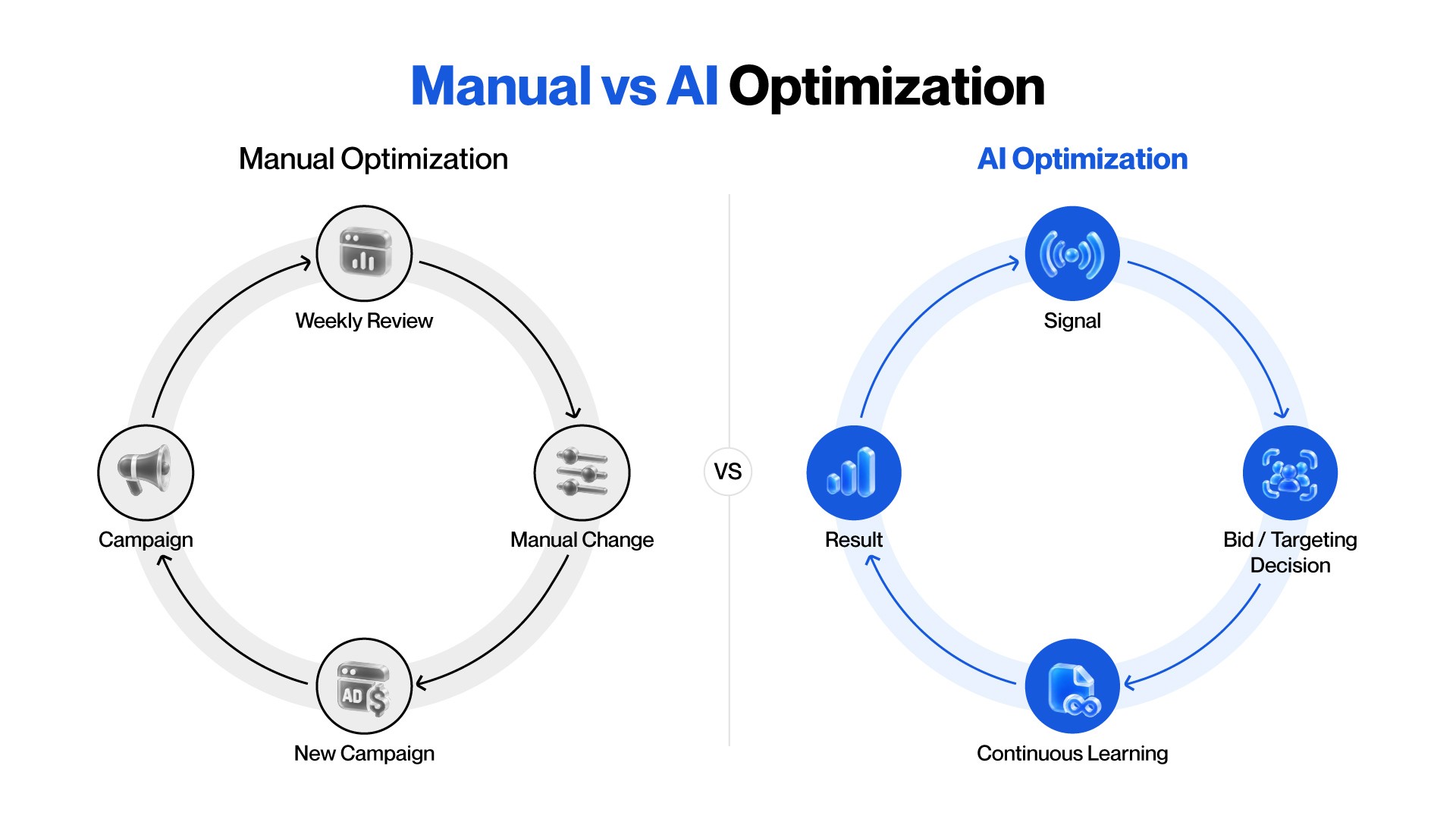
For example, Google Smart Bidding uses AI to set bids during each auction based on the likelihood of achieving a conversion or conversion value. The same principle applies to creative and targeting where AI can create more variations, test them with different audiences, identify what performs best, and feed those results back into the campaign. This creates a much shorter learning cycle and allows campaigns to improve faster.
3 Ways AI Can Reduce Lower Customer Acquisition Cost (CPA)
1. Test More Creative
Creative is one of the biggest factors in paid advertising. Even with strong targeting, a campaign can struggle if the ad does not generate enough qualified clicks and conversions. AI makes creative testing faster by helping teams create multiple hooks, headlines, visuals, offers, and formats from one campaign idea.
Kalshi offers an interesting example. A case study cited by DesignRush reports that the prediction-market platform generated around 3 million views from a $2,000 advertising budget using an AI-generated ad. While this is a single campaign result rather than a universal benchmark, it shows how cheaper production can help brands test more ideas and find potential winners faster.
2. Find Valuable Audiences
Audience targeting once relied heavily on manual segmentation, including age, location, interests, behaviors, lookalikes, and retargeting windows. AI can process these inputs alongside conversion and contextual signals to identify patterns that are harder to manage manually. Meta's Advantage+ system, for example, automates parts of audience selection, placement, creative optimization, and campaign management.
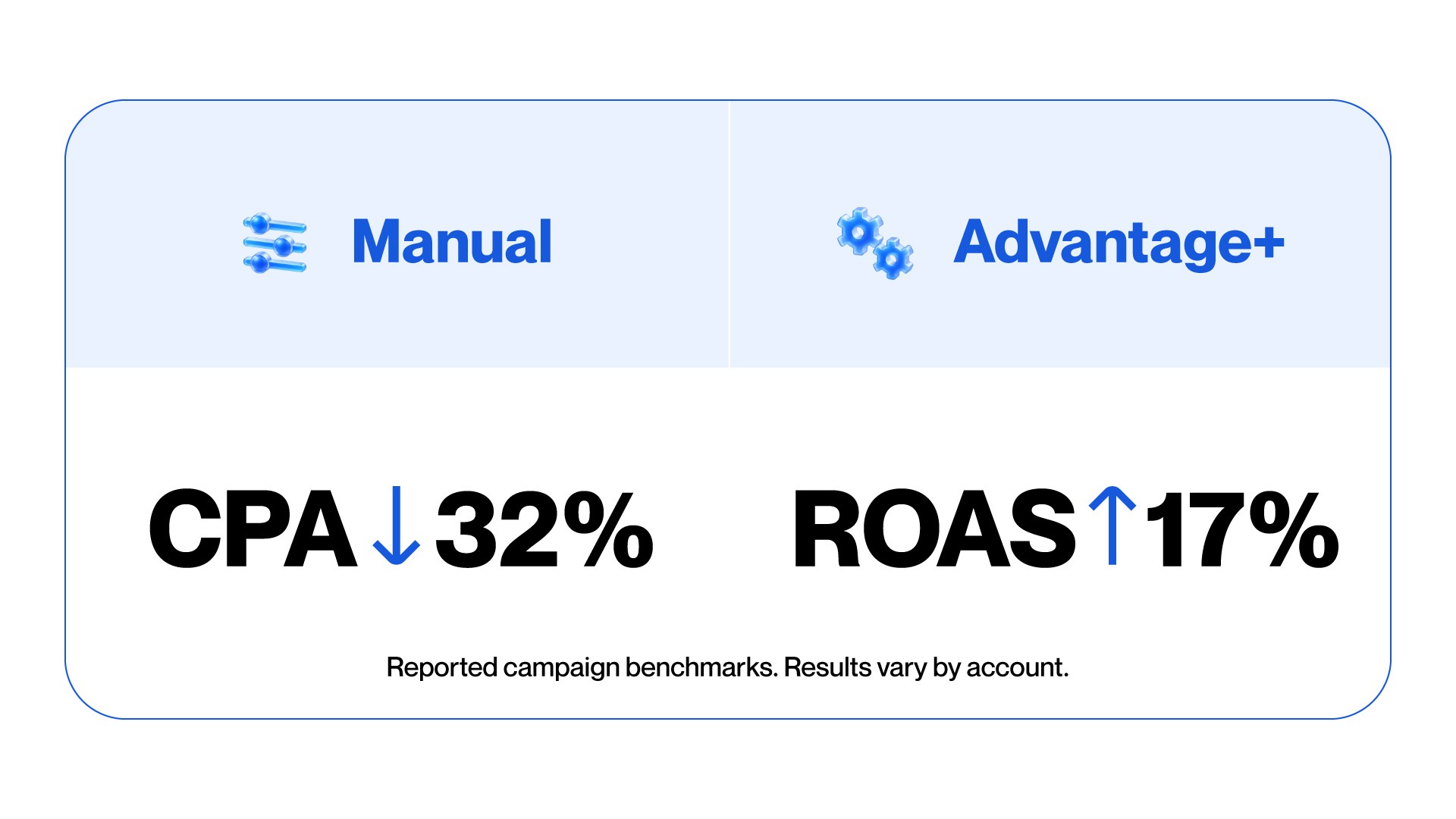
Meta reports that Advantage+ Shopping campaigns have delivered 32% lower CPA and 17% higher ROAS compared with manually configured campaigns. The system is trying to find the right combination of people, placements, and creative that is more likely to drive profitable conversions.
3. Move Budget Toward What Is Working
The third mechanism is bid and budget optimization. Google Smart Bidding uses AI to adjust bids during each auction based on contextual signals and the likelihood of conversion. This helps brands spend more on valuable opportunities and less on weaker ones.
Google reports that Pinkcube achieved 53% more conversions and a 22% lower CPA after using Target CPA Smart Bidding. Google also reports that AI Max for Search campaigns generate an average 7% more conversions or conversion value at a similar CPA or ROAS compared with search term matching alone. This is one of the clearer ways to reduce customer acquisition cost using AI by letting the bidding system move spend toward what's already converting.
AI-Driven ROAS and Ad Performance: What YouTube and MIT Research ShowsGoogle reports that brands using AI-powered YouTube advertising products achieved an average 17% higher ROAS in a Nielsen analysis covering 53,153 campaigns across 104 weeks. While this is a large-scale analysis rather than a single case study, the 17% figure is an average and does not guarantee the same result for every advertiser. AI can also improve how audiences respond to ads. Research from the MIT Initiative on the Digital Economy involving 21,000 consumers found that personalized AI-generated video ads produced a 9.4% higher CTR than personalized image ads and a 6.5% higher CTR than generic video ads. The marketing team still controlled the message while AI handled the personalized video production, showing how AI can support creative execution without replacing human strategy. |
Why Lower CPA Does Not Automatically Mean Better ROI
For CFOs, improving ROI with AI advertising means looking beyond CPA alone. A campaign with a lower acquisition cost is not always more valuable if the customers it brings in generate less profit. Make sure to track:
CPA | ROAS | Conversion rate |
Customer quality | Average order value |
The Hidden Advantage: Production Economics
One of the clearest paths to cost reduction in advertising with AI comes from production, not media spend. Creatify reports that its customers achieved 1.7x higher ROI and 90% lower production costs, based on benchmarks from Meta, Wistia, HubSpot, and Creatify. Since these are vendor-reported figures, they should be treated as directional rather than independent industry benchmarks.
Lower production costs allow brands to test more creative variations with the same budget. If automation makes 20 variations cheaper to produce, brands can run more experiments and have more opportunities to find a winning concept. The more efficiently a brand can test, the more opportunities it has to improve overall ROI.
AI can optimize toward the metric you give it, but choosing the right metric is a business decision. To understand more, see our guide to how AI ads work and how brands are using them in 2026.
AI Needs Clean Data and Human OversightAI cannot fix poor advertising infrastructure on its own. It works with the information it receives, so broken tracking, low-quality conversion data, or missing revenue values can lead the system to optimize for the wrong outcomes. Google requires conversion tracking for Smart Bidding and recommends aligning conversion goals with business objectives. There is also no universal conversion threshold for every AI advertising system. A campaign with only a few conversions may need a different approach from one with hundreds. Human judgment remains important because AI can optimize toward the wrong outcome very efficiently, such as lowering CPA while attracting lower-quality customers or increasing ROAS through existing customers. Marketing teams still need to set clear goals, check data quality, protect the brand, and decide whether an optimization makes business sense. |
AI Advertising Also Has a Compliance Cost
The rules around AI advertising are changing quickly. New York's 2025 law on disclosing AI-generated performers took effect in June 2026, while the EU AI Act introduced new transparency requirements for certain AI-generated and manipulated content starting August 2, 2026.
This means AI can reduce production costs while also creating new review and compliance costs. CFOs should consider the full picture: media efficiency + production efficiency + testing speed − technology costs − compliance costs = actual economic benefit.
A CFO's Framework for Evaluating AI Ads
Before increasing AI advertising spend, ask five questions.
1. Is CPA actually improving?Compare AI-assisted campaigns against a relevant historical or controlled benchmark. Avoid comparing completely different audiences or campaign objectives. |
2. Is ROAS improving?A cheaper conversion does not automatically mean a more profitable customer. So you have to keep track of revenue and margin alongside acquisition cost. |
3. Is the system receiving clean conversion data?Check tracking before increasing automation because the algorithm can only optimize around the signals it receives. |
4. Is creative testing getting faster?Measure how many meaningful creative variations the team can produce and evaluate within a fixed period. Speed of learning is one of AI's most valuable advantages. |
5. Is the incremental improvement larger than the cost of the system?Include software, production, agency fees, human review, and compliance work. The relevant metric is the all-in acquisition cost, not the number displayed inside an advertising dashboard. |
Turning AI Efficiency Into Business Results
The real value of AI advertising is to speed up the entire decision-making cycle since AI can create variations, test them, analyze results, adjust bids, and shift resources much faster than a human team. This creates a continuous loop of better data → faster testing → better decisions → less wasted spend → stronger CPA → more efficient scaling.
AI advertising is already showing measurable improvements across major platforms. AI advertising is already showing measurable efficiency gains across major platforms, though results still depend on data quality and campaign structure.
But AI itself is not the strategy. The biggest gains come when automation is combined with clean conversion data, high-volume testing, clear goals, and human oversight. Masterhooks takes a similar approach by helping brands develop AI-powered advertising assets while keeping creative direction and performance connected. The goal is to build a system where faster production and learning can lead to lower acquisition costs and better returns.
Want to know if your ad spend is actually turning into lower acquisition costs, not just more impressions?
Want to know if your ad spend is actually turning into lower acquisition costs, not just more impressions?
The numbers show the potential impact. A 2026 analysis from Ryze found an average CPA of $23.74 for Google Ads and $38.19 for Meta Ads, while Google Smart Bidding delivered a 22% lower cost per conversion and Meta Advantage+ Shopping delivered a 32% lower CPA compared with its manual campaign benchmarks. YouTube also reported 17% higher ROAS from its AI-powered advertising products. These figures are not universal, but they show how AI can improve efficiency when given enough quality data to learn from.
Why AI Can Make Better Advertising Decisions Faster
One clear answer to how to improve ad performance with AI starts with speed. A human media buyer may review campaign performance several times a day, while an advertising algorithm can evaluate signals continuously.
For example, Google Smart Bidding uses AI to set bids during each auction based on the likelihood of achieving a conversion or conversion value. The same principle applies to creative and targeting where AI can create more variations, test them with different audiences, identify what performs best, and feed those results back into the campaign. This creates a much shorter learning cycle and allows campaigns to improve faster.
3 Ways AI Can Reduce Lower Customer Acquisition Cost (CPA)
1. Test More Creative
Creative is one of the biggest factors in paid advertising. Even with strong targeting, a campaign can struggle if the ad does not generate enough qualified clicks and conversions. AI makes creative testing faster by helping teams create multiple hooks, headlines, visuals, offers, and formats from one campaign idea.
Kalshi offers an interesting example. A case study cited by DesignRush reports that the prediction-market platform generated around 3 million views from a $2,000 advertising budget using an AI-generated ad. While this is a single campaign result rather than a universal benchmark, it shows how cheaper production can help brands test more ideas and find potential winners faster.
2. Find Valuable Audiences
Audience targeting once relied heavily on manual segmentation, including age, location, interests, behaviors, lookalikes, and retargeting windows. AI can process these inputs alongside conversion and contextual signals to identify patterns that are harder to manage manually. Meta's Advantage+ system, for example, automates parts of audience selection, placement, creative optimization, and campaign management.
Meta reports that Advantage+ Shopping campaigns have delivered 32% lower CPA and 17% higher ROAS compared with manually configured campaigns. The system is trying to find the right combination of people, placements, and creative that is more likely to drive profitable conversions.
3. Move Budget Toward What Is Working
The third mechanism is bid and budget optimization. Google Smart Bidding uses AI to adjust bids during each auction based on contextual signals and the likelihood of conversion. This helps brands spend more on valuable opportunities and less on weaker ones.
Google reports that Pinkcube achieved 53% more conversions and a 22% lower CPA after using Target CPA Smart Bidding. Google also reports that AI Max for Search campaigns generate an average 7% more conversions or conversion value at a similar CPA or ROAS compared with search term matching alone. This is one of the clearer ways to reduce customer acquisition cost using AI by letting the bidding system move spend toward what's already converting.
AI-Driven ROAS and Ad Performance: What YouTube and MIT Research ShowsGoogle reports that brands using AI-powered YouTube advertising products achieved an average 17% higher ROAS in a Nielsen analysis covering 53,153 campaigns across 104 weeks. While this is a large-scale analysis rather than a single case study, the 17% figure is an average and does not guarantee the same result for every advertiser. AI can also improve how audiences respond to ads. Research from the MIT Initiative on the Digital Economy involving 21,000 consumers found that personalized AI-generated video ads produced a 9.4% higher CTR than personalized image ads and a 6.5% higher CTR than generic video ads. The marketing team still controlled the message while AI handled the personalized video production, showing how AI can support creative execution without replacing human strategy. |
Why Lower CPA Does Not Automatically Mean Better ROI
For CFOs, improving ROI with AI advertising means looking beyond CPA alone. A campaign with a lower acquisition cost is not always more valuable if the customers it brings in generate less profit. Make sure to track:
CPA | ROAS | Conversion rate |
Customer quality | Average order value |
The Hidden Advantage: Production Economics
One of the clearest paths to cost reduction in advertising with AI comes from production, not media spend. Creatify reports that its customers achieved 1.7x higher ROI and 90% lower production costs, based on benchmarks from Meta, Wistia, HubSpot, and Creatify. Since these are vendor-reported figures, they should be treated as directional rather than independent industry benchmarks.
Lower production costs allow brands to test more creative variations with the same budget. If automation makes 20 variations cheaper to produce, brands can run more experiments and have more opportunities to find a winning concept. The more efficiently a brand can test, the more opportunities it has to improve overall ROI.
AI can optimize toward the metric you give it, but choosing the right metric is a business decision. To understand more, see our guide to how AI ads work and how brands are using them in 2026.
AI Needs Clean Data and Human OversightAI cannot fix poor advertising infrastructure on its own. It works with the information it receives, so broken tracking, low-quality conversion data, or missing revenue values can lead the system to optimize for the wrong outcomes. Google requires conversion tracking for Smart Bidding and recommends aligning conversion goals with business objectives. There is also no universal conversion threshold for every AI advertising system. A campaign with only a few conversions may need a different approach from one with hundreds. Human judgment remains important because AI can optimize toward the wrong outcome very efficiently, such as lowering CPA while attracting lower-quality customers or increasing ROAS through existing customers. Marketing teams still need to set clear goals, check data quality, protect the brand, and decide whether an optimization makes business sense. |
AI Advertising Also Has a Compliance Cost
The rules around AI advertising are changing quickly. New York's 2025 law on disclosing AI-generated performers took effect in June 2026, while the EU AI Act introduced new transparency requirements for certain AI-generated and manipulated content starting August 2, 2026.
This means AI can reduce production costs while also creating new review and compliance costs. CFOs should consider the full picture: media efficiency + production efficiency + testing speed − technology costs − compliance costs = actual economic benefit.
A CFO's Framework for Evaluating AI Ads
Before increasing AI advertising spend, ask five questions.
1. Is CPA actually improving?Compare AI-assisted campaigns against a relevant historical or controlled benchmark. Avoid comparing completely different audiences or campaign objectives. |
2. Is ROAS improving?A cheaper conversion does not automatically mean a more profitable customer. So you have to keep track of revenue and margin alongside acquisition cost. |
3. Is the system receiving clean conversion data?Check tracking before increasing automation because the algorithm can only optimize around the signals it receives. |
4. Is creative testing getting faster?Measure how many meaningful creative variations the team can produce and evaluate within a fixed period. Speed of learning is one of AI's most valuable advantages. |
5. Is the incremental improvement larger than the cost of the system?Include software, production, agency fees, human review, and compliance work. The relevant metric is the all-in acquisition cost, not the number displayed inside an advertising dashboard. |
Turning AI Efficiency Into Business Results
The real value of AI advertising is to speed up the entire decision-making cycle since AI can create variations, test them, analyze results, adjust bids, and shift resources much faster than a human team. This creates a continuous loop of better data → faster testing → better decisions → less wasted spend → stronger CPA → more efficient scaling.
AI advertising is already showing measurable improvements across major platforms. AI advertising is already showing measurable efficiency gains across major platforms, though results still depend on data quality and campaign structure.
But AI itself is not the strategy. The biggest gains come when automation is combined with clean conversion data, high-volume testing, clear goals, and human oversight. Masterhooks takes a similar approach by helping brands develop AI-powered advertising assets while keeping creative direction and performance connected. The goal is to build a system where faster production and learning can lead to lower acquisition costs and better returns.
Want to know if your ad spend is actually turning into lower acquisition costs, not just more impressions?
Related Reading
Related Reading

What Are AI Ads? How Brands Are Using Artificial Intelligence to Create, Target, and Scale Advertising in 2026
4 min
|
What Are AI Ads? How Brands Are Using Artificial Intelligence to Create, Target, and Scale Advertising in 2026
Learn what AI advertising is, how AI creates and targets ads, and how brands use it to test, optimize, and scale campaigns in 2026.
4 min
|

How Apple Turns a Product Launch Into a Yearly UGC Event That Runs Itself
4 min
|
How Apple Turns a Product Launch Into a Yearly UGC Event That Runs Itself
How Apple's September launch cycle turns anticipation, information scarcity, creators, and product novelty into a recurring UGC engine.
4 min
|

The Sydney Sweeney Novig Playbook: Why the Most Talked-About Ad of NFL Week 1 Was Also the Smartest
4 min
|
The Sydney Sweeney Novig Playbook: Why the Most Talked-About Ad of NFL Week 1 Was Also the Smartest
How Sydney Sweeney and Novig built a smarter celebrity partnership through equity, creative control, brand fit, and strategic timing.
4 min
|



Need help scaling?
Book a strategy call with our expert team to audit your current UGC setup.
More Articles
More Articles
What Are AI Ads? How Brands Are Using Artificial Intelligence to Create, Target, and Scale Advertising in 2026
Learn what AI advertising is, how AI creates and targets ads, and how brands use it to test, optimize, and scale campaigns in 2026.
4 min
|
What Are AI Ads? How Brands Are Using Artificial Intelligence to Create, Target, and Scale Advertising in 2026
Learn what AI advertising is, how AI creates and targets ads, and how brands use it to test, optimize, and scale campaigns in 2026.
4 min
|