


Trends
What Are AI Ads? How Brands Are Using Artificial Intelligence to Create, Target, and Scale Advertising in 2026
What Are AI Ads? How Brands Are Using Artificial Intelligence to Create, Target, and Scale Advertising in 2026
Learn what AI advertising is, how AI creates and targets ads, and how brands use it to test, optimize, and scale campaigns in 2026.
Published:

Read Time:

4 min

Written by:
Fawwaz
Trend Research and Copywriter
EVERY MARKETER USING AI IN 2026
69.1% of marketers are reportedly already using AI in marketing and advertising in 2026. But using AI to write ad copy is very different from using it to build a full advertising system. AI can now help create variations, find audiences, allocate budgets, optimize bids, and measure results.
EVERY MARKETER USING AI IN 2026
69.1% of marketers are reportedly already using AI in marketing and advertising in 2026. But using AI to write ad copy is very different from using it to build a full advertising system. AI can now help create variations, find audiences, allocate budgets, optimize bids, and measure results.
EVERY MARKETER USING AI IN 2026
69.1% of marketers are reportedly already using AI in marketing and advertising in 2026. But using AI to write ad copy is very different from using it to build a full advertising system. AI can now help create variations, find audiences, allocate budgets, optimize bids, and measure results.
This is why some brands are seeing better advertising efficiency while others are simply producing more AI-generated ads. The real opportunity is deciding where AI should make the decisions, where humans should stay involved, and how both can work together across the advertising process.
What Are AI Ads, Really?
The simplest answer to what is AI ads comes down to this: advertisements created, personalized, targeted, delivered, or optimized with artificial intelligence. This can include generating images and videos, creating dozens of ad variations, or using AI to decide which audience should see an ad, when they should see it, and how much to bid.
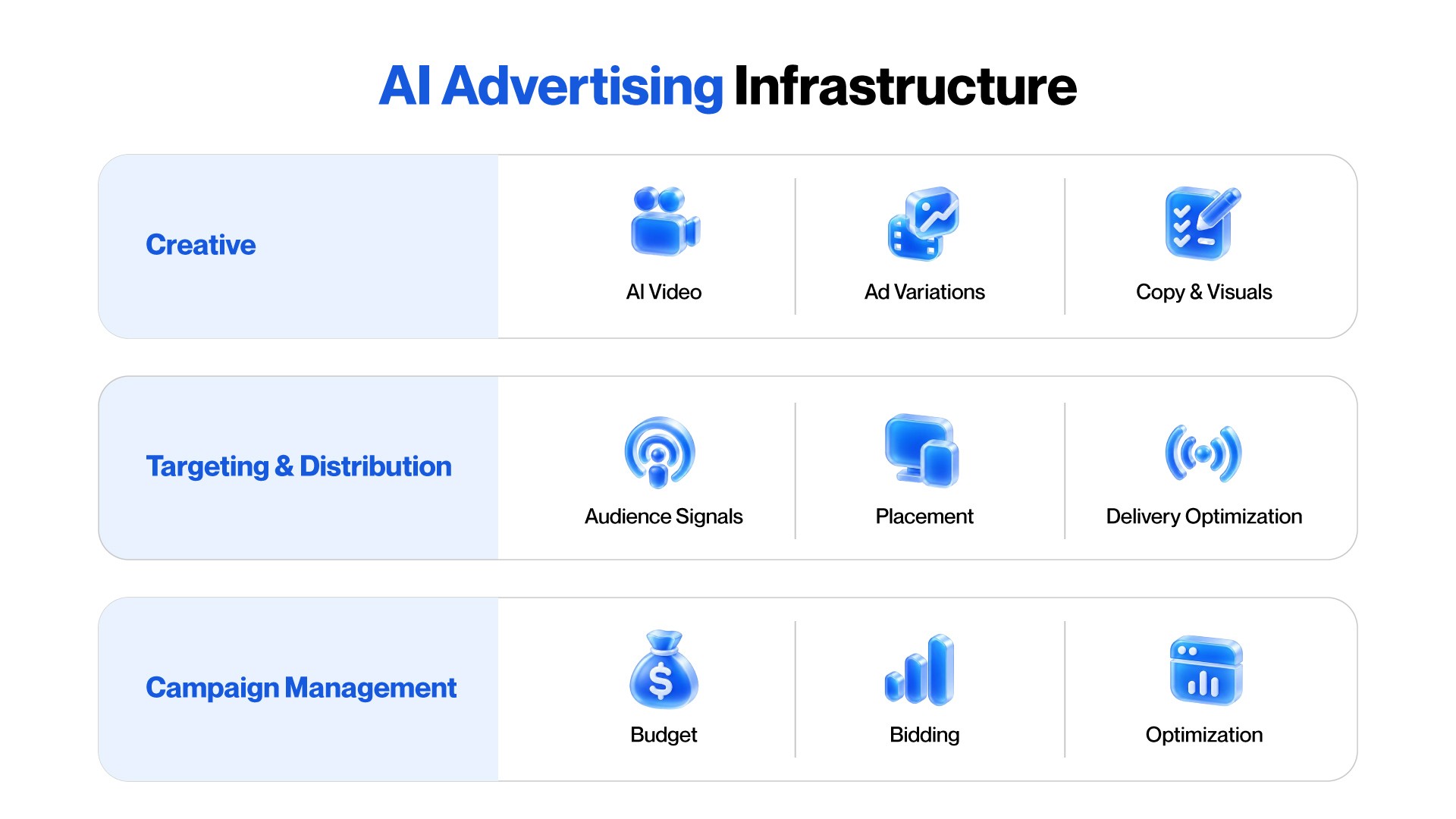
StackAdapt describes AI-powered advertising as using AI and machine learning to analyze data, create content, and optimize campaigns. Modern systems can help with creative generation, audience targeting, bidding, prediction, and performance measurement. So when people ask “what are AI ads?”, the answer goes beyond AI-generated images or videos. AI advertising generally operates across three layers.
1. Creative
AI helps create or optimize the actual advertisement that includes copy, images, video, layouts, translations, product variations, and different versions of the same message.
2. Targeting and distribution
AI analyzes audience and contextual signals to determine who should see an advertisement and where it should appear. Modern platforms can evaluate behavior, conversion signals, context, device information, location, and other auction-time signals when making decisions.
3. Campaign management
AI can manage parts of a campaign, including bidding, budget allocation, pacing, placement, and optimization toward a conversion or revenue goal.
Most brands start with one layer, but the bigger opportunity comes from connecting all three.
How Does AI Advertising Work?AI can make the advertising process faster by creating creative variations, analyzing results, finding responsive audiences, adjusting bids, and moving budgets based on performance. The goal is not just to use AI tools, but to build a campaign that can continuously test, learn, and improve. |
5 Ways Brands Are Using AI in Advertising
Looking at real AI advertising examples from brands already doing this makes the idea easier to picture.
1. Creating More Creative Variations
One of the clearest uses of AI is producing more advertising variations. A single campaign can be adapted into different languages, formats, headlines, images, and messages without rebuilding every asset manually.
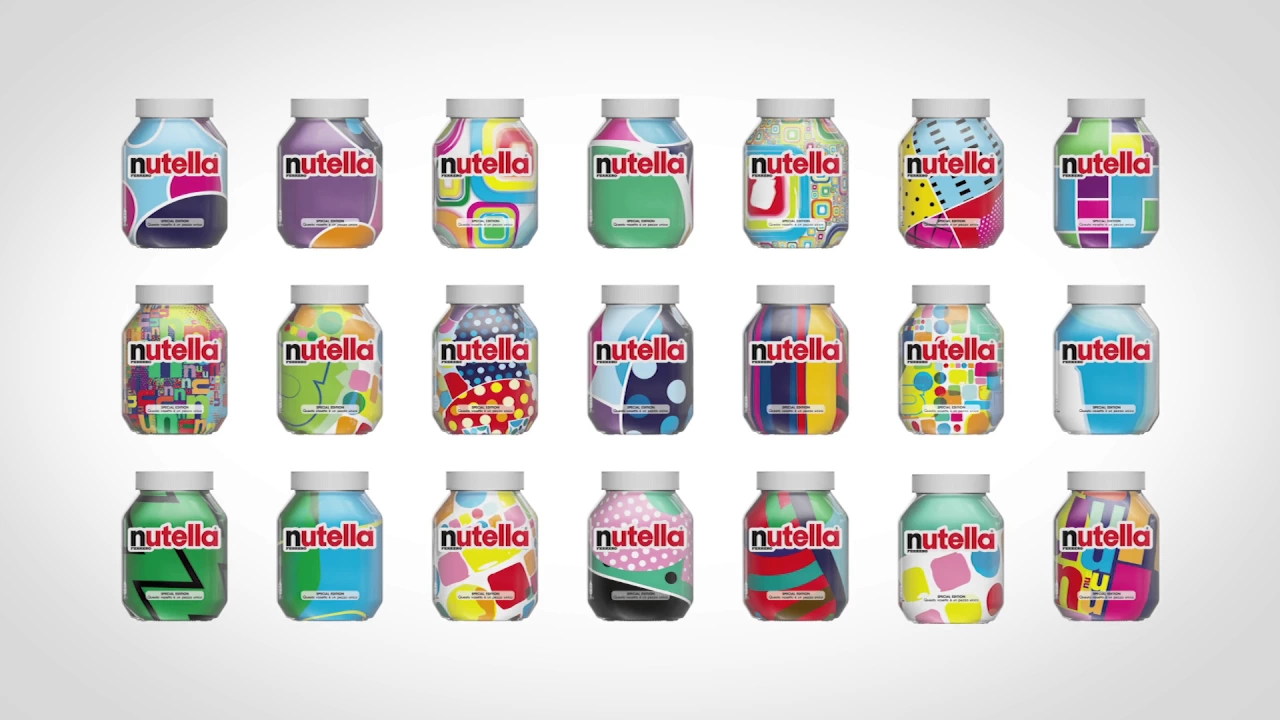
Nutella's Unica campaign showed this idea early by using an algorithm to create seven million unique jar labels, with reports saying all seven million jars sold within a month. This shows how AI makes creative variation faster and cheaper to produce.
2. Personalizing the Advertising Experience
AI can help brands move from one advertisement to many versions built for different audiences and contexts. Coca-Cola took a more interactive approach with Create Real Magic, allowing people to create artwork using Coca-Cola's visual assets and generative AI.
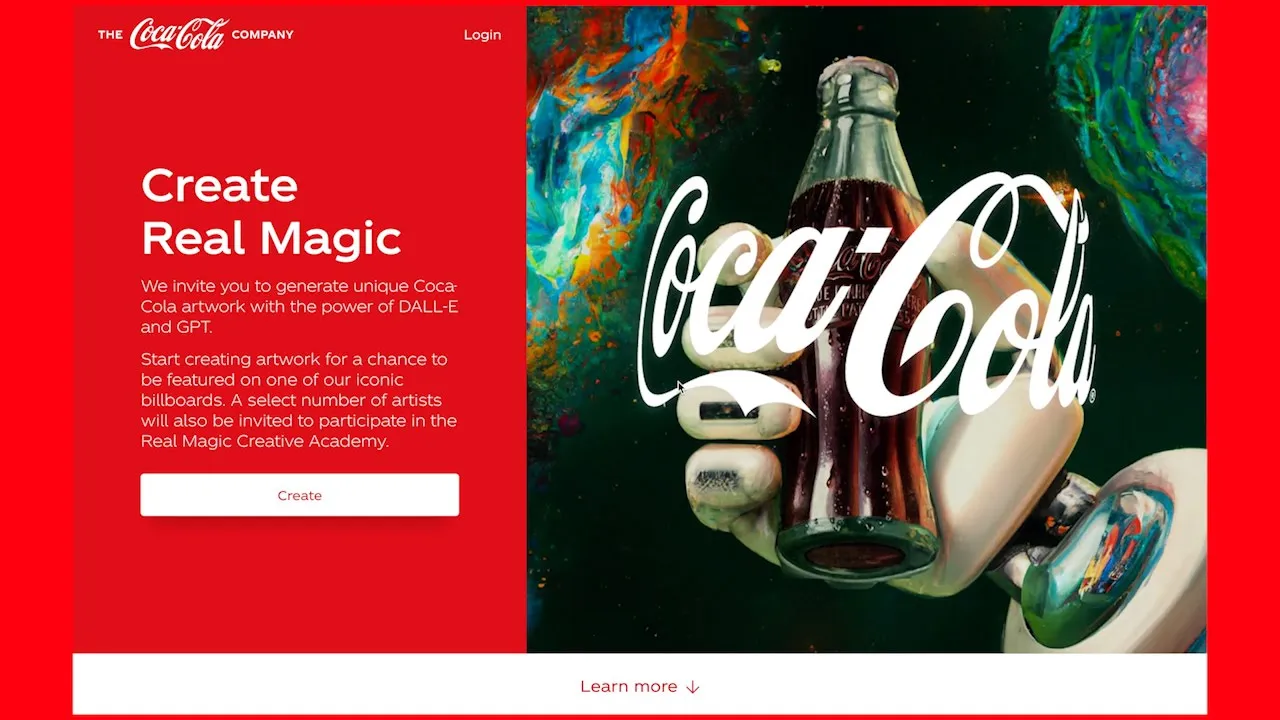
The 2023 campaign produced more than 120,000 pieces of original artwork, showing how AI can make variation part of the campaign experience itself, rather than simply adding personalization to an existing ad.
3. Optimizing Targeting and Distribution
The next layer happens behind the advertisement. Advertising platforms process huge amounts of data to decide which impressions are worth buying, and AI can analyze these signals much faster than a human. Google describes Smart Bidding as auction-time optimization, where AI adjusts bids for individual auctions based on the likelihood of achieving the campaign goal.
That's part of why manual audience selection matters less for some campaigns now. Marketers increasingly set the objective and provide useful signals, while the platform handles more of the moment-to-moment decisions.
4. Accelerating A/B Testing
AI also changes how quickly brands can test ideas. Instead of waiting weeks to create new ads, brands can produce multiple variations from one concept and launch them much faster. This creates a tighter loop:
Concept → Variation → Test → Signal → Optimization → New Variation.
The advantage is not simply creating more ads, but learning faster. A brand testing 20 meaningful variations has more chances to find a winning message than one testing two. This is especially useful in paid social, where creative fatigue can quickly reduce performance.
5. Improving Measurement and Attribution
AI is also being used after ads run. It can analyze campaign data to find patterns across audiences, creatives, placements, conversions, and channels. StackAdapt's 2026 research describes this as “signal orchestration,” where different data sources can work together to improve targeting and measurement.
But AI is only as good as the data it receives. If conversion tracking is incomplete or inaccurate, the system can make highly efficient decisions based on bad information. Better optimization starts with better data.
Where AI Ads Work Best (and Where They Don't)
AI advertising is especially useful in environments where there is enough data, enough creative volume, and enough variation for an algorithm to learn from.
Paid Social
Meta has pushed heavily toward AI-powered campaign structures through Advantage+, with industry benchmarks reporting meaningful CPA improvements compared with manually configured campaigns.
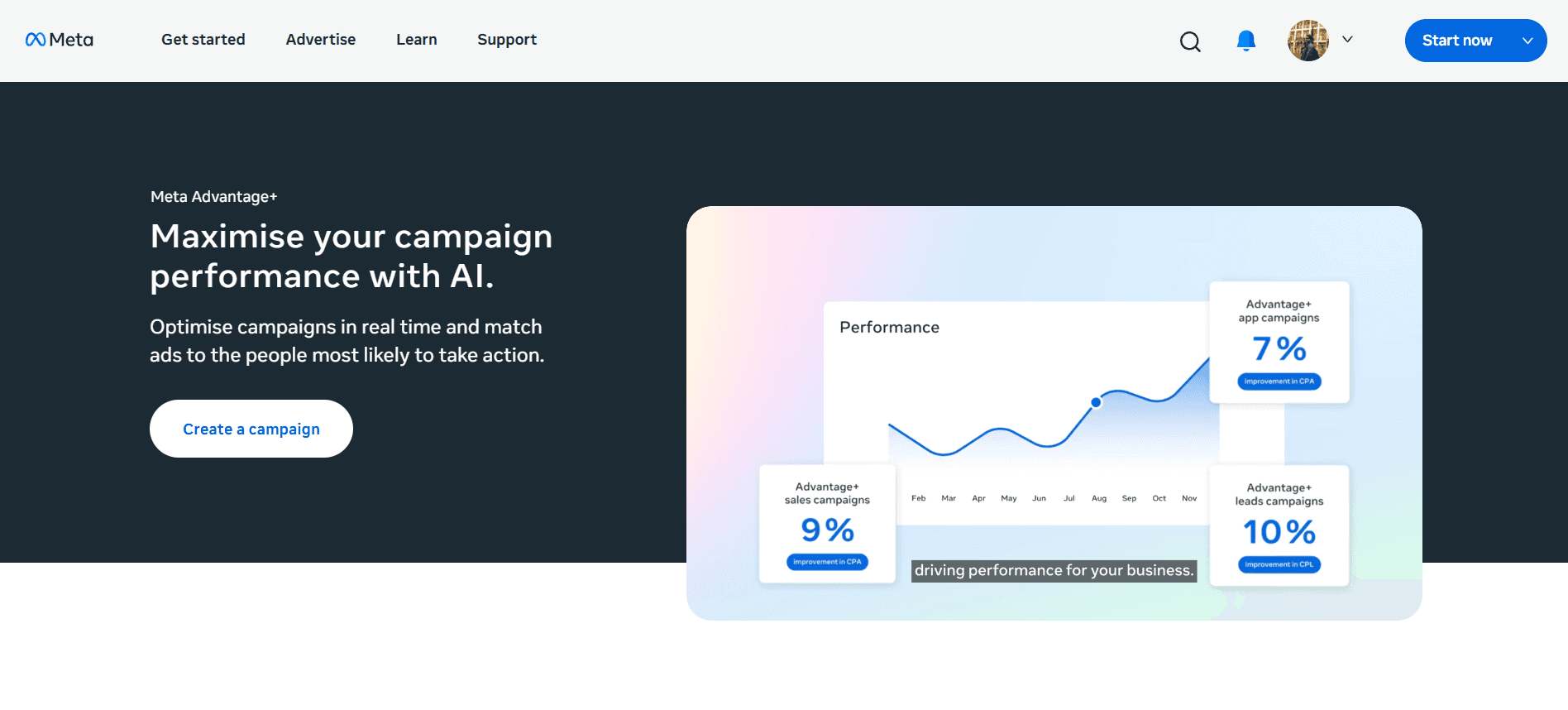
Results still vary based on account quality, conversion volume, creative supply, and campaign structure. AI works better when it has enough information to make good decisions.
Performance Video
YouTube is another strong example. Google reports that brands using AI-powered YouTube advertising products achieved an average 17% higher ROAS in a Nielsen analysis covering more than 53,000 campaigns.
This does not mean every AI-powered campaign will deliver 17% higher ROAS, but it shows how AI optimization can become more valuable when the platform has enough campaign data to learn from.
High-Volume Creative Testing
AI advertising becomes particularly attractive when a campaign needs a large number of creative variations. Imagine a brand running campaigns across several markets, they might need different:
Hooks | Headlines | Visual treatments |
Languages | Offers |
Producing all of those manually gets expensive fast, which is exactly the kind of bottleneck AI is built to clear.
When It's Not a Fit
A small advertiser with very few conversions may not have enough data for automated bidding to make reliable decisions. When conversion data is limited, the algorithm has less information to learn from, and more automation cannot replace missing data.
What AI Still Cannot Decide for You
AI is powerful, but it needs data to learn from, so this is where the human role becomes more important.
Brand Safety
AI can generate thousands of creative combinations, but it cannot reliably judge whether every one fits the brand. A visual may look impressive while still being off-brand, culturally insensitive, legally risky, or simply embarrassing.
That is why human review remains essential. StackAdapt highlights the need for human oversight in areas such as brand safety, creative quality, governance, bias, privacy, and accuracy.
Strategy and Positioning
AI can optimize toward a target, but it cannot decide whether that target makes strategic sense. If you tell it to maximize conversions, it will focus on getting more conversions without automatically considering premium positioning, customer quality, retention, or long-term brand value.
That decision still belongs to the marketing team. What should the system optimize for? The answer shapes every decision that comes after it.
Disclosure and Compliance
AI-generated advertising also creates new transparency requirements. Google announced in 2026 that it is adding a “How this ad was made” panel to help people understand when generative AI was used to create or change an ad. Advertisers can also indicate AI usage, with additional labels potentially appearing on ads depending on local requirements.
As regulation continues to evolve, brands need a clear process for checking what AI-generated assets contain, how they were created, and whether disclosure is required. Automation can speed up advertising, but it does not remove accountability.
The AI Advertising Playbook for 2026
For most brands, building an AI advertising system does not mean handing the entire campaign to a machine. The goal is to connect AI tools into a system that can create, distribute, measure, and improve advertising faster. To reach this goal, brands need to make sure these points:
1. Start With the ObjectiveDefine the business outcome first, whether that's revenue, qualified leads, purchases, app installs, or another measurable goal. AI works best when it has a clear outcome to optimize toward. |
2. Build Enough Creative SupplyGive the system meaningful creative variation. Five almost-identical ads provide less learning than genuinely different concepts, hooks, formats, and messages. |
3. Connect Your AI ToolsThe real opportunity comes when AI tools work together, with insights from performance feeding the next round of creativity. That feedback loop turns AI from a collection of tools into an advertising system. |
4. Feed the Algorithm Clean DataConversion tracking, product information, audience signals, and revenue data all influence what the system can learn. Better inputs give AI better information to work with. |
5. Automate Repetitive DecisionsLet AI handle tasks where speed and scale provide an advantage, such as generating variations, adjusting bids, optimizing placements, and personalizing content. |
6. Keep Humans Above the SystemPeople should still own positioning, brand standards, approvals, compliance, and the definition of success. The strongest AI advertising setup is an operating system that helps the team make faster decisions and learn from every campaign. |
Building the Advertising Engine
AI advertising is already changing how campaigns are produced, targeted, tested, and optimized. The brands gaining the most from it will likely be the ones that understand where automation creates leverage and where human judgment still matters.
Masterhooks sits within this shift through its AI Video Ads production offering, combining AI generation with creative direction, editing, brand alignment, and production delivery. For brands exploring AI-generated advertising, the useful question is therefore not simply whether AI can make an ad. It is whether the entire creative and performance system is structured to turn that additional speed and volume into better advertising outcomes.
Not sure if your AI-generated ads are actually built into a system, or just producing more content?

Not sure if your AI-generated ads are actually built into a system, or just producing more content?
This is why some brands are seeing better advertising efficiency while others are simply producing more AI-generated ads. The real opportunity is deciding where AI should make the decisions, where humans should stay involved, and how both can work together across the advertising process.
What Are AI Ads, Really?
The simplest answer to what is AI ads comes down to this: advertisements created, personalized, targeted, delivered, or optimized with artificial intelligence. This can include generating images and videos, creating dozens of ad variations, or using AI to decide which audience should see an ad, when they should see it, and how much to bid.
StackAdapt describes AI-powered advertising as using AI and machine learning to analyze data, create content, and optimize campaigns. Modern systems can help with creative generation, audience targeting, bidding, prediction, and performance measurement. So when people ask “what are AI ads?”, the answer goes beyond AI-generated images or videos. AI advertising generally operates across three layers.
1. Creative
AI helps create or optimize the actual advertisement that includes copy, images, video, layouts, translations, product variations, and different versions of the same message.
2. Targeting and distribution
AI analyzes audience and contextual signals to determine who should see an advertisement and where it should appear. Modern platforms can evaluate behavior, conversion signals, context, device information, location, and other auction-time signals when making decisions.
3. Campaign management
AI can manage parts of a campaign, including bidding, budget allocation, pacing, placement, and optimization toward a conversion or revenue goal.
Most brands start with one layer, but the bigger opportunity comes from connecting all three.
How Does AI Advertising Work?AI can make the advertising process faster by creating creative variations, analyzing results, finding responsive audiences, adjusting bids, and moving budgets based on performance. The goal is not just to use AI tools, but to build a campaign that can continuously test, learn, and improve. |
5 Ways Brands Are Using AI in Advertising
Looking at real AI advertising examples from brands already doing this makes the idea easier to picture.
1. Creating More Creative Variations
One of the clearest uses of AI is producing more advertising variations. A single campaign can be adapted into different languages, formats, headlines, images, and messages without rebuilding every asset manually.
Nutella's Unica campaign showed this idea early by using an algorithm to create seven million unique jar labels, with reports saying all seven million jars sold within a month. This shows how AI makes creative variation faster and cheaper to produce.
2. Personalizing the Advertising Experience
AI can help brands move from one advertisement to many versions built for different audiences and contexts. Coca-Cola took a more interactive approach with Create Real Magic, allowing people to create artwork using Coca-Cola's visual assets and generative AI.
The 2023 campaign produced more than 120,000 pieces of original artwork, showing how AI can make variation part of the campaign experience itself, rather than simply adding personalization to an existing ad.
3. Optimizing Targeting and Distribution
The next layer happens behind the advertisement. Advertising platforms process huge amounts of data to decide which impressions are worth buying, and AI can analyze these signals much faster than a human. Google describes Smart Bidding as auction-time optimization, where AI adjusts bids for individual auctions based on the likelihood of achieving the campaign goal.
That's part of why manual audience selection matters less for some campaigns now. Marketers increasingly set the objective and provide useful signals, while the platform handles more of the moment-to-moment decisions.
4. Accelerating A/B Testing
AI also changes how quickly brands can test ideas. Instead of waiting weeks to create new ads, brands can produce multiple variations from one concept and launch them much faster. This creates a tighter loop:
Concept → Variation → Test → Signal → Optimization → New Variation.
The advantage is not simply creating more ads, but learning faster. A brand testing 20 meaningful variations has more chances to find a winning message than one testing two. This is especially useful in paid social, where creative fatigue can quickly reduce performance.
5. Improving Measurement and Attribution
AI is also being used after ads run. It can analyze campaign data to find patterns across audiences, creatives, placements, conversions, and channels. StackAdapt's 2026 research describes this as “signal orchestration,” where different data sources can work together to improve targeting and measurement.
But AI is only as good as the data it receives. If conversion tracking is incomplete or inaccurate, the system can make highly efficient decisions based on bad information. Better optimization starts with better data.
Where AI Ads Work Best (and Where They Don't)
AI advertising is especially useful in environments where there is enough data, enough creative volume, and enough variation for an algorithm to learn from.
Paid Social
Meta has pushed heavily toward AI-powered campaign structures through Advantage+, with industry benchmarks reporting meaningful CPA improvements compared with manually configured campaigns.
Results still vary based on account quality, conversion volume, creative supply, and campaign structure. AI works better when it has enough information to make good decisions.
Performance Video
YouTube is another strong example. Google reports that brands using AI-powered YouTube advertising products achieved an average 17% higher ROAS in a Nielsen analysis covering more than 53,000 campaigns.
This does not mean every AI-powered campaign will deliver 17% higher ROAS, but it shows how AI optimization can become more valuable when the platform has enough campaign data to learn from.
High-Volume Creative Testing
AI advertising becomes particularly attractive when a campaign needs a large number of creative variations. Imagine a brand running campaigns across several markets, they might need different:
Hooks | Headlines | Visual treatments |
Languages | Offers |
Producing all of those manually gets expensive fast, which is exactly the kind of bottleneck AI is built to clear.
When It's Not a Fit
A small advertiser with very few conversions may not have enough data for automated bidding to make reliable decisions. When conversion data is limited, the algorithm has less information to learn from, and more automation cannot replace missing data.
What AI Still Cannot Decide for You
AI is powerful, but it needs data to learn from, so this is where the human role becomes more important.
Brand Safety
AI can generate thousands of creative combinations, but it cannot reliably judge whether every one fits the brand. A visual may look impressive while still being off-brand, culturally insensitive, legally risky, or simply embarrassing.
That is why human review remains essential. StackAdapt highlights the need for human oversight in areas such as brand safety, creative quality, governance, bias, privacy, and accuracy.
Strategy and Positioning
AI can optimize toward a target, but it cannot decide whether that target makes strategic sense. If you tell it to maximize conversions, it will focus on getting more conversions without automatically considering premium positioning, customer quality, retention, or long-term brand value.
That decision still belongs to the marketing team. What should the system optimize for? The answer shapes every decision that comes after it.
Disclosure and Compliance
AI-generated advertising also creates new transparency requirements. Google announced in 2026 that it is adding a “How this ad was made” panel to help people understand when generative AI was used to create or change an ad. Advertisers can also indicate AI usage, with additional labels potentially appearing on ads depending on local requirements.
As regulation continues to evolve, brands need a clear process for checking what AI-generated assets contain, how they were created, and whether disclosure is required. Automation can speed up advertising, but it does not remove accountability.
The AI Advertising Playbook for 2026
For most brands, building an AI advertising system does not mean handing the entire campaign to a machine. The goal is to connect AI tools into a system that can create, distribute, measure, and improve advertising faster. To reach this goal, brands need to make sure these points:
1. Start With the ObjectiveDefine the business outcome first, whether that's revenue, qualified leads, purchases, app installs, or another measurable goal. AI works best when it has a clear outcome to optimize toward. |
2. Build Enough Creative SupplyGive the system meaningful creative variation. Five almost-identical ads provide less learning than genuinely different concepts, hooks, formats, and messages. |
3. Connect Your AI ToolsThe real opportunity comes when AI tools work together, with insights from performance feeding the next round of creativity. That feedback loop turns AI from a collection of tools into an advertising system. |
4. Feed the Algorithm Clean DataConversion tracking, product information, audience signals, and revenue data all influence what the system can learn. Better inputs give AI better information to work with. |
5. Automate Repetitive DecisionsLet AI handle tasks where speed and scale provide an advantage, such as generating variations, adjusting bids, optimizing placements, and personalizing content. |
6. Keep Humans Above the SystemPeople should still own positioning, brand standards, approvals, compliance, and the definition of success. The strongest AI advertising setup is an operating system that helps the team make faster decisions and learn from every campaign. |
Building the Advertising Engine
AI advertising is already changing how campaigns are produced, targeted, tested, and optimized. The brands gaining the most from it will likely be the ones that understand where automation creates leverage and where human judgment still matters.
Masterhooks sits within this shift through its AI Video Ads production offering, combining AI generation with creative direction, editing, brand alignment, and production delivery. For brands exploring AI-generated advertising, the useful question is therefore not simply whether AI can make an ad. It is whether the entire creative and performance system is structured to turn that additional speed and volume into better advertising outcomes.
Not sure if your AI-generated ads are actually built into a system, or just producing more content?
Related Reading
Related Reading

How AI Ads Can Lower Your CPA: The Data Behind Smarter Advertising
4 min
|
Trends
How AI Ads Can Lower Your CPA: The Data Behind Smarter Advertising
See how AI advertising can lower CPA and improve ROAS through smarter bidding, targeting, creative testing, and real-time budget optimization.
4 min
|
Trends

How Apple Turns a Product Launch Into a Yearly UGC Event That Runs Itself
4 min
|
Trends
How Apple Turns a Product Launch Into a Yearly UGC Event That Runs Itself
How Apple's September launch cycle turns anticipation, information scarcity, creators, and product novelty into a recurring UGC engine.
4 min
|
Trends

The Sydney Sweeney Novig Playbook: Why the Most Talked-About Ad of NFL Week 1 Was Also the Smartest
4 min
|
Trends
The Sydney Sweeney Novig Playbook: Why the Most Talked-About Ad of NFL Week 1 Was Also the Smartest
How Sydney Sweeney and Novig built a smarter celebrity partnership through equity, creative control, brand fit, and strategic timing.
4 min
|
Trends



Need help scaling?
Book a strategy call with our expert team to audit your current UGC setup.
More Articles
More Articles
How AI Ads Can Lower Your CPA: The Data Behind Smarter Advertising
See how AI advertising can lower CPA and improve ROAS through smarter bidding, targeting, creative testing, and real-time budget optimization.
4 min
|
Trends
How AI Ads Can Lower Your CPA: The Data Behind Smarter Advertising
See how AI advertising can lower CPA and improve ROAS through smarter bidding, targeting, creative testing, and real-time budget optimization.
4 min
|
Trends
How Apple Turns a Product Launch Into a Yearly UGC Event That Runs Itself
How Apple's September launch cycle turns anticipation, information scarcity, creators, and product novelty into a recurring UGC engine.
4 min
|
Trends
How Apple Turns a Product Launch Into a Yearly UGC Event That Runs Itself
How Apple's September launch cycle turns anticipation, information scarcity, creators, and product novelty into a recurring UGC engine.
4 min
|
Trends