




Trends
What Coca-Cola's AI Ad Mistakes Teach Every Brand About Using AI in Advertising
What Coca-Cola's AI Ad Mistakes Teach Every Brand About Using AI in Advertising
What Coca-Cola's AI ads reveal about brand heritage, consumer trust, creative risk, and when AI advertising makes strategic sense.
Published:

Read Time:

4 min

Written by:
Fawwaz
Trend Research and Copywriter
THE WRONG MOVE IN AI USAGE CAN BACKFIRE ON YOUR OWN BRAND.
The controversy surrounding Coca-Cola’s AI-powered ads demonstrates that the value of AI depends not only on how quickly or cheaply an ad can be created, but also on what the audience expects from a brand. This became even more interesting when Coca-Cola used AI to revive its iconic Holidays Are Coming campaign for two consecutive years.
THE WRONG MOVE IN AI USAGE CAN BACKFIRE ON YOUR OWN BRAND.
The controversy surrounding Coca-Cola’s AI-powered ads demonstrates that the value of AI depends not only on how quickly or cheaply an ad can be created, but also on what the audience expects from a brand. This became even more interesting when Coca-Cola used AI to revive its iconic Holidays Are Coming campaign for two consecutive years.
THE WRONG MOVE IN AI USAGE CAN BACKFIRE ON YOUR OWN BRAND.
The controversy surrounding Coca-Cola’s AI-powered ads demonstrates that the value of AI depends not only on how quickly or cheaply an ad can be created, but also on what the audience expects from a brand. This became even more interesting when Coca-Cola used AI to revive its iconic Holidays Are Coming campaign for two consecutive years.
On one hand, the campaign faced criticism for allegedly lacking authenticity and a human touch. On the other hand, a consumer test by System1 awarded both campaigns a maximum score of 5.9 stars, indicating high potential effectiveness. This discrepancy raises an important question for marketers: where should AI fit into a brand’s creative process?
What Actually Happened With Coca-Cola's AI Ads?
2024: The first experiment
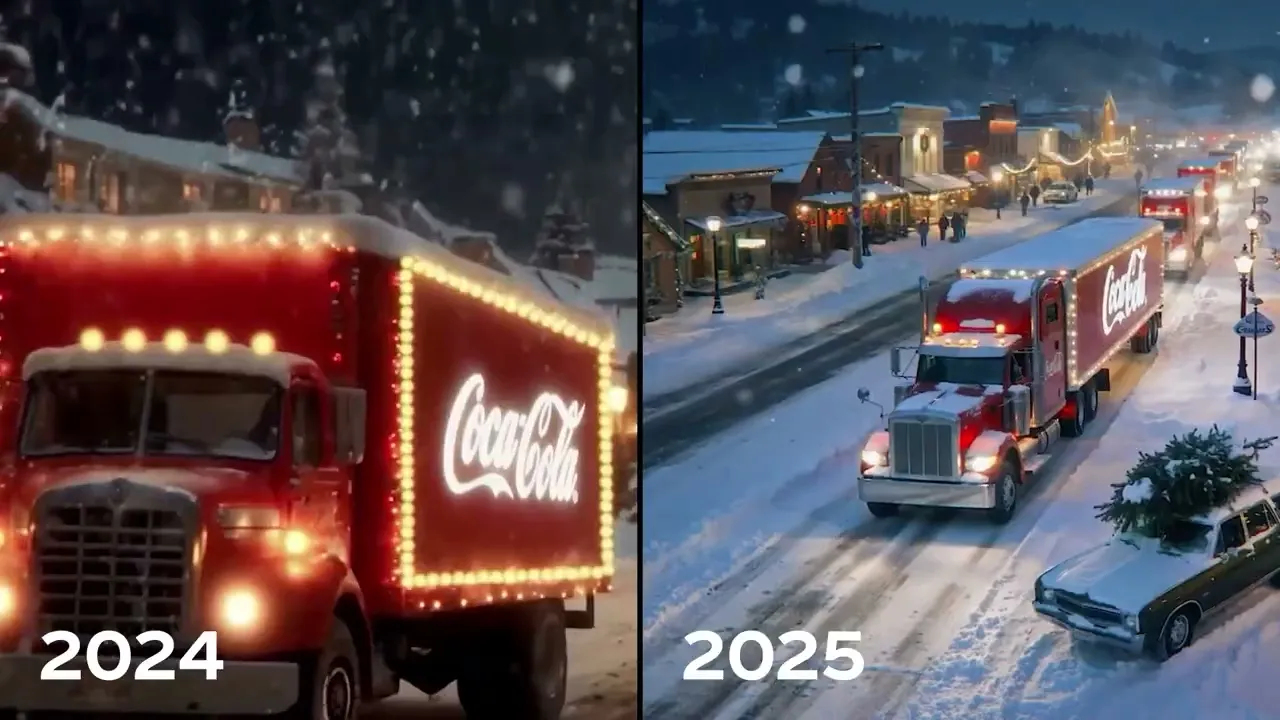
In 2024, Coca-Cola released its first AI holiday ad, an AI-generated reinterpretation of its iconic 1995 'Holidays Are Coming' commercial. The campaign recreated the familiar red trucks and winter setting using generative AI, with more than 40 creatives involved and around 10,000 generated frames. The goal was simple: bring a classic piece of holiday advertising into the present using new technology.
The audience response was more mixed. Viewers criticized the ad for awkward faces, unnatural movement, and a lack of the warmth associated with the original, while CARMA reported positive sentiment falling from 23.8% to 10.2%. Yet System1 gave the ad its maximum 5.9-star rating. This created an important contradiction: public conversation and controlled consumer testing told very different stories.
2025: Coca-Cola changed the formula
In 2025, Coca-Cola returned with another AI-generated “Holidays Are Coming” commercial, this time focusing more on animals such as polar bears, penguins, rabbits, owls, and sloths. The company also worked with AI studios Silverside and Secret Level, with more than 70,000 clips generated and refined by five AI specialists.

The production process was also much faster, with Coca-Cola saying development could be reduced from around a year to roughly a month. The result looked more polished, but viewers still criticized inconsistencies between shots, including changes to the Coca-Cola trucks and other details.
System1 again gave the campaign a 5.9-star rating, while online criticism continued. That contradiction is the real lesson from the Coca-Cola AI ads: an ad can perform well in testing while still creating concerns about the creative itself.
Why Did Coca-Cola Become So Vulnerable to AI Backlash?
AI advertising does not carry the same risk for every brand. Coca-Cola's heritage and cultural significance made this experiment especially sensitive.
1. Coca-Cola owns an enormous piece of Christmas advertising culture
Coca-Cola's Christmas advertising has been part of its brand identity for decades. The red trucks, Santa Claus, polar bears, and “Holidays Are Coming” campaign are familiar assets that carry strong emotional meaning.

That changes how people judge the creative. A typical AI-generated ad may be judged mainly on how it looks, but a Coca-Cola Christmas ad is also compared with the memories people already have. The more emotional value a brand owns, the more carefully it needs to protect the creative language that built it.
2. The audience knew AI was involved
Coca-Cola openly positioned AI as part of the creative process, which can change how people judge the work. Once audiences know something is AI-generated, they may pay closer attention to details that feel unnatural. A strange hand, changing truck, or awkward expression can become part of the conversation.
This matters because consumers are becoming more aware of AI-generated advertising. DoubleVerify reported in 2026 that 42% of consumers globally said low-quality AI advertising would negatively affect their opinion of a brand. The point is not that everyone dislikes AI advertising, but that quality can strongly influence how audiences respond to it.
3. The creative industry has its own stake in the conversation
Generative AI affects more than the final advertisement. It also raises questions about the future of work for photographers, illustrators, animators, actors, directors, editors, and designers. Coca-Cola's AI campaigns therefore became part of a wider conversation about how brands should use generative tools.
That can make criticism spread beyond people who simply dislike the ad. A technical issue, such as an unnatural AI-generated truck, can become part of a larger debate about replacing traditional creative processes with AI.
This creates an interesting effect: an ad can perform well as advertising while creating a very different reaction as a topic of industry conversation. Both can happen at the same time.
When Do AI Ads Actually Work?
The Coca-Cola case becomes more useful when compared with campaigns where AI solved a specific creative problem.
AI works well when scale is the creative idea
Cadbury's “Shah Rukh Khan-My-Ad” campaign shows how AI can solve a personalization challenge. The campaign used AI and machine learning to create personalized ads featuring Shah Rukh Khan promoting thousands of local businesses across India.

More than 130,000 videos were created for around 2,000 stores across 500+ pin codes, generating 94 million views and contributing to a record 33 million Celebrations packs sold. The important point is that AI made this level of personalization possible at scale. It was solving a production problem, not being used simply because it was cheaper.
AI works well when personalization improves relevance
Virgin Voyages used a similar approach with “Jen AI.” The campaign allowed users to create personalized invitations featuring an AI version of Jennifer Lopez, with each message tailored to a specific person and occasion.

The campaign generated more than 25,000 personalized invites and over two billion impressions, according to WPP. Here, AI was not simply used to make the ad. The technology was part of the experience, giving people a reason to interact with it and make something of their own.
AI works well when the technology becomes part of the concept
Heinz took another approach with “A.I. Ketchup.” The campaign asked an image-generation model to visualize ketchup, and many of the results looked like Heinz. The brand turned this into a way to show how recognizable its identity was.
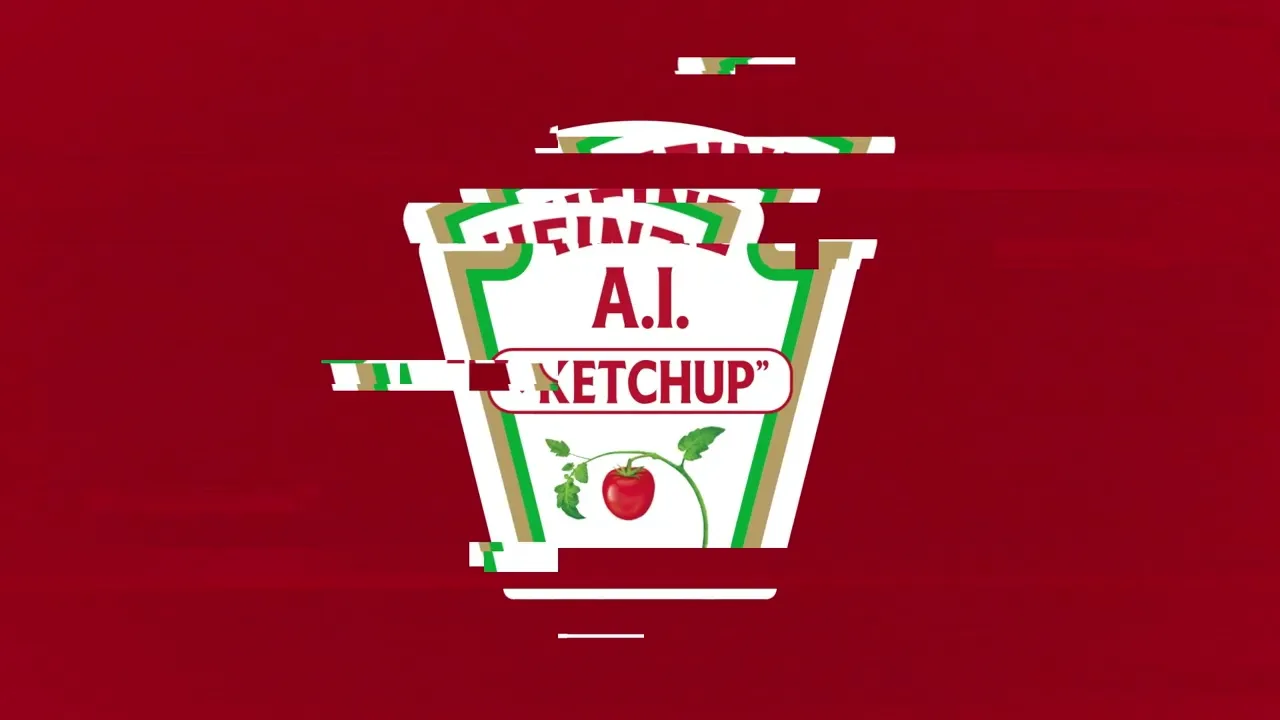
The campaign then invited people to create their own prompts and used the AI-generated images in packaging and other campaign assets. It generated more than 850 million earned impressions, with reported media value exceeding 2,500% of the initial media investment. In this case, Heinz used the technology to create something people could interact with, rather than asking AI to recreate a familiar piece of human-made advertising.
AI works well when it transforms data into something people can experience
Nike's “Never Done Evolving” campaign used machine learning to model Serena Williams at different stages of her career. The technology generated more than 130,000 virtual games, turning decades of performance data into a virtual match between different versions of Serena.
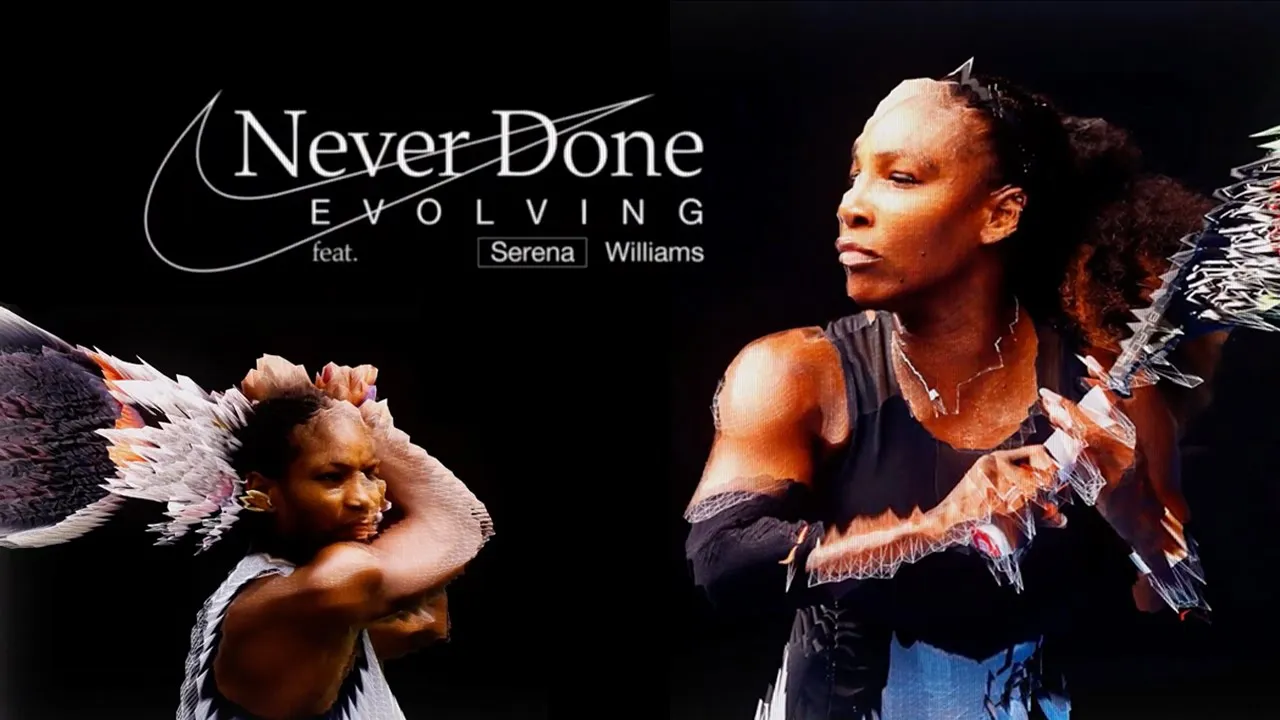
The campaign also broke Nike's previous organic YouTube view record, according to its agency AKQA. This shows how AI had a clear purpose to make an otherwise impossible comparison possible.
When Should Brands Be Careful With AI Ads?
The Coca-Cola case suggests several high-risk situations.
When the campaign is built around emotional heritageChristmas is an obvious example for Coca-Cola, but the same applies to other meaningful occasions. Audiences judge whether the creative feels right for the moment, not just whether it looks good. |
When realistic people are central to the creativeAI-generated human faces need extra care because even small inconsistencies can affect how audiences perceive the content. |
When the audience is actively looking for AI artifactsWhen AI becomes the focus of the campaign, audiences may scrutinize every detail and judge both the ad and the technology behind it. |
A Decision Framework for Using AI in Advertising
The Coca-Cola AI ad controversy can be turned into a simple decision process.
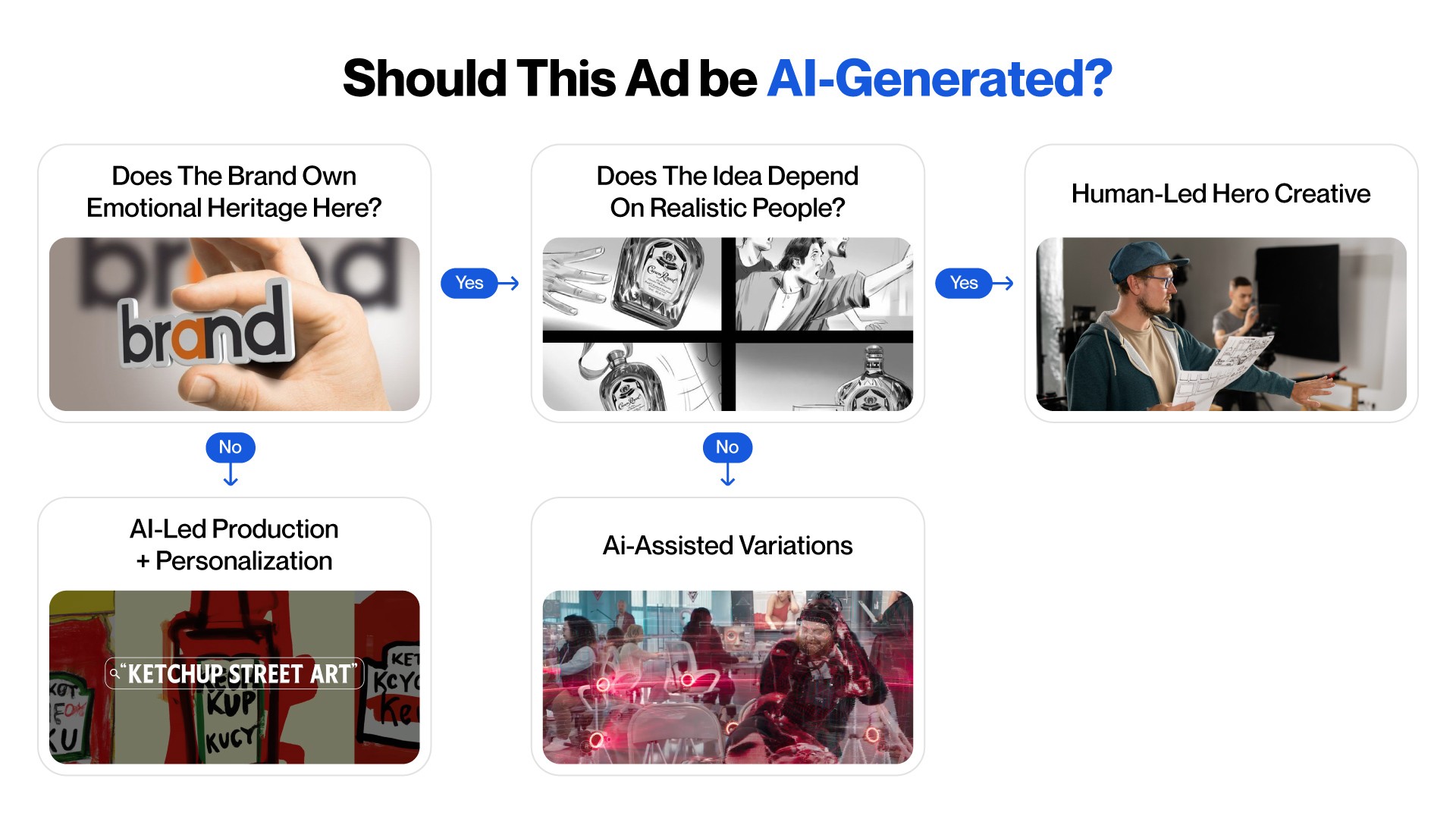
Question 1: Does the brand have emotional heritage in this category?
If the campaign is built around a strong heritage asset, keep human production at the center of the hero content. AI can support the process through concept development, visual exploration, localization, testing, and variations without carrying the full emotional weight of the campaign.
If the brand has less historical or emotional baggage, the creative team has more room to experiment with AI. There is less audience expectation to protect, making it easier to test new approaches.
Question 2: Does the campaign depend on realistic people?
If the campaign relies on a person feeling real, consider using human-generated creative, especially for testimonials, reactions, lived experiences, or content built around personal trust.
If the campaign uses a fictional character, clearly synthetic experience, or highly stylized world, AI can be more useful. The key question is not whether AI can create a person. It is whether the audience needs that person to feel real.
The Better Role for AI May Be Behind the Hero AdAI should not replace traditional production everywhere. Use AI where it creates real value through speed, scale, personalization, or testing, and rely on human production when emotional authenticity is the main value. |
What Coca-Cola's AI Experiment Really Teaches Marketers
The Coca-Cola AI ad controversy is difficult to label as simply successful or unsuccessful. The campaigns performed well in consumer testing, while also receiving public criticism around authenticity, craft, heritage, and the role of AI in creative work. The lesson is that AI advertising is not a binary choice. Brands should use AI where it creates value through scale and efficiency, while being more careful when authenticity is central to the brand experience.

Masterhooks AI Ads takes a similar approach by treating creative development as a testing and optimization system across UGC strategy, scripting, creator content, and performance testing. The Coca-Cola case highlights an important question for brands: Can AI create an advantage without weakening what makes the brand worth choosing? Knowing where that line sits can help marketers use AI as part of the creative system rather than letting the technology define the creative itself.
Want help figuring out where AI actually earns its place in your brand's creative process?

Want help figuring out where AI actually earns its place in your brand's creative process?
On one hand, the campaign faced criticism for allegedly lacking authenticity and a human touch. On the other hand, a consumer test by System1 awarded both campaigns a maximum score of 5.9 stars, indicating high potential effectiveness. This discrepancy raises an important question for marketers: where should AI fit into a brand’s creative process?
What Actually Happened With Coca-Cola's AI Ads?
2024: The first experiment
In 2024, Coca-Cola released its first AI holiday ad, an AI-generated reinterpretation of its iconic 1995 'Holidays Are Coming' commercial. The campaign recreated the familiar red trucks and winter setting using generative AI, with more than 40 creatives involved and around 10,000 generated frames. The goal was simple: bring a classic piece of holiday advertising into the present using new technology.
The audience response was more mixed. Viewers criticized the ad for awkward faces, unnatural movement, and a lack of the warmth associated with the original, while CARMA reported positive sentiment falling from 23.8% to 10.2%. Yet System1 gave the ad its maximum 5.9-star rating. This created an important contradiction: public conversation and controlled consumer testing told very different stories.
2025: Coca-Cola changed the formula
In 2025, Coca-Cola returned with another AI-generated “Holidays Are Coming” commercial, this time focusing more on animals such as polar bears, penguins, rabbits, owls, and sloths. The company also worked with AI studios Silverside and Secret Level, with more than 70,000 clips generated and refined by five AI specialists.
The production process was also much faster, with Coca-Cola saying development could be reduced from around a year to roughly a month. The result looked more polished, but viewers still criticized inconsistencies between shots, including changes to the Coca-Cola trucks and other details.
System1 again gave the campaign a 5.9-star rating, while online criticism continued. That contradiction is the real lesson from the Coca-Cola AI ads: an ad can perform well in testing while still creating concerns about the creative itself.
Why Did Coca-Cola Become So Vulnerable to AI Backlash?
AI advertising does not carry the same risk for every brand. Coca-Cola's heritage and cultural significance made this experiment especially sensitive.
1. Coca-Cola owns an enormous piece of Christmas advertising culture
Coca-Cola's Christmas advertising has been part of its brand identity for decades. The red trucks, Santa Claus, polar bears, and “Holidays Are Coming” campaign are familiar assets that carry strong emotional meaning.
That changes how people judge the creative. A typical AI-generated ad may be judged mainly on how it looks, but a Coca-Cola Christmas ad is also compared with the memories people already have. The more emotional value a brand owns, the more carefully it needs to protect the creative language that built it.
2. The audience knew AI was involved
Coca-Cola openly positioned AI as part of the creative process, which can change how people judge the work. Once audiences know something is AI-generated, they may pay closer attention to details that feel unnatural. A strange hand, changing truck, or awkward expression can become part of the conversation.
This matters because consumers are becoming more aware of AI-generated advertising. DoubleVerify reported in 2026 that 42% of consumers globally said low-quality AI advertising would negatively affect their opinion of a brand. The point is not that everyone dislikes AI advertising, but that quality can strongly influence how audiences respond to it.
3. The creative industry has its own stake in the conversation
Generative AI affects more than the final advertisement. It also raises questions about the future of work for photographers, illustrators, animators, actors, directors, editors, and designers. Coca-Cola's AI campaigns therefore became part of a wider conversation about how brands should use generative tools.
That can make criticism spread beyond people who simply dislike the ad. A technical issue, such as an unnatural AI-generated truck, can become part of a larger debate about replacing traditional creative processes with AI.
This creates an interesting effect: an ad can perform well as advertising while creating a very different reaction as a topic of industry conversation. Both can happen at the same time.
When Do AI Ads Actually Work?
The Coca-Cola case becomes more useful when compared with campaigns where AI solved a specific creative problem.
AI works well when scale is the creative idea
Cadbury's “Shah Rukh Khan-My-Ad” campaign shows how AI can solve a personalization challenge. The campaign used AI and machine learning to create personalized ads featuring Shah Rukh Khan promoting thousands of local businesses across India.
More than 130,000 videos were created for around 2,000 stores across 500+ pin codes, generating 94 million views and contributing to a record 33 million Celebrations packs sold. The important point is that AI made this level of personalization possible at scale. It was solving a production problem, not being used simply because it was cheaper.
AI works well when personalization improves relevance
Virgin Voyages used a similar approach with “Jen AI.” The campaign allowed users to create personalized invitations featuring an AI version of Jennifer Lopez, with each message tailored to a specific person and occasion.
The campaign generated more than 25,000 personalized invites and over two billion impressions, according to WPP. Here, AI was not simply used to make the ad. The technology was part of the experience, giving people a reason to interact with it and make something of their own.
AI works well when the technology becomes part of the concept
Heinz took another approach with “A.I. Ketchup.” The campaign asked an image-generation model to visualize ketchup, and many of the results looked like Heinz. The brand turned this into a way to show how recognizable its identity was.
The campaign then invited people to create their own prompts and used the AI-generated images in packaging and other campaign assets. It generated more than 850 million earned impressions, with reported media value exceeding 2,500% of the initial media investment. In this case, Heinz used the technology to create something people could interact with, rather than asking AI to recreate a familiar piece of human-made advertising.
AI works well when it transforms data into something people can experience
Nike's “Never Done Evolving” campaign used machine learning to model Serena Williams at different stages of her career. The technology generated more than 130,000 virtual games, turning decades of performance data into a virtual match between different versions of Serena.
The campaign also broke Nike's previous organic YouTube view record, according to its agency AKQA. This shows how AI had a clear purpose to make an otherwise impossible comparison possible.
When Should Brands Be Careful With AI Ads?
The Coca-Cola case suggests several high-risk situations.
When the campaign is built around emotional heritageChristmas is an obvious example for Coca-Cola, but the same applies to other meaningful occasions. Audiences judge whether the creative feels right for the moment, not just whether it looks good. |
When realistic people are central to the creativeAI-generated human faces need extra care because even small inconsistencies can affect how audiences perceive the content. |
When the audience is actively looking for AI artifactsWhen AI becomes the focus of the campaign, audiences may scrutinize every detail and judge both the ad and the technology behind it. |
A Decision Framework for Using AI in Advertising
The Coca-Cola AI ad controversy can be turned into a simple decision process.
Question 1: Does the brand have emotional heritage in this category?
If the campaign is built around a strong heritage asset, keep human production at the center of the hero content. AI can support the process through concept development, visual exploration, localization, testing, and variations without carrying the full emotional weight of the campaign.
If the brand has less historical or emotional baggage, the creative team has more room to experiment with AI. There is less audience expectation to protect, making it easier to test new approaches.
Question 2: Does the campaign depend on realistic people?
If the campaign relies on a person feeling real, consider using human-generated creative, especially for testimonials, reactions, lived experiences, or content built around personal trust.
If the campaign uses a fictional character, clearly synthetic experience, or highly stylized world, AI can be more useful. The key question is not whether AI can create a person. It is whether the audience needs that person to feel real.
The Better Role for AI May Be Behind the Hero AdAI should not replace traditional production everywhere. Use AI where it creates real value through speed, scale, personalization, or testing, and rely on human production when emotional authenticity is the main value. |
What Coca-Cola's AI Experiment Really Teaches Marketers
The Coca-Cola AI ad controversy is difficult to label as simply successful or unsuccessful. The campaigns performed well in consumer testing, while also receiving public criticism around authenticity, craft, heritage, and the role of AI in creative work. The lesson is that AI advertising is not a binary choice. Brands should use AI where it creates value through scale and efficiency, while being more careful when authenticity is central to the brand experience.
Masterhooks AI Ads takes a similar approach by treating creative development as a testing and optimization system across UGC strategy, scripting, creator content, and performance testing. The Coca-Cola case highlights an important question for brands: Can AI create an advantage without weakening what makes the brand worth choosing? Knowing where that line sits can help marketers use AI as part of the creative system rather than letting the technology define the creative itself.
Want help figuring out where AI actually earns its place in your brand's creative process?
Related Reading
Related Reading
The UGC Testing Playbook: How to Know If Your Content Is Working Before You Scale
4 min
|
Trends
The UGC Testing Playbook: How to Know If Your Content Is Working Before You Scale
A practical UGC testing SOP covering hook rate, hold rate, CTR, CPA, decision rules, and a 4-week optimization calendar. Learn how to test and scale UGC now!
4 min
|
Trends

How AI Ads Can Lower Your CPA: The Data Behind Smarter Advertising
4 min
|
Trends
How AI Ads Can Lower Your CPA: The Data Behind Smarter Advertising
See how AI advertising can lower CPA and improve ROAS through smarter bidding, targeting, creative testing, and real-time budget optimization.
4 min
|
Trends
What Are AI Ads? How Brands Are Using Artificial Intelligence to Create, Target, and Scale Advertising in 2026
4 min
|
Trends
What Are AI Ads? How Brands Are Using Artificial Intelligence to Create, Target, and Scale Advertising in 2026
Learn what AI advertising is, how AI creates and targets ads, and how brands use it to test, optimize, and scale campaigns in 2026.
4 min
|
Trends



Need help scaling?
Book a strategy call with our expert team to audit your current UGC setup.
