



How The Odyssey Made $264M Without Paying a Single Influencer
How The Odyssey Made $264M Without Paying a Single Influencer
Learn how The Odyssey used scarcity, exclusive IMAX experiences, and organic UGC instead of influencer screenings to generate a $264M opening weekend.
Published:

Read Time:

3 min

Written by:
Fawwaz
Trend Research and Copywriter
A BLOCKBUSTER MOVIE, BUT NO INFLUENCERS INVITED TO THE PREVIEW
It seems like every blockbuster movie follows a standard procedure: inviting influencers to preview screenings to flood TikTok and Instagram with early audience reactions. This time, however, Universal took a different approach for The Odyssey
A BLOCKBUSTER MOVIE, BUT NO INFLUENCERS INVITED TO THE PREVIEW
It seems like every blockbuster movie follows a standard procedure: inviting influencers to preview screenings to flood TikTok and Instagram with early audience reactions. This time, however, Universal took a different approach for The Odyssey
A BLOCKBUSTER MOVIE, BUT NO INFLUENCERS INVITED TO THE PREVIEW
It seems like every blockbuster movie follows a standard procedure: inviting influencers to preview screenings to flood TikTok and Instagram with early audience reactions. This time, however, Universal took a different approach for The Odyssey
Most blockbuster movies invite influencers to exclusive screenings before release to build early hype. Universal did the opposite for The Odyssey, canceling influencer screenings and limiting early access. While the decision seemed risky, the film went on to earn $264 million during its opening weekend, with its first trailer generating 121.4 million views in just 24 hours.
This article will explore how these numbers point to something significant: Universal didn’t actually abandon its distribution strategy, they redesigned it. Instead of asking influencers to spark conversation before audiences arrived, the studio created conditions where the audiences themselves wanted to start that conversation. This is an important lesson for marketers, and this article will break it down further for you.
The Strategy Wasn't "No Influencers"
In fact, this decision to cancel the film screenings for influencers has drawn attention because it deviates from current Hollywood practice.
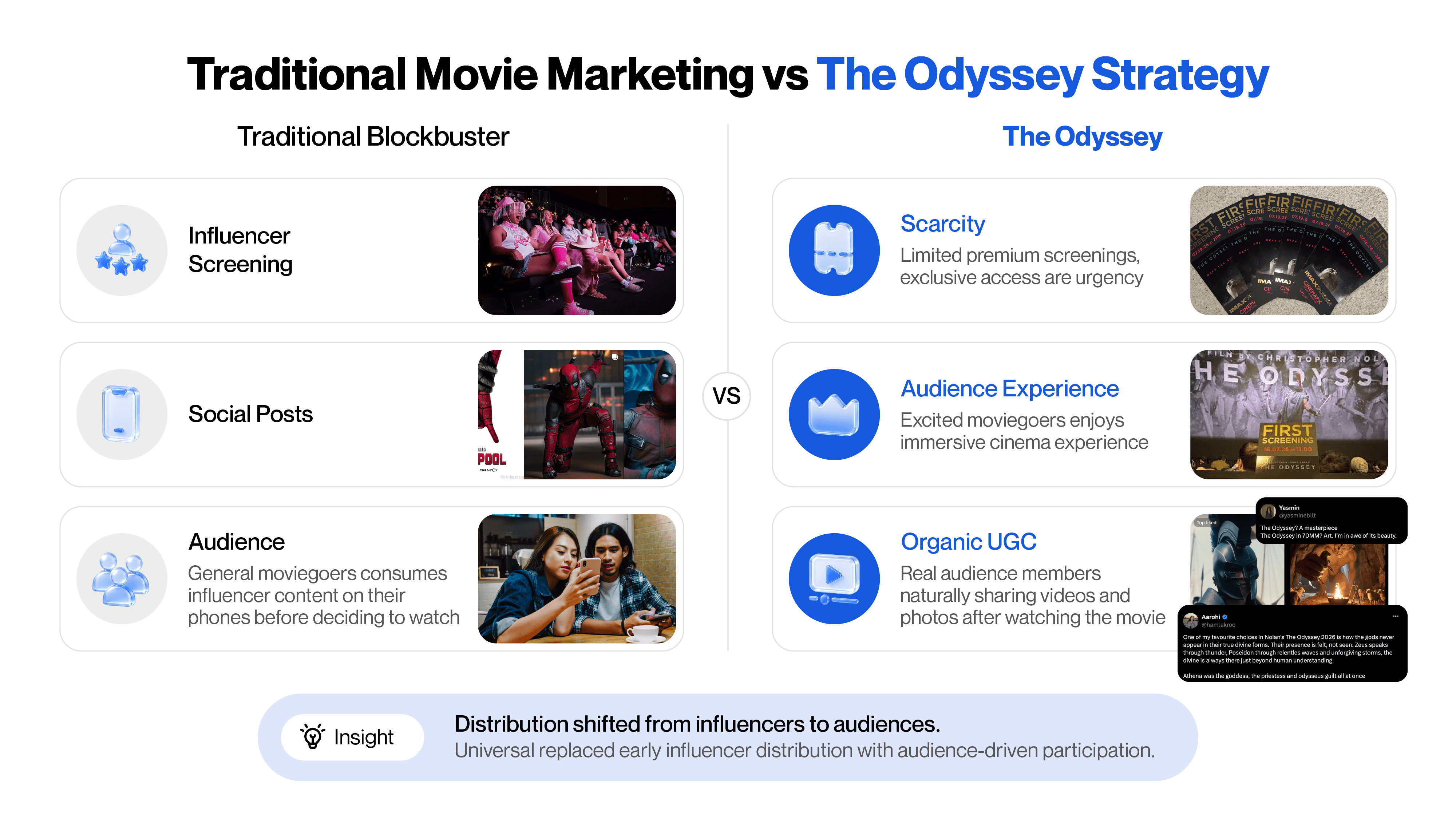
While most studios treat creators as their primary promotional tool, Universal is instead preserving the mystery. Without hundreds of identical “first reaction” videos appearing a few days before the release, audiences enter opening weekend with fewer spoilers and more curiosity. That curiosity becomes valuable because it is exclusively owned by paying moviegoers, making them the first group indirectly permitted to tell the story.
This subtle shift increases the value of attendance during opening weekend because people are no longer consuming reactions, they’re creating them through their own experiences and in their own style.
The Spread Mechanism of The Odyssey
Mechanism One: Scarcity Created Urgency
Scarcity was designed into nearly every stage of the rollout.
Examples included:
IMAX ticket presales opening roughly a year before release
A limited three-week IMAX exclusivity window
Limited access to premium large format screenings
Careful control over early footage and promotional material
Those decisions didn’t change the movie itself, but changed the access. This strategy works well because when audiences believe an opportunity is temporary, delaying the decision feels costly. So the campaign shifted from:
"I'll watch it eventually." | → | "I need to see this before everyone else does." |
That psychological shift created urgency before reviews or audience scores could influence demand.
Mechanism Two: The Format Became the Product
The second strategy employed was to highlight the film’s format as a product, an added selling point for the film.
https://www.odysseymovie.com/explore-formats/
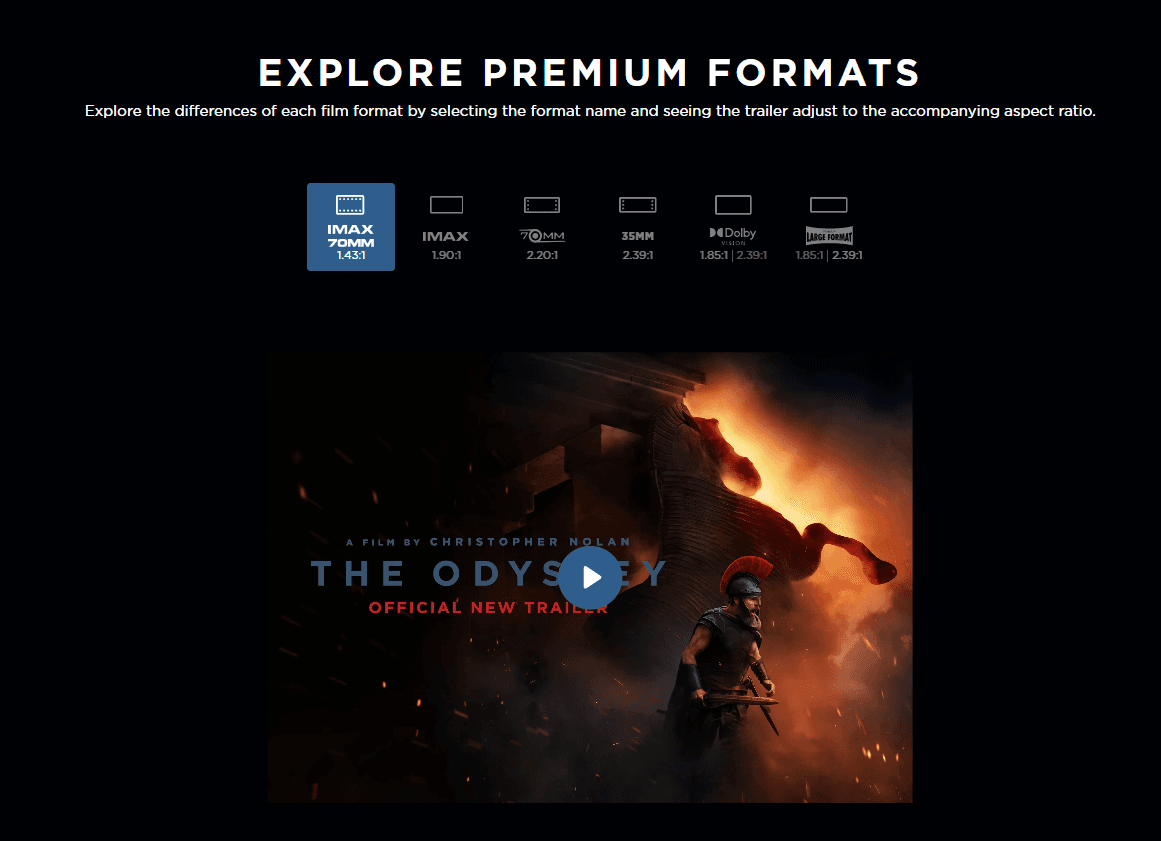
The Odyssey became the first narrative film shot entirely with IMAX film cameras, making the viewing experience a selling point rather than a technical specification. The use of IMAX in this film was a key highlight because those watching at home would never be able to replicate that experience, nor would those watching in a standard theater.
This distinction is significant because Universal indirectly ran a campaign that consistently suggested that IMAX was the intended way to enjoy the film. As a result, about half of the audience during the opening weekend opted for Premium Large Format screenings, including IMAX, Dolby Cinema, and 4DX.
By highlighting IMAX in The Odyssey, Universal succeeded in making audiences feel that they were not just buying a movie ticket but also gaining access to a version that many others couldn’t immediately enjoy. This exclusivity naturally spurred documentation from photos of tickets, theater videos, and reaction videos, each piece of content serving as a promotional channel without Universal having to spend money to pay for them.
Mechanism Three: Conversation Expanded the Campaign
Long before the opening weekend, The Odyssey sparked discussions about several casting decisions, particularly the inclusion of Lupita Nyong’o and Elliot Page.
The debate wasn’t driven by a promotional campaign but emerged organically in entertainment media and on social platforms. Regardless of whether audiences agreed or disagreed, this discussion had a similar effect: it generated more discussion, more headlines, more searches, and more awareness. Most importantly, it appears that Universal did not engineer this conversation.
The campaign capitalized on cultural momentum without making controversy its central message. This distinction is important to note because planned controversies only succeed if the underlying product is already capturing attention. Without that foundation, controversy often undermines the brand rather than supporting it.
Why Audiences Became the Marketing Team
One reason influencer campaigns succeed is that creators document their experiences. Rather than disregarding this, Universal simply changed who gets to experience it first. Instead of selected influencers, Universal prioritizes the general public as the initial storytellers.
Someone leaving a sold-out IMAX theater naturally wanted to post their ticket, the auditorium, their reaction, the scale of the screen, and also their recommendation. None of this requires sponsorship, as creators share experiences they deem worthy of sharing.
When running influencer campaigns, you are purchasing distribution. However, you can generate distribution organically by creating experiences worth documenting. This approach often feels more authentic because audience participation is voluntary.
What Smaller Brands Can Borrow
Most businesses will never release a blockbuster film, especially those who are not operating in the film industry. Nevertheless, the fundamental principles discussed above remain highly practical and can be emulated by smaller brands. Here are the fundamental principles:
Create Genuine ScarcityDon’t fabricate scarcity, let it happen naturally by offering early access, limiting availability, and rolling out products in phases. | Let Customers Tell the StoryInstead of rigidly scripting every message, create moments that customers naturally want to document. Such content typically carries more credibility than brand-created ads. |
Build Exclusive ExperiencesCustomers will remember moments they can’t easily recreate, such as private events, personalized onboarding, limited-attendance workshops, and special editions. This is important because experiences often generate stronger word-of-mouth promotion than the product itself. | Use Conversation CarefullyNot all disagreements generate valuable attention, so the most powerful campaigns spark discussions because people already care about the underlying product. You must ensure that the conversations reinforce quality, rather than replace it. |
When Less Promotion Creates More Distribution
The Odyssey demonstrates that reducing one form of promotion can sometimes strengthen another. Universal did not reject influencer marketing as a category. It recognized that, for this particular release, preserving mystery and creating exclusivity would encourage audiences to become the first voices people trusted.
That lesson extends beyond filmmaking. Brands do not always need more creators talking before launch. In some situations, they benefit more from designing experiences that customers feel compelled to share after launch.
This is one reason Masterhooks frequently studies campaigns that generate voluntary participation instead of relying solely on paid distribution. The most durable marketing systems are often those where customers become the media channel because the experience itself gives them a reason to talk.
Start applying "The Odyssey" marketing principles to your brand right away!
Start applying "The Odyssey" marketing principles to your brand right away!
Most blockbuster movies invite influencers to exclusive screenings before release to build early hype. Universal did the opposite for The Odyssey, canceling influencer screenings and limiting early access. While the decision seemed risky, the film went on to earn $264 million during its opening weekend, with its first trailer generating 121.4 million views in just 24 hours.
This article will explore how these numbers point to something significant: Universal didn’t actually abandon its distribution strategy, they redesigned it. Instead of asking influencers to spark conversation before audiences arrived, the studio created conditions where the audiences themselves wanted to start that conversation. This is an important lesson for marketers, and this article will break it down further for you.
The Strategy Wasn't "No Influencers"
In fact, this decision to cancel the film screenings for influencers has drawn attention because it deviates from current Hollywood practice.
While most studios treat creators as their primary promotional tool, Universal is instead preserving the mystery. Without hundreds of identical “first reaction” videos appearing a few days before the release, audiences enter opening weekend with fewer spoilers and more curiosity. That curiosity becomes valuable because it is exclusively owned by paying moviegoers, making them the first group indirectly permitted to tell the story.
This subtle shift increases the value of attendance during opening weekend because people are no longer consuming reactions, they’re creating them through their own experiences and in their own style.
The Spread Mechanism of The Odyssey
Mechanism One: Scarcity Created Urgency
Scarcity was designed into nearly every stage of the rollout.
Examples included:
IMAX ticket presales opening roughly a year before release
A limited three-week IMAX exclusivity window
Limited access to premium large format screenings
Careful control over early footage and promotional material
Those decisions didn’t change the movie itself, but changed the access. This strategy works well because when audiences believe an opportunity is temporary, delaying the decision feels costly. So the campaign shifted from:
"I'll watch it eventually." | → | "I need to see this before everyone else does." |
That psychological shift created urgency before reviews or audience scores could influence demand.
Mechanism Two: The Format Became the Product
The second strategy employed was to highlight the film’s format as a product, an added selling point for the film.
https://www.odysseymovie.com/explore-formats/
The Odyssey became the first narrative film shot entirely with IMAX film cameras, making the viewing experience a selling point rather than a technical specification. The use of IMAX in this film was a key highlight because those watching at home would never be able to replicate that experience, nor would those watching in a standard theater.
This distinction is significant because Universal indirectly ran a campaign that consistently suggested that IMAX was the intended way to enjoy the film. As a result, about half of the audience during the opening weekend opted for Premium Large Format screenings, including IMAX, Dolby Cinema, and 4DX.
By highlighting IMAX in The Odyssey, Universal succeeded in making audiences feel that they were not just buying a movie ticket but also gaining access to a version that many others couldn’t immediately enjoy. This exclusivity naturally spurred documentation from photos of tickets, theater videos, and reaction videos, each piece of content serving as a promotional channel without Universal having to spend money to pay for them.
Mechanism Three: Conversation Expanded the Campaign
Long before the opening weekend, The Odyssey sparked discussions about several casting decisions, particularly the inclusion of Lupita Nyong’o and Elliot Page.
The debate wasn’t driven by a promotional campaign but emerged organically in entertainment media and on social platforms. Regardless of whether audiences agreed or disagreed, this discussion had a similar effect: it generated more discussion, more headlines, more searches, and more awareness. Most importantly, it appears that Universal did not engineer this conversation.
The campaign capitalized on cultural momentum without making controversy its central message. This distinction is important to note because planned controversies only succeed if the underlying product is already capturing attention. Without that foundation, controversy often undermines the brand rather than supporting it.
Why Audiences Became the Marketing Team
One reason influencer campaigns succeed is that creators document their experiences. Rather than disregarding this, Universal simply changed who gets to experience it first. Instead of selected influencers, Universal prioritizes the general public as the initial storytellers.
Someone leaving a sold-out IMAX theater naturally wanted to post their ticket, the auditorium, their reaction, the scale of the screen, and also their recommendation. None of this requires sponsorship, as creators share experiences they deem worthy of sharing.
When running influencer campaigns, you are purchasing distribution. However, you can generate distribution organically by creating experiences worth documenting. This approach often feels more authentic because audience participation is voluntary.
What Smaller Brands Can Borrow
Most businesses will never release a blockbuster film, especially those who are not operating in the film industry. Nevertheless, the fundamental principles discussed above remain highly practical and can be emulated by smaller brands. Here are the fundamental principles:
Create Genuine ScarcityDon’t fabricate scarcity, let it happen naturally by offering early access, limiting availability, and rolling out products in phases. | Let Customers Tell the StoryInstead of rigidly scripting every message, create moments that customers naturally want to document. Such content typically carries more credibility than brand-created ads. |
Build Exclusive ExperiencesCustomers will remember moments they can’t easily recreate, such as private events, personalized onboarding, limited-attendance workshops, and special editions. This is important because experiences often generate stronger word-of-mouth promotion than the product itself. | Use Conversation CarefullyNot all disagreements generate valuable attention, so the most powerful campaigns spark discussions because people already care about the underlying product. You must ensure that the conversations reinforce quality, rather than replace it. |
When Less Promotion Creates More Distribution
The Odyssey demonstrates that reducing one form of promotion can sometimes strengthen another. Universal did not reject influencer marketing as a category. It recognized that, for this particular release, preserving mystery and creating exclusivity would encourage audiences to become the first voices people trusted.
That lesson extends beyond filmmaking. Brands do not always need more creators talking before launch. In some situations, they benefit more from designing experiences that customers feel compelled to share after launch.
This is one reason Masterhooks frequently studies campaigns that generate voluntary participation instead of relying solely on paid distribution. The most durable marketing systems are often those where customers become the media channel because the experience itself gives them a reason to talk.
Start applying "The Odyssey" marketing principles to your brand right away!
Related Reading
How Blumhouse Built a $740M Horror Franchise by Spending Less Than Any Competitor
4 min
|

How to Find & Choose the Right Influencer for Your Brand (Without Getting Burned)
5 min
|

What Is Influencer Marketing? A No-Fluff Guide for Brands Ready to Actually Use It
5 min
|


Need help scaling?
Book a strategy call with our expert team to audit your current UGC setup.
Related Reading
How Blumhouse Built a $740M Horror Franchise by Spending Less Than Any Competitor
How Blumhouse turned low-budget horror into a repeatable franchise model using controlled costs, social amplification, and audience-driven content.
4 min
|
How Blumhouse Built a $740M Horror Franchise by Spending Less Than Any Competitor
How Blumhouse turned low-budget horror into a repeatable franchise model using controlled costs, social amplification, and audience-driven content.
4 min
|
How to Find & Choose the Right Influencer for Your Brand (Without Getting Burned)
Learn how to find influencers for your brand using audience fit, engagement quality, growth patterns, content quality, and campaign history.
5 min
|
How to Find & Choose the Right Influencer for Your Brand (Without Getting Burned)
Learn how to find influencers for your brand using audience fit, engagement quality, growth patterns, content quality, and campaign history.
5 min
|
What Is Influencer Marketing? A No-Fluff Guide for Brands Ready to Actually Use It
Ready to use influencer marketing for your brands? Learn influencer types, campaign models, costs, ROI, measurement, and how to choose the right creators.
5 min
|
What Is Influencer Marketing? A No-Fluff Guide for Brands Ready to Actually Use It
Ready to use influencer marketing for your brands? Learn influencer types, campaign models, costs, ROI, measurement, and how to choose the right creators.
5 min
|