



How to Brief a Creator for Experience UGC: Lessons from The Odyssey's Organic Content Wave
How to Brief a Creator for Experience UGC: Lessons from The Odyssey's Organic Content Wave
Learn how to brief creators for Experience UGC by designing authentic moments instead of scripted messages, with practical examples brands can apply today.
Published:

Read Time:

3 min

Written by:
Fawwaz
Trend Research and Copywriter
STYLIZED “AUTHENTICITY” MEANS IT’S NOT AUTHENTIC
Brands ask creators to provide authentic reactions, but the results fall far short of that. The problem here isn’t with the creators, but often with the brief they’re given. Traditional UGC briefs are designed to control what creators say by dictating key messages, talking points, camera angles, and calls to action. It is these specific instructions that strip away authenticity.
STYLIZED “AUTHENTICITY” MEANS IT’S NOT AUTHENTIC
Brands ask creators to provide authentic reactions, but the results fall far short of that. The problem here isn’t with the creators, but often with the brief they’re given. Traditional UGC briefs are designed to control what creators say by dictating key messages, talking points, camera angles, and calls to action. It is these specific instructions that strip away authenticity.
STYLIZED “AUTHENTICITY” MEANS IT’S NOT AUTHENTIC
Brands ask creators to provide authentic reactions, but the results fall far short of that. The problem here isn’t with the creators, but often with the brief they’re given. Traditional UGC briefs are designed to control what creators say by dictating key messages, talking points, camera angles, and calls to action. It is these specific instructions that strip away authenticity.
The traditional UGC brief approach can work well for product education and testimonials, but it’s less effective for creating authentic discoveries. In the wave of audience-generated content surrounding the movie *The Odyssey*, moviegoers were never given a script to create content. Instead, they were given experiences in the form of an exclusive IMAX screening, 4DX motion seats, and a premium theater format, that created moments people naturally wanted to document.
The UGC content followed naturally afterward, created by creators who had experienced it firsthand. This is the principle behind experience-based UGC briefs, which will be discussed in this article, emphasizing that brands and marketers should design conditions that enable authentic reactions rather than overly directing the performance.
Traditional Brief vs. Experience Brief
The easiest way to understand Experience UGC is to compare it with a conventional creator brief.
Traditional UGC Brief | Experience UGC Brief |
Defines what should be said | Defines what should be experienced |
Provides a shot list | Provides a moment list |
Controls the final content | Controls the conditions that create the content |
The objective changes completely, focusing on what the creator needs to experience so they naturally want to say it. This single shift is important because it changes the quality of the final content.
The Three Biggest Differences
1. Define the Situation, Not the Script
Traditional Brief | Experience Brief | Notes | |
The Format | "Mention that the battery lasts 12 hours." | "Use the product during a full workday and record the moment you realize it still hasn't needed charging." | The second instruction produces a story instead of a statement. |
The Example | "Talk about the sound quality." | "Bring it to a picnic with friends and record the first moment someone comments on the audio." | This is for a Portable speaker, so the brief should make the experience create the talking point naturally. |
2. Replace the Shot List With a Moment List
Traditional Brief | Experience Brief | Notes | |
The Format |
|
| Shot lists describe visuals, while moment lists describe experiences. These moments give creators structure without forcing identical videos. |
The Example |
|
| For Coffee brands, make sure the moment list can be filmed by each creator differently. This is important because that variation makes the content feel more human. |
3. Control the Input, Not the Output
This is where many brands struggle, because experience-based UGC works when creators are placed in carefully designed situations and are not given pre-determined emotions. Experience-based UGC can be successful if the input is consistent, yet the output remains personal. It is this balance that creates authenticity.
How The Odyssey Briefed Millions of People Without a Brief
Nobody attending The Odyssey received creative instructions, yet thousands of audience members shared remarkably similar content.
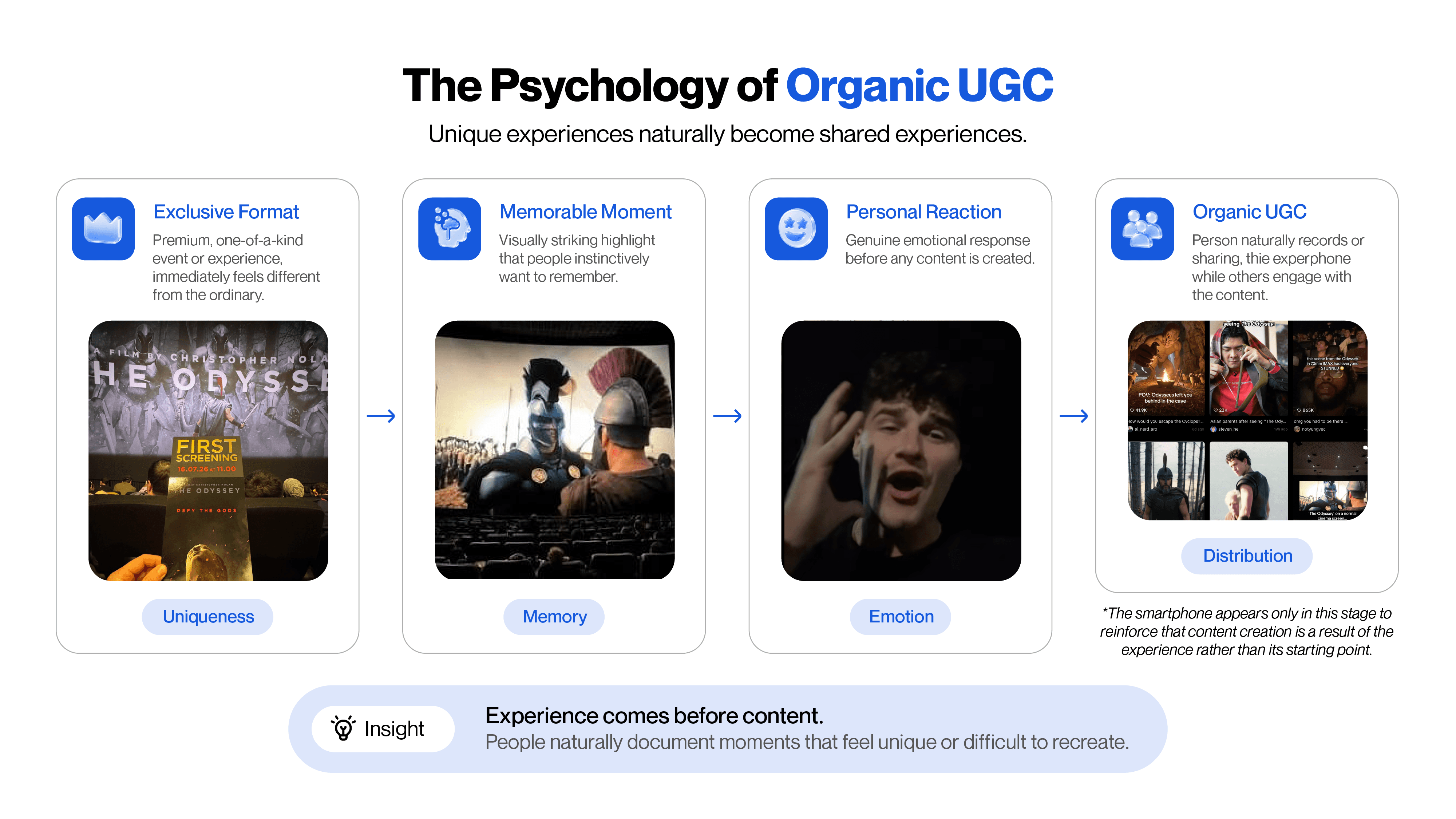
This can happen because the experience itself contains memorable moments. People filmed their IMAX tickets, theater entrances, 4DX seats moving, audience reactions, and also their thoughts immediately after the credits
Universal did not script those videos, and it created the conditions that made those moments worth recording. That is exactly how Experience UGC works, when the experience becomes the creative director.
The Experience UGC Brief Framework
A practical Experience UGC brief can be built around four components. Here are the steps:
Step 1. Define the Experience
Try to ask yourself: What should the creator genuinely feel?
Then find the answer based on your brand’s focus or products. For examples:
Your Brand/Product | Feeling Example |
Skincare | Relief after finding a moisturizer that doesn't leave the skin greasy. |
Fitness App | Satisfaction after completing the first guided workout. |
Restaurant | Surprise when the food arrives. |
The brief should focus on the experience instead of the marketing claim.
Step 2. Design the Discovery Moment
Every memorable experience contains a point where expectations change, so you have to identify those moments. For examples:
The first sip
The first visible result
The first successful feature
The first compliment from another person
That becomes the emotional center of the content.
Step 3. Leave Room for Imperfection
Don’t eliminate all unplanned moments, but allow for natural pauses. Examples include unexpected comments, small mistakes, and genuine laughter. These details often enhance credibility because reactions that are too polished rarely come across as genuine.
Step 4. Define the One Thing That Must Appear
Freedom still needs direction, so choose a single non-negotiable element.
Examples:
The packaging opening
The app interface
The product in use
The final result
Everything else can remain flexible. By creating this balance, you can protect your brand while preserving authenticity.
Great Experience UGC Starts Before the Camera Rolls
The strongest creator briefs do not begin with dialogue. They begin with experiences that naturally produce something worth talking about. When brands focus on designing memorable moments instead of perfect scripts, creators gain the freedom to respond honestly while still communicating the product's value.
That approach does not remove structure. It changes where structure is applied. Instead of controlling every sentence, brands control the environment that shapes the story.
This is why Masterhooks increasingly views creator briefs as experience design documents rather than production checklists. The most persuasive UGC often comes from giving creators something real to discover, then allowing the camera to capture what happens next.
Create a great Experience UGC with Masterhooks now!

Create a great Experience UGC with Masterhooks now!
The traditional UGC brief approach can work well for product education and testimonials, but it’s less effective for creating authentic discoveries. In the wave of audience-generated content surrounding the movie *The Odyssey*, moviegoers were never given a script to create content. Instead, they were given experiences in the form of an exclusive IMAX screening, 4DX motion seats, and a premium theater format, that created moments people naturally wanted to document.
The UGC content followed naturally afterward, created by creators who had experienced it firsthand. This is the principle behind experience-based UGC briefs, which will be discussed in this article, emphasizing that brands and marketers should design conditions that enable authentic reactions rather than overly directing the performance.
Traditional Brief vs. Experience Brief
The easiest way to understand Experience UGC is to compare it with a conventional creator brief.
Traditional UGC Brief | Experience UGC Brief |
Defines what should be said | Defines what should be experienced |
Provides a shot list | Provides a moment list |
Controls the final content | Controls the conditions that create the content |
The objective changes completely, focusing on what the creator needs to experience so they naturally want to say it. This single shift is important because it changes the quality of the final content.
The Three Biggest Differences
1. Define the Situation, Not the Script
Traditional Brief | Experience Brief | Notes | |
The Format | "Mention that the battery lasts 12 hours." | "Use the product during a full workday and record the moment you realize it still hasn't needed charging." | The second instruction produces a story instead of a statement. |
The Example | "Talk about the sound quality." | "Bring it to a picnic with friends and record the first moment someone comments on the audio." | This is for a Portable speaker, so the brief should make the experience create the talking point naturally. |
2. Replace the Shot List With a Moment List
Traditional Brief | Experience Brief | Notes | |
The Format |
|
| Shot lists describe visuals, while moment lists describe experiences. These moments give creators structure without forcing identical videos. |
The Example |
|
| For Coffee brands, make sure the moment list can be filmed by each creator differently. This is important because that variation makes the content feel more human. |
3. Control the Input, Not the Output
This is where many brands struggle, because experience-based UGC works when creators are placed in carefully designed situations and are not given pre-determined emotions. Experience-based UGC can be successful if the input is consistent, yet the output remains personal. It is this balance that creates authenticity.
How The Odyssey Briefed Millions of People Without a Brief
Nobody attending The Odyssey received creative instructions, yet thousands of audience members shared remarkably similar content.
This can happen because the experience itself contains memorable moments. People filmed their IMAX tickets, theater entrances, 4DX seats moving, audience reactions, and also their thoughts immediately after the credits
Universal did not script those videos, and it created the conditions that made those moments worth recording. That is exactly how Experience UGC works, when the experience becomes the creative director.
The Experience UGC Brief Framework
A practical Experience UGC brief can be built around four components. Here are the steps:
Step 1. Define the Experience
Try to ask yourself: What should the creator genuinely feel?
Then find the answer based on your brand’s focus or products. For examples:
Your Brand/Product | Feeling Example |
Skincare | Relief after finding a moisturizer that doesn't leave the skin greasy. |
Fitness App | Satisfaction after completing the first guided workout. |
Restaurant | Surprise when the food arrives. |
The brief should focus on the experience instead of the marketing claim.
Step 2. Design the Discovery Moment
Every memorable experience contains a point where expectations change, so you have to identify those moments. For examples:
The first sip
The first visible result
The first successful feature
The first compliment from another person
That becomes the emotional center of the content.
Step 3. Leave Room for Imperfection
Don’t eliminate all unplanned moments, but allow for natural pauses. Examples include unexpected comments, small mistakes, and genuine laughter. These details often enhance credibility because reactions that are too polished rarely come across as genuine.
Step 4. Define the One Thing That Must Appear
Freedom still needs direction, so choose a single non-negotiable element.
Examples:
The packaging opening
The app interface
The product in use
The final result
Everything else can remain flexible. By creating this balance, you can protect your brand while preserving authenticity.
Great Experience UGC Starts Before the Camera Rolls
The strongest creator briefs do not begin with dialogue. They begin with experiences that naturally produce something worth talking about. When brands focus on designing memorable moments instead of perfect scripts, creators gain the freedom to respond honestly while still communicating the product's value.
That approach does not remove structure. It changes where structure is applied. Instead of controlling every sentence, brands control the environment that shapes the story.
This is why Masterhooks increasingly views creator briefs as experience design documents rather than production checklists. The most persuasive UGC often comes from giving creators something real to discover, then allowing the camera to capture what happens next.
Create a great Experience UGC with Masterhooks now!
Related Reading
How Blumhouse Built a $740M Horror Franchise by Spending Less Than Any Competitor
4 min
|

How to Find & Choose the Right Influencer for Your Brand (Without Getting Burned)
5 min
|

What Is Influencer Marketing? A No-Fluff Guide for Brands Ready to Actually Use It
5 min
|


Need help scaling?
Book a strategy call with our expert team to audit your current UGC setup.
Related Reading
How Blumhouse Built a $740M Horror Franchise by Spending Less Than Any Competitor
How Blumhouse turned low-budget horror into a repeatable franchise model using controlled costs, social amplification, and audience-driven content.
4 min
|
How Blumhouse Built a $740M Horror Franchise by Spending Less Than Any Competitor
How Blumhouse turned low-budget horror into a repeatable franchise model using controlled costs, social amplification, and audience-driven content.
4 min
|
How to Find & Choose the Right Influencer for Your Brand (Without Getting Burned)
Learn how to find influencers for your brand using audience fit, engagement quality, growth patterns, content quality, and campaign history.
5 min
|
How to Find & Choose the Right Influencer for Your Brand (Without Getting Burned)
Learn how to find influencers for your brand using audience fit, engagement quality, growth patterns, content quality, and campaign history.
5 min
|
What Is Influencer Marketing? A No-Fluff Guide for Brands Ready to Actually Use It
Ready to use influencer marketing for your brands? Learn influencer types, campaign models, costs, ROI, measurement, and how to choose the right creators.
5 min
|
What Is Influencer Marketing? A No-Fluff Guide for Brands Ready to Actually Use It
Ready to use influencer marketing for your brands? Learn influencer types, campaign models, costs, ROI, measurement, and how to choose the right creators.
5 min
|