



What Is Experience Content? The UGC Type Brands Can't Script
What Is Experience Content? The UGC Type Brands Can't Script
Learn what Experience Content is, why it feels more authentic than scripted UGC, and how brands can create experiences people naturally want to share.
Published:

Read Time:

3 min

Written by:
Fawwaz
Trend Research and Copywriter
NO REQUEST, NO CAMPAIGN
Universal never asked audiences to record videos after watching *The Odyssey*, yet thousands of people still shared their videos. These ranged from recording themselves as they left the IMAX theater, capturing the movement of the 4DX seats, to simply posting a photo of their ticket with the caption “You have to experience this.”
NO REQUEST, NO CAMPAIGN
Universal never asked audiences to record videos after watching *The Odyssey*, yet thousands of people still shared their videos. These ranged from recording themselves as they left the IMAX theater, capturing the movement of the 4DX seats, to simply posting a photo of their ticket with the caption “You have to experience this.”
NO REQUEST, NO CAMPAIGN
Universal never asked audiences to record videos after watching *The Odyssey*, yet thousands of people still shared their videos. These ranged from recording themselves as they left the IMAX theater, capturing the movement of the 4DX seats, to simply posting a photo of their ticket with the caption “You have to experience this.”
The Universal and The Odyssey case is very interesting because people didn’t create content in response to a request, but rather because they had experienced something they wanted to remember or recommend. This type of content differs from typical UGC, as its more organic spread makes it feel more authentic and far more difficult to fake.
This article refers to this category as “Experience Content”, a type of content created by people based on experiences they consider memorable or valuable. This term isn’t used because it represents a new video format, but because this content stems from a different kind of authenticity.
What Is Experience Content?
Experience Content is user-generated content that exists because someone genuinely experienced something worth documenting.
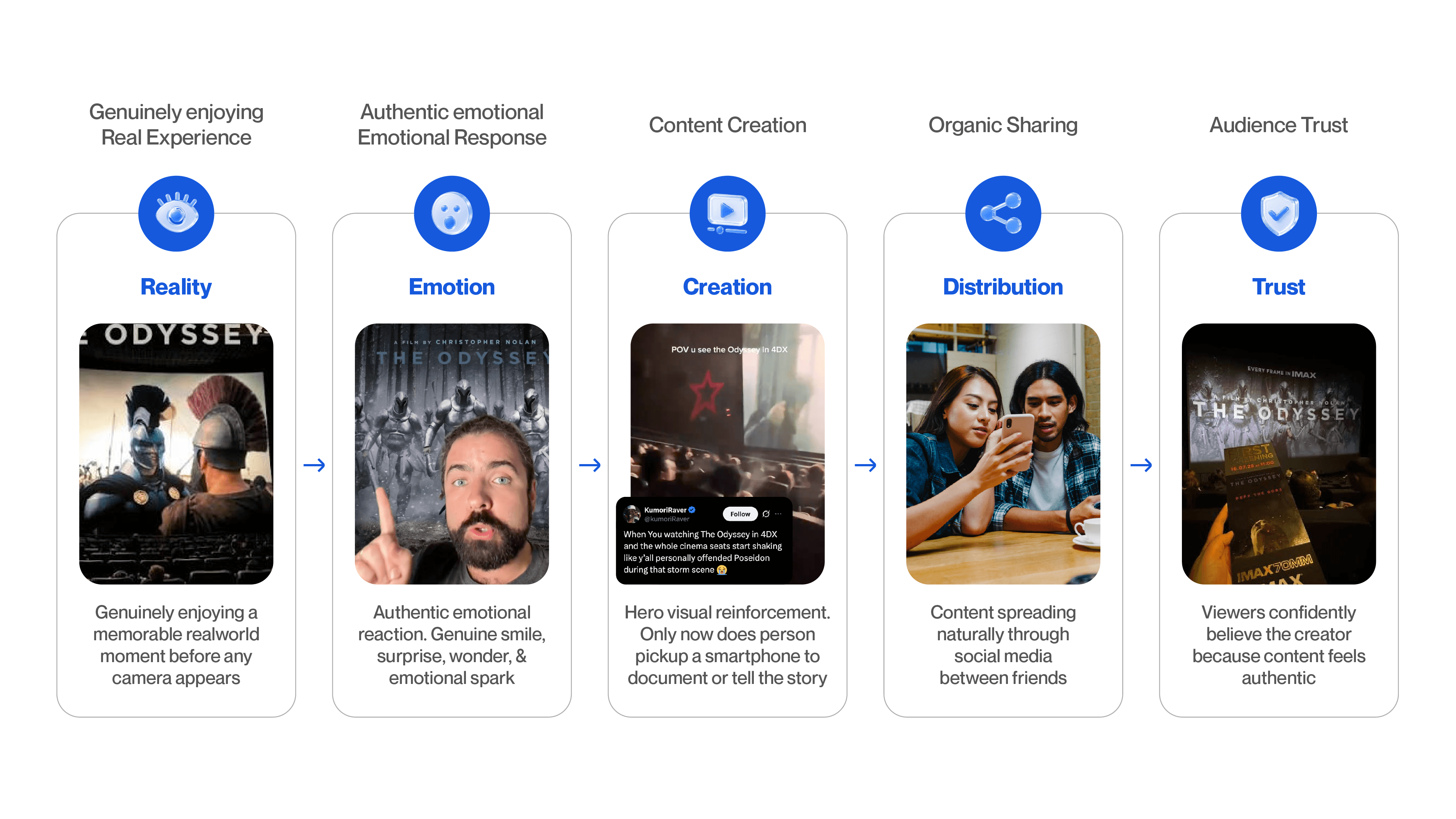
The key difference is not how the content looks, but on why the content exists. So anything can be Experience Content, whether it is a reaction video, an unboxing, a testimonial, even a short clip of a 4DX seat shaking during a movie can qualify.
What connects them is one simple characteristic: The creator had to be present. Because without the experience, the content could not exist. That makes Experience Content a category that describes the origin of the content, not just a format or production style.
Experience Content Can Look Like:
A first reaction after using a product
A genuine unboxing
A customer documenting an exclusive event
Someone filming their first ride in a 4DX theater
A skincare progress update after one week
A creator discovering an unexpected product feature
The formats vary, but the experience remains the foundation.
Why It Feels Different From a Testimonial
Traditional testimonials often start with a script, whereas Content Experience begins with an event.
This difference is important because when someone truly experiences something, small details emerge naturally, such as pausing briefly before answering, laughing unexpectedly, or pointing out something never mentioned in a brief description. All of which capture small moments that only someone who was actually there would notice. These details are difficult to fabricate because they arise during the experience itself.
However, this doesn’t mean that testimonials aren’t effective, as many excellent testimonials are carefully planned. The difference is that Experience Content contains observations that couldn’t have been written before the experience took place. As a result, the audience instinctively recognizes these moments because they feel specific, not generic.
A Simple Framework
Think about authenticity on two different levels.
Planned Execution | Unplanned Emotion |
The creator knows:
Planning is useful because it improves clarity. | The creator does not know:
Those elements emerge naturally, and this is where Experience Content becomes powerful. |
Experience Content Exists Beyond Movies
The Odyssey is simply one example from the same principle that appears across many industries.
First Product ReactionsFor example, when someone opens the packaging, they’ll notice everything about the product: its weight, texture, and sound. This kind of observation is impossible before the box is opened. |
Genuine UnboxingsAn engaging unboxing video captures a moment of discovery, rather than focusing solely on the packaging. This is because the content creator explores the product alongside their audience, making that shared sense of curiosity part of the entertainment. |
Before-and-After ContentIn this type of content, transformation is the main focus and without the passage of time, such content simply wouldn’t exist. |
Live ExperiencesExperiences like concerts, sporting events, pop-up stores, movie premieres, or exclusive workshops give customers the opportunity to naturally capture these moments because they want to remember them, and sharing the content becomes a byproduct of their participation. |
A Framework Brands Can Actually Use
One common misconception is the assumption that Experience Content must be entirely spontaneous.
This assumption is neither realistic nor helpful, because brands can actually plan for it. It’s just that they can’t script every emotional detail. Here are four steps for creating Experience Content for your brand:
Stage 1: Create a Real Experience
You need to offer something worth people’s attention, such as an exclusive launch, a memorable product interaction, a surprising feature, or a unique event.
Stage 2: Leave Room for Discovery
Avoid explaining every moment in advance; let customers discover the details for themselves. That’s because these discoveries are often the most authentic parts of the content.
Stage 3: Make Documentation Easy
Provide good lighting, visually appealing packaging, an eye-catching environment, and easy access to the product. You need to ensure that you minimize barriers to recording without forcing anyone to upload it.
Stage 4: Amplify, Don't Manufacture
When authentic Experience Content emerges, highlight it by sharing the content, utilizing its license, and even turning it into paid creative material if appropriate. The brand’s role is to amplify these genuine moments, not to replace them.
Why Experience Content Matters for Creators
Creators often focus too much on improving camera quality, editing, and storytelling. While all of these skills remain valuable, today’s audiences are increasingly drawn to details that can’t be created through editing.
The most memorable videos often include unexpected observations, spontaneous laughter, or reactions that no creative direction could predict. That’s why creators benefit from spending more time with the product before filming. The richer the experience, the richer the content.
The Best Content Begins Before Recording
Experience Content reminds us that authenticity does not come from removing planning. It comes from allowing real moments to happen inside a planned framework. Brands can design memorable experiences. Creators can prepare thoughtful productions. Neither side can fully predict the emotional details that emerge once someone is genuinely present. That is what separates content that feels performed from content that feels lived.
This is one reason Masterhooks increasingly analyzes campaigns through the experiences they create rather than the formats they use. When brands give people something worth feeling, audiences often create the most persuasive content on their own.
Create the best Experience Content with Masterhooks now!

Create the best Experience Content with Masterhooks now!
The Universal and The Odyssey case is very interesting because people didn’t create content in response to a request, but rather because they had experienced something they wanted to remember or recommend. This type of content differs from typical UGC, as its more organic spread makes it feel more authentic and far more difficult to fake.
This article refers to this category as “Experience Content”, a type of content created by people based on experiences they consider memorable or valuable. This term isn’t used because it represents a new video format, but because this content stems from a different kind of authenticity.
What Is Experience Content?
Experience Content is user-generated content that exists because someone genuinely experienced something worth documenting.
The key difference is not how the content looks, but on why the content exists. So anything can be Experience Content, whether it is a reaction video, an unboxing, a testimonial, even a short clip of a 4DX seat shaking during a movie can qualify.
What connects them is one simple characteristic: The creator had to be present. Because without the experience, the content could not exist. That makes Experience Content a category that describes the origin of the content, not just a format or production style.
Experience Content Can Look Like:
A first reaction after using a product
A genuine unboxing
A customer documenting an exclusive event
Someone filming their first ride in a 4DX theater
A skincare progress update after one week
A creator discovering an unexpected product feature
The formats vary, but the experience remains the foundation.
Why It Feels Different From a Testimonial
Traditional testimonials often start with a script, whereas Content Experience begins with an event.
This difference is important because when someone truly experiences something, small details emerge naturally, such as pausing briefly before answering, laughing unexpectedly, or pointing out something never mentioned in a brief description. All of which capture small moments that only someone who was actually there would notice. These details are difficult to fabricate because they arise during the experience itself.
However, this doesn’t mean that testimonials aren’t effective, as many excellent testimonials are carefully planned. The difference is that Experience Content contains observations that couldn’t have been written before the experience took place. As a result, the audience instinctively recognizes these moments because they feel specific, not generic.
A Simple Framework
Think about authenticity on two different levels.
Planned Execution | Unplanned Emotion |
The creator knows:
Planning is useful because it improves clarity. | The creator does not know:
Those elements emerge naturally, and this is where Experience Content becomes powerful. |
Experience Content Exists Beyond Movies
The Odyssey is simply one example from the same principle that appears across many industries.
First Product ReactionsFor example, when someone opens the packaging, they’ll notice everything about the product: its weight, texture, and sound. This kind of observation is impossible before the box is opened. |
Genuine UnboxingsAn engaging unboxing video captures a moment of discovery, rather than focusing solely on the packaging. This is because the content creator explores the product alongside their audience, making that shared sense of curiosity part of the entertainment. |
Before-and-After ContentIn this type of content, transformation is the main focus and without the passage of time, such content simply wouldn’t exist. |
Live ExperiencesExperiences like concerts, sporting events, pop-up stores, movie premieres, or exclusive workshops give customers the opportunity to naturally capture these moments because they want to remember them, and sharing the content becomes a byproduct of their participation. |
A Framework Brands Can Actually Use
One common misconception is the assumption that Experience Content must be entirely spontaneous.
This assumption is neither realistic nor helpful, because brands can actually plan for it. It’s just that they can’t script every emotional detail. Here are four steps for creating Experience Content for your brand:
Stage 1: Create a Real Experience
You need to offer something worth people’s attention, such as an exclusive launch, a memorable product interaction, a surprising feature, or a unique event.
Stage 2: Leave Room for Discovery
Avoid explaining every moment in advance; let customers discover the details for themselves. That’s because these discoveries are often the most authentic parts of the content.
Stage 3: Make Documentation Easy
Provide good lighting, visually appealing packaging, an eye-catching environment, and easy access to the product. You need to ensure that you minimize barriers to recording without forcing anyone to upload it.
Stage 4: Amplify, Don't Manufacture
When authentic Experience Content emerges, highlight it by sharing the content, utilizing its license, and even turning it into paid creative material if appropriate. The brand’s role is to amplify these genuine moments, not to replace them.
Why Experience Content Matters for Creators
Creators often focus too much on improving camera quality, editing, and storytelling. While all of these skills remain valuable, today’s audiences are increasingly drawn to details that can’t be created through editing.
The most memorable videos often include unexpected observations, spontaneous laughter, or reactions that no creative direction could predict. That’s why creators benefit from spending more time with the product before filming. The richer the experience, the richer the content.
The Best Content Begins Before Recording
Experience Content reminds us that authenticity does not come from removing planning. It comes from allowing real moments to happen inside a planned framework. Brands can design memorable experiences. Creators can prepare thoughtful productions. Neither side can fully predict the emotional details that emerge once someone is genuinely present. That is what separates content that feels performed from content that feels lived.
This is one reason Masterhooks increasingly analyzes campaigns through the experiences they create rather than the formats they use. When brands give people something worth feeling, audiences often create the most persuasive content on their own.
Create the best Experience Content with Masterhooks now!
Related Reading
How Blumhouse Built a $740M Horror Franchise by Spending Less Than Any Competitor
4 min
|

How to Find & Choose the Right Influencer for Your Brand (Without Getting Burned)
5 min
|

What Is Influencer Marketing? A No-Fluff Guide for Brands Ready to Actually Use It
5 min
|


Need help scaling?
Book a strategy call with our expert team to audit your current UGC setup.
Related Reading
How Blumhouse Built a $740M Horror Franchise by Spending Less Than Any Competitor
How Blumhouse turned low-budget horror into a repeatable franchise model using controlled costs, social amplification, and audience-driven content.
4 min
|
How Blumhouse Built a $740M Horror Franchise by Spending Less Than Any Competitor
How Blumhouse turned low-budget horror into a repeatable franchise model using controlled costs, social amplification, and audience-driven content.
4 min
|
How to Find & Choose the Right Influencer for Your Brand (Without Getting Burned)
Learn how to find influencers for your brand using audience fit, engagement quality, growth patterns, content quality, and campaign history.
5 min
|
How to Find & Choose the Right Influencer for Your Brand (Without Getting Burned)
Learn how to find influencers for your brand using audience fit, engagement quality, growth patterns, content quality, and campaign history.
5 min
|
What Is Influencer Marketing? A No-Fluff Guide for Brands Ready to Actually Use It
Ready to use influencer marketing for your brands? Learn influencer types, campaign models, costs, ROI, measurement, and how to choose the right creators.
5 min
|
What Is Influencer Marketing? A No-Fluff Guide for Brands Ready to Actually Use It
Ready to use influencer marketing for your brands? Learn influencer types, campaign models, costs, ROI, measurement, and how to choose the right creators.
5 min
|