



How to Run a UGC Contest Like Marvel: A Tactical Guide for Brands
How to Run a UGC Contest Like Marvel: A Tactical Guide for Brands
Learn how Marvel's Spider-Man fan edit contest generated massive organic reach and how brands can apply the same UGC contest framework.
Published:

Read Time:

5 min

Written by:
Fawwaz
Trend Research and Copywriter
HUGE PRIZE POOLS AREN’T THE KEY
Most brands assume that a successful UGC (user-generated content) contest requires a massive total prize pool. Marvel proved otherwise with a simple campaign for the release of Spider-Man: Brand New Day.
HUGE PRIZE POOLS AREN’T THE KEY
Most brands assume that a successful UGC (user-generated content) contest requires a massive total prize pool. Marvel proved otherwise with a simple campaign for the release of Spider-Man: Brand New Day.
HUGE PRIZE POOLS AREN’T THE KEY
Most brands assume that a successful UGC (user-generated content) contest requires a massive total prize pool. Marvel proved otherwise with a simple campaign for the release of Spider-Man: Brand New Day.
Marvel launched a fan-created content campaign based on a simple TikTok hashtag when Spider-Man: Brand New Day was released. The campaign generated 2.86 billion social media impressions, forged partnerships with 165 global brands, and inspired hundreds of thousands of fan-created posts across various social media platforms. This contest was one of the easiest ways for fans to join the conversation because they only needed to use the skills they already possessed.
This campaign is particularly compelling because, at its core, the lesson for brands isn’t about owning Spider-Man, but rather about removing barriers, creating meaningful reasons to participate, and encouraging creators to share their own content. Therefore, this article will explore the mechanics behind Marvel’s campaign and explain how brands across various industries can apply similar principles.
Official Announcement & Some #TikTokSpideyFanEditContest
Why Marvel's Fan Edit Contest Worked
This campaign is essentially very simple: it invites fans to create Spider-Man-themed edited content, asks them to upload it using the campaign hashtag, and then wait for the results of the judging.
However, if you look more closely, behind this simple process lie three strategic decisions that can drastically increase participation. Here are the three strategic decisions:
1. The Format Already Felt Familiar
Marvel didn’t create a new content format, because fans are already creating Spider-Man edits every day.
Instead of teaching creators something new, this campaign simply provides an official platform for existing behavior. This is important to note because every additional learning step tends to reduce participation, as it’s perceived as requiring too much effort.
Imagine if creators were asked to download unfamiliar software or learn complex editing techniques. That would be too complicated, and many fans might choose not to participate. Marvel avoids this problem by choosing a format that its audience already understands.
Why this works
People are more likely to participate if they already know how. Therefore, the simpler the format, the wider the range of creators who can get involved.
Brand takeaway
Before launching a contest, try asking your team or discussing with them what kind of content your audience has been creating so far. Once you’ve found the answer, build a concept based on that behavior.
2. The Stakes Felt Worth Pursuing
Not all participants expect to win. Take, for example, the creator below, who knew he couldn’t participate in the contest because he isn’t a U.S. citizen. But he participated anyway.
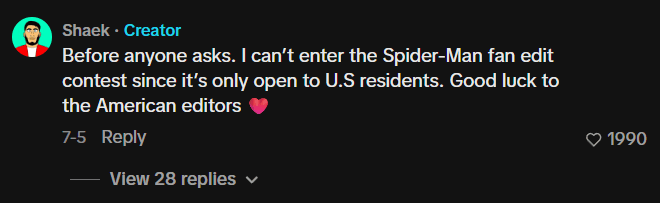
There are many creators like this because the point isn’t really about the prize. Marvel combines tangible rewards with something far more valuable: recognition. When someone wins, it means their work has been recognized by the team behind one of the world’s largest entertainment franchises. When someone doesn’t win, they still receive immense appreciation from TikTok users for their outstanding editing work.
It’s that emotional value that makes participation feel meaningful, going beyond mere monetary rewards. For many creators, recognition from an admired brand and the community becomes portfolio material whose value lasts far longer than the prize itself.
Brand takeaway
Your prize doesn’t have to be expensive, but it should feel unique and exclusive. This is more appealing because anyone can earn money, so you need to offer something people can’t get anywhere else except by entering the contest.
For example, you could feature the winners on your official channel, grant exclusive access to your products, invite them to meet the founding team, or give away limited-edition merchandise. Participants can’t get these specific rewards without participating, so they yield better results than simply offering cash prizes.
3. Participants Became the Distribution Engine
Perhaps the most ingenious part of this campaign wasn’t the video editing challenge itself, but rather what happened afterward.
Creators naturally shared their work with friends and followers. Some hoped for votes, while others simply wanted others to see their work. This served as a means of content dissemination, as each participant became an additional distribution channel.
Instead of having to pay for reach, participants actually expanded the campaign’s reach organically. This creates one of the most powerful effects in user-generated content (UGC) marketing, where each new participant attracts additional participants.
A Five-Step Framework Any Brand Can Use
Marvel benefited from one of the world's biggest entertainment brands, and most companies don't have that advantage. Fortunately, the contest structure works regardless of company size. Here is the 5-step framework you can use to make the same successful campaign:
Step 1. Choose a Familiar Format
Don't ask creators to invent new behavior, instead use content they're already comfortable creating.
For examples:
Outfit styling
Recipes
Product photography
Before-and-after videos
Screen recordings
Workspace setups
The easier the format feels, the more submissions you'll receive.
Step 2. Create Stakes That Feel Real
Big prizes aren't always necessary, but meaningful prizes are. So instead of offering participants with “exciting rewards”, try to offer them something more meaningful like:
$500 cash
One-year subscription
Featured on your homepage
Invitation to your creator program
Specificity increases motivation.
Step 3. Meet Creators Where They're Already Active
Don’t force your audience onto an unfamiliar platform. Find out which platform your audience uses the most, and run your campaign there. Whether it’s TikTok, Instagram Reels, or YouTube Shorts, you need to make sure your audience is actively creating content and engaging in conversations on that platform.
This is important because a successful contest will go with the flow and work to reduce existing barriers, rather than creating new ones.
Step 4. Design Self-Sustaining Distribution
You need to find a way to ensure that every participant has a reason to share. Here are some examples of reasons why someone might share their content:
Public voting
Campaign hashtags
Community favorites
Bonus entries for sharing
Weekly featured submissions
The goal of this strategy is simple: to ensure that every new post naturally generates additional visibility.
Step 5. Turn Winners Into the Next Campaign
Many contests end with just a single announcement. To avoid this, you need to create better contests by extending the narrative rather than simply posting a congratulatory message. You can follow up by creating:
Winner interviews
Behind-the-scenes features
Case studies
Follow-up content
Creator spotlights
By doing this, a single contest you create can generate additional content for weeks on end
Examples Beyond Entertainment
The framework works because it's based on participation, not movies. Here are some examples:
Industry | Challenge | Why it works |
Food & Beverage | Create your most creative recipe using one product. | People already enjoy sharing recipes. |
SaaS or Apps | Show your favorite workflow or productivity setup. | Screen recordings are already common within tech communities. |
Skincare | Document your first seven days using the product. | Visible progress naturally creates curiosity. |
This contest prioritizes experience over perfectly crafted ads. It’s important for you to keep this in mind and adapt it to your brand, as many UGC contests fail for predictable reasons. Try to avoid the following mistakes:
Choosing a format people have never tried
Making participation overly complicated
Offering vague rewards
Launching on platforms where the audience isn't active
Announcing winners without showcasing their work
Great contests lower effort while increasing motivation.
Great UGC Contests Create Reasons to Participate
Marvel's campaign worked because it understood a simple principle: people don't create content because they're told to. They participate because it feels rewarding, whether that's through recognition, competition, or being part of a community they already care about.
Most brands won't have a franchise like Spider-Man, but they can still apply the same idea. By giving people a genuine reason to participate and making sharing part of the experience, brands can encourage organic UGC. That's why Masterhooks focuses on building campaigns that inspire people to create, not just consume.
Make your own contest that supports distribution now!

Make your own contest that supports distribution now!
Marvel launched a fan-created content campaign based on a simple TikTok hashtag when Spider-Man: Brand New Day was released. The campaign generated 2.86 billion social media impressions, forged partnerships with 165 global brands, and inspired hundreds of thousands of fan-created posts across various social media platforms. This contest was one of the easiest ways for fans to join the conversation because they only needed to use the skills they already possessed.
This campaign is particularly compelling because, at its core, the lesson for brands isn’t about owning Spider-Man, but rather about removing barriers, creating meaningful reasons to participate, and encouraging creators to share their own content. Therefore, this article will explore the mechanics behind Marvel’s campaign and explain how brands across various industries can apply similar principles.
Official Announcement & Some #TikTokSpideyFanEditContest
Why Marvel's Fan Edit Contest Worked
This campaign is essentially very simple: it invites fans to create Spider-Man-themed edited content, asks them to upload it using the campaign hashtag, and then wait for the results of the judging.
However, if you look more closely, behind this simple process lie three strategic decisions that can drastically increase participation. Here are the three strategic decisions:
1. The Format Already Felt Familiar
Marvel didn’t create a new content format, because fans are already creating Spider-Man edits every day.
Instead of teaching creators something new, this campaign simply provides an official platform for existing behavior. This is important to note because every additional learning step tends to reduce participation, as it’s perceived as requiring too much effort.
Imagine if creators were asked to download unfamiliar software or learn complex editing techniques. That would be too complicated, and many fans might choose not to participate. Marvel avoids this problem by choosing a format that its audience already understands.
Why this works
People are more likely to participate if they already know how. Therefore, the simpler the format, the wider the range of creators who can get involved.
Brand takeaway
Before launching a contest, try asking your team or discussing with them what kind of content your audience has been creating so far. Once you’ve found the answer, build a concept based on that behavior.
2. The Stakes Felt Worth Pursuing
Not all participants expect to win. Take, for example, the creator below, who knew he couldn’t participate in the contest because he isn’t a U.S. citizen. But he participated anyway.
There are many creators like this because the point isn’t really about the prize. Marvel combines tangible rewards with something far more valuable: recognition. When someone wins, it means their work has been recognized by the team behind one of the world’s largest entertainment franchises. When someone doesn’t win, they still receive immense appreciation from TikTok users for their outstanding editing work.
It’s that emotional value that makes participation feel meaningful, going beyond mere monetary rewards. For many creators, recognition from an admired brand and the community becomes portfolio material whose value lasts far longer than the prize itself.
Brand takeaway
Your prize doesn’t have to be expensive, but it should feel unique and exclusive. This is more appealing because anyone can earn money, so you need to offer something people can’t get anywhere else except by entering the contest.
For example, you could feature the winners on your official channel, grant exclusive access to your products, invite them to meet the founding team, or give away limited-edition merchandise. Participants can’t get these specific rewards without participating, so they yield better results than simply offering cash prizes.
3. Participants Became the Distribution Engine
Perhaps the most ingenious part of this campaign wasn’t the video editing challenge itself, but rather what happened afterward.
Creators naturally shared their work with friends and followers. Some hoped for votes, while others simply wanted others to see their work. This served as a means of content dissemination, as each participant became an additional distribution channel.
Instead of having to pay for reach, participants actually expanded the campaign’s reach organically. This creates one of the most powerful effects in user-generated content (UGC) marketing, where each new participant attracts additional participants.
A Five-Step Framework Any Brand Can Use
Marvel benefited from one of the world's biggest entertainment brands, and most companies don't have that advantage. Fortunately, the contest structure works regardless of company size. Here is the 5-step framework you can use to make the same successful campaign:
Step 1. Choose a Familiar Format
Don't ask creators to invent new behavior, instead use content they're already comfortable creating.
For examples:
Outfit styling
Recipes
Product photography
Before-and-after videos
Screen recordings
Workspace setups
The easier the format feels, the more submissions you'll receive.
Step 2. Create Stakes That Feel Real
Big prizes aren't always necessary, but meaningful prizes are. So instead of offering participants with “exciting rewards”, try to offer them something more meaningful like:
$500 cash
One-year subscription
Featured on your homepage
Invitation to your creator program
Specificity increases motivation.
Step 3. Meet Creators Where They're Already Active
Don’t force your audience onto an unfamiliar platform. Find out which platform your audience uses the most, and run your campaign there. Whether it’s TikTok, Instagram Reels, or YouTube Shorts, you need to make sure your audience is actively creating content and engaging in conversations on that platform.
This is important because a successful contest will go with the flow and work to reduce existing barriers, rather than creating new ones.
Step 4. Design Self-Sustaining Distribution
You need to find a way to ensure that every participant has a reason to share. Here are some examples of reasons why someone might share their content:
Public voting
Campaign hashtags
Community favorites
Bonus entries for sharing
Weekly featured submissions
The goal of this strategy is simple: to ensure that every new post naturally generates additional visibility.
Step 5. Turn Winners Into the Next Campaign
Many contests end with just a single announcement. To avoid this, you need to create better contests by extending the narrative rather than simply posting a congratulatory message. You can follow up by creating:
Winner interviews
Behind-the-scenes features
Case studies
Follow-up content
Creator spotlights
By doing this, a single contest you create can generate additional content for weeks on end
Examples Beyond Entertainment
The framework works because it's based on participation, not movies. Here are some examples:
Industry | Challenge | Why it works |
Food & Beverage | Create your most creative recipe using one product. | People already enjoy sharing recipes. |
SaaS or Apps | Show your favorite workflow or productivity setup. | Screen recordings are already common within tech communities. |
Skincare | Document your first seven days using the product. | Visible progress naturally creates curiosity. |
This contest prioritizes experience over perfectly crafted ads. It’s important for you to keep this in mind and adapt it to your brand, as many UGC contests fail for predictable reasons. Try to avoid the following mistakes:
Choosing a format people have never tried
Making participation overly complicated
Offering vague rewards
Launching on platforms where the audience isn't active
Announcing winners without showcasing their work
Great contests lower effort while increasing motivation.
Great UGC Contests Create Reasons to Participate
Marvel's campaign worked because it understood a simple principle: people don't create content because they're told to. They participate because it feels rewarding, whether that's through recognition, competition, or being part of a community they already care about.
Most brands won't have a franchise like Spider-Man, but they can still apply the same idea. By giving people a genuine reason to participate and making sharing part of the experience, brands can encourage organic UGC. That's why Masterhooks focuses on building campaigns that inspire people to create, not just consume.
Make your own contest that supports distribution now!



Need help scaling?
Book a strategy call with our expert team to audit your current UGC setup.

