


10 Proven Hooks AI Apps Use to Go Viral on Instagram and TikTok
10 Proven Hooks AI Apps Use to Go Viral on Instagram and TikTok
10 hook formulas drawn from viral AI app content on TikTok and Instagram — with the psychology behind each and how to apply them to your next ad.
Published:

Read Time:

2 min

Written by:
Fawwaz
Trend Research and Copywriter
YOU CAN'T DEMONSTRATE WHAT PEOPLE CAN'T SEE
AI products face a unique challenge because the value is often invisible until someone experiences it.
YOU CAN'T DEMONSTRATE WHAT PEOPLE CAN'T SEE
AI products face a unique challenge because the value is often invisible until someone experiences it.
YOU CAN'T DEMONSTRATE WHAT PEOPLE CAN'T SEE
AI products face a unique challenge because the value is often invisible until someone experiences it.
The hooks that consistently work for AI apps are the ones that make the viewer feel something before the product is ever mentioned.
These ten formulas are drawn from patterns across high-performing AI app content on TikTok and Instagram Reels.
The 10 Hook Formulas
1. "I wish I knew this earlier"
Why it works: This hook activates the curiosity loop by implying that the viewer is currently missing something valuable. The phrase carries a built-in promise of a shortcut or insight the viewer hasn't encountered yet. For AI apps, it works particularly well when the "thing" being teased is a workflow change that saves meaningful time or removes friction from a common task.
2. "You're doing this wrong"
Why it works: This is a pattern interrupt combined with mild ego threat. The viewer stops because the statement implies they've been making a mistake — and most people would rather know about a mistake than scroll past it. The hook performs best when the "wrong way" is something the target audience actually does and recognizes.
3. "Here's how I fixed this in one week"
Why it works: Problem plus solution plus timeframe in one sentence. The timeframe does specific work here — "one week" is short enough to feel achievable but long enough to imply a real change rather than a gimmick. AI apps that solve recurring workflow problems map naturally onto this structure.
4. "POV: You're trying to grow but nothing is working"
Why it works: This hook works through audience identification rather than curiosity. The viewer who recognizes themselves in the POV stops because they feel addressed. It's a high-empathy entry point that bypasses skepticism because it leads with the viewer's experience rather than the product's features.
5. "Almost nobody knows this"
Why it works: Exclusivity and implied insider knowledge. The viewer stops because they want to be among the people who do know this — there's a social and competitive incentive layered on top of the basic curiosity trigger. For AI apps, this works best when the insight being teased is genuinely non-obvious rather than something widely covered.
6. "3 things I'd do differently if I were starting over"
Why it works: Numbered structures reduce cognitive load and set a clear expectation. The "starting over" framing signals hard-won experience rather than generic advice, which makes the content feel more credible before it begins. This format performs well for productivity, business, and workflow AI tools.
7. "This one thing changed everything"
Why it works: Transformation hook. The language implies a single actionable change with disproportionate impact — which is exactly what most viewers are looking for when they're trying to solve a recurring problem. For AI apps that genuinely change a workflow when adopted, this hook can be used honestly rather than as hyperbole.
8. "Why is no one talking about this?"
Why it works: This hook signals that the content contains overlooked information — a category of insight that feels more valuable than widely known advice. It also creates a tribal dynamic: the viewer and the creator share knowledge that most people don't have. Works well for newer AI tools that aren't yet mainstream.
9. "Don't walk. Run."
Why it works: Three words, extreme urgency, and FOMO packed into a minimal package. The brevity is part of the mechanism — there's no time to be skeptical because the hook is already over. Best used for AI tools where the competitive or time-sensitive angle is genuinely relevant, not as a generic urgency play.
10. "The reason your [common task] isn't working"
Why it works: This is a diagnostic hook — it implies that the viewer's current approach has a specific, identifiable flaw that the content will reveal. People with an active frustration around the task named in the hook will stop almost reflexively. The bracket should be filled with something the target audience is actively struggling with, not a generic outcome like "content" or "ads."
What These Hooks Have in Common
Each of these formulas works for the same underlying reason: they create an open loop in the first second. The viewer's brain registers an incomplete thought and staying to watch is the path of least resistance to closing it.
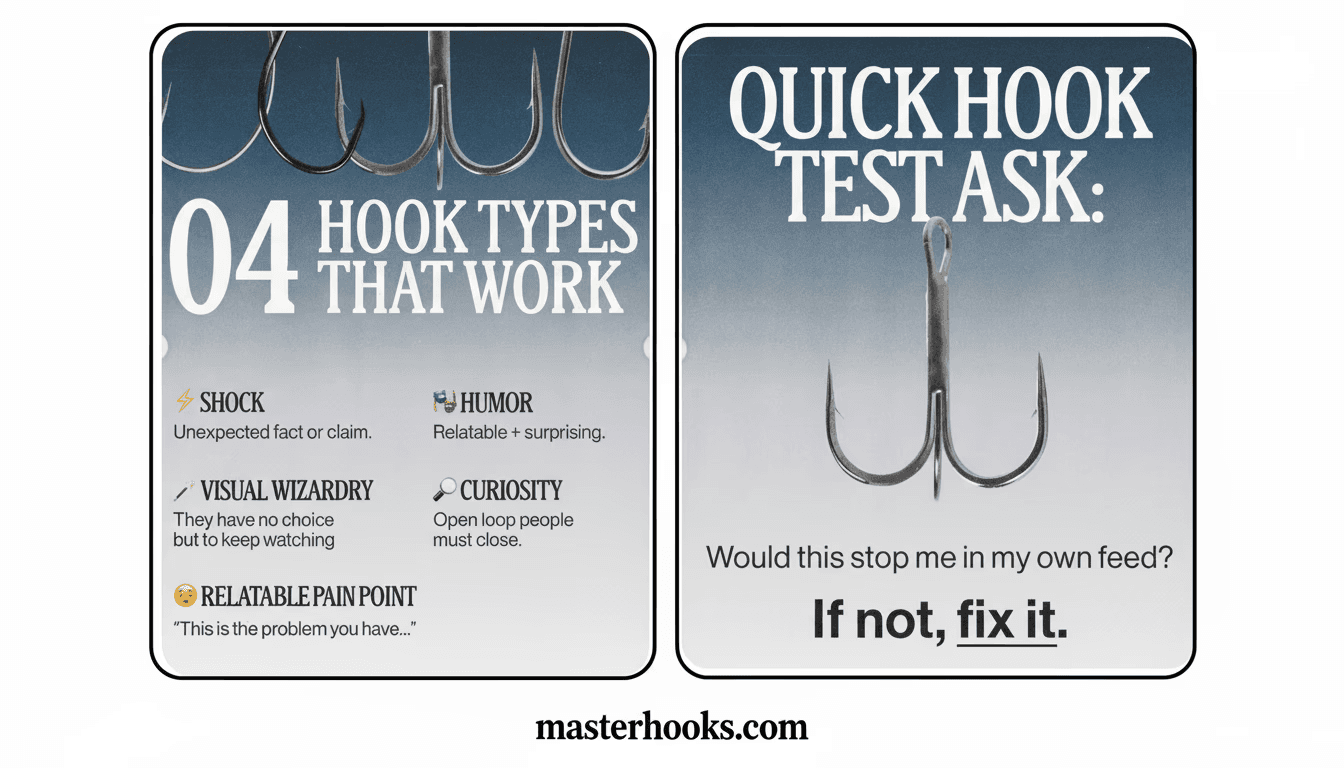
The practical implication for AI app brands is that the hook should never open with the product. It should open with something the viewer is already thinking, feeling, or doing, and let the product enter as the resolution to that state.
Test one hook formula per video, not multiple. Track watch-through rate and comment sentiment rather than likes. The data from ten tested variations tells you more about your audience than a hundred posted videos all using the same opening.
Building hook-first UGC for an AI app and want an outside perspective on what's actually driving installs in your category?
Stop buying vanity metrics. Start engineering your TikTok conversions.
Stop buying vanity metrics. Start engineering your TikTok conversions.
The hooks that consistently work for AI apps are the ones that make the viewer feel something before the product is ever mentioned.
These ten formulas are drawn from patterns across high-performing AI app content on TikTok and Instagram Reels.
The 10 Hook Formulas
1. "I wish I knew this earlier"
Why it works: This hook activates the curiosity loop by implying that the viewer is currently missing something valuable. The phrase carries a built-in promise of a shortcut or insight the viewer hasn't encountered yet. For AI apps, it works particularly well when the "thing" being teased is a workflow change that saves meaningful time or removes friction from a common task.
2. "You're doing this wrong"
Why it works: This is a pattern interrupt combined with mild ego threat. The viewer stops because the statement implies they've been making a mistake — and most people would rather know about a mistake than scroll past it. The hook performs best when the "wrong way" is something the target audience actually does and recognizes.
3. "Here's how I fixed this in one week"
Why it works: Problem plus solution plus timeframe in one sentence. The timeframe does specific work here — "one week" is short enough to feel achievable but long enough to imply a real change rather than a gimmick. AI apps that solve recurring workflow problems map naturally onto this structure.
4. "POV: You're trying to grow but nothing is working"
Why it works: This hook works through audience identification rather than curiosity. The viewer who recognizes themselves in the POV stops because they feel addressed. It's a high-empathy entry point that bypasses skepticism because it leads with the viewer's experience rather than the product's features.
5. "Almost nobody knows this"
Why it works: Exclusivity and implied insider knowledge. The viewer stops because they want to be among the people who do know this — there's a social and competitive incentive layered on top of the basic curiosity trigger. For AI apps, this works best when the insight being teased is genuinely non-obvious rather than something widely covered.
6. "3 things I'd do differently if I were starting over"
Why it works: Numbered structures reduce cognitive load and set a clear expectation. The "starting over" framing signals hard-won experience rather than generic advice, which makes the content feel more credible before it begins. This format performs well for productivity, business, and workflow AI tools.
7. "This one thing changed everything"
Why it works: Transformation hook. The language implies a single actionable change with disproportionate impact — which is exactly what most viewers are looking for when they're trying to solve a recurring problem. For AI apps that genuinely change a workflow when adopted, this hook can be used honestly rather than as hyperbole.
8. "Why is no one talking about this?"
Why it works: This hook signals that the content contains overlooked information — a category of insight that feels more valuable than widely known advice. It also creates a tribal dynamic: the viewer and the creator share knowledge that most people don't have. Works well for newer AI tools that aren't yet mainstream.
9. "Don't walk. Run."
Why it works: Three words, extreme urgency, and FOMO packed into a minimal package. The brevity is part of the mechanism — there's no time to be skeptical because the hook is already over. Best used for AI tools where the competitive or time-sensitive angle is genuinely relevant, not as a generic urgency play.
10. "The reason your [common task] isn't working"
Why it works: This is a diagnostic hook — it implies that the viewer's current approach has a specific, identifiable flaw that the content will reveal. People with an active frustration around the task named in the hook will stop almost reflexively. The bracket should be filled with something the target audience is actively struggling with, not a generic outcome like "content" or "ads."
What These Hooks Have in Common
Each of these formulas works for the same underlying reason: they create an open loop in the first second. The viewer's brain registers an incomplete thought and staying to watch is the path of least resistance to closing it.
The practical implication for AI app brands is that the hook should never open with the product. It should open with something the viewer is already thinking, feeling, or doing, and let the product enter as the resolution to that state.
Test one hook formula per video, not multiple. Track watch-through rate and comment sentiment rather than likes. The data from ten tested variations tells you more about your audience than a hundred posted videos all using the same opening.
Building hook-first UGC for an AI app and want an outside perspective on what's actually driving installs in your category?
Stop buying vanity metrics. Start engineering your TikTok conversions.
Related Reading


Need help scaling?
Book a strategy call with our expert team to audit your current UGC setup.
Related Reading

What Is a UGC Hook? And How Is It Different From a Regular Hook?
Learn what a UGC hook is, why it's different from regular content hooks, and discover six proven hook types with examples for higher-performing UGC.
6 min
|
What Is a UGC Hook? And How Is It Different From a Regular Hook?
Learn what a UGC hook is, why it's different from regular content hooks, and discover six proven hook types with examples for higher-performing UGC.
6 min
|

What The Odyssey and Spider-Man: Brand New Day Have in Common (Besides Tom Holland and Zendaya)
Learn how The Odyssey and Spider-Man: Brand New Day used opposite marketing strategies to generate massive organic UGC and audience engagement.
4 min
|
What The Odyssey and Spider-Man: Brand New Day Have in Common (Besides Tom Holland and Zendaya)
Learn how The Odyssey and Spider-Man: Brand New Day used opposite marketing strategies to generate massive organic UGC and audience engagement.
4 min
|

The Odyssey's Marketing Playbook: What Brands Can Learn From a $264M Opening
Learn how The Odyssey used scarcity, exclusive IMAX experiences, and FOMO to drive a $264M opening and millions of dollars in earned media.
4 min
|
The Odyssey's Marketing Playbook: What Brands Can Learn From a $264M Opening
Learn how The Odyssey used scarcity, exclusive IMAX experiences, and FOMO to drive a $264M opening and millions of dollars in earned media.
4 min
|