

Creator Economy
Why Horror Brands Consistently Win on Social Media (And What Any Brand Can Learn From It)
Learn why horror marketing consistently generates organic UGC and how brands can use emotion, shared experiences, and audience participation to grow.
Published:

Read Time:

5 min

Written by:
Fawwaz
Trend Research and Copywriter
HORROR IS BOOMING. SHOULD BRANDS GET IN ON THE ACT?
Horror film marketing consistently outperforms most genres on social media, and the numbers behind Insidious: Out of the Further make that clear. This new Insidious movie hit theaters with a social media audience reach of 282.2 million people across TikTok, Facebook, Instagram, X, and YouTube. That figure far exceeds the 182 million recorded for Insidious: The Red Door prior to its 2023 release.
HORROR IS BOOMING. SHOULD BRANDS GET IN ON THE ACT?
Horror film marketing consistently outperforms most genres on social media, and the numbers behind Insidious: Out of the Further make that clear. This new Insidious movie hit theaters with a social media audience reach of 282.2 million people across TikTok, Facebook, Instagram, X, and YouTube. That figure far exceeds the 182 million recorded for Insidious: The Red Door prior to its 2023 release.
HORROR IS BOOMING. SHOULD BRANDS GET IN ON THE ACT?
Horror film marketing consistently outperforms most genres on social media, and the numbers behind Insidious: Out of the Further make that clear. This new Insidious movie hit theaters with a social media audience reach of 282.2 million people across TikTok, Facebook, Instagram, X, and YouTube. That figure far exceeds the 182 million recorded for Insidious: The Red Door prior to its 2023 release.
The horror genre consistently generates organic UGC because it provides an intense experience that encourages viewers to react, discuss, come up with theories, and share them with others. For marketers, the key lesson isn’t to create scary content, but to understand what makes an experience powerful enough to drive the audience to engage others. That’s where organic UGC can flourish.
The UGC Engine Built Into Horror
Major horror releases tend to generate a familiar set of social formats. The exact film changes, but the audience behaviors remain remarkably consistent.
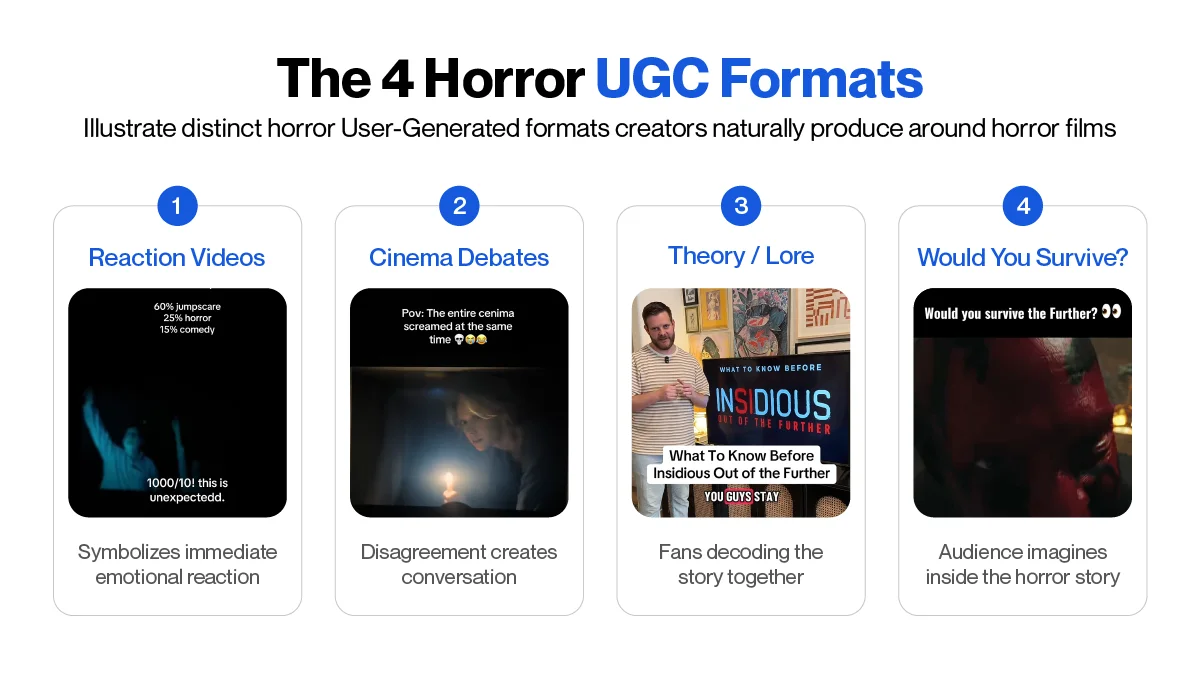
1. Reaction videos
Someone witnesses a tense moment and then records their reaction, whether to the footage itself or to seeing a friend, partner, or family member go through it. The appeal lies in the fact that viewers get two experiences at once: the original moment and another person’s emotional response.
Tap to play
This is what makes reaction content effective on short-form video platforms. Creators don’t need to explain why a moment is important because their facial expressions, voices, and physical reactions can convey emotions instantly.
2. Cinema etiquette debates
The horror genre also sparks debates about the viewing experience. Who screams first? Who chats during a crucial scene? Who spoils the surprise? Or is it too scary to keep watching? Simple questions like these can become fascinating topics of conversation among viewers.
Tap to play
Interestingly, these conversations don’t always discuss the film directly, but they still create a layer of UGC surrounding its release. The audience isn’t just talking about what they’re watching, but also how others are experiencing it, and that experience then becomes new content.
3. Theory and lore videos
The horror genre is very good at leaving questions unanswered, thereby giving viewers room to find their own answers. They can examine the details, connect various clues, and even propose theories about what actually happened. As a result, a single film can continue to generate content for weeks after its release.
Tap to play
An important lesson for marketers is to give the audience something to interpret. When not everything is explained outright, the audience has a reason to think, discuss, and create their own interpretations.
4. "Would you survive?" content
The format can be as simple as inviting the audience to imagine how they would act in the same situation: Would you walk into that room? Try to find the source of the sound? Or manage to survive until morning? Questions like these encourage the audience not only to follow the story but to start imagining themselves in it.
Tap to play
This is where passive viewing turns into participation. When the audience starts offering opinions, choosing actions, or comparing the story to their own experiences, they already have a reason to contribute to the conversation. And participation is the starting point for UGC.
Why Fear Creates So Much Shareable Content
This is the core mechanic of fear marketing: not the scare itself, but the reaction, conversation, and content that follows. Fear can make the viewing experience feel more intense while also encouraging people to react and share that experience. Viewers compare reactions, explain what happened, send clips to friends, or debate what they saw. From this, it’s clear that intense experiences ultimately become topics of conversation.
The mechanism can be summarized as:
Experience → Reaction → Conversation → New Content.
Brands or studios create the initial experience, but it is the audience that develops the conversation and content afterward. This is why horror serves as an interesting example for marketers: not because brands have to create something scary, but because they can learn how an experience encourages the audience to participate.
The Blumhouse Model: Small Budgets, Large Conversation
The Insidious franchise is one of the clearest examples of horror film marketing that compounds over time when a relatively controlled production model repeatedly produces a strong emotional response.
Sony currently describes the franchise as having earned more than $740 million worldwide. The latest installment, Insidious: Out of the Further, was produced with a reported $18 million budget and opened to $25.3 million domestically, plus $35 million internationally, for a $60.3 million worldwide opening.
The economic aspect of this franchise is certainly part of the story, but the social lesson behind it lies in how the horror genre doesn’t require a massive production budget to create an experience that audiences will want to talk about. The first Insidious film reportedly cost around $1.5 million to make and ultimately grossed over $100 million globally. Throughout the franchise’s journey, relatively contained production costs have combined with a large and loyal audience base, creating a cumulative effect.
Each new film already has an established audience base. Every new audience reaction adds to the conversation. Every theory or reaction can introduce the franchise to others. Thus, the value of this franchise extends beyond its individual films, as its true value lies in the audience’s willingness to keep talking about it.
The Part Brands Can Actually Copy
The biggest mistake is to view the lessons from horror as marketing horror stories about brands that went too far trying to scare people. In reality, brands don't need to scare anyone, create anxiety, or spark controversy to apply the same principles. What matters more is emotional intensity, whether it takes the form of fear, surprise, joy, curiosity, disbelief, enthusiasm, anger, relief, or recognition.
What matters isn’t the type of emotion, but whether the experience is powerful enough to make people react, talk about it, and share it with others.
Principle 1: Give people something to feel
Product demonstrations can explain a product’s features, but more impactful UGC can make the audience experience something before the product is even explained. For example, an AI-powered productivity app might showcase a creator’s look of disbelief after completing a task in seconds, while a food brand could highlight reactions to unexpected flavor combinations, or a beauty brand might demonstrate a before-and-after transformation following product use.
The product remains an important element, but emotional responses give viewers a reason to keep watching. This aligns with Masterhooks’ reaction video framework: the creator’s response serves as the main hook, while the product appears naturally as part of that experience.
Principle 2: Create an "in-group"
Horror fans often develop their own language and references around a franchise. They understand the various conventions, inside jokes, and moments that fellow fans are talking about. Brands can create a similar effect by building a familiar language around their products or categories. A running gear brand, for example, might highlight the experience of running 10 km for the first time, while a productivity app could directly address someone who has 47 tabs open in their browser.
The goal is simple: to make the audience think, “They really understand what I’m going through.” When the audience feels understood, they’re more likely to feel like they’re part of a community, and it’s this community that drives conversation.
Principle 3: Give the audience something to process
The most powerful UGC doesn’t always end a conversation, but it actually starts one. That’s why every campaign brief should ask: What will the audience want to tell others after seeing this content? If the answer is “nothing,” the content may be informative but will be hard to share. Conversely, if the audience thinks, “I have to send this to a friend,” “So it’s not just me,” or “Wait, someone else noticed this too?”, that content has a much greater chance of going viral.
This is why experience-based UGC can be more powerful than content with overly rigid scripts. Creators have the freedom to interpret the experience in their own way, making the content feel more personal and giving the audience a reason to react, comment, or share it.
From Emotional Trigger to Content System
Horror's advantage on social media isn't simply that people enjoy being scared. The genre naturally creates moments people want to experience, interpret, and talk about together. That's what brands can borrow. The strongest horror movie marketing campaigns turn the film into the starting point for a larger conversation by creating an emotional experience, giving audiences a shared reference point, and leaving room for them to make the story their own.
Masterhooks takes a similar approach to UGC by looking beyond individual videos and identifying the structures that make content emotionally engaging and easy to participate in. For brands, the first step is understanding whether their creativity gives people something worth reacting to, discussing, and sharing. A free Masterhooks Brand Audit can help identify those opportunities before the next UGC campaign.
Want to find out if your UGC gives people something worth reacting to?

Want to find out if your UGC gives people something worth reacting to?
The horror genre consistently generates organic UGC because it provides an intense experience that encourages viewers to react, discuss, come up with theories, and share them with others. For marketers, the key lesson isn’t to create scary content, but to understand what makes an experience powerful enough to drive the audience to engage others. That’s where organic UGC can flourish.
The UGC Engine Built Into Horror
Major horror releases tend to generate a familiar set of social formats. The exact film changes, but the audience behaviors remain remarkably consistent.
1. Reaction videos
Someone witnesses a tense moment and then records their reaction, whether to the footage itself or to seeing a friend, partner, or family member go through it. The appeal lies in the fact that viewers get two experiences at once: the original moment and another person’s emotional response.
Tap to play
This is what makes reaction content effective on short-form video platforms. Creators don’t need to explain why a moment is important because their facial expressions, voices, and physical reactions can convey emotions instantly.
2. Cinema etiquette debates
The horror genre also sparks debates about the viewing experience. Who screams first? Who chats during a crucial scene? Who spoils the surprise? Or is it too scary to keep watching? Simple questions like these can become fascinating topics of conversation among viewers.
Tap to play
Interestingly, these conversations don’t always discuss the film directly, but they still create a layer of UGC surrounding its release. The audience isn’t just talking about what they’re watching, but also how others are experiencing it, and that experience then becomes new content.
3. Theory and lore videos
The horror genre is very good at leaving questions unanswered, thereby giving viewers room to find their own answers. They can examine the details, connect various clues, and even propose theories about what actually happened. As a result, a single film can continue to generate content for weeks after its release.
Tap to play
An important lesson for marketers is to give the audience something to interpret. When not everything is explained outright, the audience has a reason to think, discuss, and create their own interpretations.
4. "Would you survive?" content
The format can be as simple as inviting the audience to imagine how they would act in the same situation: Would you walk into that room? Try to find the source of the sound? Or manage to survive until morning? Questions like these encourage the audience not only to follow the story but to start imagining themselves in it.
Tap to play
This is where passive viewing turns into participation. When the audience starts offering opinions, choosing actions, or comparing the story to their own experiences, they already have a reason to contribute to the conversation. And participation is the starting point for UGC.
Why Fear Creates So Much Shareable Content
This is the core mechanic of fear marketing: not the scare itself, but the reaction, conversation, and content that follows. Fear can make the viewing experience feel more intense while also encouraging people to react and share that experience. Viewers compare reactions, explain what happened, send clips to friends, or debate what they saw. From this, it’s clear that intense experiences ultimately become topics of conversation.
The mechanism can be summarized as:
Experience → Reaction → Conversation → New Content.
Brands or studios create the initial experience, but it is the audience that develops the conversation and content afterward. This is why horror serves as an interesting example for marketers: not because brands have to create something scary, but because they can learn how an experience encourages the audience to participate.
The Blumhouse Model: Small Budgets, Large Conversation
The Insidious franchise is one of the clearest examples of horror film marketing that compounds over time when a relatively controlled production model repeatedly produces a strong emotional response.
Sony currently describes the franchise as having earned more than $740 million worldwide. The latest installment, Insidious: Out of the Further, was produced with a reported $18 million budget and opened to $25.3 million domestically, plus $35 million internationally, for a $60.3 million worldwide opening.
The economic aspect of this franchise is certainly part of the story, but the social lesson behind it lies in how the horror genre doesn’t require a massive production budget to create an experience that audiences will want to talk about. The first Insidious film reportedly cost around $1.5 million to make and ultimately grossed over $100 million globally. Throughout the franchise’s journey, relatively contained production costs have combined with a large and loyal audience base, creating a cumulative effect.
Each new film already has an established audience base. Every new audience reaction adds to the conversation. Every theory or reaction can introduce the franchise to others. Thus, the value of this franchise extends beyond its individual films, as its true value lies in the audience’s willingness to keep talking about it.
The Part Brands Can Actually Copy
The biggest mistake is to view the lessons from horror as marketing horror stories about brands that went too far trying to scare people. In reality, brands don't need to scare anyone, create anxiety, or spark controversy to apply the same principles. What matters more is emotional intensity, whether it takes the form of fear, surprise, joy, curiosity, disbelief, enthusiasm, anger, relief, or recognition.
What matters isn’t the type of emotion, but whether the experience is powerful enough to make people react, talk about it, and share it with others.
Principle 1: Give people something to feel
Product demonstrations can explain a product’s features, but more impactful UGC can make the audience experience something before the product is even explained. For example, an AI-powered productivity app might showcase a creator’s look of disbelief after completing a task in seconds, while a food brand could highlight reactions to unexpected flavor combinations, or a beauty brand might demonstrate a before-and-after transformation following product use.
The product remains an important element, but emotional responses give viewers a reason to keep watching. This aligns with Masterhooks’ reaction video framework: the creator’s response serves as the main hook, while the product appears naturally as part of that experience.
Principle 2: Create an "in-group"
Horror fans often develop their own language and references around a franchise. They understand the various conventions, inside jokes, and moments that fellow fans are talking about. Brands can create a similar effect by building a familiar language around their products or categories. A running gear brand, for example, might highlight the experience of running 10 km for the first time, while a productivity app could directly address someone who has 47 tabs open in their browser.
The goal is simple: to make the audience think, “They really understand what I’m going through.” When the audience feels understood, they’re more likely to feel like they’re part of a community, and it’s this community that drives conversation.
Principle 3: Give the audience something to process
The most powerful UGC doesn’t always end a conversation, but it actually starts one. That’s why every campaign brief should ask: What will the audience want to tell others after seeing this content? If the answer is “nothing,” the content may be informative but will be hard to share. Conversely, if the audience thinks, “I have to send this to a friend,” “So it’s not just me,” or “Wait, someone else noticed this too?”, that content has a much greater chance of going viral.
This is why experience-based UGC can be more powerful than content with overly rigid scripts. Creators have the freedom to interpret the experience in their own way, making the content feel more personal and giving the audience a reason to react, comment, or share it.
From Emotional Trigger to Content System
Horror's advantage on social media isn't simply that people enjoy being scared. The genre naturally creates moments people want to experience, interpret, and talk about together. That's what brands can borrow. The strongest horror movie marketing campaigns turn the film into the starting point for a larger conversation by creating an emotional experience, giving audiences a shared reference point, and leaving room for them to make the story their own.
Masterhooks takes a similar approach to UGC by looking beyond individual videos and identifying the structures that make content emotionally engaging and easy to participate in. For brands, the first step is understanding whether their creativity gives people something worth reacting to, discussing, and sharing. A free Masterhooks Brand Audit can help identify those opportunities before the next UGC campaign.
Want to find out if your UGC gives people something worth reacting to?
Related Reading
Related Reading

UGC and Influencer Marketing Pricing Guide for Brands in 2026
4 min
|
Creator Economy
UGC and Influencer Marketing Pricing Guide for Brands in 2026
Compare UGC rates, influencer fees, usage rights, and agency costs, with published pricing references and an example creator campaign budget for 2026.
4 min
|
Creator Economy

How to Find the Right Influencer Marketing Agency for Your Brand (Without Wasting Budget)
6 min
|
Creator Economy
How to Find the Right Influencer Marketing Agency for Your Brand (Without Wasting Budget)
Learn how to choose an influencer marketing agency using a practical scorecard, performance criteria, red flags, and pre-contract checks.
6 min
|
Creator Economy

AI Video Ad Agencies: A Buyer's Guide for DTC Brands (2026)
4 min
|
Creator Economy
AI Video Ad Agencies: A Buyer's Guide for DTC Brands (2026)
Compare AI video ad agency types, pricing, performance metrics, ownership rights, and seven questions DTC brands should ask before hiring.
4 min
|
Creator Economy


Need help scaling?
Book a strategy call with our expert team to audit your current UGC setup.