What Are Trial Reels and Why Are Brands Not Using Them to Test UGC?
Learn what Instagram Trial Reels are, how they work, and how brands can test UGC with non-followers before scaling winning content.
Published:

Read Time:

4 min

Written by:
Fawwaz
Trend Research and Copywriter
TESTING CANT BE WASTING YOUR BUDGET
Brands often spend money producing UGC, immediately turning the finished video into a paid ad, and only then finding out whether the hook they used is truly effective. If the performance is poor, part of the budget has already been spent. Instagram Trial Reels offers a way to mitigate that risk by testing content first before allocating a larger ad budget.
TESTING CANT BE WASTING YOUR BUDGET
Brands often spend money producing UGC, immediately turning the finished video into a paid ad, and only then finding out whether the hook they used is truly effective. If the performance is poor, part of the budget has already been spent. Instagram Trial Reels offers a way to mitigate that risk by testing content first before allocating a larger ad budget.
TESTING CANT BE WASTING YOUR BUDGET
Brands often spend money producing UGC, immediately turning the finished video into a paid ad, and only then finding out whether the hook they used is truly effective. If the performance is poor, part of the budget has already been spent. Instagram Trial Reels offers a way to mitigate that risk by testing content first before allocating a larger ad budget.
The Instagram Trial Reels feature offers a more cost-effective testing phase by first showing the Reel to non-followers, observing their response, and then using those results to determine whether the content is worth distributing further. For brands that collaborate with many creators or test several UGC concepts at once, this feature can serve as an initial screening phase before the content is used in paid ads. That way, brands don’t have to treat every finished video as an asset that’s automatically ready for distribution; instead, they can first identify which concepts show the most promise.
What Are Trial Reels?
Trial Reels are Instagram Reels designed to reach people who do not already follow the account. To understand how Trial Reels work on Instagram, it helps to look at what happens the moment a creator enables the option.
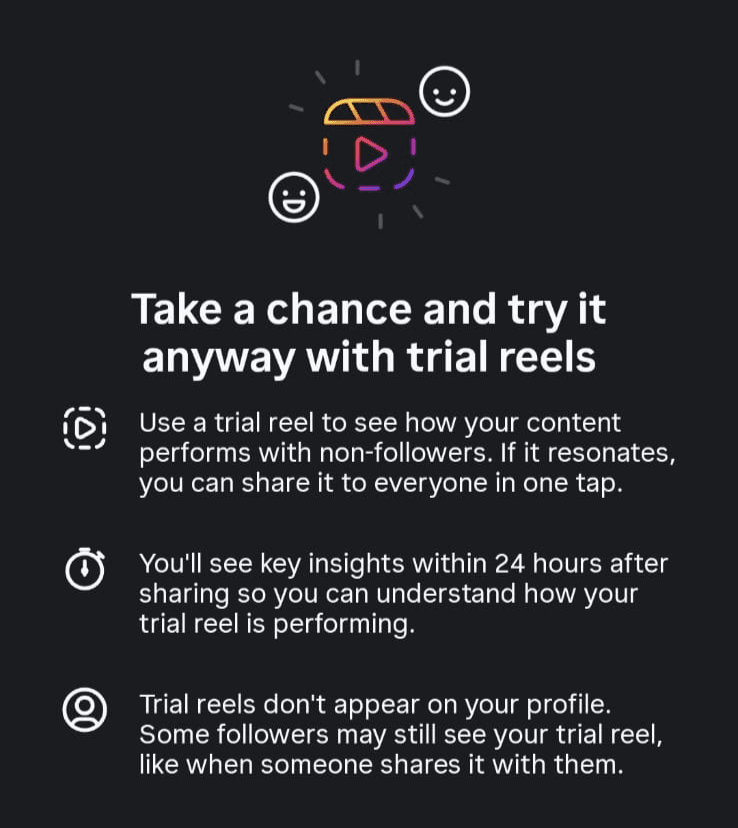
When a creator enables the Trial option before publishing, Instagram distributes the Reel to non-followers first. The content does not appear on the creator's main grid or Reels tab unless they later choose to share it with everyone.
After about 24 hours, Instagram provides performance data such as the number of views, likes, comments, and shares. If a Reel performs well, creators can publish it to their followers or enable the automatic sharing feature based on its performance during the first 72 hours. In this way, Trial Reels helps answer one important question: “Is this content effective enough to attract the attention of people who don’t know us yet?”
Are Trial Reels Worth It?
UGC videos may look good but have a weak hook. This happens because the format is unproven; before Trial Reels, brands typically had to learn this through paid distribution.
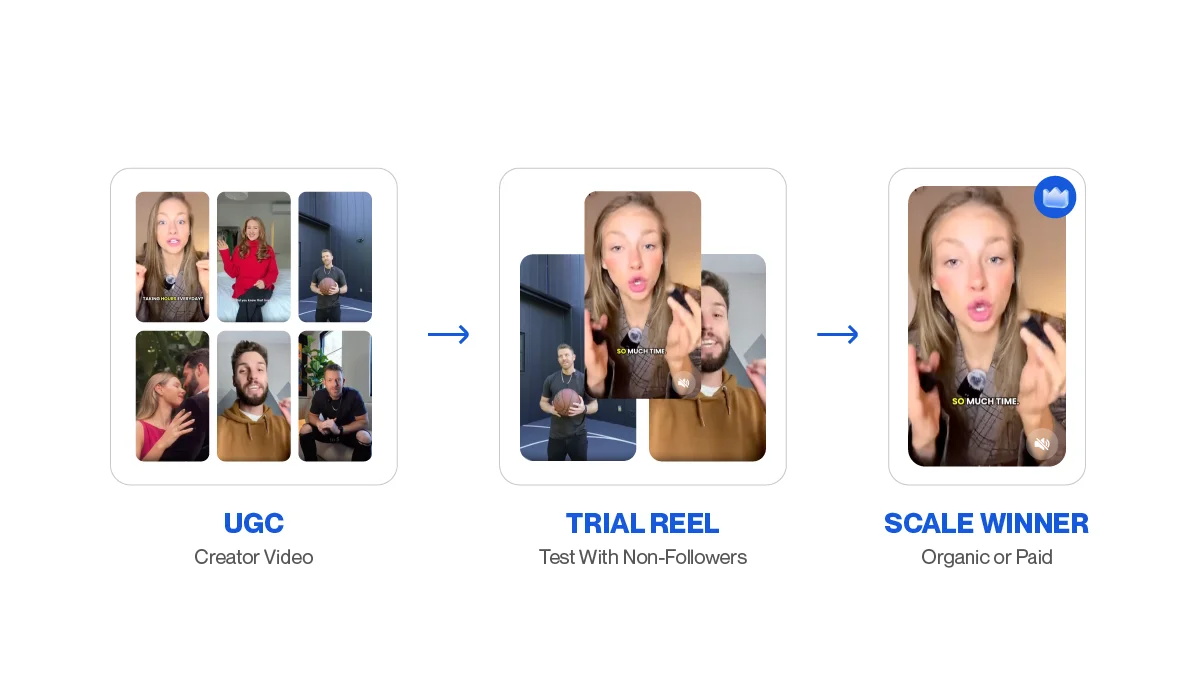
The traditional approach follows a flow where creators submit videos, brands launch ads, costs are incurred, and meaningful performance data isn’t obtained until after the campaign has run. The introduction of Trial Reels adds an extra step:
Create → Test organically → Learn → Scale
The value of Trial Reels becomes especially clear when a brand has multiple versions of the same concept. Instead of immediately spending ad budget on every video, brands can use Trial Reels to see which concepts are most effective at capturing the attention of a cold audience. This makes Trial Reels especially useful for testing different hooks, UGC formats, creators, or concepts before committing more budget.
So are Trial Reels worth it? For UGC-heavy brands, yes, but as a screening tool, not a guarantee of ad performance. A strong result can show that a creative has potential with people who do not already follow the brand, helping marketers filter which assets are worth testing further through paid campaigns.
There is also one thing you need to take note of: Instagram chooses the non-follower audience and controls distribution, so strong performance does not prove that one creative will generate better conversions, ROAS, or purchase intent. The winning video still needs to be validated through paid testing before brands can confidently scale it.
How to Post Trial Reels on Instagram
The process is straightforward. Here's how to post Trial Reels on Instagram step by step:
1. Create the Reel
Upload the UGC video exactly as you normally would.

2. Turn on Trial
Before publishing, activate the Trial option in the Reel publishing flow. Instagram's current interface may change over time, so use the controls visible in your account as the final reference.
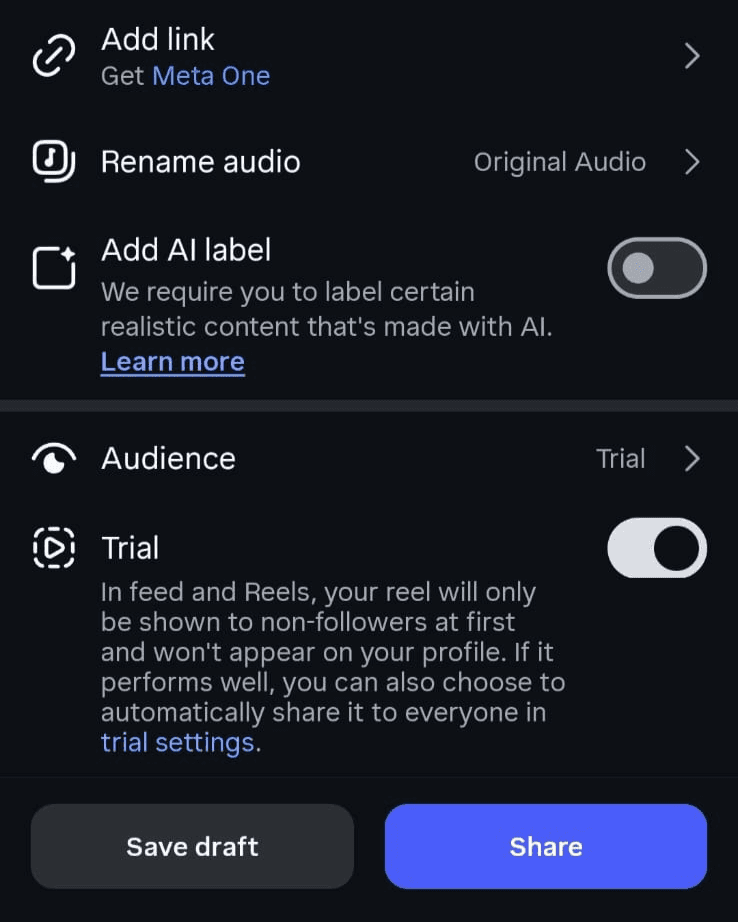
3. Let Instagram test it
The Reel is primarily distributed to non-followers. Your existing audience does not receive it through the normal follower feed while it is in trial mode.
4. Check the results
Give the test enough time to generate useful data. Instagram provides key metrics after about 24 hours, while automatic sharing evaluates performance over 72 hours.
5. Decide what happens next
A strong Trial Reel can become a regular organic post or a candidate for paid testing, while a weak result can simply provide a useful learning. The goal isn't to make every Trial Reel a winner, but to identify which creative decisions are worth repeating.
Turn Trial Reels Into a UGC Testing System
The greatest opportunities arise when Trial Reels are integrated into the creative workflow, rather than being merely a feature used occasionally. Brands can organically test content from ten creators, compare audience responses, and then identify the strongest concepts before deciding which content is worth developing or testing further. The process might look like this:
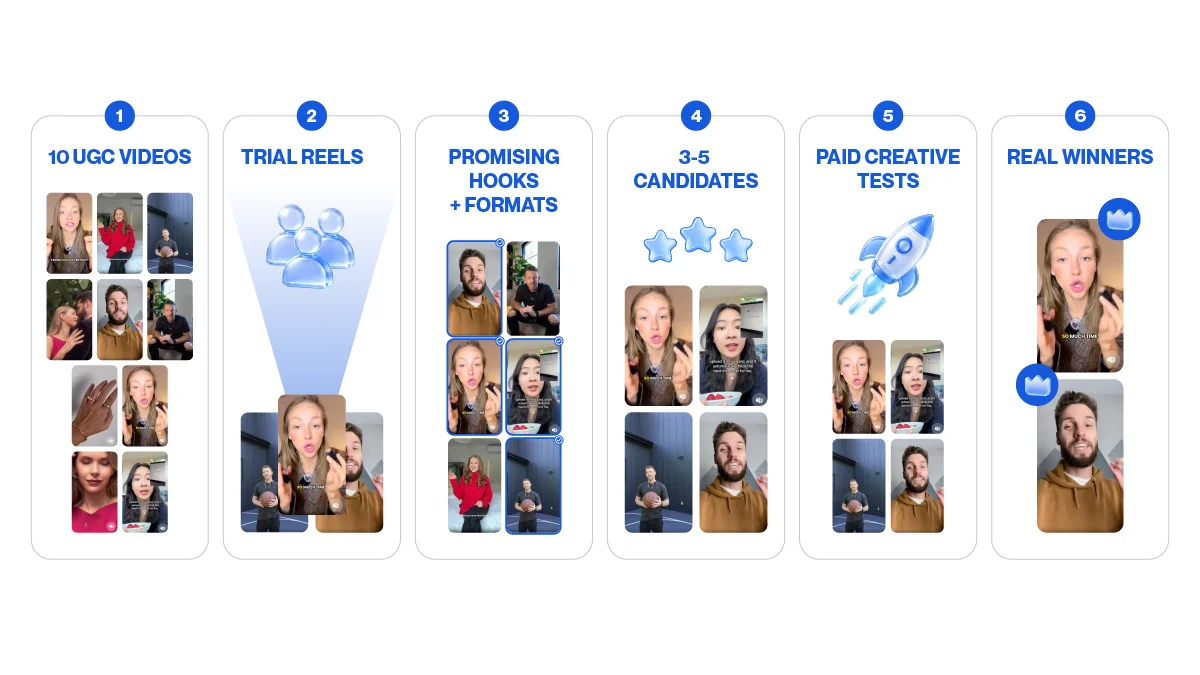
This creates an important distinction between creative validation and campaign validation. Trial Reels help determine whether a piece of content can capture the audience’s attention through views, interactions, or shares, while paid distribution tests whether that attention can generate tangible business impact.
From Testing to Better UGC
Trial Reels become even more useful when test results are used to determine future content. If some videos fail because the hook is too slow, brands can adjust their structure. Conversely, if a particular creator consistently generates high shares with problem-first hooks, that pattern can be applied to the next UGC brief. In this way, Trial Reels create a feedback loop between content and audience response.
Masterhooks takes a similar approach by viewing UGC as an ever-evolving creative system. Performance data can be used to determine which hooks, creators, formats, and concepts are worth developing before moving them to paid distribution. The goal is simple: test more intelligently, allocate the budget to content with the most potential, and use every result to make the next round of UGC even better.
Want to know which of your UGC concepts are actually worth scaling?

Want to know which of your UGC concepts are actually worth scaling?
The Instagram Trial Reels feature offers a more cost-effective testing phase by first showing the Reel to non-followers, observing their response, and then using those results to determine whether the content is worth distributing further. For brands that collaborate with many creators or test several UGC concepts at once, this feature can serve as an initial screening phase before the content is used in paid ads. That way, brands don’t have to treat every finished video as an asset that’s automatically ready for distribution; instead, they can first identify which concepts show the most promise.
What Are Trial Reels?
Trial Reels are Instagram Reels designed to reach people who do not already follow the account. To understand how Trial Reels work on Instagram, it helps to look at what happens the moment a creator enables the option.
When a creator enables the Trial option before publishing, Instagram distributes the Reel to non-followers first. The content does not appear on the creator's main grid or Reels tab unless they later choose to share it with everyone.
After about 24 hours, Instagram provides performance data such as the number of views, likes, comments, and shares. If a Reel performs well, creators can publish it to their followers or enable the automatic sharing feature based on its performance during the first 72 hours. In this way, Trial Reels helps answer one important question: “Is this content effective enough to attract the attention of people who don’t know us yet?”
Are Trial Reels Worth It?
UGC videos may look good but have a weak hook. This happens because the format is unproven; before Trial Reels, brands typically had to learn this through paid distribution.
The traditional approach follows a flow where creators submit videos, brands launch ads, costs are incurred, and meaningful performance data isn’t obtained until after the campaign has run. The introduction of Trial Reels adds an extra step:
Create → Test organically → Learn → Scale
The value of Trial Reels becomes especially clear when a brand has multiple versions of the same concept. Instead of immediately spending ad budget on every video, brands can use Trial Reels to see which concepts are most effective at capturing the attention of a cold audience. This makes Trial Reels especially useful for testing different hooks, UGC formats, creators, or concepts before committing more budget.
So are Trial Reels worth it? For UGC-heavy brands, yes, but as a screening tool, not a guarantee of ad performance. A strong result can show that a creative has potential with people who do not already follow the brand, helping marketers filter which assets are worth testing further through paid campaigns.
There is also one thing you need to take note of: Instagram chooses the non-follower audience and controls distribution, so strong performance does not prove that one creative will generate better conversions, ROAS, or purchase intent. The winning video still needs to be validated through paid testing before brands can confidently scale it.
How to Post Trial Reels on Instagram
The process is straightforward. Here's how to post Trial Reels on Instagram step by step:
1. Create the Reel
Upload the UGC video exactly as you normally would.
2. Turn on Trial
Before publishing, activate the Trial option in the Reel publishing flow. Instagram's current interface may change over time, so use the controls visible in your account as the final reference.
3. Let Instagram test it
The Reel is primarily distributed to non-followers. Your existing audience does not receive it through the normal follower feed while it is in trial mode.
4. Check the results
Give the test enough time to generate useful data. Instagram provides key metrics after about 24 hours, while automatic sharing evaluates performance over 72 hours.
5. Decide what happens next
A strong Trial Reel can become a regular organic post or a candidate for paid testing, while a weak result can simply provide a useful learning. The goal isn't to make every Trial Reel a winner, but to identify which creative decisions are worth repeating.
Turn Trial Reels Into a UGC Testing System
The greatest opportunities arise when Trial Reels are integrated into the creative workflow, rather than being merely a feature used occasionally. Brands can organically test content from ten creators, compare audience responses, and then identify the strongest concepts before deciding which content is worth developing or testing further. The process might look like this:
This creates an important distinction between creative validation and campaign validation. Trial Reels help determine whether a piece of content can capture the audience’s attention through views, interactions, or shares, while paid distribution tests whether that attention can generate tangible business impact.
From Testing to Better UGC
Trial Reels become even more useful when test results are used to determine future content. If some videos fail because the hook is too slow, brands can adjust their structure. Conversely, if a particular creator consistently generates high shares with problem-first hooks, that pattern can be applied to the next UGC brief. In this way, Trial Reels create a feedback loop between content and audience response.
Masterhooks takes a similar approach by viewing UGC as an ever-evolving creative system. Performance data can be used to determine which hooks, creators, formats, and concepts are worth developing before moving them to paid distribution. The goal is simple: test more intelligently, allocate the budget to content with the most potential, and use every result to make the next round of UGC even better.
Want to know which of your UGC concepts are actually worth scaling?
Related Reading
Related Reading

UGC and Influencer Marketing Pricing Guide for Brands in 2026
4 min
|
UGC and Influencer Marketing Pricing Guide for Brands in 2026
Compare UGC rates, influencer fees, usage rights, and agency costs, with published pricing references and an example creator campaign budget for 2026.
4 min
|

How to Find the Right Influencer Marketing Agency for Your Brand (Without Wasting Budget)
6 min
|
How to Find the Right Influencer Marketing Agency for Your Brand (Without Wasting Budget)
Learn how to choose an influencer marketing agency using a practical scorecard, performance criteria, red flags, and pre-contract checks.
6 min
|

AI Video Ad Agencies: A Buyer's Guide for DTC Brands (2026)
4 min
|
AI Video Ad Agencies: A Buyer's Guide for DTC Brands (2026)
Compare AI video ad agency types, pricing, performance metrics, ownership rights, and seven questions DTC brands should ask before hiring.
4 min
|


Need help scaling?
Book a strategy call with our expert team to audit your current UGC setup.