
Creator Economy
How Silence Marketing Help Rockstar Built 12 Years of GTA 6 Hype
Learn how GTA 6 marketing used silence, scarcity, leaks, and fan theories to build organic hype, and what brands can learn from the strategy.
Published:

Read Time:

5 min

Written by:
Fawwaz
Trend Research and Copywriter
A VERY SIMPLE STRATEGY WITHOUT ANY SINGLE AD NEEDED
Rockstar provides just enough information to spark conversation, then lets fans, leaks, theories, memes, and public reactions keep the topic alive between official announcements.
A VERY SIMPLE STRATEGY WITHOUT ANY SINGLE AD NEEDED
Rockstar provides just enough information to spark conversation, then lets fans, leaks, theories, memes, and public reactions keep the topic alive between official announcements.
A VERY SIMPLE STRATEGY WITHOUT ANY SINGLE AD NEEDED
Rockstar provides just enough information to spark conversation, then lets fans, leaks, theories, memes, and public reactions keep the topic alive between official announcements.
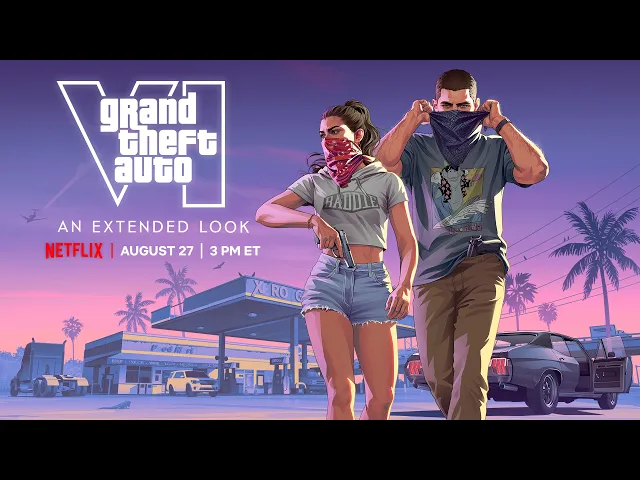
The GTA 6 marketing approach has kept the game in the spotlight for years, even though Rockstar released only two official trailers before the Extended Look on August 27. The first trailer came out in December 2023, followed by the second in May 2025, and then Rockstar kept communication to a minimum until the next reveal.
This strategy is a clear example of silence marketing: Rockstar doesn’t need to fill every week with branded content because the audience itself fills the information gap with their own theories, discussions, and content.
Rockstar Created a Vacuum, Then Let the Internet Fill It
The most important part of the GTA strategy is the amount of information Rockstar chooses to release.
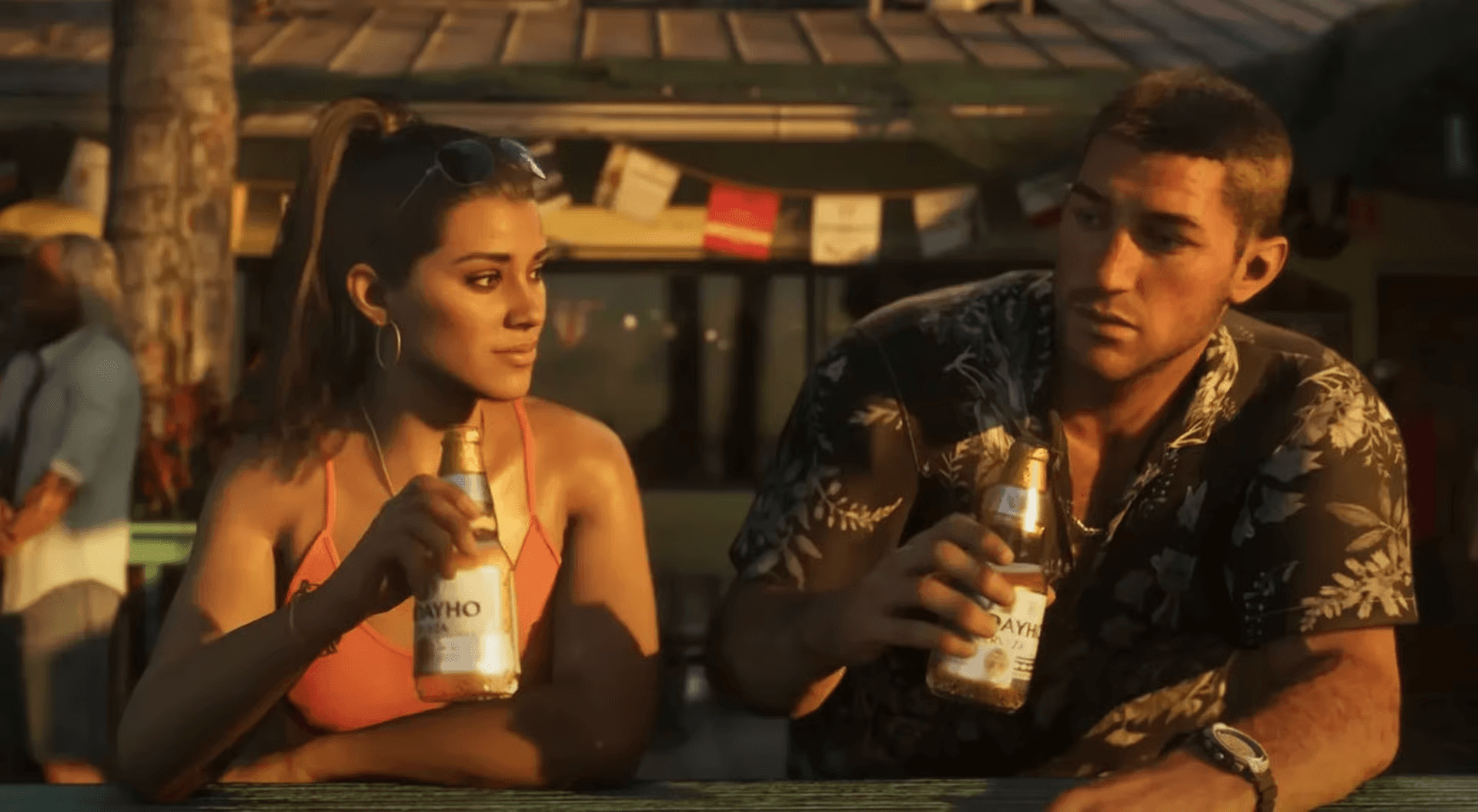
Trailer 1 was released in December 2023. Trailer 2 followed about 17 months later. Rockstar’s official GTA VI website now features both trailers alongside the upcoming Extended Look (a more in-depth look); meanwhile, Take-Two described Trailer 1 as a record-breaking YouTube debut and Trailer 2 as a cross-platform video launch that garnered over 475 million views in the first 24 hours.
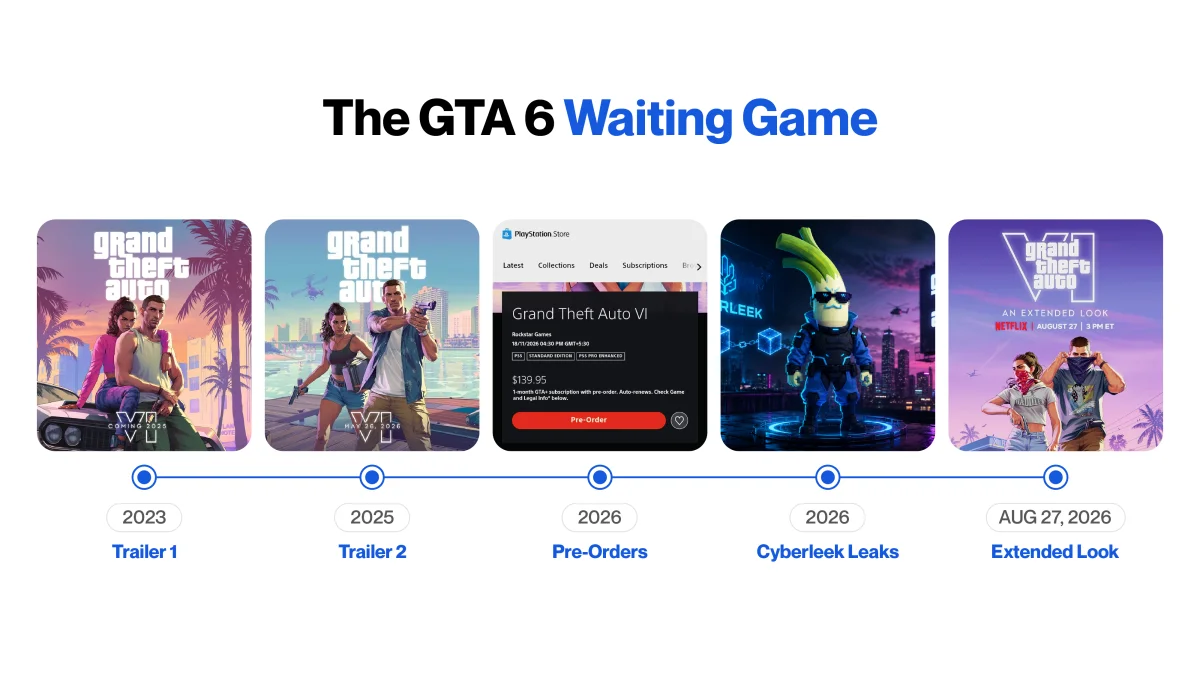
That time gap created a challenge for Rockstar, but it actually turned into an advantage in terms of distribution. Since the public still wanted something to talk about during that lull, they began discussing whatever material was available.
These discussions could take the form of a screenshot analyzed in detail, a character design sparking various theories, small details in the game’s environment becoming the subject of Reddit posts, rumors about specific features leading to in-depth YouTube reviews, or even a release date delay turning into meme material. Rockstar didn’t orchestrate any of this; instead, the audience effectively dictated the content calendar.
The cycle of information leaks makes this effect even more pronounced, and the recent CyberLeek incident is the clearest example.
In August 2026, gameplay clips linked to CyberLeek began circulating online, just a few days before Rockstar’s scheduled Extended Look. Take-Two and Rockstar responded with legal action and takedown notices for copyrighted content, while the leak itself made headlines across various gaming media outlets.
The key marketing lesson here isn’t that brands should tolerate information leaks, because they absolutely should not. The main lesson lies in what happens after the information is leaked to the public, as the leak triggers a series of new questions:
Is the footage authentic?
How old is the build?
What does it reveal?
What is still missing?
Will Rockstar change the August 27 reveal?
How much of the game has actually leaked?
Each question becomes a topic of discussion in its own right, prompting GTA fans to use it as material for their own content. Rockstar’s legal response also kept the incident in the news spotlight as reports circulated about content takedowns, court orders (subpoenas), and investigation reports.
That is the extraordinary power of information scarcity. The less official material available, the more valuable every new piece of information becomes.
The GTA 6 Extended Look Turned Scarcity Into an Event
Rockstar’s next move is somewhat unusual: it has scheduled the GTA 6 Extended Look to premiere on Netflix at 3:00 p.m. ET on August 27, while the same content will be available on Rockstar’s YouTube channel and the GTA VI website six hours later, at 9:00 p.m. ET.
Netflix called this partnership a first-of-its-kind opportunity to showcase an in-depth preview of one of the most highly anticipated games in the entertainment world. This six-hour delay quickly became a topic of discussion, starting with some fans questioning why they would need a Netflix subscription just to see the preview early. On the other hand, some argued that waiting six hours wasn’t a big deal since the video would be available for free on the same day anyway. Both sides created content discussing this decision.
This distinction is important because the marketing value in this case does not depend on whether Netflix’s strategy was good or bad. The controversy itself created an additional reason to discuss the reveal even before anyone had seen it. Thus, the announcement contained two stories:
Story 1: GTA 6 is getting a major new look.
Story 2: Why is Rockstar making people wait for it on Netflix?
The second story serves as a free means of spreading the first story, and this is where the Streisand Effect becomes relevant as a marketing principle. When access to information becomes more complicated, people may actually become more interested in discussing that information itself.
For brands, the lesson is simple: scarcity is only effective if what people are waiting for is already valuable to the audience. Waiting six hours for a demo of an unknown app might feel annoying and be easily forgotten. However, waiting six hours for GTA 6 could turn into a major event.
The Real Distribution Engine Was the Audience
So, what actually kept GTA 6 in the conversation between official announcements? The audience itself.
The easiest way to understand the GTA 6 strategy is to observe what happens between official announcements, as shown in the following image:
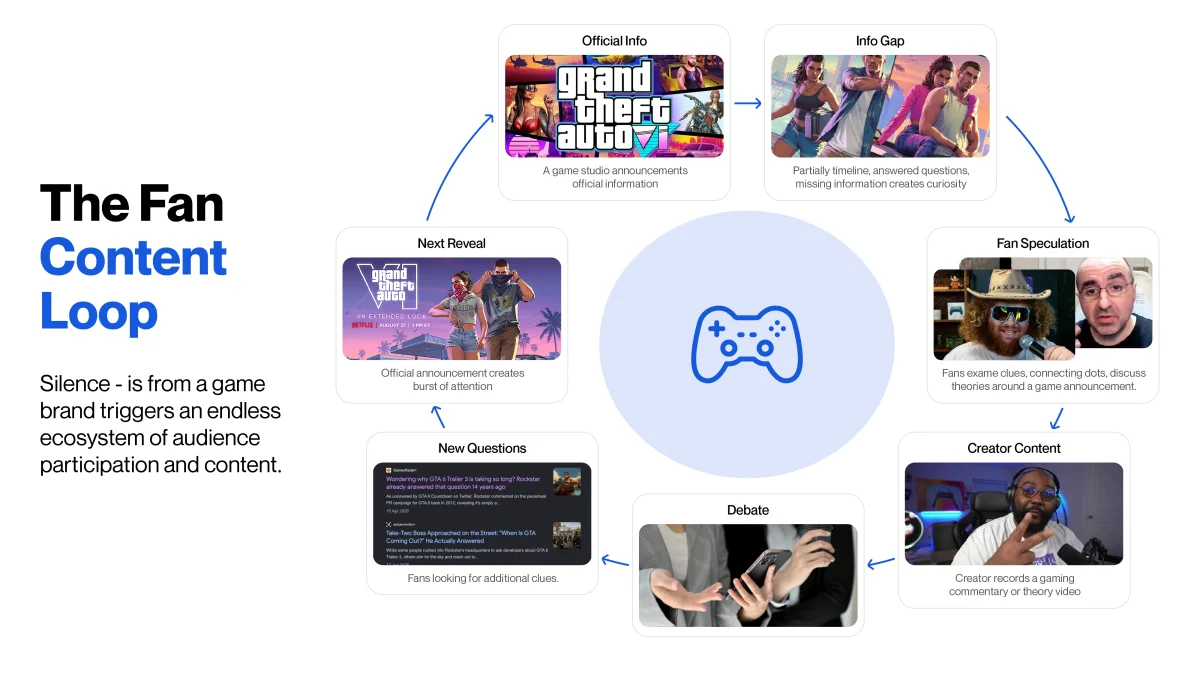
Rockstar releases something → public interprets → creators turn it into videos → other fans react → reactions raise new questions → questions spark the next wave of content → Rockstar eventually releases more official information.
This creates a new surge of interest, which is why referring to the GTA 6 approach as merely “minimal marketing” overlooks an intriguing aspect.
Rockstar is, in fact, still marketing the game, even though it doesn’t produce all of its marketing content in-house. A prime example is the second trailer, which garnered 475 million views across various platforms within 24 hours. The trailer itself is just one asset, but the accompanying reaction videos, in-depth analyses, screenshots, memes, theories, social media posts, news coverage, and fan discussions generated thousands of additional pieces of content.
This is a very different distribution model compared to simply producing branded posts every day.
The Extended Look Will Show What Rockstar Can Learn From the Audience
The GTA 6 Extended Look isn't just a typical content launch, but a major opportunity to learn about the audience.
Once the video is released to the public, Rockstar will gain access to thousands of spontaneous reactions that reveal what people are actually paying attention to. As a result, some details will dominate the conversation, while others may go almost unnoticed. Some moments will spark the creation of various theories, while others will become meme material.
These signals can tell a brand what its audience finds interesting, without having to ask them directly.
What to watch after the reveal
For brands studying the GTA strategy, four signals will be especially useful:
1. The first moments people clip These reveal which visual or narrative moments are immediately understandable and shareable. |
2. The questions appearing repeatedly Repeated questions reveal information gaps that audiences genuinely want answered. |
3. The formats creators choose A flood of "things you missed" videos means the audience is interested in detail. Reaction videos indicate emotional impact. Theory videos indicate unresolved questions. |
4. The debates that continue after the initial excitement A moment that produces disagreement can have a longer content lifespan than a moment everyone simply agrees is impressive. |
This is where the strategy becomes measurable, because marketers are better able to uncover far more useful creative insights by revealing what people choose to talk about when no one is dictating their topics of conversation.
Silence Marketing Only Works When the Product Can Carry the Silence
Silence marketing works for Rockstar because GTA already enjoys massive cultural recognition. This is where brands need to be cautious if they want to follow in Rockstar’s footsteps, because a company can’t simply stop sharing content and expect the internet to remain captivated.
Rockstar can afford to take a long hiatus because GTA already enjoys massive cultural recognition. The franchise has been built across generations, GTA V has remained a commercial success for years, and the audience already understands the value of the next installment. Take-Two’s own investor documents refer to Grand Theft Auto as one of the world’s most successful entertainment properties.
The existence of established market demand changes the dynamics of this “silent” approach, and the effects can vary for each brand. For lesser-known brands, silence might simply mean no one notices them. For established brands with strong market demand, however, silence can actually build anticipation. Essentially, the difference lies in the presence of unmet demand.
As a brand, you need to ensure that people will seek you out when you stop communicating for 30 days. If you can’t guarantee this, then you may need stronger content or a more solid product narrative before attempting a silence marketing strategy.
What brands can actually copy
Just because it doesn’t apply equally to every brand doesn’t mean you can’t take anything at all from Rockstar’s strategy. You can still try to emulate their information-sharing structure, where instead of revealing everything at once, you can try to:
Announce a product without revealing every feature.
Show a result while leaving the process unexplained.
Reveal one part of a larger launch and allow people to speculate about the rest.
Give creators enough information to form opinions while leaving room for interpretation.
Release meaningful updates at moments when the audience has accumulated enough questions.
The goal of all this isn’t to create artificial confusion, but to leave intriguing, unanswered questions. This is because unanswered questions give the audience something to investigate, discuss, explain, and share.
The GTA Strategy Is Really a Distribution Strategy
The most interesting aspect of GTA 6 marketing is that Rockstar’s greatest strength lies not in the amount of content it produces itself, but in the amount of content generated by others because Rockstar has released something worth talking about.
This distinction changes the brand’s perspective on organic distribution by utilizing a distribution model with an inherent multiplier effect. You can see the comparison in the following table:
Conventional Campaign | The GTA Model |
|---|---|
Brand creates → Brand publishes → Audience consumes | Brand reveals → Audience interprets → Audience creates → More audiences discover → New questions emerge → Brand reveals again |
Every creator who makes a video discussing the theory becomes an additional distribution channel. Every fan who uploads a screenshot creates a new entry point. Every debate provides a reason for the initial announcement to resurface.
That’s why silence can sometimes be more effective than constant communication, as it gives the audience more room to participate.
From GTA 6 to a Better UGC Distribution System
Rockstar's approach works because the audience already has a reason to care, but the underlying principle applies much more broadly. Masterhooks approaches UGC from a similar distribution perspective, where the goal is to create content that gives audiences a reason to watch, react, share, or continue the conversation. Rather than relying on a constant stream of brand announcements, brands can build a broader content system around strong hooks, creator perspectives, organic formats, and the signals that emerge from real audience behavior.
For brands, the practical takeaway from GTA 6 is simple: you do not always need more content from the brand. Sometimes you need better reasons for the audience to create the next piece of content.
Stop buying vanity metrics. Start engineering your TikTok conversions.
Stop buying vanity metrics. Start engineering your TikTok conversions.
The GTA 6 marketing approach has kept the game in the spotlight for years, even though Rockstar released only two official trailers before the Extended Look on August 27. The first trailer came out in December 2023, followed by the second in May 2025, and then Rockstar kept communication to a minimum until the next reveal.
This strategy is a clear example of silence marketing: Rockstar doesn’t need to fill every week with branded content because the audience itself fills the information gap with their own theories, discussions, and content.
Rockstar Created a Vacuum, Then Let the Internet Fill It
The most important part of the GTA strategy is the amount of information Rockstar chooses to release.
Trailer 1 was released in December 2023. Trailer 2 followed about 17 months later. Rockstar’s official GTA VI website now features both trailers alongside the upcoming Extended Look (a more in-depth look); meanwhile, Take-Two described Trailer 1 as a record-breaking YouTube debut and Trailer 2 as a cross-platform video launch that garnered over 475 million views in the first 24 hours.
That time gap created a challenge for Rockstar, but it actually turned into an advantage in terms of distribution. Since the public still wanted something to talk about during that lull, they began discussing whatever material was available.
These discussions could take the form of a screenshot analyzed in detail, a character design sparking various theories, small details in the game’s environment becoming the subject of Reddit posts, rumors about specific features leading to in-depth YouTube reviews, or even a release date delay turning into meme material. Rockstar didn’t orchestrate any of this; instead, the audience effectively dictated the content calendar.
The cycle of information leaks makes this effect even more pronounced, and the recent CyberLeek incident is the clearest example.
In August 2026, gameplay clips linked to CyberLeek began circulating online, just a few days before Rockstar’s scheduled Extended Look. Take-Two and Rockstar responded with legal action and takedown notices for copyrighted content, while the leak itself made headlines across various gaming media outlets.
The key marketing lesson here isn’t that brands should tolerate information leaks, because they absolutely should not. The main lesson lies in what happens after the information is leaked to the public, as the leak triggers a series of new questions:
Is the footage authentic?
How old is the build?
What does it reveal?
What is still missing?
Will Rockstar change the August 27 reveal?
How much of the game has actually leaked?
Each question becomes a topic of discussion in its own right, prompting GTA fans to use it as material for their own content. Rockstar’s legal response also kept the incident in the news spotlight as reports circulated about content takedowns, court orders (subpoenas), and investigation reports.
That is the extraordinary power of information scarcity. The less official material available, the more valuable every new piece of information becomes.
The GTA 6 Extended Look Turned Scarcity Into an Event
Rockstar’s next move is somewhat unusual: it has scheduled the GTA 6 Extended Look to premiere on Netflix at 3:00 p.m. ET on August 27, while the same content will be available on Rockstar’s YouTube channel and the GTA VI website six hours later, at 9:00 p.m. ET.
Netflix called this partnership a first-of-its-kind opportunity to showcase an in-depth preview of one of the most highly anticipated games in the entertainment world. This six-hour delay quickly became a topic of discussion, starting with some fans questioning why they would need a Netflix subscription just to see the preview early. On the other hand, some argued that waiting six hours wasn’t a big deal since the video would be available for free on the same day anyway. Both sides created content discussing this decision.
This distinction is important because the marketing value in this case does not depend on whether Netflix’s strategy was good or bad. The controversy itself created an additional reason to discuss the reveal even before anyone had seen it. Thus, the announcement contained two stories:
Story 1: GTA 6 is getting a major new look.
Story 2: Why is Rockstar making people wait for it on Netflix?
The second story serves as a free means of spreading the first story, and this is where the Streisand Effect becomes relevant as a marketing principle. When access to information becomes more complicated, people may actually become more interested in discussing that information itself.
For brands, the lesson is simple: scarcity is only effective if what people are waiting for is already valuable to the audience. Waiting six hours for a demo of an unknown app might feel annoying and be easily forgotten. However, waiting six hours for GTA 6 could turn into a major event.
The Real Distribution Engine Was the Audience
So, what actually kept GTA 6 in the conversation between official announcements? The audience itself.
The easiest way to understand the GTA 6 strategy is to observe what happens between official announcements, as shown in the following image:
Rockstar releases something → public interprets → creators turn it into videos → other fans react → reactions raise new questions → questions spark the next wave of content → Rockstar eventually releases more official information.
This creates a new surge of interest, which is why referring to the GTA 6 approach as merely “minimal marketing” overlooks an intriguing aspect.
Rockstar is, in fact, still marketing the game, even though it doesn’t produce all of its marketing content in-house. A prime example is the second trailer, which garnered 475 million views across various platforms within 24 hours. The trailer itself is just one asset, but the accompanying reaction videos, in-depth analyses, screenshots, memes, theories, social media posts, news coverage, and fan discussions generated thousands of additional pieces of content.
This is a very different distribution model compared to simply producing branded posts every day.
The Extended Look Will Show What Rockstar Can Learn From the Audience
The GTA 6 Extended Look isn't just a typical content launch, but a major opportunity to learn about the audience.
Once the video is released to the public, Rockstar will gain access to thousands of spontaneous reactions that reveal what people are actually paying attention to. As a result, some details will dominate the conversation, while others may go almost unnoticed. Some moments will spark the creation of various theories, while others will become meme material.
These signals can tell a brand what its audience finds interesting, without having to ask them directly.
What to watch after the reveal
For brands studying the GTA strategy, four signals will be especially useful:
1. The first moments people clip These reveal which visual or narrative moments are immediately understandable and shareable. |
2. The questions appearing repeatedly Repeated questions reveal information gaps that audiences genuinely want answered. |
3. The formats creators choose A flood of "things you missed" videos means the audience is interested in detail. Reaction videos indicate emotional impact. Theory videos indicate unresolved questions. |
4. The debates that continue after the initial excitement A moment that produces disagreement can have a longer content lifespan than a moment everyone simply agrees is impressive. |
This is where the strategy becomes measurable, because marketers are better able to uncover far more useful creative insights by revealing what people choose to talk about when no one is dictating their topics of conversation.
Silence Marketing Only Works When the Product Can Carry the Silence
Silence marketing works for Rockstar because GTA already enjoys massive cultural recognition. This is where brands need to be cautious if they want to follow in Rockstar’s footsteps, because a company can’t simply stop sharing content and expect the internet to remain captivated.
Rockstar can afford to take a long hiatus because GTA already enjoys massive cultural recognition. The franchise has been built across generations, GTA V has remained a commercial success for years, and the audience already understands the value of the next installment. Take-Two’s own investor documents refer to Grand Theft Auto as one of the world’s most successful entertainment properties.
The existence of established market demand changes the dynamics of this “silent” approach, and the effects can vary for each brand. For lesser-known brands, silence might simply mean no one notices them. For established brands with strong market demand, however, silence can actually build anticipation. Essentially, the difference lies in the presence of unmet demand.
As a brand, you need to ensure that people will seek you out when you stop communicating for 30 days. If you can’t guarantee this, then you may need stronger content or a more solid product narrative before attempting a silence marketing strategy.
What brands can actually copy
Just because it doesn’t apply equally to every brand doesn’t mean you can’t take anything at all from Rockstar’s strategy. You can still try to emulate their information-sharing structure, where instead of revealing everything at once, you can try to:
Announce a product without revealing every feature.
Show a result while leaving the process unexplained.
Reveal one part of a larger launch and allow people to speculate about the rest.
Give creators enough information to form opinions while leaving room for interpretation.
Release meaningful updates at moments when the audience has accumulated enough questions.
The goal of all this isn’t to create artificial confusion, but to leave intriguing, unanswered questions. This is because unanswered questions give the audience something to investigate, discuss, explain, and share.
The GTA Strategy Is Really a Distribution Strategy
The most interesting aspect of GTA 6 marketing is that Rockstar’s greatest strength lies not in the amount of content it produces itself, but in the amount of content generated by others because Rockstar has released something worth talking about.
This distinction changes the brand’s perspective on organic distribution by utilizing a distribution model with an inherent multiplier effect. You can see the comparison in the following table:
Conventional Campaign | The GTA Model |
|---|---|
Brand creates → Brand publishes → Audience consumes | Brand reveals → Audience interprets → Audience creates → More audiences discover → New questions emerge → Brand reveals again |
Every creator who makes a video discussing the theory becomes an additional distribution channel. Every fan who uploads a screenshot creates a new entry point. Every debate provides a reason for the initial announcement to resurface.
That’s why silence can sometimes be more effective than constant communication, as it gives the audience more room to participate.
From GTA 6 to a Better UGC Distribution System
Rockstar's approach works because the audience already has a reason to care, but the underlying principle applies much more broadly. Masterhooks approaches UGC from a similar distribution perspective, where the goal is to create content that gives audiences a reason to watch, react, share, or continue the conversation. Rather than relying on a constant stream of brand announcements, brands can build a broader content system around strong hooks, creator perspectives, organic formats, and the signals that emerge from real audience behavior.
For brands, the practical takeaway from GTA 6 is simple: you do not always need more content from the brand. Sometimes you need better reasons for the audience to create the next piece of content.
Stop buying vanity metrics. Start engineering your TikTok conversions.
Related Reading
Related Reading

How to Find the Right Influencer Marketing Agency for Your Brand (Without Wasting Budget)
6 min
|
Creator Economy
How to Find the Right Influencer Marketing Agency for Your Brand (Without Wasting Budget)
Learn how to choose an influencer marketing agency using a practical scorecard, performance criteria, red flags, and pre-contract checks.
6 min
|
Creator Economy

AI Video Ad Agencies: A Buyer's Guide for DTC Brands (2026)
4 min
|
Creator Economy
AI Video Ad Agencies: A Buyer's Guide for DTC Brands (2026)
Compare AI video ad agency types, pricing, performance metrics, ownership rights, and seven questions DTC brands should ask before hiring.
4 min
|
Creator Economy

How Taylor Swift Engineered a UGC Wave With 13 Seconds of Video and One Awards Show
4 min
|
Creator Economy
How Taylor Swift Engineered a UGC Wave With 13 Seconds of Video and One Awards Show
How Taylor Swift turned a 13-second teaser, Easter eggs, and a live VMA premiere into a UGC engine brands can adapt for organic distribution.
4 min
|
Creator Economy


Need help scaling?
Book a strategy call with our expert team to audit your current UGC setup.