



What Nobody Tells You When You First Google "What Is UGC"
What Nobody Tells You When You First Google "What Is UGC"
Learn the UGC truths most guides skip, from creator vs influencer differences to what brands actually look for in 2026.
Published:

Read Time:

3 min

Written by:
Fawwaz
Trend Research and Copywriter
EVERY ARTICLE ABOUT UGC SAYS THE SAME THING.
User-Generated Content (UGC) is authentic, trusted by consumers, and cost-effective. All of this is true, but it doesn’t fully explain the reality behind UGC.
EVERY ARTICLE ABOUT UGC SAYS THE SAME THING.
User-Generated Content (UGC) is authentic, trusted by consumers, and cost-effective. All of this is true, but it doesn’t fully explain the reality behind UGC.
EVERY ARTICLE ABOUT UGC SAYS THE SAME THING.
User-Generated Content (UGC) is authentic, trusted by consumers, and cost-effective. All of this is true, but it doesn’t fully explain the reality behind UGC.
The statements you find in those articles don’t answer the questions people actually have when they enter this industry.
Whether you’re a brand trying to launch your first UGC campaign or a creator trying to get paid to create content, you might be wondering: What’s the difference between a UGC creator and an influencer? Why do some UGC ads perform exceptionally well while others fail completely? What are brands actually looking for when they recruit creators? Why are creators with 500 followers sometimes hired while those with 100,000 followers aren’t?
These are the questions that most newcomers to the UGC industry overlook, and this article will try to help you find the answers to them.
UGC Creator vs Influencer: The Difference That Changes Everything
The biggest misconception in this industry is the widespread assumption that UGC creators and influencers do the same work, when in fact they do not. The differences between the two even affect pricing, expectations, deliverables, and performance metrics.
Influencers Sell Distribution
An influencer’s value comes from their audience, so brands pay to gain access to their followers. In influencer marketing, creators publish content on their own channels.
Performance is often measured through:
Reach
Impressions
Engagement
Audience demographics
The audience is the product.
UGC Creators Sell Assets
They create content for brands to use, so their content is usually not on the creator's page
Instead, brands use it for:
Paid social ads
Product pages
Landing pages
Email campaigns
Organic brand content
Performance is measured differently:
Hook retention
Click-through rate
Conversion rate
Cost per acquisition
The content is the product.
Influencers Sell Distribution
An influencer’s value comes from their audience, so brands pay to gain access to their followers. In influencer marketing, creators publish content on their own channels.
Performance is often measured through:
Reach
Impressions
Engagement
Audience demographics
The audience is the product.
UGC Creators Sell Assets
They create content for brands to use, so their content is usually not on the creator's page
Instead, brands use it for:
Paid social ads
Product pages
Landing pages
Email campaigns
Organic brand content
Performance is measured differently:
Hook retention
Click-through rate
Conversion rate
Cost per acquisition
The content is the product.
¡This distinction is now well documented in the creator economy. Several creator economy reports from 2025 and 2026 consistently note that UGC creators are evaluated by brands on content performance (retention, CTR, conversion) rather than audience size, because the deliverable is an asset the brand distributes, not a post the creator distributes. The metrics that matter follow from that difference.
Why Content That Feels Like Ads Doesn't Work
One of the biggest surprises for brands entering the world of UGC is that traditional advertising instincts often result in weaker UGC.
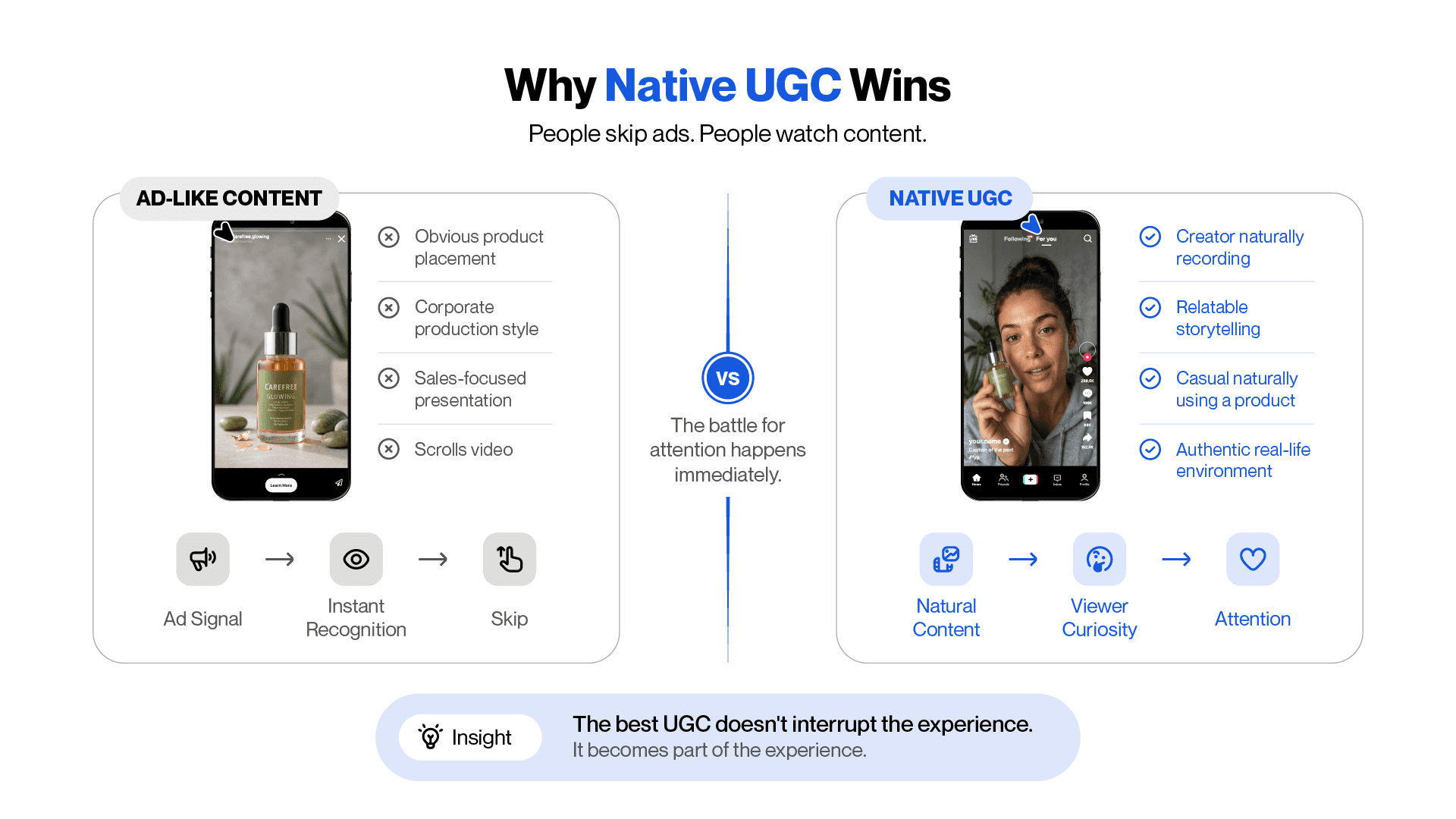
Creating content that looks like an ad is the quickest way to fail at UGC. This is because most audiences make split-second decisions in the first few seconds to determine whether they’ll continue watching the content until the end or not. When content signals that it’s an ad, many viewers will leave before the main message even begins.
The failure point lies in whether the content is able to capture the attention of the audience before revealing its commercial purpose. Some campaigns that are obviously promotional go viral precisely because they are entertaining enough to watch regardless, like WALOVI's Haaland campaign or Gap's recent format experiments. What consistently fails is content that signals "advertisement" in the first second without giving the viewer a reason to stay. When that happens, most viewers leave before the main message begins. UGC works because the format, when executed well, tends to lead with something the viewer finds useful, funny, or relevant before the product becomes the focus.
What This Means for Brands and Creators
Many new creators assume that brands care primarily about the number of followers. This assumption often misleads people because UGC is not influencer marketing, so the number of followers is usually not the main determining factor.
Creators have to take notes that brands essentially evaluate the following three things:
Can You Create Native Content?Does the content feel natural for TikTok, Reels, or Shorts, or does it come across as an ad? This is important because consistently executing original content can outperform forced promotions. |
Can You Deliver a Strong Hook?The first three seconds determine whether viewers will keep watching, and if the hook fails, people will ignore your video. It’s crucial for brands to analyze retention metrics before almost anything else. |
Can You Be Consistent?A single great video is valuable because reliable output is highly prized. However, most brands prefer creators who can consistently produce strong content over those who occasionally create something extraordinary. |
For brands, understanding these three criteria changes how you write a brief. The brief's job is not to specify what the creator should say, but to make sure the creator has enough context to make native, hook-strong, consistent content. A brief that over-scripts kills the first criterion. A brief that under-informs usually kills the second.
Two Ways To Enter The UGC World
The advice changes depending on who you are.
For Brands
The biggest mistake is micromanaging the creative process, as this can make your content feel unnatural. Micromanaging the creative process makes your UGC brief feel like a script, where every sentence, reaction, and camera angle feels overly scripted and planned.
To avoid this, you need to create a brief that provides general guidelines while still leaving room for creators to interpret the overarching idea. Creators understand the platform’s culture and their audience better than you do as a brand, and their expertise should be a key consideration in your UGC production process.
For Creators
The biggest mistake is waiting for opportunities without creating any samples of your work. How can brands find you if they can’t see the work you’ve done?
You just need to start creating content like a speculative ad promoting a product you already use. That way, you can build a portfolio and show social media platforms your style of content creation. By doing so, you can also demonstrate that you understand the platform’s appeal, storytelling, and user behavior.
Once you have a few pieces in your portfolio, you’ll be easier for brands to find and hire. Actually, there’s one more way you can become a UGC creator without waiting to be hired by a brand through Canvas UGC, which you can learn about in detail in the following article.
The Part Most Beginner Guides Skip
The biggest misconception about UGC is that success depends on having a large audience or expensive production. In reality, many of the highest-performing UGC campaigns are created by people with relatively small followings who understand how to create content that feels natural within the platform.
For brands, that means evaluating creators differently. For creators, it means focusing on skill development rather than audience size. Understanding this distinction often accelerates progress because it aligns effort with what the market actually values.
This is one reason Masterhooks frequently studies creator behavior, platform-native content, and UGC performance patterns. The definition of UGC is easy to find. Understanding how the industry actually works is where the real advantage begins.
Interested in using UGC for your brand? Or you want to be a UGC creator?

Interested in using UGC for your brand? Or you want to be a UGC creator?
The statements you find in those articles don’t answer the questions people actually have when they enter this industry.
Whether you’re a brand trying to launch your first UGC campaign or a creator trying to get paid to create content, you might be wondering: What’s the difference between a UGC creator and an influencer? Why do some UGC ads perform exceptionally well while others fail completely? What are brands actually looking for when they recruit creators? Why are creators with 500 followers sometimes hired while those with 100,000 followers aren’t?
These are the questions that most newcomers to the UGC industry overlook, and this article will try to help you find the answers to them.
UGC Creator vs Influencer: The Difference That Changes Everything
The biggest misconception in this industry is the widespread assumption that UGC creators and influencers do the same work, when in fact they do not. The differences between the two even affect pricing, expectations, deliverables, and performance metrics.
Influencers Sell Distribution
An influencer’s value comes from their audience, so brands pay to gain access to their followers. In influencer marketing, creators publish content on their own channels.
Performance is often measured through:
Reach
Impressions
Engagement
Audience demographics
The audience is the product.
UGC Creators Sell Assets
They create content for brands to use, so their content is usually not on the creator's page
Instead, brands use it for:
Paid social ads
Product pages
Landing pages
Email campaigns
Organic brand content
Performance is measured differently:
Hook retention
Click-through rate
Conversion rate
Cost per acquisition
The content is the product.
¡This distinction is now well documented in the creator economy. Several creator economy reports from 2025 and 2026 consistently note that UGC creators are evaluated by brands on content performance (retention, CTR, conversion) rather than audience size, because the deliverable is an asset the brand distributes, not a post the creator distributes. The metrics that matter follow from that difference.
Why Content That Feels Like Ads Doesn't Work
One of the biggest surprises for brands entering the world of UGC is that traditional advertising instincts often result in weaker UGC.
Creating content that looks like an ad is the quickest way to fail at UGC. This is because most audiences make split-second decisions in the first few seconds to determine whether they’ll continue watching the content until the end or not. When content signals that it’s an ad, many viewers will leave before the main message even begins.
The failure point lies in whether the content is able to capture the attention of the audience before revealing its commercial purpose. Some campaigns that are obviously promotional go viral precisely because they are entertaining enough to watch regardless, like WALOVI's Haaland campaign or Gap's recent format experiments. What consistently fails is content that signals "advertisement" in the first second without giving the viewer a reason to stay. When that happens, most viewers leave before the main message begins. UGC works because the format, when executed well, tends to lead with something the viewer finds useful, funny, or relevant before the product becomes the focus.
What This Means for Brands and Creators
Many new creators assume that brands care primarily about the number of followers. This assumption often misleads people because UGC is not influencer marketing, so the number of followers is usually not the main determining factor.
Creators have to take notes that brands essentially evaluate the following three things:
Can You Create Native Content?Does the content feel natural for TikTok, Reels, or Shorts, or does it come across as an ad? This is important because consistently executing original content can outperform forced promotions. |
Can You Deliver a Strong Hook?The first three seconds determine whether viewers will keep watching, and if the hook fails, people will ignore your video. It’s crucial for brands to analyze retention metrics before almost anything else. |
Can You Be Consistent?A single great video is valuable because reliable output is highly prized. However, most brands prefer creators who can consistently produce strong content over those who occasionally create something extraordinary. |
For brands, understanding these three criteria changes how you write a brief. The brief's job is not to specify what the creator should say, but to make sure the creator has enough context to make native, hook-strong, consistent content. A brief that over-scripts kills the first criterion. A brief that under-informs usually kills the second.
Two Ways To Enter The UGC World
The advice changes depending on who you are.
For Brands
The biggest mistake is micromanaging the creative process, as this can make your content feel unnatural. Micromanaging the creative process makes your UGC brief feel like a script, where every sentence, reaction, and camera angle feels overly scripted and planned.
To avoid this, you need to create a brief that provides general guidelines while still leaving room for creators to interpret the overarching idea. Creators understand the platform’s culture and their audience better than you do as a brand, and their expertise should be a key consideration in your UGC production process.
For Creators
The biggest mistake is waiting for opportunities without creating any samples of your work. How can brands find you if they can’t see the work you’ve done?
You just need to start creating content like a speculative ad promoting a product you already use. That way, you can build a portfolio and show social media platforms your style of content creation. By doing so, you can also demonstrate that you understand the platform’s appeal, storytelling, and user behavior.
Once you have a few pieces in your portfolio, you’ll be easier for brands to find and hire. Actually, there’s one more way you can become a UGC creator without waiting to be hired by a brand through Canvas UGC, which you can learn about in detail in the following article.
The Part Most Beginner Guides Skip
The biggest misconception about UGC is that success depends on having a large audience or expensive production. In reality, many of the highest-performing UGC campaigns are created by people with relatively small followings who understand how to create content that feels natural within the platform.
For brands, that means evaluating creators differently. For creators, it means focusing on skill development rather than audience size. Understanding this distinction often accelerates progress because it aligns effort with what the market actually values.
This is one reason Masterhooks frequently studies creator behavior, platform-native content, and UGC performance patterns. The definition of UGC is easy to find. Understanding how the industry actually works is where the real advantage begins.
Interested in using UGC for your brand? Or you want to be a UGC creator?
Related Reading
How Blumhouse Built a $740M Horror Franchise by Spending Less Than Any Competitor
4 min
|

How to Find & Choose the Right Influencer for Your Brand (Without Getting Burned)
5 min
|

What Is Influencer Marketing? A No-Fluff Guide for Brands Ready to Actually Use It
5 min
|


Need help scaling?
Book a strategy call with our expert team to audit your current UGC setup.
Related Reading
How Blumhouse Built a $740M Horror Franchise by Spending Less Than Any Competitor
How Blumhouse turned low-budget horror into a repeatable franchise model using controlled costs, social amplification, and audience-driven content.
4 min
|
How Blumhouse Built a $740M Horror Franchise by Spending Less Than Any Competitor
How Blumhouse turned low-budget horror into a repeatable franchise model using controlled costs, social amplification, and audience-driven content.
4 min
|
How to Find & Choose the Right Influencer for Your Brand (Without Getting Burned)
Learn how to find influencers for your brand using audience fit, engagement quality, growth patterns, content quality, and campaign history.
5 min
|
How to Find & Choose the Right Influencer for Your Brand (Without Getting Burned)
Learn how to find influencers for your brand using audience fit, engagement quality, growth patterns, content quality, and campaign history.
5 min
|
What Is Influencer Marketing? A No-Fluff Guide for Brands Ready to Actually Use It
Ready to use influencer marketing for your brands? Learn influencer types, campaign models, costs, ROI, measurement, and how to choose the right creators.
5 min
|
What Is Influencer Marketing? A No-Fluff Guide for Brands Ready to Actually Use It
Ready to use influencer marketing for your brands? Learn influencer types, campaign models, costs, ROI, measurement, and how to choose the right creators.
5 min
|