



How Much Do UGC Creators Actually Make in 2026? (Real Numbers by Tier)
How Much Do UGC Creators Actually Make in 2026? (Real Numbers by Tier)
Discover how much UGC creators earn in 2026, average rates by experience level, pricing by niche, and what brands should budget for campaigns.
Published:

Read Time:

3 min

Written by:
Fawwaz
Trend Research and Copywriter
SOME SUCCEED, BUT OTHERS DON’T
Some creators post screenshots showing monthly PayPal payments of $10,000. On the other hand, there are creators who struggle to land their first paid collaboration. So, who’s actually telling the truth?
SOME SUCCEED, BUT OTHERS DON’T
Some creators post screenshots showing monthly PayPal payments of $10,000. On the other hand, there are creators who struggle to land their first paid collaboration. So, who’s actually telling the truth?
SOME SUCCEED, BUT OTHERS DON’T
Some creators post screenshots showing monthly PayPal payments of $10,000. On the other hand, there are creators who struggle to land their first paid collaboration. So, who’s actually telling the truth?
By 2026, UGC has evolved into a mature creator economy ecosystem with clearer pricing benchmarks than ever before. While most creators don’t earn five-figure monthly incomes, many have successfully built sustainable businesses by producing content for various brands, rather than relying solely on a large following.
Whether you’re a creator setting your rates or a brand looking to determine a reasonable budget, understanding current market pricing standards will help you avoid unrealistic expectations on both sides.
This article takes an in-depth look at the actual earnings of UGC creators in 2026, the factors that influence those figures, and how to set content prices with greater confidence.
What Is the Average UGC Rate in 2026?
Across multiple creator marketplaces and pricing surveys, the most consistent benchmark falls within a fairly narrow range.
Rate | $ per Video |
|---|---|
Average | $150–$212 |
Median | Around $175 |
The median is particularly useful because it isn't distorted by a small number of creators charging premium rates. For most negotiations, as observed on UGC community platforms like ifluee and DansUGC, $175 per video is a realistic starting point. But of course, the average prices above are not set in stone, but you can use them as a basic guide or reference when determining the price of your UGC services per video.
The price you set for each video may also vary depending on several factors, such as:
Experience
Industry
Usage rights
Deliverables
Editing complexity
Here is a more detailed example of price estimate adjustments based on the creator’s experience tier:
UGC Creator Rates by Experience Level
Experience | Typical Rate per Video | Monthly Income |
|---|---|---|
Beginner (0–6 months) | $50–$150 | $500–$1,000 |
Intermediate (6 months–2 years) | $150–$300 | $1,500–$3,000 |
Experienced (2+ years) | $300–$600 | $4,000–$8,000 |
Expert / Studio | $600–$1,500+ | $8,000–$10,000+ |
Monthly income assumes a consistent flow of paid work and should be viewed as a broad market range rather than a guaranteed outcome.
The highest tier represents a relatively small share of the market. Most creators spend years building the portfolio, client relationships, and systems needed to reach that level.
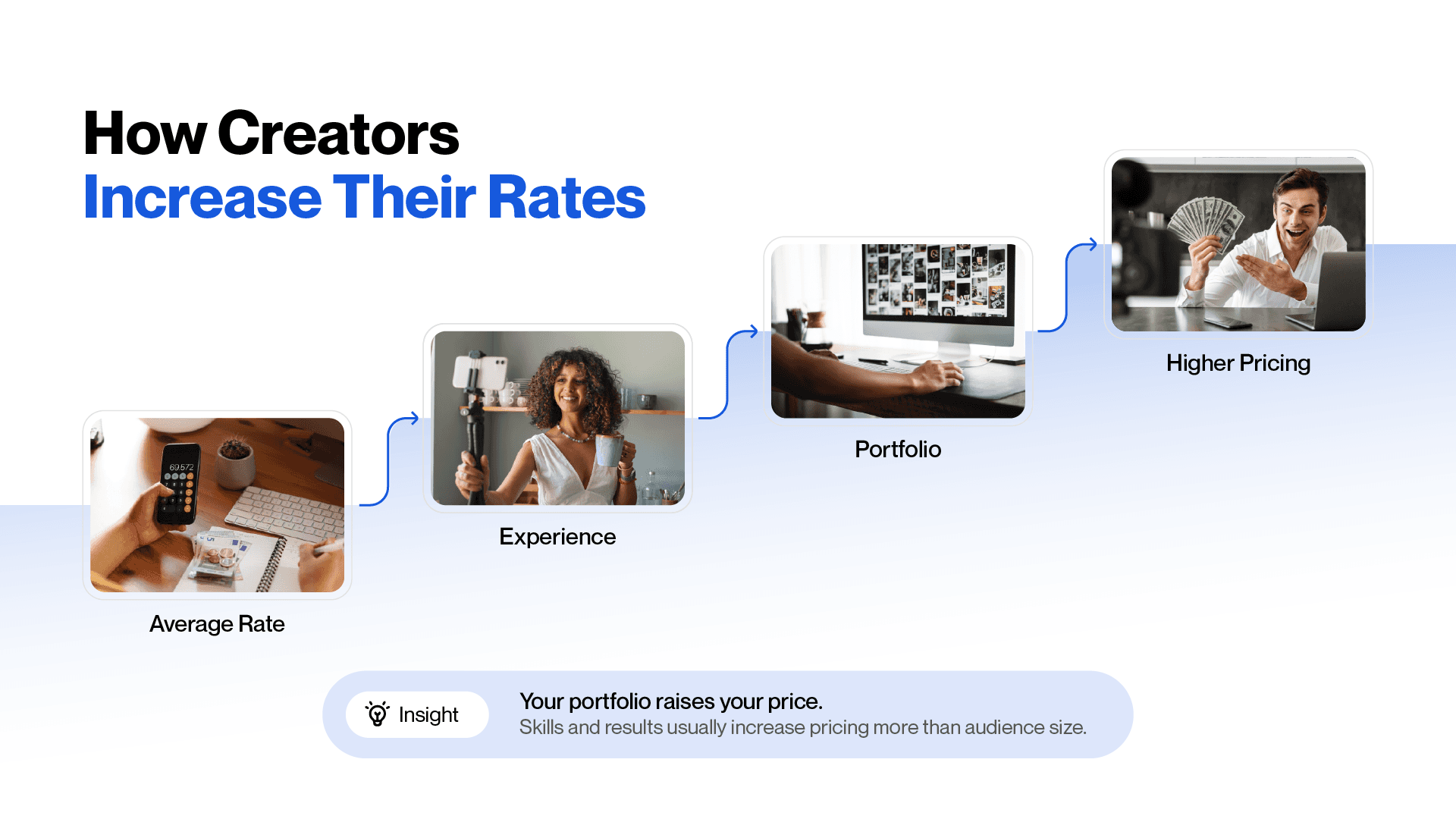
What Makes Some Creators Charge More?
Experience matters, but it isn't the only factor. There are three variables that consistently have the biggest impact on pricing.
1. Your Niche
Not every industry pays the same, each has their own rate. Technology products, SaaS platforms, fintech, and AI tools often offer the highest rates because strong creative directly influences customer acquisition. Here are the typical examples:
Industry | Typical Rate |
|---|---|
SaaS | $300–$600 |
Fintech | $300–$600 |
AI Tools | $250–$500 |
Beauty | $150–$350 |
Fashion | $100–$300 |
Food & Beverage | $75–$250 |
Higher-priced industries usually expect stronger scripting and product understanding in return.
2. Usage Rights
Many new creators completely forget that a brand doesn’t always pay just for content production. Sometimes they pay for the right to reuse that content in the media they produce, such as paid ads, website landing pages, email campaigns, or social media ads.
These additional usage rights typically add 30–100% to the base cost of the content.
For example:
Base Content Price | Six Months Of Advertising Rights | Final Project Price |
|---|---|---|
$200 | +$100 | $300 |
3. Payment Model
Not every project follows the same structure. These are three most common payment models:
Flat Fee | One payment for one deliverable. This type of fee is the most simple and predictable. |
Performance-Based | This offer compensation depends on clicks, conversions, or sales. This give creator greater upside, but more uncertainty |
Hybrid Model | This type of payment combines lower production costs with performance bonuses. It is preferred by many experienced creators because it balances stability with growth potential. |
What Should Brands Budget?
Brands often ask the wrong questions. Some ask what rate creators should charge, when they should actually be asking what the appropriate budget should be for the campaigns they’re running. Here’s a practical guide:
Goal | Suggested Budget |
|---|---|
Testing new creatives | $500–$1,500 |
Product launch | $2,000–$5,000 |
Multi-creator campaign | $5,000–$15,000+ |
Always-on UGC production | Monthly retainer |
The budget shouldn't be determined by creator popularity alone. You have to understand that two creators might both charge $250. However, while one might only provide a single organic post, the other might include a variety of hooks, raw footage, reuse rights, and even multiple revisions.
Both charge the same price, but offer services with different levels of value. That’s why comparing rates without understanding what’s included in the service often leads to unrealistic expectations. This point is especially important for those of you representing brands, so you don’t make the decision to hire a creator based solely on their low price.
There are many important factors to consider besides a low price, and your attention to detail will determine whether your UGC campaign succeeds or fails.
Great UGC Pricing Reflects Value, Not Followers
Follower count often gets the most attention, but it isn't the biggest factor in UGC pricing. Brands pay for creators who consistently produce authentic, high-performing content that supports their marketing goals. As creators deliver better results, their rates naturally increase.
That's why Masterhooks focuses on portfolio quality, creative strategy, and platform-native storytelling rather than follower count alone. In the end, the value of UGC comes from how well it performs, not how many followers the creator has.
Want to start a UGC Campaign but still confused with the budget?

Want to start a UGC Campaign but still confused with the budget?
By 2026, UGC has evolved into a mature creator economy ecosystem with clearer pricing benchmarks than ever before. While most creators don’t earn five-figure monthly incomes, many have successfully built sustainable businesses by producing content for various brands, rather than relying solely on a large following.
Whether you’re a creator setting your rates or a brand looking to determine a reasonable budget, understanding current market pricing standards will help you avoid unrealistic expectations on both sides.
This article takes an in-depth look at the actual earnings of UGC creators in 2026, the factors that influence those figures, and how to set content prices with greater confidence.
What Is the Average UGC Rate in 2026?
Across multiple creator marketplaces and pricing surveys, the most consistent benchmark falls within a fairly narrow range.
Rate | $ per Video |
|---|---|
Average | $150–$212 |
Median | Around $175 |
The median is particularly useful because it isn't distorted by a small number of creators charging premium rates. For most negotiations, as observed on UGC community platforms like ifluee and DansUGC, $175 per video is a realistic starting point. But of course, the average prices above are not set in stone, but you can use them as a basic guide or reference when determining the price of your UGC services per video.
The price you set for each video may also vary depending on several factors, such as:
Experience
Industry
Usage rights
Deliverables
Editing complexity
Here is a more detailed example of price estimate adjustments based on the creator’s experience tier:
UGC Creator Rates by Experience Level
Experience | Typical Rate per Video | Monthly Income |
|---|---|---|
Beginner (0–6 months) | $50–$150 | $500–$1,000 |
Intermediate (6 months–2 years) | $150–$300 | $1,500–$3,000 |
Experienced (2+ years) | $300–$600 | $4,000–$8,000 |
Expert / Studio | $600–$1,500+ | $8,000–$10,000+ |
Monthly income assumes a consistent flow of paid work and should be viewed as a broad market range rather than a guaranteed outcome.
The highest tier represents a relatively small share of the market. Most creators spend years building the portfolio, client relationships, and systems needed to reach that level.
What Makes Some Creators Charge More?
Experience matters, but it isn't the only factor. There are three variables that consistently have the biggest impact on pricing.
1. Your Niche
Not every industry pays the same, each has their own rate. Technology products, SaaS platforms, fintech, and AI tools often offer the highest rates because strong creative directly influences customer acquisition. Here are the typical examples:
Industry | Typical Rate |
|---|---|
SaaS | $300–$600 |
Fintech | $300–$600 |
AI Tools | $250–$500 |
Beauty | $150–$350 |
Fashion | $100–$300 |
Food & Beverage | $75–$250 |
Higher-priced industries usually expect stronger scripting and product understanding in return.
2. Usage Rights
Many new creators completely forget that a brand doesn’t always pay just for content production. Sometimes they pay for the right to reuse that content in the media they produce, such as paid ads, website landing pages, email campaigns, or social media ads.
These additional usage rights typically add 30–100% to the base cost of the content.
For example:
Base Content Price | Six Months Of Advertising Rights | Final Project Price |
|---|---|---|
$200 | +$100 | $300 |
3. Payment Model
Not every project follows the same structure. These are three most common payment models:
Flat Fee | One payment for one deliverable. This type of fee is the most simple and predictable. |
Performance-Based | This offer compensation depends on clicks, conversions, or sales. This give creator greater upside, but more uncertainty |
Hybrid Model | This type of payment combines lower production costs with performance bonuses. It is preferred by many experienced creators because it balances stability with growth potential. |
What Should Brands Budget?
Brands often ask the wrong questions. Some ask what rate creators should charge, when they should actually be asking what the appropriate budget should be for the campaigns they’re running. Here’s a practical guide:
Goal | Suggested Budget |
|---|---|
Testing new creatives | $500–$1,500 |
Product launch | $2,000–$5,000 |
Multi-creator campaign | $5,000–$15,000+ |
Always-on UGC production | Monthly retainer |
The budget shouldn't be determined by creator popularity alone. You have to understand that two creators might both charge $250. However, while one might only provide a single organic post, the other might include a variety of hooks, raw footage, reuse rights, and even multiple revisions.
Both charge the same price, but offer services with different levels of value. That’s why comparing rates without understanding what’s included in the service often leads to unrealistic expectations. This point is especially important for those of you representing brands, so you don’t make the decision to hire a creator based solely on their low price.
There are many important factors to consider besides a low price, and your attention to detail will determine whether your UGC campaign succeeds or fails.
Great UGC Pricing Reflects Value, Not Followers
Follower count often gets the most attention, but it isn't the biggest factor in UGC pricing. Brands pay for creators who consistently produce authentic, high-performing content that supports their marketing goals. As creators deliver better results, their rates naturally increase.
That's why Masterhooks focuses on portfolio quality, creative strategy, and platform-native storytelling rather than follower count alone. In the end, the value of UGC comes from how well it performs, not how many followers the creator has.
Want to start a UGC Campaign but still confused with the budget?
Related Reading
Related Reading

How to Find the Right Influencer Marketing Agency for Your Brand (Without Wasting Budget)
6 min
|
How to Find the Right Influencer Marketing Agency for Your Brand (Without Wasting Budget)
Learn how to choose an influencer marketing agency using a practical scorecard, performance criteria, red flags, and pre-contract checks.
6 min
|

AI Video Ad Agencies: A Buyer's Guide for DTC Brands (2026)
4 min
|
AI Video Ad Agencies: A Buyer's Guide for DTC Brands (2026)
Compare AI video ad agency types, pricing, performance metrics, ownership rights, and seven questions DTC brands should ask before hiring.
4 min
|

How Taylor Swift Engineered a UGC Wave With 13 Seconds of Video and One Awards Show
4 min
|
How Taylor Swift Engineered a UGC Wave With 13 Seconds of Video and One Awards Show
How Taylor Swift turned a 13-second teaser, Easter eggs, and a live VMA premiere into a UGC engine brands can adapt for organic distribution.
4 min
|



Need help scaling?
Book a strategy call with our expert team to audit your current UGC setup.

