



How Reacher Built a TikTok Clip Machine, And How Any Brand Can Use the Same Blueprint
How Reacher Built a TikTok Clip Machine, And How Any Brand Can Use the Same Blueprint
Reacher shows how highly clippable moments can keep generating UGC long after release. Learn the same content blueprint for your brand.
Published:

Read Time:

6 min

Written by:
Fawwaz
Trend Research and Copywriter
RELEASED YEARS AGO, BUT STILL FEATURED IN MANY CLIPS
Reacher is a series that’s very interesting to discuss from a content perspective because, even though it was released years ago, many people are still creating clips about it.
RELEASED YEARS AGO, BUT STILL FEATURED IN MANY CLIPS
Reacher is a series that’s very interesting to discuss from a content perspective because, even though it was released years ago, many people are still creating clips about it.
RELEASED YEARS AGO, BUT STILL FEATURED IN MANY CLIPS
Reacher is a series that’s very interesting to discuss from a content perspective because, even though it was released years ago, many people are still creating clips about it.
Season 4 of Reacher premiered on August 12, 2026, but conversations about the series aren’t limited to the latest episodes. Old scenes continue to circulate because many of them have a simple structure that’s easy to understand and turn into memes, so they can still be enjoyed without the full context and are easy to pair with various captions. For brands, the lesson is simple: content that’s easy to turn into short clips isn’t just something you discover after it’s created, but can also be designed from the very beginning.
What Makes a Scene "Clippable"?
A scene is considered clip-worthy if you can take it out of its original context and still understand why it’s compelling. This may sound simple, but it changes the way content should be produced.
An ordinary scene might rely on ten minutes of story setup, whereas a clip-worthy scene can convey its premise in just a matter of seconds. In the case of Reacher, there are three characteristics that support this:
1. The setup is immediately obvious
Many confrontational scenes follow a simple visual structure: someone approaches Reacher, underestimates him, the situation changes, and then Reacher reacts. Viewers don’t need to understand the entire plot to grasp the basic dynamics, and this is what makes these clips useful as standalone content.
2. The dialogue can survive outside the scene
A single powerful and impactful line can serve as the core of a short video, whether it functions as a caption, reaction material, is combined with another story, or is even completely detached from its original context. This is one reason why scenes that rely on dialogue often make for valuable clip material, as they provide content that creators can repurpose.
3. The visual tells the story quickly
Reacher’s physical presence is integral to the format, allowing viewers to grasp the contrast even before hearing the dialogue. This is crucial on TikTok and Reels because thumbnails and opening frames often need to convey the premise instantly. When someone can understand the joke, conflict, or underlying emotion from just the first frame, that scene has a high chance of succeeding when presented outside its original context.
The Clip Became a Template
This is where Reacher transitions from mere entertainment to a part of creator culture. When a familiar premise can be summed up in the phrase “They don’t know who they’re dealing with” as a line that can describe any situation. A creator can use a Reacher clip as a template to discuss:
Managers who underestimate their employees
Competitors who look down on small businesses
The assumption that quiet people lack experience
Customers who underestimate a product
Friends who are just discovering someone’s hidden talent
The original clip is no longer the sole focus of the content, but rather a tool for telling other people’s stories.
The most impactful entertainment clips don’t always spark UGC (user-generated content) simply because people want to discuss the show, but because they provide a practical way for people to talk about themselves.
The Reacher hashtag alone has amassed billions of views across related TikTok content, while individual clips continue to emerge alongside discussions about Season 4. Third-party tracking data for that TikTok hashtag currently shows over 3.3 billion views.
This demonstrates how a widely recognized entertainment property can continue to generate social reach through short-form content, long after its initial launch.
The Reacher Blueprint for Brands
A brand does not need a giant action franchise to create clippable content. They just need moments with the same structural properties. Here are the framework brands can use to be clippable:
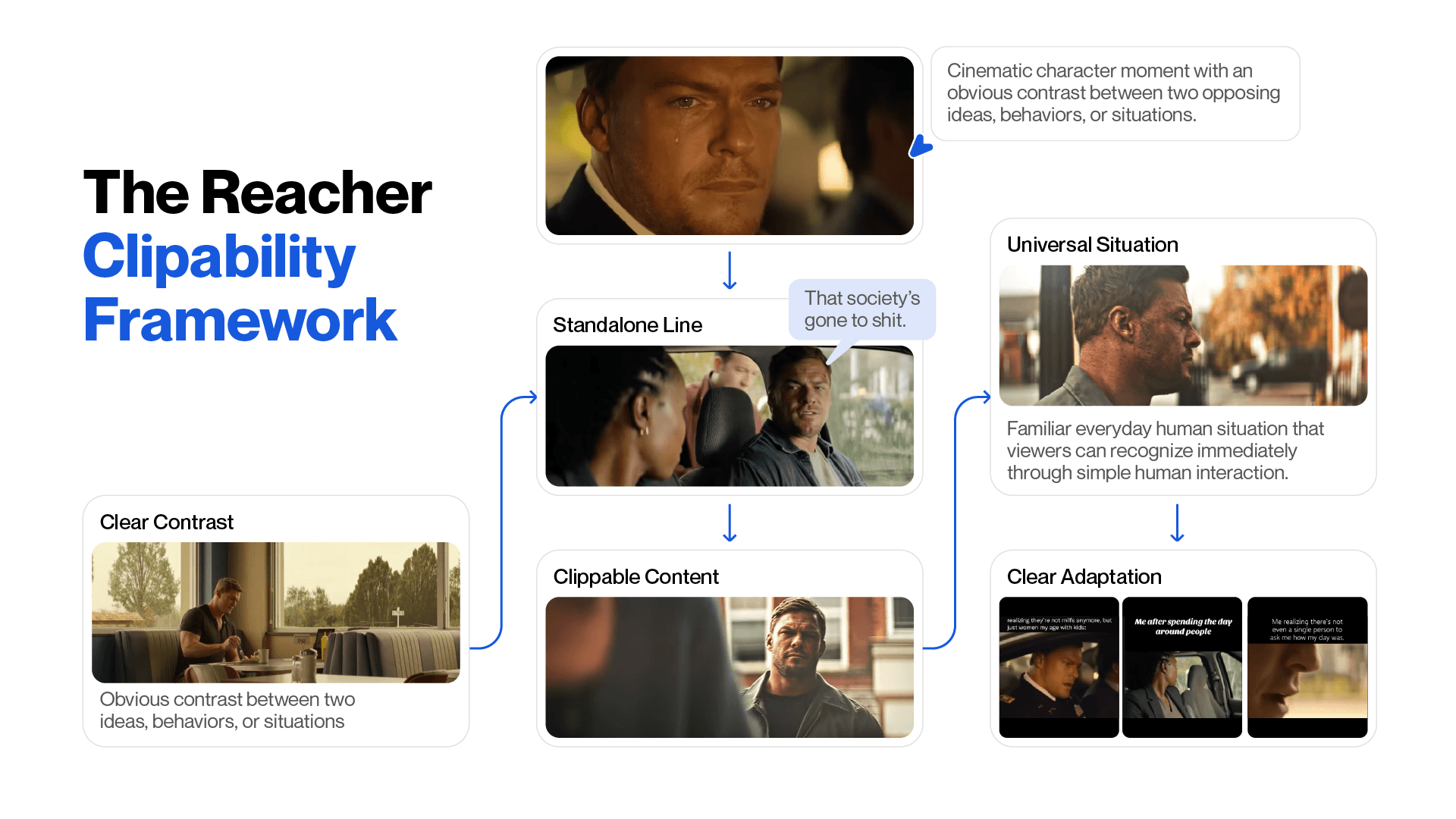
Element 1: Give the viewer an obvious contrast
Contrast creates instant understanding. Instead of creating a generic video that says, “Here are five features of our productivity app,” a brand can show someone with 47 open browser tabs, then highlight a single feature that immediately solves that problem. Viewers don’t need a long explanation because they immediately understand the situation, and the contrast between the problem and the solution is the core of the clip.
Element 2: Create a line that can live independently
A good sentence for a clip doesn’t depend on the original video as a whole. Here are some sentences that can be used across various industries:
Financial App | "I thought I was saving money." |
Fitness Product | "I thought this was going to be easy." |
SaaS Product | "This is the part nobody showed me." |
The exact wording isn’t as important as the underlying principle, but the sentence must still make sense when viewed without the original video. This gives creators more opportunities to reuse it.
Element 3: Make the situation universal
The best clips have just enough specificity to be easily recognizable, yet enough flexibility to be reused in other contexts. This is why the Reacher-style formula works, because the specific character is Reacher, and the universal situation is being underestimated by others.
If you want to emulate this, brands should identify their own universal situations based on their respective niches or industries. This is important because your product provides the context, while the universal situation you create makes your content appealing enough to be shared.
Build for Clipping Before You Start Filming
This is where many brands make a mistake: they create a long video first and only think about distributing short clips afterward. In fact, a better approach is to identify potential clips during production.
What is the strongest visual moment?Mark the moment where the viewer immediately understands what is happening. |
What is the strongest standalone line?Look for a sentence that can work as a hook, caption, or reaction. |
What is the universal situation?Ask what someone outside your existing audience could relate to. |
If a long video contains five strong moments, it’s no longer a single piece of content. It has the potential to become five distribution assets, and that’s the start of the clip machine.
How to Create Clips Faster with AI
The biggest challenge in a clipping strategy isn’t actually a lack of content, but time. Every podcast, webinar, interview, YouTube video, product demo, or event recording must be rewatched, the best moments identified, cut, converted to a vertical format, captioned, and then prepared for each platform. The more content you produce, the harder it is to maintain this process manually. That’s why a clipping workflow that can be quickly repeated is far more valuable than simply having more videos.
One of the easiest ways to speed up this process is to use AI tools like Vizard AI.
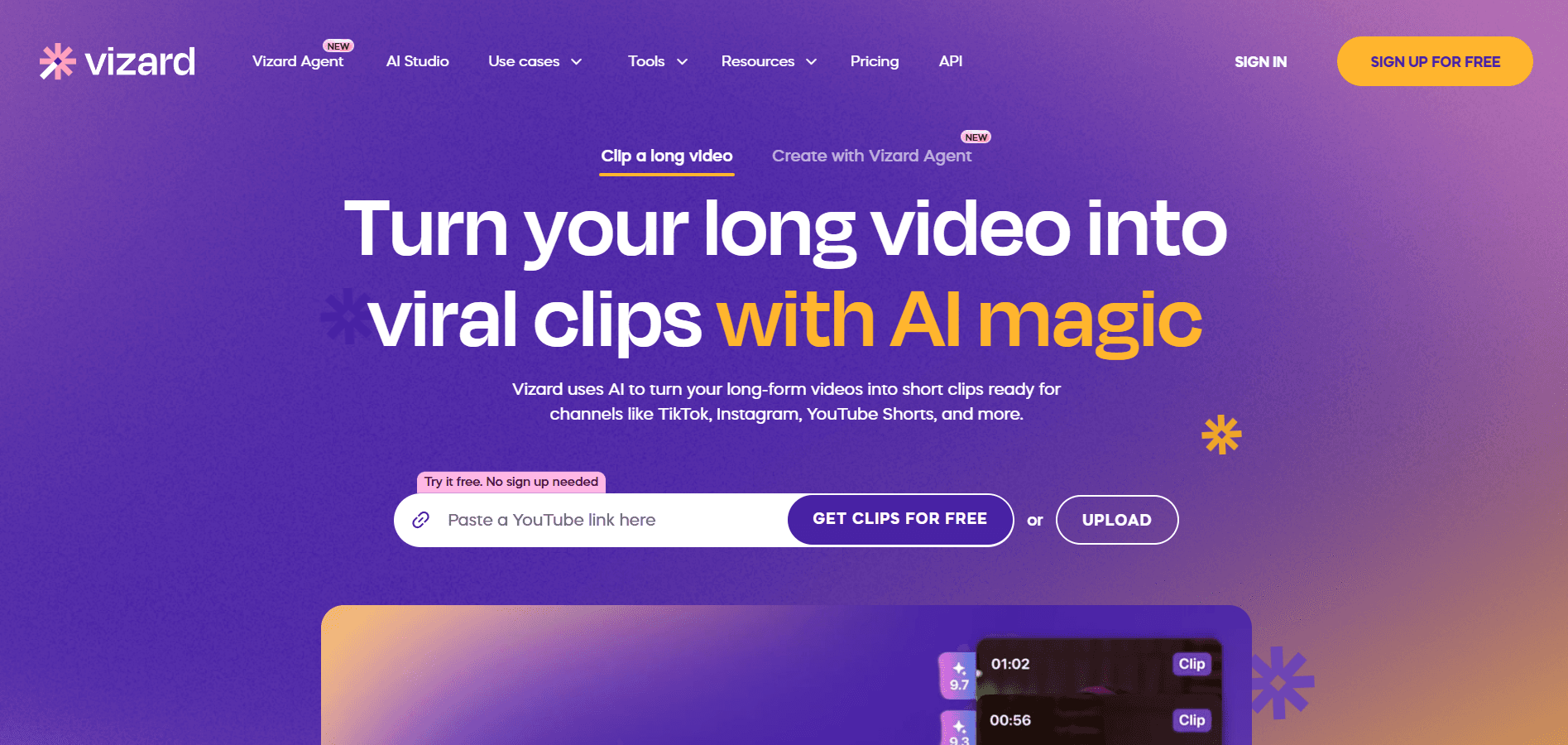
Vizard can help identify potential highlights from long-form videos, automatically trim them, adjust the framing for TikTok, Reels, and Shorts, and then add transcripts and captions, all in a single workflow. As a result, a process that typically consists of five steps that can be completed much faster:
Finding Highlights → Trimming → Reframing → Adding Captions → Publishing
However, AI should be viewed as an assistant, not the primary editor. AI can identify potential highlights, but humans must still determine whether a clip truly has enough contrast, emotion, or impact to be worth sharing. In other words, AI speeds up the technical process, while creative decisions remain a human strength.
A Simple Reacher-Inspired Clipping Workflow
The workflow can be kept surprisingly simple.
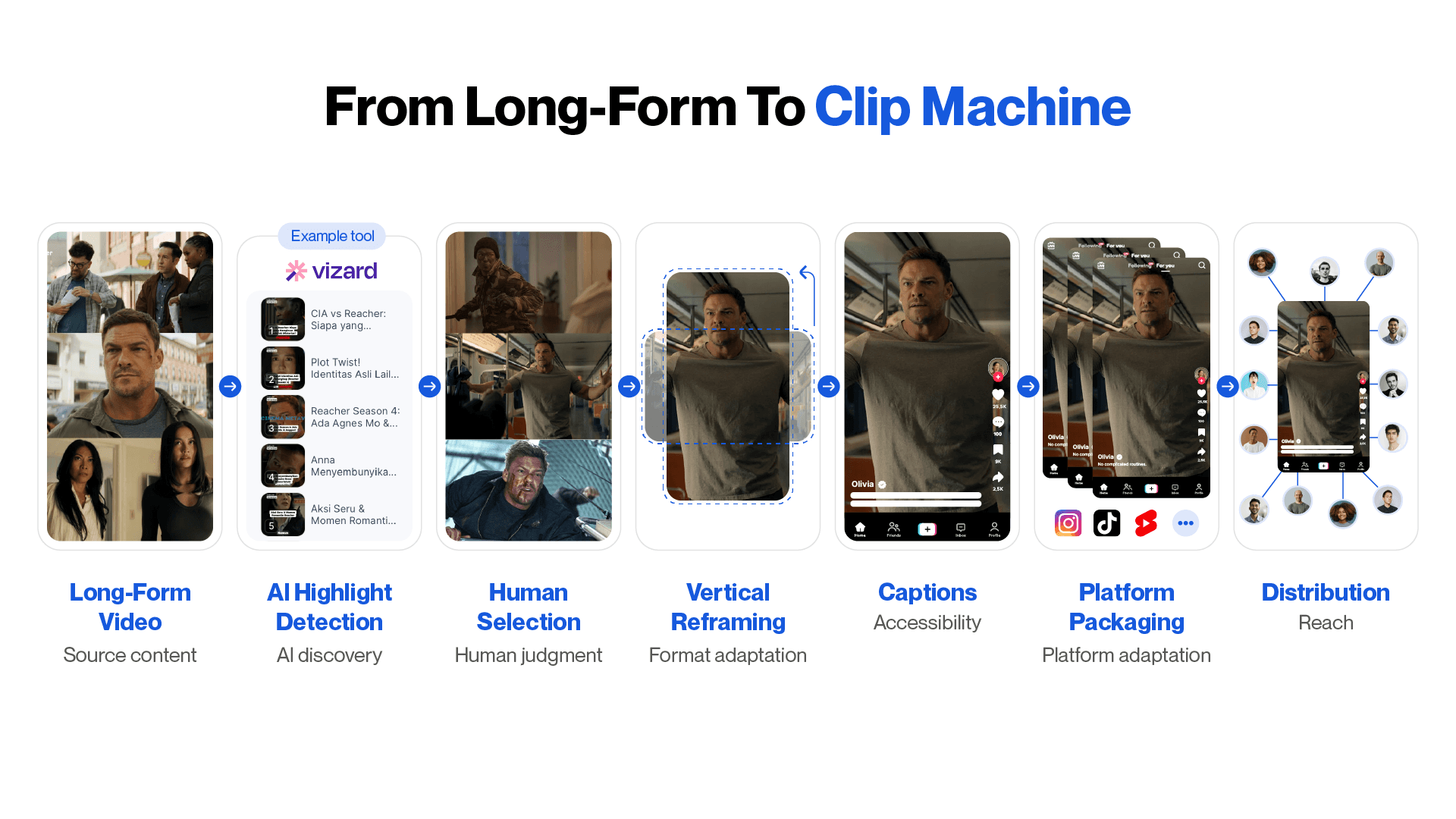
Step 1: Create the long-form content
Film the interview, podcast, product demo, creator video, or campaign.
Step 2: Identify potential moments
Use Vizard or another clipping workflow to surface sections worth reviewing.
Step 3: Apply the three-part test
For every candidate clip, ask:
Is there a clear visual contrast?
Does the line work without the original context?
Can someone apply the situation to their own life?
If the answer is yes to all three, the clip has strong potential.
Step 4: Repackage for each platform
Change the opening text, framing, captions, or CTA depending on where the clip will appear.
Step 5: Let performance determine the next batch
Do not assume every clip will work, but make sure to publish multiple moments then see which structures generate retention, shares, comments, and remixes. Then create more content around the patterns that actually work.
Build Content People Can Reuse
The most valuable question for brands isn't "How do we make more videos?" but "Which moments could become useful pieces of culture after they leave the original video?" Reacher shows the power of clipability: a clear setup gives context, a memorable line makes the clip stand alone, and a universal situation gives people a reason to adapt it. That turns individual scenes into content that can keep circulating long after release.

For brands, Masterhooks treats clipping as part of the creative strategy rather than an editing task at the end. Tools like Vizard can speed up production, but the real work happens earlier by designing moments that people can understand, reuse, and connect to their own experiences. That's how long-form footage becomes a clip machine.
Make your own clippable content for your brand now!

Make your own clippable content for your brand now!
Season 4 of Reacher premiered on August 12, 2026, but conversations about the series aren’t limited to the latest episodes. Old scenes continue to circulate because many of them have a simple structure that’s easy to understand and turn into memes, so they can still be enjoyed without the full context and are easy to pair with various captions. For brands, the lesson is simple: content that’s easy to turn into short clips isn’t just something you discover after it’s created, but can also be designed from the very beginning.
What Makes a Scene "Clippable"?
A scene is considered clip-worthy if you can take it out of its original context and still understand why it’s compelling. This may sound simple, but it changes the way content should be produced.
An ordinary scene might rely on ten minutes of story setup, whereas a clip-worthy scene can convey its premise in just a matter of seconds. In the case of Reacher, there are three characteristics that support this:
1. The setup is immediately obvious
Many confrontational scenes follow a simple visual structure: someone approaches Reacher, underestimates him, the situation changes, and then Reacher reacts. Viewers don’t need to understand the entire plot to grasp the basic dynamics, and this is what makes these clips useful as standalone content.
2. The dialogue can survive outside the scene
A single powerful and impactful line can serve as the core of a short video, whether it functions as a caption, reaction material, is combined with another story, or is even completely detached from its original context. This is one reason why scenes that rely on dialogue often make for valuable clip material, as they provide content that creators can repurpose.
3. The visual tells the story quickly
Reacher’s physical presence is integral to the format, allowing viewers to grasp the contrast even before hearing the dialogue. This is crucial on TikTok and Reels because thumbnails and opening frames often need to convey the premise instantly. When someone can understand the joke, conflict, or underlying emotion from just the first frame, that scene has a high chance of succeeding when presented outside its original context.
The Clip Became a Template
This is where Reacher transitions from mere entertainment to a part of creator culture. When a familiar premise can be summed up in the phrase “They don’t know who they’re dealing with” as a line that can describe any situation. A creator can use a Reacher clip as a template to discuss:
Managers who underestimate their employees
Competitors who look down on small businesses
The assumption that quiet people lack experience
Customers who underestimate a product
Friends who are just discovering someone’s hidden talent
The original clip is no longer the sole focus of the content, but rather a tool for telling other people’s stories.
The most impactful entertainment clips don’t always spark UGC (user-generated content) simply because people want to discuss the show, but because they provide a practical way for people to talk about themselves.
The Reacher hashtag alone has amassed billions of views across related TikTok content, while individual clips continue to emerge alongside discussions about Season 4. Third-party tracking data for that TikTok hashtag currently shows over 3.3 billion views.
This demonstrates how a widely recognized entertainment property can continue to generate social reach through short-form content, long after its initial launch.
The Reacher Blueprint for Brands
A brand does not need a giant action franchise to create clippable content. They just need moments with the same structural properties. Here are the framework brands can use to be clippable:
Element 1: Give the viewer an obvious contrast
Contrast creates instant understanding. Instead of creating a generic video that says, “Here are five features of our productivity app,” a brand can show someone with 47 open browser tabs, then highlight a single feature that immediately solves that problem. Viewers don’t need a long explanation because they immediately understand the situation, and the contrast between the problem and the solution is the core of the clip.
Element 2: Create a line that can live independently
A good sentence for a clip doesn’t depend on the original video as a whole. Here are some sentences that can be used across various industries:
Financial App | "I thought I was saving money." |
Fitness Product | "I thought this was going to be easy." |
SaaS Product | "This is the part nobody showed me." |
The exact wording isn’t as important as the underlying principle, but the sentence must still make sense when viewed without the original video. This gives creators more opportunities to reuse it.
Element 3: Make the situation universal
The best clips have just enough specificity to be easily recognizable, yet enough flexibility to be reused in other contexts. This is why the Reacher-style formula works, because the specific character is Reacher, and the universal situation is being underestimated by others.
If you want to emulate this, brands should identify their own universal situations based on their respective niches or industries. This is important because your product provides the context, while the universal situation you create makes your content appealing enough to be shared.
Build for Clipping Before You Start Filming
This is where many brands make a mistake: they create a long video first and only think about distributing short clips afterward. In fact, a better approach is to identify potential clips during production.
What is the strongest visual moment?Mark the moment where the viewer immediately understands what is happening. |
What is the strongest standalone line?Look for a sentence that can work as a hook, caption, or reaction. |
What is the universal situation?Ask what someone outside your existing audience could relate to. |
If a long video contains five strong moments, it’s no longer a single piece of content. It has the potential to become five distribution assets, and that’s the start of the clip machine.
How to Create Clips Faster with AI
The biggest challenge in a clipping strategy isn’t actually a lack of content, but time. Every podcast, webinar, interview, YouTube video, product demo, or event recording must be rewatched, the best moments identified, cut, converted to a vertical format, captioned, and then prepared for each platform. The more content you produce, the harder it is to maintain this process manually. That’s why a clipping workflow that can be quickly repeated is far more valuable than simply having more videos.
One of the easiest ways to speed up this process is to use AI tools like Vizard AI.
Vizard can help identify potential highlights from long-form videos, automatically trim them, adjust the framing for TikTok, Reels, and Shorts, and then add transcripts and captions, all in a single workflow. As a result, a process that typically consists of five steps that can be completed much faster:
Finding Highlights → Trimming → Reframing → Adding Captions → Publishing
However, AI should be viewed as an assistant, not the primary editor. AI can identify potential highlights, but humans must still determine whether a clip truly has enough contrast, emotion, or impact to be worth sharing. In other words, AI speeds up the technical process, while creative decisions remain a human strength.
A Simple Reacher-Inspired Clipping Workflow
The workflow can be kept surprisingly simple.
Step 1: Create the long-form content
Film the interview, podcast, product demo, creator video, or campaign.
Step 2: Identify potential moments
Use Vizard or another clipping workflow to surface sections worth reviewing.
Step 3: Apply the three-part test
For every candidate clip, ask:
Is there a clear visual contrast?
Does the line work without the original context?
Can someone apply the situation to their own life?
If the answer is yes to all three, the clip has strong potential.
Step 4: Repackage for each platform
Change the opening text, framing, captions, or CTA depending on where the clip will appear.
Step 5: Let performance determine the next batch
Do not assume every clip will work, but make sure to publish multiple moments then see which structures generate retention, shares, comments, and remixes. Then create more content around the patterns that actually work.
Build Content People Can Reuse
The most valuable question for brands isn't "How do we make more videos?" but "Which moments could become useful pieces of culture after they leave the original video?" Reacher shows the power of clipability: a clear setup gives context, a memorable line makes the clip stand alone, and a universal situation gives people a reason to adapt it. That turns individual scenes into content that can keep circulating long after release.
For brands, Masterhooks treats clipping as part of the creative strategy rather than an editing task at the end. Tools like Vizard can speed up production, but the real work happens earlier by designing moments that people can understand, reuse, and connect to their own experiences. That's how long-form footage becomes a clip machine.
Make your own clippable content for your brand now!
Related Reading
Related Reading
Why Pretty Little Liars and The Love Hypothesis Are Going Viral in the Same Week
5 min
|
Why Pretty Little Liars and The Love Hypothesis Are Going Viral in the Same Week
Learn how Pretty Little Liars and The Love Hypothesis turn fans into engines for fan-generated content, and what brands can learn about community-led growth.
5 min
|
What Is a Content Pillar? (And How to Build One That Actually Works for UGC)
4 min
|
What Is a Content Pillar? (And How to Build One That Actually Works for UGC)
Learn what a content pillar is, why it matters for UGC, and how to build a practical content pillar strategy with creator briefs and real examples.
4 min
|
First Day of Fall, First Day of Content: The UGC Formats That Win in October
4 min
|
First Day of Fall, First Day of Content: The UGC Formats That Win in October
Discover five October UGC formats brands can use this fall, from seasonal transitions and cozy routines to Halloween teasers and reset content.
4 min
|


Need help scaling?
Book a strategy call with our expert team to audit your current UGC setup.

