The “It’s a Clock” TikTok Trend: Why This Hunger Games Audio Works for UGC
The “It’s a Clock” TikTok trend works because delayed realization makes relatable experiences instantly shareable. Here’s how brands can use it.
Published:

Read Time:

3 min

Written by:
Fawwaz
Trend Research and Copywriter
BEING SUCCESSFUL THROUGH SIMPLICITY
Most people think that the more complex a piece of content is, the more people will be interested in watching it. This isn’t entirely true, because the TikTok trend “It’s a Clock” succeeded precisely because it presented a simple story that viewers could fill in themselves.
BEING SUCCESSFUL THROUGH SIMPLICITY
Most people think that the more complex a piece of content is, the more people will be interested in watching it. This isn’t entirely true, because the TikTok trend “It’s a Clock” succeeded precisely because it presented a simple story that viewers could fill in themselves.
BEING SUCCESSFUL THROUGH SIMPLICITY
Most people think that the more complex a piece of content is, the more people will be interested in watching it. This isn’t entirely true, because the TikTok trend “It’s a Clock” succeeded precisely because it presented a simple story that viewers could fill in themselves.
The “It’s a Clock” TikTok trend is compelling because it uses a simple pattern: a misunderstanding, the emergence of a pattern, and then the moment when the creator realizes it. This structure piques viewers’ curiosity while making them think, “Wait, I’ve been through that too,” with the TikTok trend sound from The Hunger Games serving as a supporting element. Creators then applied this to various situations, ranging from family to work and everyday life. This is what makes it relevant for UGC: the format is clear enough to follow, yet still leaves room for each creator to adapt it according to their own experiences and style.
The Real Hook Is the Delayed Realization
This format begins with a memory or situation that once felt confusing, and continues with the emergence of a realization in which the content creator finally understands what actually happened.
This structure creates a small information gap where viewers know an explanation is coming, but they don’t yet know what it is. This kind of knowledge gap is a mechanism that motivates people to seek information and close that gap. For TikTok, this is beneficial because viewers don’t need to understand the entire story right away. They just need enough information to feel curious about where the video is headed. The basic structure is very simple:
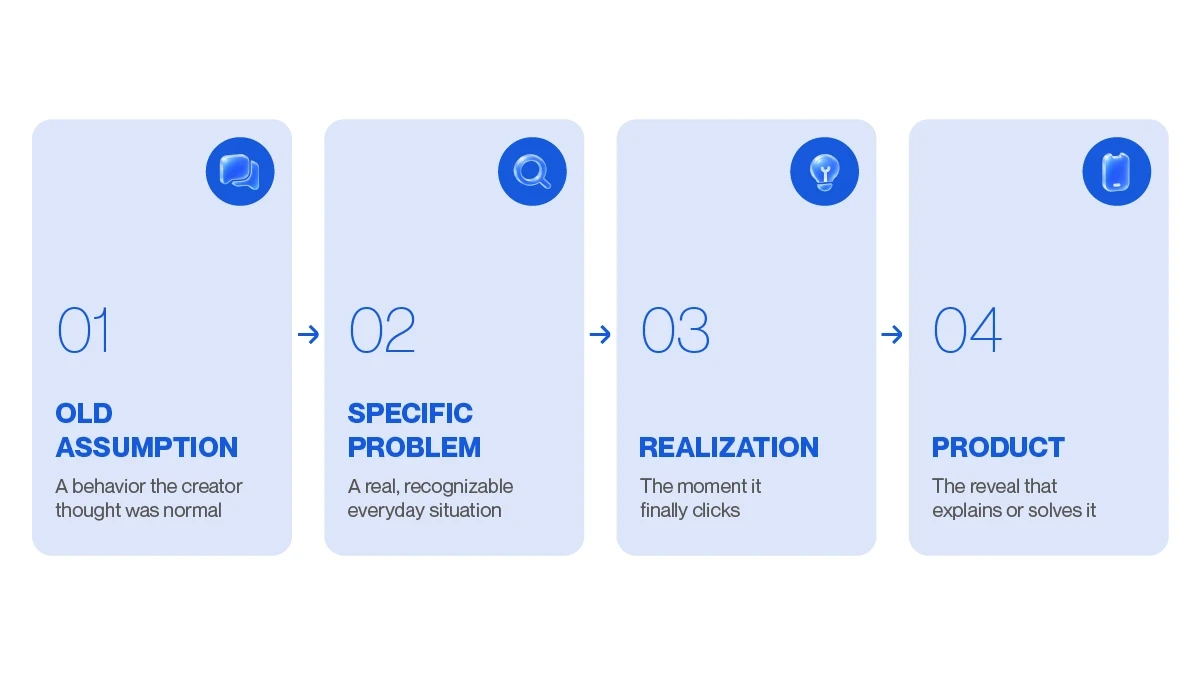
This structure encourages viewers to immediately relate it to their own experiences, which makes this format more than just a reference to a movie.
Why the specific example matters
There’s an interesting paradox here: the more specific a content creator’s memory is, the easier it is for others to see themselves in that memory. For example, “I finally understand why my manager always asks me for that spreadsheet” feels more real than “I realize people rely on me.” Those details provide something concrete for the audience to relate to their own lives.
Content that is perceived as personally or socially relevant is more likely to trigger the desire to share it, especially when people see a connection between the content and someone they know. So, content creators shouldn’t try to come up with examples that everyone can understand right away. Just create a specific situation and let the audience draw their own connections.
Why This Is Such a Strong UGC Format
Traditional product-centric UGC often starts with the product itself. For example, you might begin a post by saying, “I found an app that helps me manage my tasks.”
In this trend, the “It’s a Clock” structure provides a different starting point for creators, where the product can be introduced after a moment of realization. You can phrase it like, “I finally understand why I keep forgetting the things I need to do,” and then reveal the system, app, product, or habit that solves that problem. In this structure, the product becomes part of the story, not just the opening subject of the content.
This distinction is important because the audience already has a reason to care even before the brand appears in the video. Research on UGC and consumer behavior also shows that authenticity and perceived credibility are key factors in determining how audiences respond to creator-style content.
Three Ways Brands Can Adapt the Format
The best part about this TikTok audio is that the underlying structure can travel across categories. Here are three ways of how you can adapt that format:
Productivity and SaaS
The easiest adaptation is the hidden workflow problem where creators can talk about a behavior they assumed was normal before realizing what was actually causing it. For examples:
“I finally realized why I kept missing deadlines.”
“I finally understood why my to-do list kept getting longer.”
“I finally figured out why I was spending an hour looking for one file.”
The product then provides the explanation or solution for the workflow problem. This works particularly well for software because the reveal can transition directly into a screen recording.
Beauty and Skincare
Beauty creators can use the same structure around a recurring problem. For examples:
“I finally understood why my makeup never looked right by noon.”
“I finally figured out why my skin kept reacting.”
“I finally realized what was missing from my routine.”
The product reveal can happen immediately after the realization, but the important part is to make the problem recognizable before showing the product.
Finance and Personal Productivity
Financial products have an especially large pool of everyday behaviors to reinterpret. For examples:
“I finally figured out why my paycheck disappeared so quickly.”
“I finally understood where my money was going.”
“I finally realized why saving felt impossible.”
A budgeting app, expense tracker, or financial tool can then enter as the mechanism behind the realization. This approach gives the creator room to tell a personal story while still demonstrating a product feature.
Productivity and SaaS
The easiest adaptation is the hidden workflow problem where creators can talk about a behavior they assumed was normal before realizing what was actually causing it. For examples:
“I finally realized why I kept missing deadlines.”
“I finally understood why my to-do list kept getting longer.”
“I finally figured out why I was spending an hour looking for one file.”
The product then provides the explanation or solution for the workflow problem. This works particularly well for software because the reveal can transition directly into a screen recording.
Beauty and Skincare
Beauty creators can use the same structure around a recurring problem. For examples:
“I finally understood why my makeup never looked right by noon.”
“I finally figured out why my skin kept reacting.”
“I finally realized what was missing from my routine.”
The product reveal can happen immediately after the realization, but the important part is to make the problem recognizable before showing the product.
Finance and Personal Productivity
Financial products have an especially large pool of everyday behaviors to reinterpret. For examples:
“I finally figured out why my paycheck disappeared so quickly.”
“I finally understood where my money was going.”
“I finally realized why saving felt impossible.”
A budgeting app, expense tracker, or financial tool can then enter as the mechanism behind the realization. This approach gives the creator room to tell a personal story while still demonstrating a product feature.
How to Film the “It’s a Clock” Format
Recent creator guidance around the format recommends using the audio at 2x playback speed, with the creator matching the timing of the recognizable section and then using on-screen text to explain the scenario. The technical execution is deliberately simple, you can follow this guide:
1. Start with the audioFind the relevant TikTok audio song and set the recording/playback setup to 2x as recommended by current trend examples. |
2. Keep the camera simpleA phone camera, front-facing setup, and clean background are enough. |
3. Use on-screen textThe text should explain the realization or situation. Keep it short enough to understand while the video is playing. |
4. Stack multiple examplesInstead of making one video about one realization, creators can test two or three related scenarios. The repetition helps establish the pattern and gives viewers more opportunities to recognize themselves in the video. |
5. Keep the delivery deadpanHeavy editing is unnecessary since the humor comes from the seriousness of the delivery compared with the realization being described. Current creator guidance specifically recommends a continuous take and restrained delivery. |
A Playbook for Turning the Trend Into UGC
Before briefing creators, brands can use this five-step filter:
Step | Question |
1. Find the problem | What does your customer misunderstand about their own behavior? |
2. Make it specific | What real-life situation makes that problem recognizable? |
3. Create the realization | What did the creator eventually understand? |
4. Connect the product | Can the product naturally explain or solve that realization? |
5. Leave room for creators | Can different creators tell the same idea from their own experience? |
If the answer to the last question is no, the concept may be too restrictive for UGC since a strong UGC format should give creators a recognizable framework while leaving enough room for individual experiences.
That is also why this trend is worth studying alongside other replicated formats. Masterhooks' analysis of The Odyssey's Sirens scene found a similar principle: a recognizable situation becomes valuable when creators can replace the original context with their own everyday experience.
The surface format changes, but the creative mechanism stays surprisingly consistent.
From Trend to Repeatable Creative
Masterhooks approaches trends with the same perspective: looking beyond trend music on TikTok, memes, or trending topics to understand the creative structure that makes a format easy to replicate. The focus isn’t just on figuring out what’s going viral, but on identifying the patterns behind it, such as why people are interested, how the format can be adapted, and what elements make it easy for creators to use across influencer marketing and UGC. These insights are then translated into UGC concepts that can be tailored to the brand’s and creators’ unique identities, rather than simply advising brands to copy whatever is trending that week.
This approach helps brands build a UGC strategy that’s more responsive to trends without having to constantly chase the latest fads. Instead of jumping on every new audio clip or meme that pops up, brands can identify formats with the potential to be repurposed across various contexts.
Want to find the trend formats your brand can actually repeat, not just chase?

Want to find the trend formats your brand can actually repeat, not just chase?
The “It’s a Clock” TikTok trend is compelling because it uses a simple pattern: a misunderstanding, the emergence of a pattern, and then the moment when the creator realizes it. This structure piques viewers’ curiosity while making them think, “Wait, I’ve been through that too,” with the TikTok trend sound from The Hunger Games serving as a supporting element. Creators then applied this to various situations, ranging from family to work and everyday life. This is what makes it relevant for UGC: the format is clear enough to follow, yet still leaves room for each creator to adapt it according to their own experiences and style.
The Real Hook Is the Delayed Realization
This format begins with a memory or situation that once felt confusing, and continues with the emergence of a realization in which the content creator finally understands what actually happened.
This structure creates a small information gap where viewers know an explanation is coming, but they don’t yet know what it is. This kind of knowledge gap is a mechanism that motivates people to seek information and close that gap. For TikTok, this is beneficial because viewers don’t need to understand the entire story right away. They just need enough information to feel curious about where the video is headed. The basic structure is very simple:
This structure encourages viewers to immediately relate it to their own experiences, which makes this format more than just a reference to a movie.
Why the specific example matters
There’s an interesting paradox here: the more specific a content creator’s memory is, the easier it is for others to see themselves in that memory. For example, “I finally understand why my manager always asks me for that spreadsheet” feels more real than “I realize people rely on me.” Those details provide something concrete for the audience to relate to their own lives.
Content that is perceived as personally or socially relevant is more likely to trigger the desire to share it, especially when people see a connection between the content and someone they know. So, content creators shouldn’t try to come up with examples that everyone can understand right away. Just create a specific situation and let the audience draw their own connections.
Why This Is Such a Strong UGC Format
Traditional product-centric UGC often starts with the product itself. For example, you might begin a post by saying, “I found an app that helps me manage my tasks.”
In this trend, the “It’s a Clock” structure provides a different starting point for creators, where the product can be introduced after a moment of realization. You can phrase it like, “I finally understand why I keep forgetting the things I need to do,” and then reveal the system, app, product, or habit that solves that problem. In this structure, the product becomes part of the story, not just the opening subject of the content.
This distinction is important because the audience already has a reason to care even before the brand appears in the video. Research on UGC and consumer behavior also shows that authenticity and perceived credibility are key factors in determining how audiences respond to creator-style content.
Three Ways Brands Can Adapt the Format
The best part about this TikTok audio is that the underlying structure can travel across categories. Here are three ways of how you can adapt that format:
Productivity and SaaS
The easiest adaptation is the hidden workflow problem where creators can talk about a behavior they assumed was normal before realizing what was actually causing it. For examples:
“I finally realized why I kept missing deadlines.”
“I finally understood why my to-do list kept getting longer.”
“I finally figured out why I was spending an hour looking for one file.”
The product then provides the explanation or solution for the workflow problem. This works particularly well for software because the reveal can transition directly into a screen recording.
Beauty and Skincare
Beauty creators can use the same structure around a recurring problem. For examples:
“I finally understood why my makeup never looked right by noon.”
“I finally figured out why my skin kept reacting.”
“I finally realized what was missing from my routine.”
The product reveal can happen immediately after the realization, but the important part is to make the problem recognizable before showing the product.
Finance and Personal Productivity
Financial products have an especially large pool of everyday behaviors to reinterpret. For examples:
“I finally figured out why my paycheck disappeared so quickly.”
“I finally understood where my money was going.”
“I finally realized why saving felt impossible.”
A budgeting app, expense tracker, or financial tool can then enter as the mechanism behind the realization. This approach gives the creator room to tell a personal story while still demonstrating a product feature.
How to Film the “It’s a Clock” Format
Recent creator guidance around the format recommends using the audio at 2x playback speed, with the creator matching the timing of the recognizable section and then using on-screen text to explain the scenario. The technical execution is deliberately simple, you can follow this guide:
1. Start with the audioFind the relevant TikTok audio song and set the recording/playback setup to 2x as recommended by current trend examples. |
2. Keep the camera simpleA phone camera, front-facing setup, and clean background are enough. |
3. Use on-screen textThe text should explain the realization or situation. Keep it short enough to understand while the video is playing. |
4. Stack multiple examplesInstead of making one video about one realization, creators can test two or three related scenarios. The repetition helps establish the pattern and gives viewers more opportunities to recognize themselves in the video. |
5. Keep the delivery deadpanHeavy editing is unnecessary since the humor comes from the seriousness of the delivery compared with the realization being described. Current creator guidance specifically recommends a continuous take and restrained delivery. |
A Playbook for Turning the Trend Into UGC
Before briefing creators, brands can use this five-step filter:
Step | Question |
1. Find the problem | What does your customer misunderstand about their own behavior? |
2. Make it specific | What real-life situation makes that problem recognizable? |
3. Create the realization | What did the creator eventually understand? |
4. Connect the product | Can the product naturally explain or solve that realization? |
5. Leave room for creators | Can different creators tell the same idea from their own experience? |
If the answer to the last question is no, the concept may be too restrictive for UGC since a strong UGC format should give creators a recognizable framework while leaving enough room for individual experiences.
That is also why this trend is worth studying alongside other replicated formats. Masterhooks' analysis of The Odyssey's Sirens scene found a similar principle: a recognizable situation becomes valuable when creators can replace the original context with their own everyday experience.
The surface format changes, but the creative mechanism stays surprisingly consistent.
From Trend to Repeatable Creative
Masterhooks approaches trends with the same perspective: looking beyond trend music on TikTok, memes, or trending topics to understand the creative structure that makes a format easy to replicate. The focus isn’t just on figuring out what’s going viral, but on identifying the patterns behind it, such as why people are interested, how the format can be adapted, and what elements make it easy for creators to use across influencer marketing and UGC. These insights are then translated into UGC concepts that can be tailored to the brand’s and creators’ unique identities, rather than simply advising brands to copy whatever is trending that week.
This approach helps brands build a UGC strategy that’s more responsive to trends without having to constantly chase the latest fads. Instead of jumping on every new audio clip or meme that pops up, brands can identify formats with the potential to be repurposed across various contexts.
Want to find the trend formats your brand can actually repeat, not just chase?
Related Reading
Related Reading
UGC and Influencer Marketing Pricing Guide for Brands in 2026
4 min
|
UGC and Influencer Marketing Pricing Guide for Brands in 2026
Compare UGC rates, influencer fees, usage rights, and agency costs, with published pricing references and an example creator campaign budget for 2026.
4 min
|

How to Find the Right Influencer Marketing Agency for Your Brand (Without Wasting Budget)
6 min
|
How to Find the Right Influencer Marketing Agency for Your Brand (Without Wasting Budget)
Learn how to choose an influencer marketing agency using a practical scorecard, performance criteria, red flags, and pre-contract checks.
6 min
|

AI Video Ad Agencies: A Buyer's Guide for DTC Brands (2026)
4 min
|
AI Video Ad Agencies: A Buyer's Guide for DTC Brands (2026)
Compare AI video ad agency types, pricing, performance metrics, ownership rights, and seven questions DTC brands should ask before hiring.
4 min
|


Need help scaling?
Book a strategy call with our expert team to audit your current UGC setup.